

B. Braun Emerges as a Leader in Coronary Interventions with Drug-Coated Balloon Innovation

B. Braun Medical
Infusion Therapy and Pain Management Products and Services Provider
Among cardiovascular diseases, coronary artery disease is highly prevalent, with its incidence rising year by year. In 2018, the number of percutaneous coronary intervention (PCI) procedures performed in China exceeded 900,000, representing a year-on-year increase of approximately 21.5% from the previous year. From 2009 to 2018, the compound annual growth rate (CAGR) was 16.7%, indicating an overall accelerating growth trend.
Interventional therapy occupies a relatively paramount position in the treatment of coronary heart disease. With advancements in technology and improvements in device manufacturing, the field has primarily progressed through three significant eras: percutaneous transluminal coronary balloon angioplasty, bare-metal stents, and drug-eluting stents.
With in-depth research into interventional techniques, particularly given that in-stent restenosis remains a global challenge, efforts to address this issue have led to the exploration of bioresorbable stents. However, the asynchronous degradation of biodegradable materials has increased the risk of late thrombosis at the intervention site, prompting a gradual shift toward the era of drug-coated balloons (DCB).
Drug-coated balloons (DCBs) combine conventional balloon angioplasty with drug-eluting technology by coating the balloon surface with antiproliferative agents. During inflation, these drugs are delivered to the local vascular wall at the lesion site, thereby inhibiting smooth muscle cell proliferation and preventing restenosis.
By eliminating permanent intravascular foreign bodies, this approach overcomes limitations such as in-stent thrombosis, stent fracture, and metal allergy, while also shortening the duration of dual antiplatelet therapy post-procedure and reducing the risk of bleeding complications. In recent years, the safety and efficacy of drug-coated balloon (DCB) therapy for primary coronary large vessel disease (LVD) have garnered increasing attention, with growing evidence supporting its application in primary coronary large vessel lesions.
Breakthroughs in drug-coated balloon (DCB) therapy have opened up new possibilities for the clinical treatment of coronary artery disease. In the international market, while medical giants such as Medtronic and Boston Scientific hold frontier technologies in this field, there is another notable enterprise. With a history spanning over a century, it has evolved from a small pharmacy into a multinational corporation specializing in medical supplies. In recent years, it has focused on breakthrough innovations in drug-coated balloons. Within just a few years, leveraging technological innovation, it has refined its products to achieve top-tier quality, rapidly emerging as an industry benchmark. This company is B. Braun from Germany (Chinese name: “German B. Braun”).
VCBeat seeks to provide insights for the innovative development of drug-coated balloons in China by examining the evolution of DCB technology and tracing B. Braun’s breakthroughs and innovation trajectory in this field.
In the 1960s, balloon angioplasty was first applied as a revolutionary new technology for the treatment of peripheral artery disease. German physician Andreas Grüntzig performed the world’s first percutaneous transluminal coronary angioplasty in Switzerland and subsequently introduced this technique into the field of coronary intervention, marking a major breakthrough in the treatment of coronary artery disease. Since then, percutaneous coronary intervention has entered a phase of rapid development.
Subsequently, the advent of bare-metal stents (BMS) addressed, to some extent, complications such as arterial dissection, acute vessel occlusion, and elastic recoil that may occur following balloon angioplasty. However, this advancement introduced another inevitable challenge: in-stent restenosis. Persistent irritation of the vascular intima by metallic stents can lead to excessive neointimal hyperplasia, resulting in in-stent restenosis (ISR), with an incidence rate of up to 30%.
To reduce the incidence of in-stent restenosis (ISR), physicians ultimately opted for drug-eluting stents (DES). These stents are loaded with immunosuppressive or antineoplastic agents, which are released locally at the site of the diseased vessel. They provide sustained, low-dose drug elution over an extended period, effectively inhibiting excessive neointimal hyperplasia and significantly reducing the rate of ISR. Unfortunately, the inhibition of intimal hyperplasia by DES can lead to delayed endothelial healing in a small subset of patients. Furthermore, the polymer carriers used in DES may induce vascular wall inflammation and endothelial dysfunction, thereby predisposing patients to late or very late stent thrombosis.
The concept of drug-coated balloons (DCBs) was first proposed in the 1980s. However, the development of DCBs progressed relatively slowly due to the emergence and gradual clinical adoption of drug-eluting stents (DES). Inspired by early studies on local drug delivery at various vascular lesion sites, two German physicians, Ulrich Speck and Bruno Scheller, dedicated themselves to developing a novel drug delivery system distinct from traditional stent-based platforms that influence endothelial hyperplasia. They used contrast media as a carrier for intravascular drug delivery, incorporating the antiproliferative agent paclitaxel into the contrast medium. This approach significantly increased drug solubility, thereby substantially enhancing local drug concentration at the lesion site. Thus, the initial concept of DCBs began to take shape.
In his article "Application of Drug-Coated Balloons in the Cardiovascular Field," Professor Ji Fusui from the Department of Cardiology at Beijing Hospital pointed out that the first clinical study on drug-coated balloons (DCBs) was the Paccocath-ISR I study, published in 2006, which investigated DCB treatment for in-stent restenosis after bare-metal stent implantation (BMS-ISR). This study demonstrated that DCBs were superior to plain balloon angioplasty in reducing late lumen loss. Subsequently, DCBs were compared with drug-eluting stents (DES). The PEPCAD II study showed that the efficacy of DCBs in treating coronary BMS-ISR was at least comparable to that of DES, with good tolerability and without the need for additional stent implantation.
Subsequently, the PEPCAD-DES study demonstrated that drug-coated balloons (DCB) are safer and more effective for complex lesions requiring repeat revascularization. The PEPCAD China ISR study confirmed the safety and efficacy of DCB, showing that DCB treatment for drug-eluting stent in-stent restenosis (DES-ISR) avoids the need for additional stent implantation and yields outcomes non-inferior to those of repeat DES implantation, making it a superior option for treating DES-ISR. Both the 2018 ESC/EACTS Guidelines on Myocardial Revascularization and the 2016 Chinese Percutaneous Coronary Intervention Guidelines recommend the use of DCB for treating bare-metal stent in-stent restenosis (BMS-ISR) or DES-ISR, with a Class I, Level A recommendation.
“Intervention without implantation” is undoubtedly the ultimate goal pursued by clinical interventional cardiologists, and drug-coated balloons (DCBs) offer a treatment modality with immense promise in this regard.
Before outlining B. Braun’s innovation trajectory in the drug-coated balloon (DCB) field, let us first discuss its background.
B. Braun, founded in 1839 with a history of 181 years, is headquartered in Melsungen, Germany. Its major subsidiaries are Aesculap AG in Germany and McGaw Inc. in the United States, which were formerly publicly listed companies in their respective countries. Driven by B. Braun’s outstanding achievements in research and development, its products continue to innovate and are marketed worldwide.
B. Braun’s business portfolio covers infusion therapy, anesthesia, dialysis, neurosurgery, spinal surgery, diabetes care, clinical nutrition, wound management, and infection prevention, with over 58,000 employees in 64 countries worldwide.
Over the past nearly two centuries, B. Braun has undergone six generations of stewardship and development, as shown below:
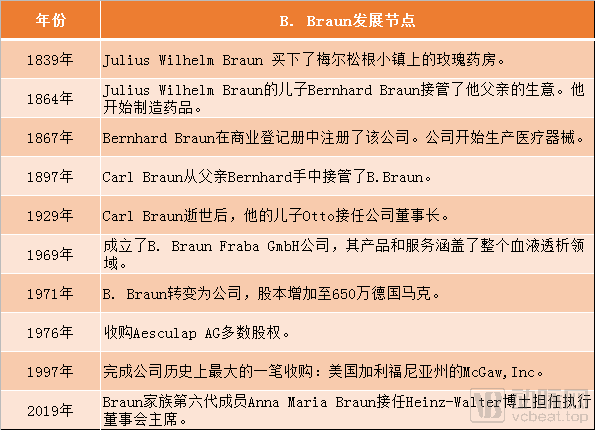
(B. Braun’s Milestones, chart by VCBeat)
B. Braun is currently one of the world’s largest medical and pharmaceutical device companies, offering approximately 5,000 products, 95% of which are manufactured in-house. Starting as a pharmacy and expanding into medical consumables, B. Braun has achieved leadership positions across multiple fields through its commitment to rigor and innovation.
In the field of intestinal diseases, B. Braun introduced lipoproteins to the market in 1962, developing high-concentration amino acid solutions and combination solutions for needs-based nutritional therapy, providing optimal nutritional solutions for patients with severe or chronic diseases who are partially or completely unable to absorb nutrients through the digestive system;
In the field of hematology, following breakthroughs in clinical dialysis during the 1950s, B. Braun invested in cutting-edge technologies and emerged as a supplier for extracorporeal blood processing. Its developed filtration procedures removed numerous toxins from the blood. Since 2008, the company has successfully established itself globally as a full-service provider of extracorporeal blood therapies and now operates more than 360 renal care centers.
In the field of infusion therapy, Sterofundin, developed by B. Braun, was one of the first industrially manufactured infusion solutions; today, it has become an essential, comprehensive suite of infusion devices in modern clinical practice.
In the field of surgical instruments, specifically in abdominal surgery, B. Braun introduced its first forceps-type suturing device equipped with metal clips in 1922, enabling reliable suturing within the gastrointestinal tract. The product portfolio was subsequently expanded to include products for cardiothoracic and vascular surgery. Furthermore, B. Braun developed innovative motors for orthopedic surgery, launching its first electric surgical motor in 1935, followed by its first pneumatic motor in 1967.
In the field of wound care, B. Braun developed sterile suture materials in 1908. In 1935, Synthofil A, a non-absorbable synthetic suture material, was successfully launched. This was followed by the sequential introduction of Supramid, a nylon-based suture material; Histoacryl, a tissue adhesive for closing skin wounds; and Monosyn, a synthetic absorbable suture material made from glycolide.
These innovative R&D efforts have cemented B. Braun’s leading position in the field of medical consumables, while also laying the groundwork for its entry into drug-coated balloon (DCB) development and its emergence as an industry benchmark.
According to B. Braun’s 2019 annual report, its sales increased by 8.2%, with revenue exceeding €7.4 billion (approximately RMB 59 billion). Sales across all divisions grew steadily, with particularly strong performance in basic care, hemodialysis, infusion systems, and compounding products. Its primary revenue sources were markets in North America, China, the ASEAN region, Brazil, and Colombia.
The clinical value of drug-coated balloons (DCBs) is being re-explored and prioritized, attracting the entry of leading industry giants such as Medtronic, Boston Scientific, and Abbott. Unexpectedly, B. Braun, which has long been deeply rooted in the consumables sector, has expanded its R&D footprint into the cardiovascular intervention field and innovatively developed the SeQuent® Please NEO drug-coated balloon, a product that leads internationally.
SeQuent®Please NEO is a next-generation drug-coated balloon for PTCA. As an innovative product for coronary angioplasty, it offers cardiologists a novel approach to treating vascular stenosis without implantation.
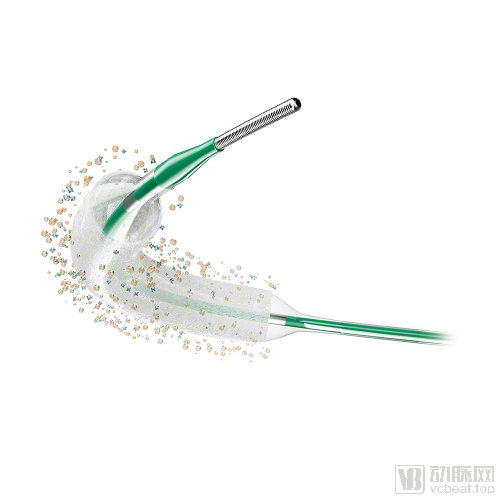
(SeQuent®Please NEO)
Leveraging B. Braun’s proprietary polymer-free paclitaxel/iopromide drug-coating technology, SeQuent® Please NEO enables targeted drug delivery. Clinical indications include in-stent restenosis, small vessel disease, and bifurcation lesions. Clinical evidence has demonstrated that this product offers interventional cardiologists a new procedural option for managing various lesion types and patient populations in routine catheterization laboratory procedures.
This product features a reduced tip profile, a low-profile balloon, and an optimized shaft design. Leveraging a comprehensive portfolio (49 different sizes, with a maximum length of 40 mm), durable coating technology (a matrix coating incorporating iopromide and paclitaxel), and robust clinical evidence (22 clinical trials involving more than 3,500 patients across various indications), this product delivers superior performance in terms of flexibility, trackability, and pushability. It helps avoid unnecessary stent implantation and maintains natural vasodilation.
Furthermore, this product features solution-directed angioplasty, providing effective lesion preparation and treatment solutions with outstanding clinical performance. Currently, SeQuent® Please NEO has been approved for marketing in Europe.
Industry experts point out that this balloon is a second-generation product featuring improvements to the original PACCOCATH technology. It uniformly coats the distal balloon of a conventional balloon catheter with a mixed matrix of paclitaxel and the contrast agent iopromide. Paclitaxel serves as the pharmacologically active ingredient in the matrix coating, exhibiting high lipophilicity, with a drug loading concentration of 3 µg/mm². As a coating drug for various drug-eluting stents, paclitaxel has been used in coronary intervention therapy for many years. During mitosis, paclitaxel inhibits smooth muscle cell proliferation by stabilizing microtubules attached to chromosomes. The addition of iopromide reduces intermolecular forces among drug molecules, thereby enhancing drug solubility, increasing the contact area between the drug and the vessel wall, and prolonging the time for drug uptake into the vessel wall, ultimately improving the bioavailability of paclitaxel.
Drug-coated balloons are single-use devices and cannot be reused for drug delivery. A single adequate dilation lasting 30–60 seconds enables the release of over 90% of the loaded drug. Compared with in-stent restenosis following drug-eluting stent (DES) therapy, drug-coated balloons (DCBs) eliminate the drawback of untreated areas within the stent struts. Moreover, DCBs provide low and uniform local drug concentrations on the vessel wall, which can reduce delayed endothelialization caused by high local drug levels and minimize therapeutic instability resulting from uneven drug distribution. More importantly, DCBs leave no residual material, making them suitable for treating patients with recurrent restenosis. Furthermore, this therapeutic approach aligns with the concept of bioresorbability, as it preserves the biological integrity of the coronary arteries after intervention, holding promise for sparking another revolution in percutaneous coronary intervention (PCI) technology.
In August 2019, Professor Raban Jeger from University Hospital Basel in Switzerland presented the latest results of the SeQuent® Please NEO BASKET-SMALL 2 trial at the ESC Congress in Munich, Germany. Professor Raban Jeger explained, “The aim of the BASKET-SMALL 2 trial was to evaluate the safety and efficacy of the paclitaxel-coated SeQuent® Please drug-coated balloon (DCB) compared with second-generation drug-eluting coronary stents.” A total of 758 patients were enrolled in the clinical trial and randomly assigned to undergo either DCB angioplasty using a paclitaxel-coated balloon or implantation of a second-generation drug-eluting stent for comparative analysis.
“The BASKET-SMALL 2 trial largely achieved the clinical efficacy of second-generation drug-eluting stents (DES). In patients treated with permanent implant DES (7.5%) and drug-coated balloon (DCB) angioplasty (7.6%), there was no difference in major adverse cardiovascular events for de novo coronary lesions less than 12 months.”
Anna Maria Braun, Chair of the Executive Board of B. Braun, pointed out that it is the investment and innovative R&D in the field of cardiovascular intervention over the past decade that have led to the emergence of products such as SeQuent®Please NEO. In addition, B. Braun has developed multiple interventional products, including the SeQuent®NEO NC coronary balloon catheter, Coroflex®ISAR NEO drug-eluting stent, and Celsite®Safety access port system.
Drug-Coated Balloon (DCB): Broad Market Prospects and a Favorable Competitive Landscape in China. As the preferred treatment for in-stent restenosis (ISR) and the optimal therapeutic option for small vessel disease and bifurcation lesions, DCBs are poised for rapid penetration in both coronary and peripheral intervention fields. Assuming full market penetration of domestic drug-coated balloons in the segments of ISR at the site of drug-eluting stents (DES), bifurcation lesions, and small vessel disease, and based on a price of RMB 20,000 per unit, the total addressable market is estimated at approximately RMB 11.5 billion.
In a Market Worth Billions, What Is the R&D Status of Chinese Medical Companies in Drug-Coated Balloons (DCB)?
Currently, drug-coated balloons (DCBs) have been approved in Europe for the treatment of in-stent restenosis, small vessel disease, and bifurcation lesions. In contrast, DCBs are currently approved only for the treatment of in-stent restenosis in China. We have summarized some of the drug-coated balloons (DCBs) marketed domestically and internationally, as shown in the table below:
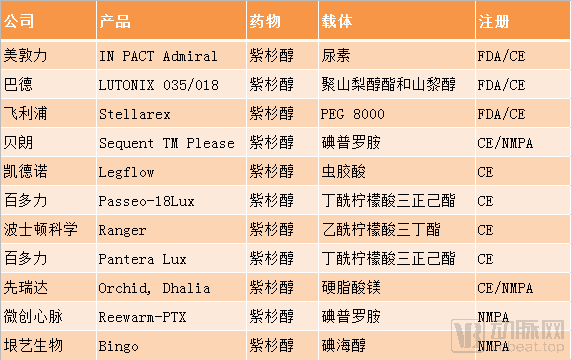
(Partial list of domestic and international certified companies; graphic by VCBeat)
According to industry insiders, B. Braun’s SeQuent Please NEO has the longest track record of clinical use and is considered the most classic product in its category. Among domestic innovative medical device companies, there are currently five enterprises in China that have obtained regulatory approval for drug-coated balloons (DCBs): Beijing SciClot Therapeutics, Dalian YinYi Medical Technology, Shanghai Shenqi Medical, MicroPort Endovascular (Shanghai), and Lepu Medical.
In addition to the five companies mentioned above, there is a cohort of innovative enterprises currently applying for registration certificates, such as Zhejiang Baitai Medical, Shanghai Xinzhi Medical, and Suzhou Dingke Medical. Furthermore, capital markets have shown keen interest in this niche sector in recent years, with multiple high-value financing rounds occurring in the drug-coated balloon field since 2020.
We have reason to believe that drug-coated balloons (DCBs) will bring about a new transformation in coronary intervention therapy. In this context, domestically produced interventional devices are also poised to reach new heights, rivaling leading international manufacturers.
"Application of Drug-Coated Balloons in the Cardiovascular Field" 2020Ji Fusui
“Intervention Without Implantation: Industry Research on Drug-Coated Balloons (DCB)” 2020 Guan Shan