

Tsumura & Co., Backed by Ping An, Bets Big on China: What's in Its Medicine Cabinet?

TSUMURA
Drug Developer
On March 21, 2020, Ping An Tsumura announced the acquisition of an 80% stake in Tianjin Shengshi Baicao Traditional Chinese Medicine Technology Co., Ltd. (Shengshi Baicao) for JPY 18.6 billion (approximately RMB 1.2 billion). Following this acquisition, Ping An Tsumura will further expand its crude drug platform in China, secure a stable supply of traditional Chinese medicine (TCM) raw materials, and advance quality management and centralized oversight of crude drug production regions. Additionally, Shengshi Baicao’s experienced TCM industry professionals and team will help Ping An Tsumura further expand its business operations in China.
Tsumura & Co., the controlling entity of Ping An Tsumura, was founded in 1893 and went public in 1980. It is the largest Kampo pharmaceutical company in Japan and worldwide. This transaction also marks Tsumura & Co.’s first acquisition in 12 years.
According to official data, as of March 31, 2020, TSUMURA & CO.’s net assets amounted to JPY 30.142 billion (approximately RMB 1.937 billion). The difference between the acquisition price and TSUMURA & CO.’s net assets was JPY 12 billion, which will be amortized evenly over the next 20 years. This indicates that the JPY 18.6 billion investment is far from an ordinary acquisition.
Paying JPY 12 billion in lease fees to bring Shengshi Baicao under its wing, what is this century-old pharmaceutical company really up to? We attempt to find out by examining the growth trajectory and development strategy of TSUMURA & CO.
Tsumura & Co. (formerly known as Jundoan) was founded by Shigeji Tsumura in 1983. Guided by the firm belief that “good medicine will surely sell well,” Tsumura & Co. gained renown for launching “CHushoyu,” a proprietary herbal remedy for women. Committed to the scientific research of Kampo formulations, the company established Japan’s first crude drug research institute, the “Tsumura Research Institute,” and the “Tsumura Medicinal Plant Garden” in 1924. At its inception, the plant garden covered an area of approximately 3,600 tsubo (1 tsubo equals 3.3057 square meters). Its scale gradually expanded, eventually reaching 230,000 tsubo, making it the largest botanical garden in Japan.
In 1976, Japan’s National Health Insurance incorporated Kampo (Chinese herbal medicine) formulations into its coverage. In 1980, Tsumura & Co. was listed on the Second Section of the Tokyo Stock Exchange, and in October 1988, it was officially renamed Tsumura & Co.
Currently, TSUMURA & CO. employs over 3,000 people worldwide, with an average employee tenure of 19.8 years. The company’s core business is the production and sales of prescription Kampo formulations, with a strategic focus on geriatric care, women’s health, and oncology.
At present, TSUMURA & CO.’s product portfolio can be divided into four segments: medical Kampo formulations, general Kampo/over-the-counter drugs, TSUMURA medicinal liquors, and TSUMURA herbal bath products. Among these, the number of medical Kampo formulation products has increased to 139, serving as the primary profit source for TSUMURA & CO. and accounting for more than 95% of its sales revenue.
Our research has identified four key characteristics in the development of TSUMURA & CO.:
1. Prioritize the development of Kampo medicines.In 1924, TSUMURA & CO. established the “TSUMURA Research Institute” and the TSUMURA Medicinal Plant Garden, laying the foundation for subsequent pharmaceutical research. By the late 1970s, TSUMURA & CO. had completed the development of new manufacturing processes for tablet formulations; by the mid-1980s, it had finalized new processes for granule formulations; and by 1990, TSUMURA & CO. had produced 128 types of compound Kampo granules.
Tsumura has also established advanced and unique manufacturing processes in the production of Kampo medicines, encompassing ten meticulous steps: cutting, weighing, formulation, extraction, separation, concentration, drying, granulation, filling, and packaging. Herbal materials are derived from plant roots, fruits, and other parts, which vary in shape and size. Traditionally, after harvesting and drying in the fields, human visual inspection was used to determine their suitability as raw materials for Kampo medicines. With the integration of AI technology, the screening process can now be automated. Currently, Shenzhen Tsumura, the Chinese subsidiary of Tsumura & Co., has introduced color-based sorting to assess quality by analyzing the color of roots and fruits.
Tsumura & Co.’s Kampo medicines are largely derived from monomers and compounds extracted from botanical drugs. In addition to non-clinical trials, the company has conducted clinical studies to re-evaluate therapeutic Kampo formulations. Starting in 1999, 148 Kampo formulations were included as prescription drugs under Japan’s National Health Insurance program, of which 129 were supplied by Tsumura & Co. At that time, Tsumura & Co. held an 80% market share for Kampo prescription products.
2. Prioritize the acquisition and production of crude drug raw materials.Due to the influence of various factors such as climate and soil conditions on the quality of crude drugs, most of the crude drugs required for Japanese Kampo medicines are imported from abroad. To address this, TSUMURA & CO. established several crude drug bases in China and set up a processing plant in Shenzhen. Crude drugs procured from various regions across China were centralized at this facility for screening and sorting before being shipped back to factories in Japan. This approach not only ensures the quality of crude drugs and safeguards raw material supply against adverse climatic conditions but also lays the foundation for traceability of domestically produced crude drugs in China. In the 21st century, TSUMURA & CO. launched a crude drug traceability system, enabling the origin of each piece of medicinal material to be traced, thereby implementing more stringent quality control.
3. Continuously expand into overseas markets.In 1991, TSUMURA & CO. submitted an application to the FDA for clinical trials. Starting in 1992, TSUMURA products entered the U.S. market and were sold as pharmaceuticals. In 1998, TSUMURA established representative offices in New York and Los Angeles, and began marketing over-the-counter (OTC) Kampo medicines as dietary supplements to Japanese residents in the United States. In 2001, Tsumura USA, Inc. was established, serving as TSUMURA’s drug development base in the United States and responsible for U.S. operations and pharmaceutical development.
In November 2004, TSUMURA officially launched the Phase II clinical trial of its Kampo medicine Keishi-bukuryo-gan in the United States; in May 2005, TSUMURA’s Daikenchu-to granules also entered clinical trials.
Daikenchuto, a warming interior formula, is used as a prescription drug in Japan. TSUMURA & CO has developed it into a convenient granular formulation, which has been widely used and well received. To enter the U.S. market, TSUMURA & CO has conducted eight clinical trials in the United States; one was terminated due to insufficient enrollment, while seven have been completed.
In May 2018, after 13 years of exploration, the indication for Dajianzhong Tang under development and market approval in the United States was determined to be postoperative ileus. This Kampo medicine is expected to gain U.S. market approval in 2021.
4. Prioritize intellectual property strategy.Tsumura & Co. has applied for the registration of English, Japanese, and figurative trademarks across all product and service categories, and has registered these three types of trademarks in multiple countries, thereby implementing the strategy of “trademarks before market entry.” Furthermore, Tsumura & Co. has secured defensive trademark registrations for combined word-and-device marks, figurative marks, and word marks.
Tsumura & Co.’s ties with China date back to 1978. At that time, coinciding with the launch of China’s reform and opening-up policy, Shigeaki Tsumura, the second-generation president of Tsumura, visited Qian Xinzhong, then Minister of Health of China. The two parties reached a consensus on a long-term supply agreement for crude drug raw materials, thereby inaugurating a history of friendly exchanges between Tsumura and China that has now spanned more than four decades.
In January 1991, Tsumura & Co. established a representative office in China to formulate and implement effective sales strategies for developing the Chinese market. In March of the same year, Tsumura & Co. wholly funded the establishment of Shenzhen Tsumura Pharmaceutical Co., Ltd., a manufacturing enterprise specializing in traditional Chinese medicinal materials and prepared slices of Chinese crude drugs, serving as a procurement, classification, quality control, and storage base for active pharmaceutical ingredients (APIs) in China. Shenzhen Tsumura was also the first manufacturer of prepared slices of Chinese crude drugs in Shenzhen to obtain Good Manufacturing Practice (GMP) certification.
Since the turn of the new century, TSUMURA & CO. has been highly active. In 2000, TSUMURA & CO. established a representative office in Shanghai. In 2001, it formed a joint venture with Shanghai Medicinal Materials Co., Ltd. and Shanghai Zhangjiang Hi-Tech Park Development Co., Ltd. to establish Shanghai Tsumura Pharmaceutical Co., Ltd., serving as TSUMURA’s production base in China for powdered herbal extracts. Shenzhen Tsumura supplied raw herbal materials, which Shanghai Tsumura processed into extract powders for export to TSUMURA’s factories in Japan, thereby stabilizing TSUMURA’s product supply. In 2015, TSUMURA & CO. partnered once again with Shanghai Pharmaceuticals to establish Shanghai SPH Tsumura Pharmaceutical Technology Co., Ltd., engaging in the production and sales of proprietary Chinese medicines, standardized Chinese herbal formula granules, and herbal extracts, with the aim of rapidly entering the market for standardized Chinese herbal formula granules.
In September 2017, Ping An Insurance invested JPY 27.3 billion (approximately RMB 1.6 billion), with Ping An Life Insurance acquiring a 10% stake in TSUMURA & CO., thereby becoming its largest shareholder. It is reported that this investment by Ping An represents the largest-scale investment by a Chinese enterprise in Japan’s Kampo medicine and health industry, marking a convergence of the world’s most advanced Kampo pharmaceutical technologies with the globe’s largest healthcare market.
On June 13, 2018, Ping An Tsumura Co., Ltd., a joint venture established by Ping An Insurance (Group) Company of China, Ltd. and Tsumura & Co., was founded. Tsumura (China) Co., Ltd., a subsidiary of Japan’s Tsumura & Co., contributed RMB 560 million, holding a 56% equity stake.
On April 1, 2019, Ping An Tsumura Co., Ltd. and Guangzhou Zhengdaodi Pharmaceutical Co., Ltd. jointly established their first subsidiary, Pingcun (Shenzhen) Pharmaceutical Co., Ltd., with Ping An Tsumura holding a 90% equity stake.
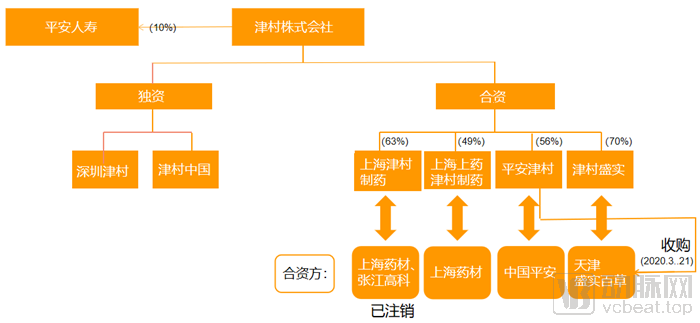
As mentioned at the beginning of the article, Tsumura & Co. spent half of its assets to acquire Tianjin Shengshi Baicao. In fact, this move was related to a mid-term management plan formulated in May 2019. The plan, with a deadline of March 2022, defined its domestic business strategy in Japan as “establishing Kampo medicine” and its China market strategy as “contributing to the health of Chinese citizens.” Additionally, it established a specific task to realize these strategies: “growth investment in China and building a business foundation.”
This plan sets a sales target of ¥135 billion (approximately RMB 8.67645 billion), with operating profit for the same period exceeding ¥19 billion (approximately RMB 1.22 billion), and outlines four specific objectives:
First, increase the sales of existing products in China to JPY 4 billion within the plan period;
Second, to build the business foundation for proprietary Chinese medicines, an investment of JPY 50 billion to JPY 100 billion will be made;
Third, within the planning period, launch an Analytical Research Center aimed at establishing quality standards for crude drugs and proprietary Chinese medicines;
Fourth, the Tianjin factory (Tsumura Shengshi) will begin producing extract powders for Japan and is poised to become a major production base for pharmaceuticals in China in the future.
To achieve these four objectives, the acquisition of Shengshi Baicao is inevitable.
Shengshi Baicao, established in 2011, is an industry leader specializing in the standardized cultivation of high-quality Chinese herbal medicines and the production and operation of Chinese herbal decoction pieces. According to an announcement released by TSUMURA & CO., Shengshi Baicao’s sales revenue and operating income for the first half of 2018 were JPY 14.393 billion and JPY 1.7 billion, respectively, representing year-on-year increases of 32.4% and 31.0%. Ordinary income amounted to JPY 1.808 billion, a 23.2% increase from the previous year, while net profit reached JPY 1.8 billion. Both sales and profits saw significant growth, with the latter reaching JPY 8 million, an increase of 24.4%.
Tsumura & Co. has maintained close business ties with Shengshi Baicao. Over the past three years, sales to Tsumura & Co. have accounted for more than 70% of Shengshi Baicao’s total revenue. In 2016, Tsumura & Co. and Shengshi Baicao formed a business alliance to strengthen their operations in China and secure a stable supply chain of raw materials for export to Japan.
In March 2018, TSUMURA & CO. and Shengshi Baicao jointly established TSUMURA Shengshi Pharmaceutical Co., Ltd., with the aim of entering the market for traditional Chinese medicine (TCM) extract powders and the broader TCM business. Considering factors such as the sharing of key technologies, TSUMURA & CO. decided to acquire Shengshi Baicao. After two years of preparation, the acquisition was completed in March 2020. Moving forward, TSUMURA & CO. and Shengshi Baicao will share their expertise in TCM and crude drug businesses, as well as Shengshi Baicao’s proprietary technologies.
In addition to expanding its operations in China, TSUMURA & CO.’s Medium-Term Management Plan also includes “continuously expanding the Kampo market and establishing businesses,” “improving productivity through new technologies,” and “cultivating corporate culture and developing diverse human resources through philosophical management,” while outlining “promoting Sustainable Development Goals (SDGs) through the Kampo value chain.”
In March 2020, TSUMURA & CO. announced its financial results for the first year of its Medium-Term Management Plan. Sales and operating income stood at JPY 123.248 billion and JPY 18.876 billion, respectively, both representing a 1.9% increase from the previous fiscal year. Ordinary profit and net income were JPY 19.649 billion and JPY 13.765 billion, respectively, reflecting decreases of 0.3% and 5.7% compared to the previous fiscal year.
Due to the impact of the COVID-19 pandemic, some of TSUMURA & CO.’s raw material production bases suffered losses. Meanwhile, the dissolution of Shanghai SPH Tsumura Pharmaceutical Co., Ltd. resulted in impairment losses, leading to a 5.7% decrease in TSUMURA & CO.’s profit for the current period. Fortunately, TSUMURA & CO. maintained a certain stockpile of raw materials in Japan, ensuring that its supply chain remained intact. Moreover, against this special backdrop, sales volume actually increased.
Tsumura & Co. is placing increasing emphasis on the Chinese market, driven by the vast potential of China’s traditional Chinese medicine (TCM) sector. According to data from the “Healthy China 2030” Planning Outline, the total size of China’s health industry was projected to exceed RMB 8 trillion in 2020 and reach over RMB 16 trillion by 2030. Within this, the TCM market size in China was expected to reach RMB 580.6 billion in 2020, with a compound annual growth rate (CAGR) of 8.2%, continuing to outpace GDP growth and indicating promising future prospects for the industry. Consequently, Tsumura & Co. has launched its herbal health food business and is preparing to expand its scope into decoctions and proprietary Chinese medicines, setting a sales target of RMB 10 billion for its overall operations in China by 2027.
However, if TSUMURA & CO. is to gain further market share in China, it will inevitably have to engage in direct competition with Chinese traditional medicine enterprises. Meanwhile, the Chinese cohort—led by major players such as Guangzhou Pharmaceutical Group, Buchang Pharmaceuticals, China Resources Sanjiu, Tasly, Yunnan Baiyao, and Beijing Tongrentang—is poised to deliver significant value in this new era of rising prominence for traditional Chinese medicine.
References:
[1] Sun Xianmin, Ren Ping. Challenges Facing China's Traditional Chinese Medicine Industry: Insights from the Development of Japan's TSUMURA & CO.[J]. World Science and Technology, 2001(04):73-75.
TSUMURA & CO. Official Website
Japan's Leading Kampo Medicine Company—Tsumura & Co.: Industrial Layout and Quality Control Management
maonline: What prompted Tsumura to embark on M&A for the first time in 12 years?