

Intuitive Surgical: The Tesla of MedTech – Dominating the Surgical Robotics Industry for Two Decades

Intuitive
Surgical Robot Developer
In the investment and financing of medical devices, it is difficult to find another sector as hot as surgical robots are today.
According to statistics from VCBeat (WeChat ID: vcbeat), five financing deals occurred in the surgical robotics sector in September alone, with each deal exceeding RMB 100 million; the largest amount reached RMB 3 billion. Investing institutions included well-known domestic funds such as Hillhouse, Baidu, and Fosun Pharma.
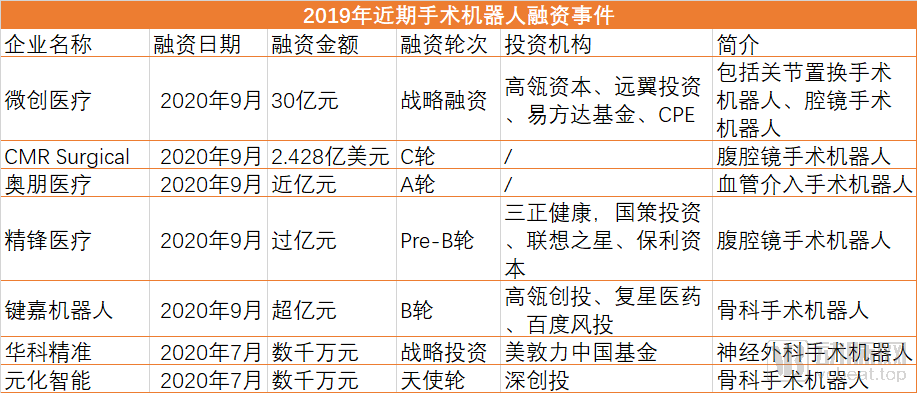
Data source: VCBeat Orange Database
Undoubtedly, everyone hopes to back a domestically produced “Da Vinci Surgical System” and discover China’s own Intuitive Surgical—the company behind the Da Vinci robot. Often dubbed the “Tesla of healthcare,” Intuitive Surgical saw its stock price soar from just $9 per share at its IPO in 2000 to over $700 per share today.
It can be said that Intuitive Surgical’s market capitalization of over $80 billion has fueled expectations regarding the growth potential of China’s surgical robotics industry.
Currently, although the surgical robotics field is flourishing with a wide range of applicable procedures, and giants such as Medtronic and Boston Scientific, along with new-generation players, are continuously entering the market, no company can yet be considered the “second da Vinci” in terms of product application scope.
How Did Intuitive Surgical Become the Tesla of Healthcare, Disrupting and Leading the Industry for Years? VCBeat Provides an Overview.
The success of the da Vinci Surgical System is inseparable from Frederic H. Moll, one of the founders of Intuitive Surgical.
Throughout the development of many industries, a visionary figure often emerges to revitalize the sector, much like Steve Jobs did for the mobile phone industry, or Frederic Moll, founder of Intuitive Surgical, Inc., did for the medical device industry. Prior to the advent of surgical robots, innovation in the medical device sector was predominantly incremental. Taking imaging equipment as an example, while such devices have become increasingly intelligent and efficient, there is no fundamental difference in principle between the earliest CT scanners and X-ray machines and the latest-generation imaging systems available today. Surgical robots, by contrast, represent an entirely new concept and product category, distinctly different from traditional incremental innovation.
Just as many disruptive innovations emerge from individuals with interdisciplinary backgrounds, Mohr comes from a family of physicians, with both parents being pediatricians. Although Mohr pursued an M.D., he did not devote himself exclusively to medicine. During his medical studies, he majored in economics at the University of California, Berkeley, where he earned a Bachelor of Arts degree, before continuing his medical education and obtaining his Doctor of Medicine degree from the University of Washington.
Frederic Moll founded Intuitive Surgical not out of a desire to use robots, but driven by the aspiration to reduce the invasiveness of surgery.
In 1980, Mohr also completed his residency internship at Virginia Mason Medical Center in Seattle. As an intern, Mohr witnessed open surgeries firsthand, which involved large incisions and exposed patients to greater risks. Mohr recalled, “Such massive wounds left a profound impression on me; I felt the approach was obsolete.”
With ambitions beyond merely practicing medicine, Moore left Seattle for Silicon Valley to embark on a journey of entrepreneurship in the medical device industry.
Before founding Intuitive Surgical, Inc., Mr. Moll had co-founded multiple medical device companies, including Endotherapeutics, a laparoscopic surgical instrument company later acquired by US Surgical, and Origin MedSystems. These experiences laid an implicit foundation for his establishment of Intuitive Surgical, Inc.
The initial research on the da Vinci Surgical Robot was conducted at SRI International, a nonprofit research institution. In 1990, SRI received funding from the National Institutes of Health (NIH) to begin developing a prototype surgical robotic system. This research attracted the interest of the Defense Advanced Research Projects Agency (DARPA) due to its potential to enable surgeons to perform remote operations on soldiers injured on the battlefield.
In 1994, Dr. Mohr became interested in the SRI system. Although he presented this technology to his employer at the time, his proposal was rejected.
In 1995, Dr. Mohr met John Freund, another founder of Intuitive Surgical. At the time, Freund was resigning from his position as Vice President at Acuson, a leading U.S. ultrasound company (acquired by Siemens in 2001). Freund exercised the option to acquire SRI’s intellectual property and registered a new company, which he named “Intuitive Surgical.”
Intuitive Surgical’s initial business plan was authored by John Freund, Mohr, and Robert Younge, who also secured the company’s initial venture capital. Early investors included Mayfield Fund, Sierra Ventures, and Morgan Stanley.
However, when Intuitive Surgical was founded, it was not the only company developing surgical robots. In the 1980s, Computer Motion, with backgrounds from SRI International and NASA, also attempted to develop surgical robots, but ultimately the da Vinci Surgical System emerged as the winner.
Mohl believes that the greatest value of robots is their ability to enable general surgeons to perform at a level comparable to world-class surgeons.
Mohl’s influence on the surgical robotics industry extends far beyond founding Intuitive Surgical, Inc.; he has also been present in the founding and board teams of multiple surgical robotics companies worldwide. Since entering the field of surgical robotics in the 1980s, Mohl has not only created Intuitive Surgical, Inc., the dominant player in the sector, but has also built a surgical robotics empire.
In 2009, Mohar founded Auris Health, a developer of bronchoscopy surgical robots, which was acquired by Johnson & Johnson for $3.4 billion in 2019. Mohar also serves on the boards of directors of surgical robotics companies such as Mako (acquired by Stryker for $1.68 billion in 2013) and RefleXion.
In the field of surgical robotics, you may choose not to mimic the da Vinci Surgical System, but it is difficult to avoid following in Mohr’s footsteps.
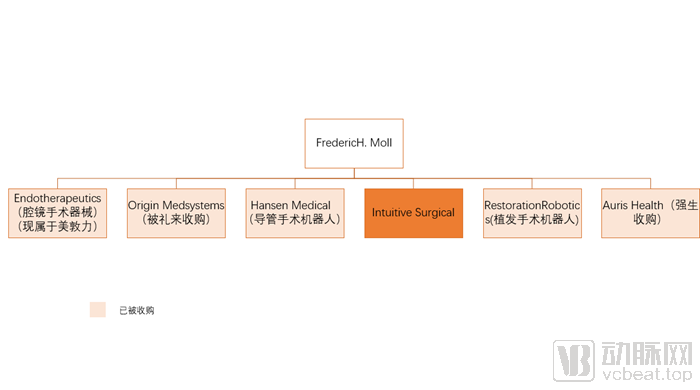
Medical device company founded by Moore
Intuitive Surgical was founded in 1995, but its true heyday came after 2000. Prior to 2000, Intuitive Surgical endured a five-year patent litigation battle with its competitor, ComputerMotion. In 2003, the two companies, both battered by the dispute, decided to merge. Thereafter, Intuitive Surgical’s sales and profits began to soar.
In its early days, Intuitive Surgical offered only the da Vinci surgical robot. Today, however, the company has established a comprehensive portfolio of surgical robotic products, encompassing multiple product categories that span from surgery to diagnosis, with the aim of creating multiple growth engines.
The first da Vinci surgical robot was approved in 2000. To date, Intuitive Surgical has successfully commercialized four generations of the da Vinci Surgical System, forming a comprehensive family that includes the fourth-generation da Vinci X, da Vinci Xi, and da Vinci SP systems, as well as the first three generations of the da Vinci Surgical System.
Intuitive Surgical’s most lucrative da Vinci Surgical System consists of six major components.
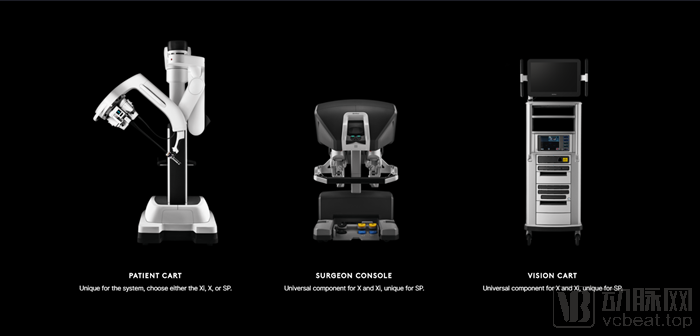
Da Vinci Surgical System. Image source: Intuitive Surgical official website
First is the surgeon console.The console allows the surgeon to comfortably sit in a chair and perform surgery by viewing 3D images, with the finger grips located below the display. The da Vinci Surgical System precisely and in real time translates the surgeon’s hand movements into operations of surgical instruments fixed within the patient’s body, through electronic software, algorithms, and mechanical systems.
Part 2: Bedside TrolleyThe system is equipped with robotic arms that manipulate devices within the patient’s body, supporting up to four arms. Two of these arms control surgical instruments inside the patient, functioning analogously to the surgeon’s left and right hands. The third arm holds an endoscope, enabling the surgeon to easily pan, zoom, and rotate the visual field. The fourth arm allows the surgeon to introduce additional surgical instruments for auxiliary tasks, thereby extending the surgeon’s capabilities.
The da Vinci SP Single-Port Surgical Robotic System features a single robotic arm that integrates three surgical instruments with independent degrees of freedom, along with the first fully articulating 3D HD camera in the da Vinci Surgical System portfolio. Both the surgical instruments and the camera emerge through a single cannula and triangulate around the anatomical target to prevent external instrument collisions within confined surgical workspaces.
The third important component is the 3D HD vision system,The 3DHD vision system comprises the Insite3D endoscope, where two independent visual channels are connected via high-performance cameras and dedicated image processing hardware to two separate color monitors. The resulting 3DHD images feature high resolution, high contrast, and low flicker. The digital zoom function within the 3DHD vision system enables surgeons to obtain an optimal field of view without adjusting the endoscope’s position, thereby reducing interference between the endoscope and surgical instruments.
In addition to the surgeon console, patient-side cart, and vision system, the da Vinci Surgical System also includes a surgical skills simulator, integrated table motion system, and fluorescence imaging system.
Surgical Skills TrainerIt is a practical tool that provides users with the opportunity to practice skills. The training simulator, based on physics-enabled computer simulation technology, immerses users in a virtual environment to familiarize them with the surgeon console. Upon completion, the simulator also provides quantitative assessments of performance across various specific tasks.
Fluorescence Imaging SystemBy integrating fluorescent dyes with specialized da Vinci cameras, endoscopes, and laser-based illuminators, surgeons can identify blood vessels, tissue perfusion, or three-dimensional bile ducts on the tissue surface, thereby visualizing critical anatomical structures. This technology is commonly applied in urology, gynecology, and general surgery.
In addition to surgical robot systems, Intuitive Surgical also manufactures various staplers as well as surgical instruments and accessories such as forceps, electrocautery devices, and dissectors.
The complex composition of the da Vinci Surgical System enables its application in a wide variety of surgical procedures. Currently, the da Vinci robotic surgical system primarily focuses on five major surgical specialties: gynecologic surgery, urologic surgery, general surgery, cardiothoracic surgery, and head and neck surgery. Key procedures performed include da Vinci hysterectomy, da Vinci prostatectomy, da Vinci hernia repair, da Vinci colorectal surgery, da Vinci partial nephrectomy, da Vinci lobectomy, and da Vinci sacrocolpopexy.
In 2019, the volume of da Vinci surgeries increased by 18%, with the surgical growth rate in the United States reaching 17%. The growth in surgical volume was primarily driven by general surgery procedures, most notably hernia repair, cholecystectomy, colorectal surgery, and bariatric surgery.
Overall, these procedures were historically complex and predominantly performed via open surgery. Taking hysterectomy as an example, the most common gynecologic procedure indicated for various benign and malignant conditions, it can be performed using either open techniques or minimally invasive surgery (MIS) approaches, including vaginal, laparoscopic, and robotic routes. Prior to the introduction of the da Vinci Surgical System for gynecologic applications in 2005, the majority of hysterectomies were performed as open procedures. The da Vinci Surgical System has provided patients with access to minimally invasive treatment options, offering an alternative to open abdominal hysterectomy.
In terms of sales performance, as of 2019, the da Vinci Surgical System had been used in more than 7 million procedures worldwide, with 5,582 units installed.
Although the da Vinci Surgical System has remained highly competitive over the past two decades, it is no longer a young product and has significant room for improvement. The surgical robotics market is undergoing continuous innovation, with new products emerging endlessly. Intuitive Surgical is pinning its future growth hopes on newly developed products, primarily the Ion lung biopsy robot and the da Vinci SP single-port surgical robot.
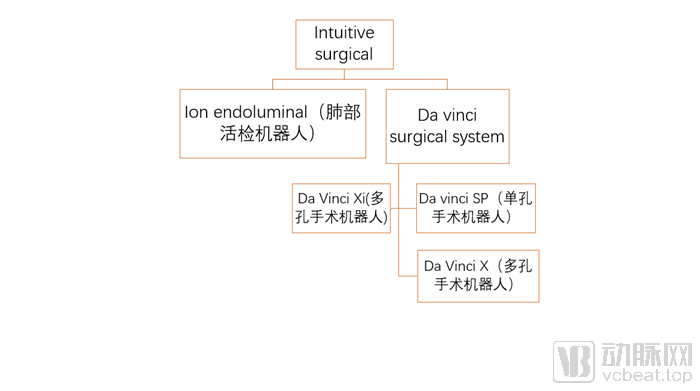
Intuitive Surgical's Product Matrix
The da Vinci Single-Port (SP) Surgical Robot has been deployed in over 40 centers. However, the overall market performance of the da Vinci SP Surgical Robot has fallen short of expectations. The primary reasons are the global regulatory authorities’ continuous demands for updated SP data, as well as the challenges the SP system itself has faced in demonstrating its robustness.
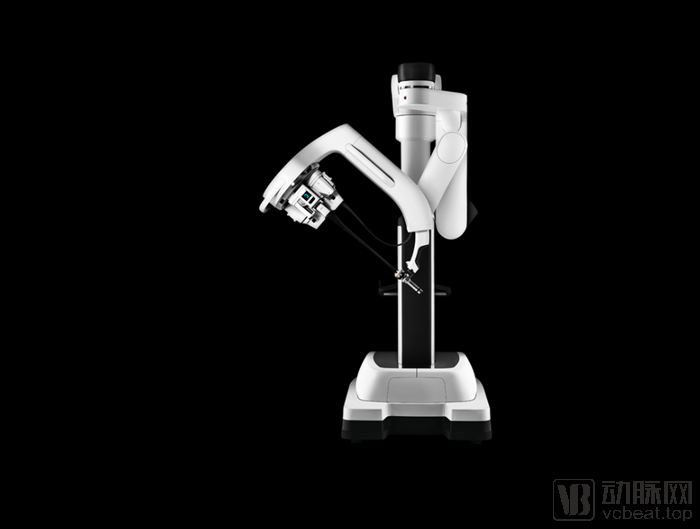
Da Vinci SP Surgical System. Image source: Intuitive Surgical official website
The Ion endoluminal system for lung biopsy was approved in 2019, enabling minimally invasive pulmonary biopsies. The Ion endoluminal system consists of a flexible, robot-assisted catheter platform that can navigate through very small airways in the lungs to perform biopsies of peripheral tissue. The Ion endoluminal system utilizes an ultra-thin articulated robotic catheter with an outer diameter of 3.5 millimeters. The catheter can articulate 180° in all directions, allowing physicians to reach nodules in most airway segments deep within the lungs via small and tortuous airways. The system’s flexible biopsy needle can collect surrounding lung tissue, and the catheter’s 2-millimeter working channel can also accommodate other biopsy tools, such as biopsy forceps and cytology brushes. This product has expanded Intuitive Surgical’s market from the surgical domain into the diagnostic field.
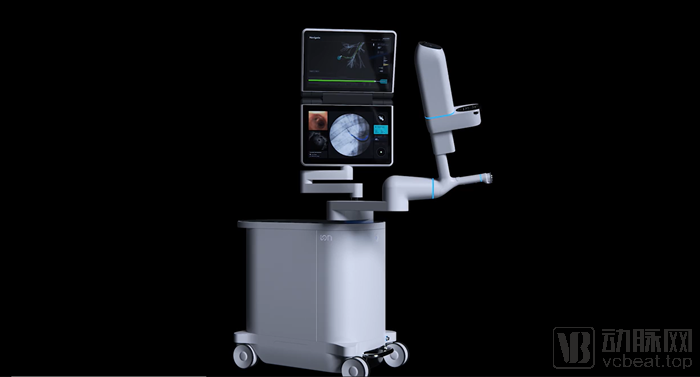
Ion Endoluminal System. Image source: Intuitive Surgical official website
Intuitive Surgical’s new product performance still needs improvement; the da Vinci SP system had 29 units installed in 2019, and the Ion lung biopsy robot, approved in 2019, sold 10 units that year.
Through years of accumulation, Intuitive Surgical’s revenue is no longer solely dependent on new system sales. From the perspective of its revenue structure, recurring revenue constitutes the majority of Intuitive Surgical’s income. This recurring revenue includes income from instruments and accessories, service revenue, and operating lease revenue—essentially representing the post-sale revenue generated from installed da Vinci surgical robot systems.
This is primarily attributable to the business model of the da Vinci Surgical System, in which the robotic arms are classified as consumable devices with a maximum reuse limit of 10 procedures. This unique model has generated a steady stream of revenue for Intuitive Surgical.
In 2019, Intuitive Surgical’s recurring revenue increased to $3.2 billion, accounting for 72% of total revenue. This compares to $2.6 billion (71% of total revenue) in 2018 and $2.2 billion (71% of total revenue) in 2017. Recurring revenue is primarily derived from instruments and accessories, with revenue from these items rising to $2.4 billion in 2019, up from $2.0 billion in 2018.
Intuitive Surgical also introduced a leasing model. From 2017 to 2019, Intuitive Surgical sold 139, 272, and 425 da Vinci surgical systems through leasing, respectively.
Over the past 25 years, the da Vinci Surgical Robot System has dominated the market by establishing robust foundational capabilities in mechanical interaction, real-time computation and imaging, and instrument manufacturing.
For hospitals, the reasons why the da Vinci Surgical System has been highly sought after are as follows. First, the product ecosystem of the da Vinci Surgical System indeed delivers tangible clinical value, providing support and benefits for surgical procedures. Second, the da Vinci Surgical System has gained the endorsement of surgeons, who, upon recognizing the value of robotic assistance, personally advocate for its adoption.
Third, hospital data analysis indicates that the da Vinci Surgical System can enhance operational efficiency and profitability. The primary value the da Vinci system brings to hospitals lies in its ability to reduce invasiveness through minimally invasive techniques, thereby lowering the incidence of complications, shortening hospital stays, and increasing surgical revenue.
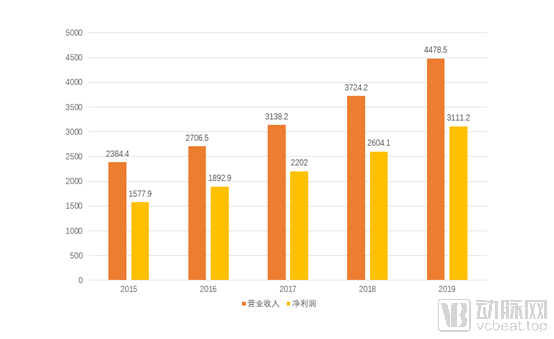
Changes in Intuitive Surgical’s Revenue and Profit (Unit: Million USD)
Intuitive Surgical has long dominated the surgical robotics landscape. Although numerous surgical robotics companies have emerged in recent years, none have managed to challenge Intuitive Surgical’s position.
First, Intuitive Surgical has established a formidable patent barrier. According to the database of the United States Patent and Trademark Office, the da Vinci Surgical System holds more than 2,000 related patents, covering multi-degree-of-freedom surgical robotic arms, end-effectors, three-dimensional stereoscopic visualization, human-computer interaction, and other areas, thereby encompassing nearly all key technological protection points for existing surgical robots of the same category. The patent portfolio for the da Vinci Surgical Robot System is so detailed that it even includes patents on the color of the pedals on its surgeon console. However, starting in 2018, the initial batch of patent protections for the da Vinci Surgical Robot System began to expire successively.
Intuitive Surgical will face greater competition as an increasing number of companies launch laparoscopic surgical robots similar to the da Vinci Surgical System, including: Avatera Medical (laparoscopic surgical robot); CMR Surgical (smaller laparoscopic surgical robot); Johnson & Johnson (including its subsidiaries Auris Health and Verb Surgical); MedRobotics (flexible robot for natural orifice transluminal endoscopic surgery in the gastrointestinal tract); Medtronic (Hugo RAS laparoscopic surgical robot); Meere Company; Smart Robot Technology; Titan Medical (laparoscopic surgical robot); TransEnterix (Senhance laparoscopic surgical robot); and Weigao Medical (Miaoshou laparoscopic surgical robot).
Meanwhile, numerous companies have entered surgical robotics segments where Intuitive Surgical has not yet established a presence, such as orthopedic surgical robots, vascular interventional robots, and percutaneous puncture robots. In these areas, Intuitive Surgical has not secured a first-mover advantage.
Taking orthopedic surgical robots as an example, the major players in this field include MAKO Surgical (a subsidiary of Stryker), Medtech (under Zimmer Biomet), Mazor Robotics (acquired by Medtronic), and China’s Tinavi.
At the time of Intuitive Surgical’s inception, surgical robots were not yet a necessity for hospitals. Intuitive Surgical earned widespread recognition among surgeons and came to dominate the field. Today, surgical robots are being adopted in an increasing number of hospital settings, and the market is continuously expanding. To maintain its leading position, Intuitive Surgical faces growing challenges.
Although many companies claim to be the “second da Vinci surgical robot,” it is clear that the dominant position of the da Vinci Surgical System in the field of surgical robotics is not easily shaken, as it has established a strong competitive advantage. Simple analogies such as “the Terminator of da Vinci” or “China’s da Vinci surgical robot” may help highlight a company’s value, but this does not mean that physicians will readily accept their products.
Reference: Why Can the da Vinci Surgical Robot Dominate the Market? – Kankan News
Intuitive Surgical 2019 Annual Report
The Story of da Vinci’s Founder, Moll! The Father of Surgical Robots Who Founded Six Companies: “I Want More Than Just One da Vinci!”