

Alibaba Cloud Tianchi and VB Insights Release Digital Healthcare Report: The Sector Enters a Transformative Era with Defined Digital Pathways and Scenarios
In April 2020, as the socioeconomic landscape suffered severe impacts from the COVID-19 pandemic, the National Development and Reform Commission (NDRC) officially defined the scope of “New Infrastructure” for the first time and incorporated it into the Government Work Report. It is foreseeable that new technological infrastructure—represented by artificial intelligence, cloud computing, and blockchain—and computing power infrastructure—exemplified by data centers and intelligent computing centers—will become major drivers stimulating national economic growth.
Healthcare is an industry vital to the national economy and people’s livelihood, with digital technology serving as one of the key drivers transforming healthcare delivery. China’s healthcare sector is currently undergoing a new round of healthcare reform: on one hand, the medical insurance fund faces significant payment pressures; on the other, population aging and the growing burden of chronic diseases are raising public expectations for higher quality care and improved medical services.
Amid the intricate and challenging process of building digital healthcare, we have also witnessed typical cases and initiatives that are braving the headwinds to reshape the medical and health system.
As the digitalization of healthcare continues to mature, numerous enterprises are transforming cutting-edge technologies—such as artificial intelligence, cloud computing, and big data—into clinically viable solutions. The application scenarios for these technologies are becoming increasingly diverse across disease diagnosis and treatment, health management, drug research and development, and precision medicine. They are gradually emerging as critical supporting factors that influence the development of the health sector and enhance the capacity and quality of health services. Addressing the varied needs within the health sector, digital technologies bring not only technological innovation but also a transformation in the supply of health services and management models, thereby establishing themselves as new infrastructure for the healthcare industry.
Currently, the new healthcare reforms are more firmly advancing toward better quality of medical services, greater accessibility to healthcare, and more transparent medical costs. The integration of various data technologies with clinical practice is also evolving from superficial applications to deep-level interaction. We believe that, driven by a combination of multiple forces, digital healthcare construction has entered a golden age of development.
To better analyze the current state of digital innovation in China’s healthcare industry and explore future innovation models, VCBeat, in collaboration with Alibaba Cloud Tianchi, released the report “New Infrastructure for Digital Healthcare” at the Spark AI “Digital Human” Challenge – Spinal Disease Intelligent Diagnosis Competition symposium, jointly hosted by Alibaba Cloud and Intel in Hangzhou on October 10.
In this report, we categorize smart healthcare into four major scenarios: In-Hospital · Smart Hospitals, Out-of-Hospital · Smart Health, Vertical · Smart Specialties, and Horizontal · Regional Population Health Platforms. We analyze the key domains, development pathways, and active enterprises within each of these four scenarios.
Looking back at the development of smart healthcare, the journey has not been smooth. Clues can be found in the core policies governing smart healthcare construction over the years. As early as July 2015, the State Council issued the Guiding Opinions on Actively Promoting the “Internet Plus” Action, encouraging the development of internet-based online medical services, remote healthcare, and cross-hospital data sharing. In the same year, the former National Health and Family Planning Commission formulated the Comprehensive Evaluation Indicators for Smart Hospitals (2015 Edition), which introduced the first evaluation indicator system for smart hospitals; however, this version of the evaluation system was never implemented.
In fact, most smart healthcare-related policies issued before 2018 were directional in nature, offering limited impetus for the development of smart healthcare. An analysis of the number and relevance of policies related to smart hospital construction, as compiled in the report, reveals a clear trend: during 2018–2019, policies on smart hospital construction became significantly more in-depth. These policies began to be linked with hospital performance evaluations, introduced hospital rating systems, and saw the issuance of detailed implementation guidelines.
The 2018 “Graded Evaluation Standards for the Application Level of Electronic Medical Record Systems (Trial)” required that “by 2019, all tertiary hospitals should reach Level 3 or above in the graded evaluation; by 2020, all tertiary hospitals should reach Level 4 or above, and secondary hospitals should reach Level 3 or above.” In March 2019, the “Notice of the General Office of the National Health Commission on Issuing the Graded Assessment Standard System for Smart Hospital Services (Trial)” proposed the establishment of a 0–5 level graded assessment system for smart services in medical institutions.
As policies deepen, they correspond to the new healthcare reform entering its most challenging phase. At this stage, the policy direction for healthcare system reform is becoming increasingly clear, calling for a more transparent and inclusive payment system, a higher-quality and more efficient healthcare service delivery system, and greater healthcare accessibility.
At this juncture, the deepening of policies for smart healthcare development signifies that such initiatives have evolved beyond mere informatization and have become a critical lever for implementing the new round of healthcare reform.
On the supply side, comprehensively enhancing the service capacity and quality of China’s healthcare system is inseparable from digital technologies; on the payment side, a more transparent payment system requires big data support. Digital health has become the infrastructure and underlying technology of China’s new healthcare reform.
McKinsey’s research findings indicate that interoperable electronic health records, hospital automation, digital tools for clinical collaboration, and digital disease prevention measures can drive payment reform and effectively control costs. For both investors and operators, the importance and necessity of building smart hospitals have become increasingly clear. Developing countries are poised to leverage the “digital” wave to overtake traditional service models.
As the core entities driving the development of smart healthcare, hospitals have significantly increased their enthusiasm for such initiatives. VCBeat conducted a statistical analysis of hospital bidding investments and project trends by aggregating data from multiple third-party public sources, including government procurement platforms and official institutional websites, as well as the "Survey on Informatization Status of Chinese Hospitals." The analysis reveals that, driven by policy incentives and internal hospital demands, there has been a substantial increase in smart hospital projects with investments reaching the tens of millions of yuan in recent years, while informatization construction projects have become increasingly diversified.
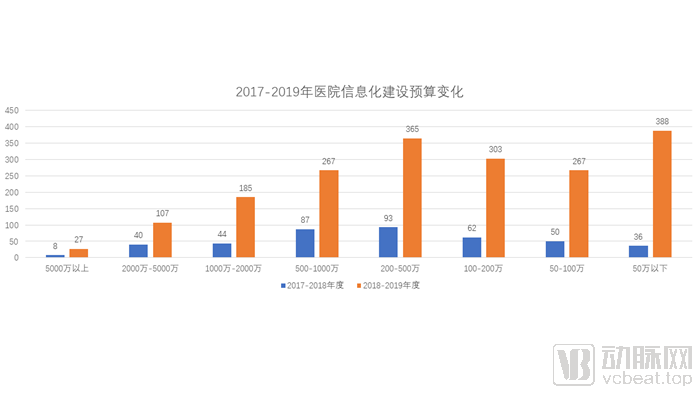
Data Source: "Survey on the Informatization Status of Chinese Hospitals"
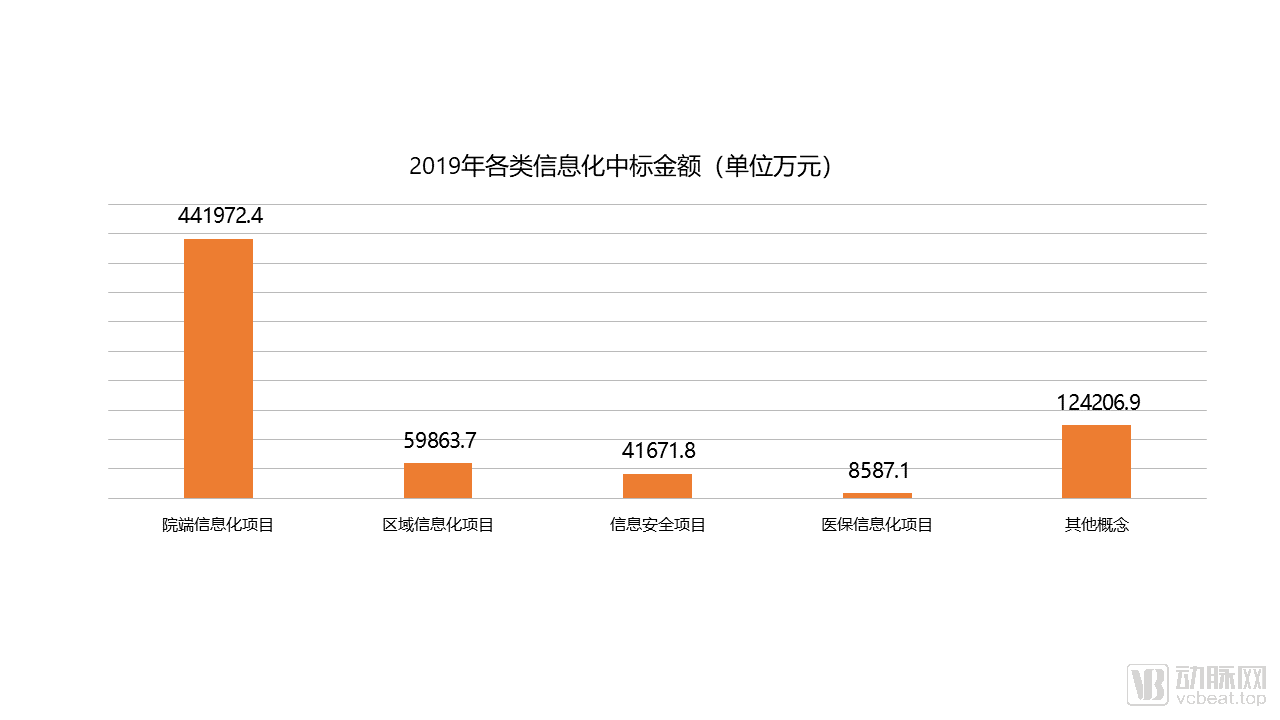
Data Sources: Government Procurement Network/Official Websites of Institutions and Other Third-Party Public Channels
With the development of smart healthcare becoming a key driver of the new healthcare reform, it also signifies that hospital informatization must shift from primarily serving hospitals to adopting a patient-centered approach that serves doctors, hospitals, and supports the coordinated “three-medical” reforms (medical care, health insurance, and pharmaceuticals). This fundamental transformation poses greater challenges to hospital services, operations, management, and interoperability.
Specifically, we believe that the development of smart healthcare in the new era is undergoing transformative trends in four major areas.
First, the service provider will evolve from a single entity to an ecosystem, ultimately centering on the patient.
Historically, the model for hospital information technology (IT) development was straightforward: IT systems were sold directly to hospitals and integrated continuously based on evolving needs. Today, hospitals must transition toward building multi-party, win-win ecosystems involving hospitals, government entities, and vendors, as well as fostering collaboration between IT departments, clinical operations, and suppliers. The development of smart hospitals must shift from a focus on management objectives and business process digitalization to a patient-centered, disease-centric approach, thereby achieving synergistic development of hospital functions.
In terms of service scope, the transition will be from closed to open, and smart hospitals need to accommodate new business models.
Historically, hospital informatization initiatives primarily served traditional, fixed clinical and diagnostic operations within hospitals. Today, emerging business models and formats—such as internet-based healthcare services, regional medical collaboration, and precision medicine—are generating entirely new demands for informatization construction. Smart hospitals require more open and inclusive design approaches.
Conceptually, the shift from fragmentation to integration has been realized in informatization policies, achieving unified top-level planning and integrated infrastructure.
In the past, hospital informatization construction followed a process-oriented approach, with modules designed according to specific hospital requirements. At present, hospital development necessitates top-level information resource planning for informatization, with standards integrated throughout the entire process. From the perspective of underlying design, infrastructure integration is required. The integration of storage, data, and computing resources facilitates the adoption of technologies such as virtualization and hyper-convergence. Meanwhile, integrated management is also needed in areas including disaster recovery, data protection and reuse, operations and maintenance management, and computing services.
In terms of process, it will achieve a transition from traditional to intelligent, forming a data-driven closed loop.
The future will be data-driven. As a large number of medical devices become digitized and IoT applications capture more information—such as in medical waste management and indoor hospital navigation—data volume will increase substantially and in real time. How to store and compute massive amounts of data, enable efficient and scalable usage, and ensure data security will emerge as new challenges.
In Which Scenarios Will Digital Hospital Construction Be Implemented in the New Era? In the report "New Infrastructure for Digital Healthcare," we have selected four major scenarios: On-campus Smart Hospital Construction; Off-campus Smart Health; Horizontal Regional Population Health Platforms; and Vertical Smart Specialty Care.
Smart Hospital
First and foremost is the smart hospital, which lies at the core of healthcare institutions. Smart hospitals enable interconnectivity among patients, medical personnel, healthcare institutions, and medical equipment, thereby improving hospital operational efficiency and optimizing the experience across pre-diagnosis, intra-diagnosis, and post-diagnosis stages of medical services. The three major subsectors of smart healthcare are smart medical care, smart services, and smart management.
Smart services are patient-oriented, encompassing pre-consultation, during-consultation, and post-consultation services, as well as whole-process care and foundational security. Specific scenarios include appointment scheduling, emergency care coordination, and referral services; information push notifications, signage and navigation, and patient convenience support; patient feedback, patient management, medication dispensing and delivery, home-based services, and guidance for primary care physicians; fee payment, intelligent triage, health education, and telemedicine. Foundational security includes safety management and service supervision.
“Smart Management” for Hospital Administration. The earliest hospital management system was the Hospital Information System (HIS). Currently, systems designed for hospital administration have evolved into diverse forms, encompassing financial management, billing and settlement, and supply chain management. These systems cover the management of extensive pharmaceuticals, medical consumables, and laboratory reagents, as well as materials such as medical waste and patient linens. They even extend to facility management utilities, including water, electricity, and gas. A core focus of refined hospital management is precise cost accounting.
Smart healthcare refers to the development of information systems centered on electronic medical records (EMRs), a nationwide initiative that has been promoted in China since 2010. Internationally, hospital informatization assessments are also EMR-centric, utilizing EMR grading systems to guide the construction of smart hospitals.
Smart hospital initiatives within medical institutions encompass all clinical and operational workflows. In the development of smart hospitals, the Electronic Medical Record (EMR) system serves as the core component. As the foundation of information technology infrastructure in healthcare organizations, EMRs play a pivotal role in eliminating internal data silos, strengthening medical record quality control, managing clinical pathways, ensuring medical quality control, enhancing diagnostic and treatment safety, and facilitating mobile healthcare. They constitute the basis for improving medical service efficiency, service quality, and patient safety. Furthermore, internet-based EMRs lay a critical foundation for remote transmission and sharing of patient information, as well as for the advancement of telemedicine.
VCBeat screened active vendors in China’s smart hospital construction sector, with a core focus on their electronic medical record (EMR) system development capabilities.
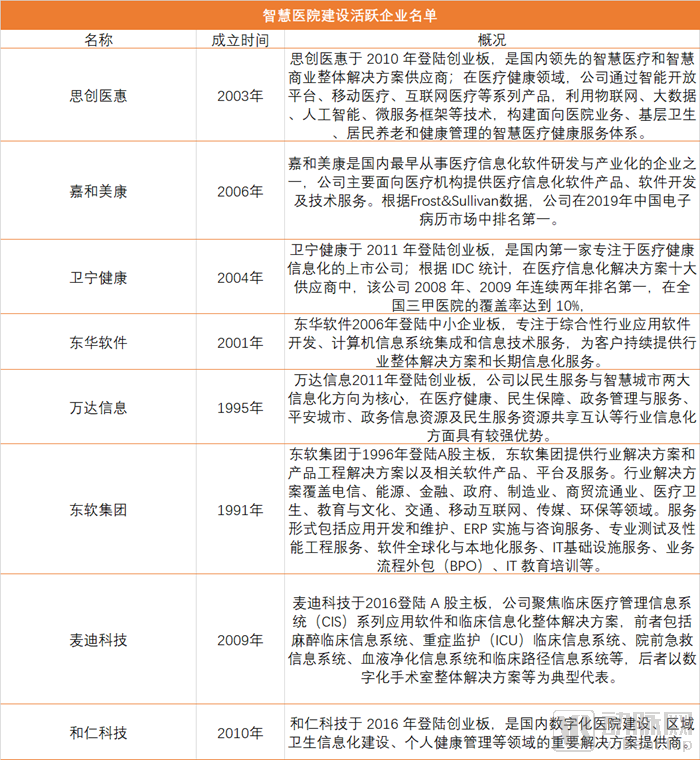
Smart Health: A Market Exceeding $10 Billion in the Future
Smart healthcare primarily focuses on in-hospital settings, whereas smart health is more prevalent in out-of-hospital and home-based scenarios. We categorize the primary application scenarios of smart health into three major areas: health management, chronic disease management, and rehabilitation.
Frost & Sullivan previously published a forecast predicting that digital health technologies facilitating patient care outside of hospital settings would grow by 30%, with the global market exceeding $25 billion in 2019.
Analysis of the Three Major Scenarios in Smart Health: Health management primarily refers to leveraging big data mining and analysis, along with integration with smart hardware such as wearable devices, to monitor and record individual metrics including body fat, blood glucose, heart rate, respiration, and sleep patterns. Furthermore, it utilizes artificial intelligence technologies to assist individuals in developing flexible and personalized health management solutions.
Chronic disease management primarily refers to prevention and early screening, employing various methods to detect potential future diseases at an early stage for timely intervention. Disease screening enables early prevention and control measures, facilitates the identification of early-stage conditions, ensures prompt treatment, reduces the risk of incidence, and decreases the number of advanced cases and mortality rates.
Rehabilitation is an extension of in-hospital treatment, helping patients better resume their daily lives. In the realm of smart rehabilitation, technologies such as brain-computer interfaces, rehabilitation robots, big data, and virtual reality are making it a growing trend to extend rehabilitation services into homes and communities.
Smart Specialty: Orthopedics Emerges as a Hub for Intelligent Specialized Care
The ultimate focus of smart hospital development will be smart specialty departments, encompassing three key areas: smart medical care, smart services, and smart management. Among these, smart management and smart services are primarily reflected in the hospital’s overall information technology infrastructure, whereas smart medical care requires deep integration with the specific characteristics of individual clinical departments. The construction of smart specialty departments will build upon the hospital’s existing IT foundation to achieve intelligent transformation in diagnostic and therapeutic tools, clinical practices, and departmental management.
Orthopedics is a high ground for the development of smart healthcare. It integrates numerous cutting-edge intelligent technologies, such as AI, 3D printing, and virtual reality, and presents significant challenges in digitalization. Nevertheless, it holds substantial market potential.
Smart Orthopedics comprises four major components: Smart Healthcare, Smart Research, Smart Services, and Smart Management.
Smart surgery integrates 3D reconstruction, VR technology, 3D printing, computer-assisted navigation, and surgical robotics to provide orthopedic joint surgeons with comprehensive solutions covering preoperative planning, intraoperative navigation, and postoperative follow-up. This approach effectively enhances the precision, standardization, and safety of orthopedic procedures, addressing physicians’ practical clinical needs.
Current Practical Cases of Smart Orthopedic Research Primarily Include Leveraging Specialty-Specific Big Data Management and AI-Powered Intelligent Follow-Up Systems to Address Existing Issues Such as Redundant Case Documentation, Unstructured Pathological Data That Hinders Management and Research, and Low Efficiency in Follow-Up Tracking, Which Impedes the Accumulation of Clinical Experience.
Orthopedic smart services include one-stop orthopedic diagnosis and treatment, online services, hospital service platforms, and intelligent triage. Remote consultations facilitate the integration of online and offline care, addressing issues related to patient matching efficiency and management efficiency.
Current Applications of Smart Orthopedic Management Include: Smart Orthopedic Supply Chain Management: By leveraging technologies such as cloud computing, the Internet of Things (IoT), and artificial intelligence, this approach enables unique item-level coding for high-value orthopedic consumables. It transforms the traditionally complex, inefficient, and labor-intensive orthopedic supply chain into an efficient and intelligent distribution network, achieving full-process data traceability and automated inventory inbound and outbound operations. This innovation reshapes the circulation pathways of orthopedic consumables. The report also compiles a list of active enterprises in the smart orthopedics sector.
Regional Population Health Platform
The Regional Population Health Platform is a standardized and unified data exchange and sharing platform established to enable dynamic updates of residents' electronic health records (EHRs) within the region, as well as mutual recognition of examination and laboratory test results. Users within the region can easily query their personal health records, including medical visit histories, physical examination reports, follow-up information, and laboratory and diagnostic test results.
In the context of regional population health platforms, key policy standards include interoperability, a concept first proposed in 2012. Hospitals began achieving interoperability ratings in 2014, with acceleration in recent years. In 2017, the National Health Commission issued the Interoperability Maturity Assessment Framework.
Based on the data from the “Public Notice of the 2019 National Medical and Health Information Interconnectivity Standard Maturity Assessment Results” released by the National Health Commission on September 16, the report selected typical cases in the field of regional population health platform development.
Finally, the report “New Digital Health Infrastructure” outlines six major trends across three key dimensions: data value, business trends, and industry development.
We believe that data will become a key driver of smart healthcare in the future, with medical data emerging as a critical asset; the crucial challenge lies in how to activate its value. At the operational level, hospital smart healthcare systems will undergo an upgrade from piecemeal patching to integrated transformation. Hospital informatization will no longer be conducted in isolation; instead, the focus will shift to balanced allocation of medical resources through collaborative healthcare services. At the industry level, the smart hospital construction market is poised for a significant reshuffle. Within the smart hospital industrial ecosystem, platform-based enterprises that provide underlying data computing capabilities will play a pivotal role.