

Lingtai Bio: Pioneering Targeted Protein Degradation for Next-Generation Small Molecule Therapeutics
895 Entrepreneurship Camp is an innovation and entrepreneurship service brand created by Zhangjiang High-Tech (Stock Code: 600895). With the original aspiration of focusing on industries, optimizing resources, and empowering innovation, it builds a robust entrepreneurial cluster through the joint support of partners in capital, technology, media, and other sectors.
Lingtai Biotech is one of the standout projects in the Healthcare Track of the 895 Startup Camp (Season 9).
VCBeat has meticulously produced a series of featured reports on high-quality healthcare projects from the 895 Startup Camp. We welcome you to follow our coverage. If you are interested in any of the projects highlighted in this series, please feel free to contact us directly.
Nestled among lush greenery, the China Pharma Valley Building in Zhangjiang, Shanghai, is neither tall nor new. Yet it stands as a highland for pharmaceutical innovation in China, having given rise to numerous star enterprises and major breakthroughs in drug development. Today, the building remains a fully equipped incubator for cutting-edge biomedical innovation, bustling yet serene—so much so that one can almost hear the clinking of laboratory instruments.
I first met Dr. Feng Yan in a laboratory at the Pharma Valley Building. As he briefly introduced me to the basic functions of the neatly arranged instruments, he shared his professional journey. Dr. Feng earned his bachelor’s degree in Chemistry from Nankai University and his Ph.D. in Organic Chemistry from the Shanghai Institute of Organic Chemistry, Chinese Academy of Sciences. He has also conducted medicinal chemistry research at the University of Michigan and Columbia University in the United States.
With nearly 20 years of experience in medicinal chemistry research, Dr. Feng Yan has accumulated extensive expertise in new drug development and project management, spanning drug discovery, IND filing, and clinical development. He previously served as Executive Director of Medicinal Chemistry at Sandia Pharmaceuticals, a highly influential CRO company ranked among the top players in China’s new drug R&D sector. Many active innovative pharmaceutical companies in China have varying degrees of association with Sandia Pharmaceuticals.

Dr. Feng Yan’s Business Portrait (Provided by the Interviewee)
In 2019, Dr. Feng Yan assembled a scientific R&D team with extensive experience in new drug development and a management and operations team with work experience at international pharmaceutical giants, domestic pharmaceutical R&D enterprises, and CROs, to establish Lingtai Technology. The new company focuses on the research and development of novel drugs and technology platforms for the treatment of cancer and autoimmune-related diseases. It has established the nano-SPUD® innovative drug discovery and screening platform, which differs from conventional small-molecule and antibody-based therapeutics. Currently, Lingtai Biopharma has four projects in its pipeline and plans to complete the selection of preclinical candidate compounds, conduct preclinical studies, and submit Investigational New Drug (IND) applications within two years.
In recent years, as “druggable” targets have been increasingly identified, small-molecule drug development has encountered a bottleneck. According to the Human Protein Atlas, 5,068 proteins are known to be associated with diseases, among which 3,131 are considered “undruggable” targets because they cannot be modulated by either small-molecule drugs or protein-based therapeutics. Of the remaining 1,937 potential drug targets, 672 have been validated as targets with multiple drugs already marketed, leaving fewer than 200 potential novel drug targets that align with traditional development paradigms.
Researchers have begun to shift their focus toward targets initially deemed “undruggable,” bringing protein degradation technology into the spotlight. Dr. Feng Yan told VCBeat that the ubiquitin-proteasome system (UPS) exists within human cells, functioning similarly to a cellular waste disposal facility. “It degrades misfolded or no-longer-needed proteins and damaged organelles, recycling amino acids for the synthesis of new proteins,” Dr. Feng pointed out. “Within the UPS, the cell attaches ubiquitin molecules to proteins destined for degradation, akin to labeling ‘waste’ as ‘recyclable.’ Subsequently, these ubiquitin-tagged proteins are transported to the proteasomes within the cell for processing.”
At this stage, among protein degradation technologies, PROTACs are the category receiving the most attention from entrepreneurs and investors.
PROTACs, short for Proteolysis-Targeting Chimeras, are protein degradation-targeting chimeras derived from a discovery that earned the Nobel Prize in Chemistry in 2004. One end of a PROTAC molecule features a ligand that binds to the target protein, while the other end contains a ligand that recruits an E3 ubiquitin ligase; these two components are connected by a linker of appropriate length, enabling specific degradation of the target protein. For the pharmaceutical industry, the most significant advantage of PROTACs is their ability to “capture” proteins without being constrained by active sites on the protein surface, thereby theoretically allowing targeting of traditionally “undruggable” targets.
In recent years, multinational pharmaceutical companies have paid significant attention to the research and development of protein-degrading drugs. Since 2017, companies such as Sanofi, Pfizer, Gilead, and GSK have made strategic investments in this area, serving as catalysts for the rapid commercialization of this new pharmaceutical technology.
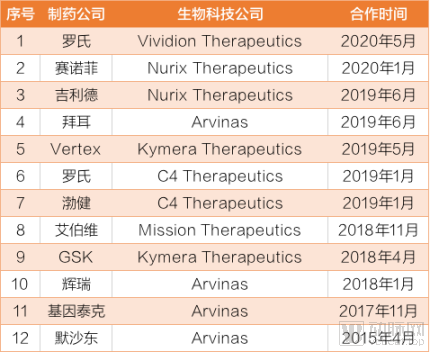
A Brief Overview of Multinational Pharmaceutical Companies’ Layout in Protein Degradation Drugs (Data Source: Compiled by VCBeat)
In July 2020, Sanofi entered into a collaboration agreement with Kymera Therapeutics, a U.S. biotechnology company dedicated to the development of protein degraders, featuring an upfront payment of $150 million, up to $2 billion in potential milestone payments, and sales royalties. Kymera subsequently went public on the NASDAQ in August of that year. Additionally, startup biotech firms specializing in protein degradation drug development, such as Arvinas, Nurix, and Monte Rosa, emerged as industry stars during this period, securing substantial external financing to rapidly advance their new drug R&D efforts.
Five months ago, both Arvinas and BMS presented clinical trial data related to protein degraders at the American Society of Clinical Oncology (ASCO) Annual Meeting, providing the necessary “proof of concept” for translating this innovative therapeutic modality from preclinical research into clinical-stage studies.
According to data released by Arvinas, a total of 22 patients with metastatic castration-resistant prostate cancer (mCRPC) received varying doses of ARV-110 in a Phase 1/2 clinical trial. ARV-110 is a protein degradation therapy developed by Arvinas that targets the androgen receptor. The data showed that one patient experienced no disease progression for 18 weeks after receiving ARV-110, with a 97% reduction in prostate-specific antigen (PSA) levels compared to baseline and an 80% reduction in tumor volume compared to baseline. Another patient achieved a 74% reduction in PSA levels and maintained no disease progression for 30 weeks. In terms of safety, ARV-110 demonstrated favorable safety and tolerability in the other 20 patients, except for two patients who experienced potential drug-drug interactions.
CC-92480, a protein degrader developed by BMS, is derived from lenalidomide, an approved therapy for multiple myeloma (MM), but exhibits enhanced protein degradation capability. In the Phase 1 clinical trial with results presented at ASCO, among the 11 MM patients treated with CC-92480, the objective response rate (ORR) reached54.4%, including one case of complete response (CR) and one case of very good partial response (VGPR).
However, although the foundational technical conditions for commercialization are already in place, there are still some challenges in the development of protein-degrading drugs that need to be addressed urgently. On one hand, current research is largely centered around targets that have already been validated; truly achieving targeting of “undruggable” targets will require more effort. On the other hand, protein-degrading drugs require more sophisticated design in terms of drugability to avoid issues such as high molecular weight and poor water solubility. "The poor membrane permeability and oral absorption of protein-degrading drugs are also key areas that many startups are currently focusing on overcoming," Dr. Feng Yan told VCBeat.
Dr. Feng Yan told VCBeat,Protein Degradation Drug DevelopmentWhile these technologies have achieved global stardom, there are relatively few domestic teams engaged in related R&D. This disparity is commonplace, as new drug development is a high-risk endeavor where success for one often comes at the expense of many failures. It is both capital-intensive and knowledge-intensive, making all-or-nothing gambles not entirely rational. Therefore, at Lingtai Biopharma, Dr. Feng Yan adheres to a “VC + Platform + IP + CXO” business strategy, leveraging specialized teams to handle specific stages of the new drug development process and employing professional tools to mitigate specific risks.
By shifting the commonly adopted VIC (VC + IP + CRO) model in new drug development upstream, Lintai Bio emphasizes an independent R&D philosophy. The company has established its own internal R&D platform to continuously generate first-in-class or best-in-class innovative pipelines with global independent intellectual property rights, targeting disease areas with unmet clinical needs and maintaining autonomy in its pipeline layout. According to Dr. Feng Yan, Lintai Bio’s scientific R&D team comprises pharmaceutical experts with profound expertise in chemistry, molecular biology, pharmacology, pharmacokinetics, animal disease models, formulation, synthetic processes, and CMC. They possess unique insights into autoimmune diseases, oncology, metabolic disorders, and other therapeutic areas, and have successfully advanced several small-molecule drugs into clinical development stages in both China and the United States. Relying on this team, they have developed a Specific Protein Ubiquitination and Degradation drug discovery platform (SPUD®), Lingtai Biotech has established a pipeline of four preclinical candidates targeting cancer and autoimmune diseases.
Among them, the LT-04 project, indicated for rheumatoid arthritis, is Lingtai Biopharma’s most advanced investigational product.
Dr. Feng Yan told VCBeat that there is enormous global patient demand for therapeutic drugs targeting autoimmune diseases such as rheumatoid arthritis, with medications like Humira (adalimumab) and Enbrel (etanercept) long ranking among the top treatments for autoimmune conditions.Global Drug Sales Rankingsleading position. The Blue Book on China’s Pharmaceutical Market Development (2017) shows that the domestic market for drugs treating rheumatism and rheumatoid arthritis alone reached RMB 48 billion. Unlike in Europe and the United States, where biological agents such as monoclonal antibodies are the mainstay of rheumatoid arthritis treatment, chemical drugs account for 66.3% of China’s rheumatoid arthritis drug market. “If the LT-04 project can be rapidly developed into a marketed drug, it will greatly help optimize the medication structure for rheumatoid arthritis patients in China,” said Dr. Feng Yan.
Furthermore, as a key pillar of the “VC + Platform + IP + CXO” business strategy, the company’s operations management team comprises professionals with experience at major international pharmaceutical companies, domestic pharmaceutical R&D enterprises, and CROs, who are well-versed in diverse corporate management models. Driving new drug development from the ground up demands strong leadership, execution, and communication skills to handle complex, multifaceted tasks. Dr. Feng Yan is confident that Lintai Bio’s operations management team can effectively establish and maintain partnerships with government agencies, academic institutions, biotechnology firms, pharmaceutical companies, and outsourcing service providers, thereby helping the company rapidly translate its technological capabilities into market-ready products.
Writing Reference:
Protein Degradation Therapy: What Insights Do the First Clinical Efficacy Data Provide?