

Alibaba Health Partners with China Volunteer Doctors to Establish a Permanent Digital Medical Advisory Team for Grassroots Healthcare

AliHealth
Medical and Health Services Network Service Provider
Medical support for the western plateau regions has been continuous. However, due to constraints such as transportation, climate, and altitude, both the deployment of physicians from tertiary hospitals in coastal areas to these regions (“going in”) and the training of local medical personnel outside their home areas (“coming out”) entail substantial human resource and time costs. This has, to some extent, hindered the enhancement of professional capabilities at local healthcare institutions.
2020 was the year China achieved its goal of poverty alleviation. In response to the relatively weak medical capabilities in remote western regions, AliHealth proposed a new model of digital healthcare-based poverty relief, aiming to build a permanent medical “advisory team” for healthcare institutions in these areas. On October 13, 2020, we witnessed this vision become a reality.
After more than three hours of winding drives along mountain roads at an altitude exceeding 4,000 meters, we finally arrived in Nangqian County from Yushu City. The sky here is high and the clouds are light, but the air is thin; people from plain areas are prone to experiencing altitude sickness upon arrival.
“We once went on a poverty alleviation mission, which lasted four days in total. Two of those days were spent traveling, and we also suffered from altitude sickness, so the actual time we spent working at the local hospital was only about half a day,” recalled Dr. Guo Yi, Director and neurosurgery specialist at Beijing Tsinghua Changgung Hospital.
“In the past, traveling to Yushu or Xining for training not only involved long distances but also posed challenges related to funding, inability to care for family members, and local adaptation, which to some extent affected our motivation and learning outcomes,” said Tashi Phuntsok, a resident physician at Nangqian County People’s Hospital in the Yushu Tibetan Autonomous Prefecture of Qinghai Province.
In response, AliHealth has partnered with charitable physician organizations such as Chinese Volunteer Doctors to explore and establish a healthcare poverty alleviation platform that integrates online and offline services. Initially, AliHealth collaborates with these physician organizations to conduct grassroots offline free clinics and field surveys, gaining an in-depth understanding of local conditions. Based on this comprehensive assessment, AliHealth leverages its digital capabilities to develop tailored assistance plans.
Taking Nangqian County in Qinghai Province as an example, during the preliminary free clinic and research activities organized earlier, doctors found that, in addition to some high-altitude diseases, the primary local need lies in improving the level of treatment for common diseases.
“When we were in Nangqên County, E Cairen, the president of the County People’s Hospital, immediately presented us with a list of training needs covering more than 50 common diseases,” recalled Ling Feng, founder of Chinese Volunteer Doctors and chief neurosurgery expert at Xuanwu Hospital of Capital Medical University. “President E’s strong commitment to improving local healthcare left a deep impression on me.”
Based on in-depth preliminary research, an online platform was established leveraging AliHealth’s digital capabilities. Organizations such as Chinese Volunteer Doctors dispatch one professional physician each week to conduct online training for physicians at Nangqian County People’s Hospital, with each session focusing on a specific disease.
At Nangqian County People’s Hospital, we observed frequent interactions between trainees and instructors during the “classroom” sessions, with some participants taking notes on site. After the training concluded, the trainees engaged in discussions and completed the course examination.
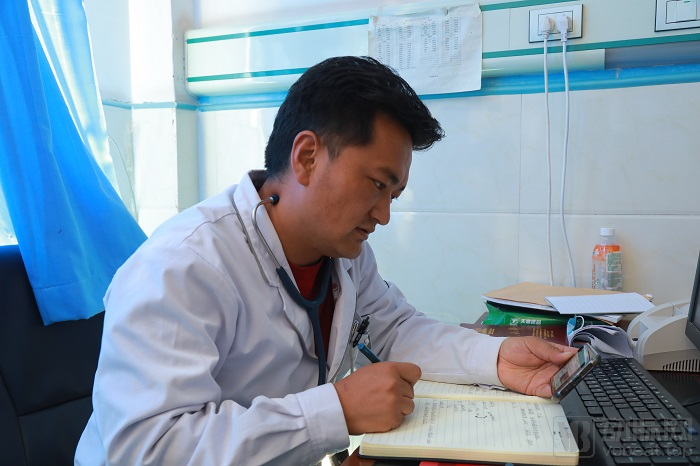 Nima Jiangcai, Director of the Emergency Center at Nangqian County People’s Hospital in Qinghai Province, diligently takes notes while attending online training courses on a digital learning platform during his spare time.
It is worth noting that the platform established by AliHealth can automatically record each participant’s learning progress and interactions. These records are fed back to partner primary care hospitals, helping them better organize and supervise participants’ studies, thereby ensuring the effective implementation of online training outcomes.
“Previously, we also engaged in some online training programs, but physicians found it difficult to sustain participation due to various reasons. Leveraging the platform provided by AliHealth, we can achieve more effective organization and follow-up,” said E Cairen, President of Nangqian County People’s Hospital.
Ma Li, Senior Vice President of AliHealth, revealed that, building upon its one-to-many online training model, the platform will sequentially launch modules including one-on-one remote case discussions, remote consultations, remote ward rounds, and content operations for public-facing platforms targeting broader audiences. These initiatives aim to effectively enhance the professional competencies of healthcare professionals in poverty-stricken areas and grassroots communities.
Currently, in addition to Nangqian County in Qinghai Province, the aforementioned model has been expanded to regions such as the Garzê Tibetan Autonomous Prefecture in Sichuan Province, Songpan County in the Aba Tibetan and Qiang Autonomous Prefecture, and Weinan in Shaanxi Province. At present, Chinese Volunteer Doctors are organizing medical professionals to conduct on-site poverty-alleviation free clinics and research in Yutian County, Luopu County, and Moyu County in Xinjiang. The new model of digital healthcare for poverty alleviation is bringing benefits to an increasing number of regions.
“There is no doubt that leveraging the internet to enhance the professional competence of primary care physicians, thereby addressing the imbalance in China’s healthcare standards, will prove to be a beneficial complement and important direction for offline poverty alleviation efforts,” said Ling Feng.
This new digital model for medical poverty alleviation emerged during the pandemic this year. In response to the global spread of COVID-19, the Jack Ma Foundation and Alibaba Foundation established the Global Multi-center Collaboration Consortium (GMCC) for practical sharing on COVID-19 prevention and control, which is operated by AliHealth. The platform organized a group of Chinese doctors with experience in fighting the epidemic to conduct cross-border consultations, playing a significant role in exchanging measures for COVID-19 prevention and treatment. To date, hospitals from more than 200 countries and regions overseas have joined the consortium, and over 10,000 domestic and international doctors have engaged in online exchanges through the GMCC platform. This initiative for online medical poverty alleviation within China undoubtedly represents the continuation and development of GMCC’s efforts domestically.
It is reported that AliHealth aims to promote the aforementioned new model of digital medical poverty alleviation over the next three years, reaching 100,000 primary care physicians across more than 1,000 counties in China and benefiting 200 million people.
“We will further deepen our collaboration with volunteer doctors in China. Meanwhile, our platform remains open; we call on more compassionate doctors and institutions to join us, and welcome grassroots medical facilities in need of assistance to contact us, so that together we can address the imbalance in medical resource distribution across the country,” said Ma Li.