

Anwo Health Files IPO Prospectus After Amassing Millions of Users and Expanding into At-Home Testing Market
Hundreds of testing items, cumulative service to millions of users, ranking first in multiple categories on Tmall, a nationally certified medical testing laboratory, and dozens of intellectual property rights... These are the achievements Anwo Health has made in just two years since its establishment.
When Anwo Health was established, ancestry genetic testing projects were flourishing in China. In the United States, Ancestry accumulated 3 million users and generated annual revenue of approximately $1 billion by leveraging genealogical and family tree-based ancestry tracing tests. The success of Ancestry further solidified the resolve of consumer-grade genetic testing companies to deepen their focus on ancestry testing.
Wu Jian, Founder and CEO of Anwo Health, stated that the United States has a complex ethnic composition and a large immigrant population, resulting in strong interest in ancestry testing—a market driven primarily by consumer curiosity. In contrast, as the Chinese population shares common ancestral roots, ancestry testing lacks the necessary conditions to take root and flourish in China.Wu Jian believes that the Chinese population is largely problem-driven, purchasing home testing products in the hope of helping them address specific issues.
Through market research, the company’s founding team observed that issues affecting the growth and development of infants and young children in China—such as allergies, height, and immunity—as well as women’s health management needs, including body shape and skin care, remain largely unaddressed. In response, Anwo Health has focused on the maternal and infant market, leveraging genetic testing technology to elucidate the underlying scientific principles and provide corresponding interventions and solutions.
It is precisely by virtue of its precise positioning and high growth potential that Anwo Health has risen to the forefront of the consumer-grade genetic testing industry and the maternal and child health industry within just one year of its establishment.
In 2020, Anwo Health expanded its product line from maternal and infant health to home health testing, enabling users to conduct tests at home without leaving their houses.
Currently, the company has launched a range of at-home testing products, including HPV genotyping tests, gut microbiota tests, and infant allergy genetic tests, with a focus on meeting users’ diverse health management needs in home settings.
Home-based testing, as a novel testing modality, has freed diagnostic services from being confined to hospitals and health examination centers. However, Wu Jian emphasized thatHome-based health monitoring should not be positioned in opposition to hospitals and physical examination centers.He summarized the significance of at-home health testing as follows: subtracting from the burden for those requiring intensive medical examinations, while adding value for those needing only basic check-ups.
The population requiring frequent medical check-ups primarily includes individuals who prioritize health management and patients with chronic diseases. These individuals need to visit hospitals or examination centers frequently and regularly for screenings. Home-based testing simplifies this process by enabling them to easily perform lightweight tests at home, thereby reducing the time costs associated with outpatient visits and the risk of cross-infection in crowded settings, while also helping to conserve hospital medical resources to a certain extent.
There is also another group: individuals who opt for minimal health screenings. These individuals may consider the process time-consuming and laborious, lack the time, or feel that certain tests compromise their privacy; thus, they prefer to forgo examinations at hospitals and check-up centers despite the associated health risks. Home-based testing perfectly meets the needs of this demographic.
With the introduction of policies such as tiered diagnosis and treatment and family doctor contract services, coupled with technological advancements, an increasing number of testing items can now be performed at home. Keenly recognizing the booming trend in home-based testing, Anwo Health has focused on home health testing, beginning to provide household health testing and diagnostic products and services for Chinese families. This enables users to conveniently and rapidly complete self-health checks, access hospital-grade health testing and diagnostics from the comfort of their homes, and obtain more scientific health management solutions for themselves and their families.
Currently, Anwo Health has a total ofWomen's Health, Baby Care, Family HealthThree major product categories. Among them, the company’s launched home health testing products include over thirty items, such as at-home HPV genotyping tests, seven-panel tests for gynecological inflammation, Helicobacter pylori tests, routine urine tests, gut microbiota tests, infant allergy risk genetic tests, weight management genetic tests, and tumor risk genetic tests. Currently,It has basically met the needs of three generations of a family for home testing and health management.
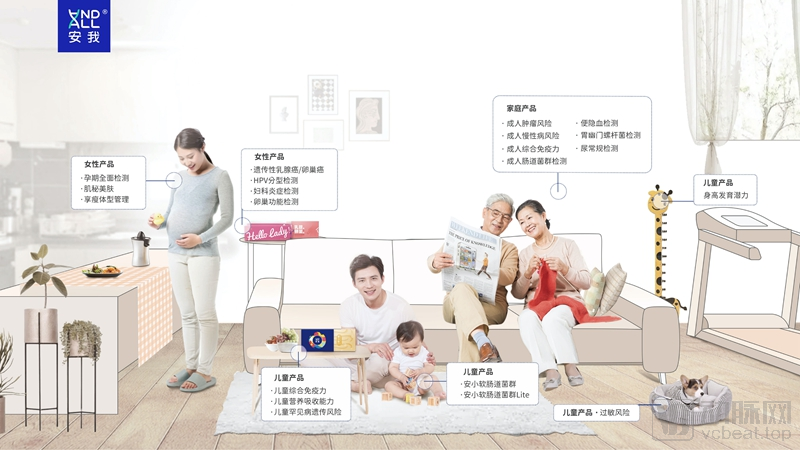
Going forward, the company will continue to launch new products centered on health management needs in home settings. “We will essentially engage in any testing services that are suitable for home use and can create value for users.”The company is expected to launch more than 10 home-based health testing products by the end of this year.
Since its establishment in 2018, Anwo Health has grown to serve millions of users, but its journey has not been without challenges. The biggest hurdle has been market education, as both the genetic testing and at-home health testing markets remain immature. Companies need to invest heavily in educating the market, reaching out to more users, and addressing their distrust of at-home testing products.
Wu Jian stated that staying indoors became the norm during the pandemic, driving subtle shifts in user behavior and heightened health management awareness. Meanwhile, given the cumbersome and time-consuming nature of medical consultation processes in China, users are increasingly accepting convenient at-home testing methods. Driven by these factors, the home health testing market is gradually heating up, with a major boom being only a matter of time.
“With changing patient consultation habits and heightened health management awareness, now is the optimal time to tap into the home-based health testing market, which has the potential to rival the pregnancy test kit market in the future.”
Wu Jian also noted that technological advancement is a prerequisite for the maturation of the home health testing market. Issues such as how to develop more user-friendly home testing tools (e.g., by simplifying blood sampling methods and procedures) and how to achieve integrated health data management remain worthy of consideration by enterprises.
In the future, Anwo Health will closely follow the emerging trends in at-home health testing, focusing on addressing existing market pain points to build a comprehensive system of at-home testing products and services. By providing users with simple, professional, and accurate testing solutions, we aim to bring a wider range of testing options into the home setting.
Meanwhile, after receiving the test results, users can access expert-provided guidance and recommendations to facilitate interventions for subsequent health management. Wu Jian stated that, subsequently,Anwo Health will integrate channels such as family doctors, internet healthcare, insurance, assistive living products, and nutritional supplements, providing users with a one-stop home health management service alongside home testing products.