

Baidu Lingyi Zhihui Brings AI to Grassroots Healthcare: Two Pathways and Three Key Strategies
Located in the northeast of Beijing, the Mafang Community Health Service Center in Pinggu District does not boast the well-distributed tertiary hospitals found in urban areas, nor does it have top-tier medical experts providing on-site diagnosis and treatment. Nevertheless, for local residents, the community health service center remains their primary choice for accessing daily medical care.
“Our average daily outpatient volume exceeds 300 patients. The number increases toward the end of the year when patients come to collect medications, but due to limited staffing, the hospital is often overwhelmed. Therefore, we have designed a comprehensive medication-prescribing workflow involving a three-person team comprising a physician, a nurse, and a preventive care specialist. Each member performs their specific duties to improve efficiency and enable more patients to access medical care,” a doctor at Mafang told VCBeat. “As the first choice for medical care among residents of Pinggu District, we strive to deliver high-quality services.”
Nodes on the outermost periphery of the medical institution network, such as Mafang, are found throughout China. With the implementation of the tiered diagnosis and treatment system, an increasing number of functions are being decentralized from tertiary Grade A hospitals at the network’s core to the periphery. As a result, primary healthcare is assuming a more significant role within the overall medical system, while also encountering numerous challenges previously unexperienced.
As described in the "impossible trinity" model of healthcare, it is difficult to simultaneously improve healthcare quality, increase access to medical services, and reduce healthcare costs. To implement the tiered diagnosis and treatment policy, it is essential to address the challenge of structural imbalance in medical resources and strengthen the capacity for initial consultations at the primary care level. Therefore, to effectively fulfill their role as gatekeepers of healthcare services, primary healthcare institutions may require assistance from third-party forces.
In October 2019, to address challenges in primary healthcare and accelerate the informatization and intelligent transformation of grassroots medical services, the Pinggu District Health Commission joined forces with numerous internet and information technology enterprises to establish the “Joint R&D and Application Center for Health Informatization.” Baidu served as one of the core enabling partners.

Baidu’s Lingyi Zhihui “Ai Zhu Yi” integrated solution for primary healthcare leverages health informatics at the grassroots level to enhance service accessibility by strengthening primary care capabilities and interoperability; improves diagnostic and treatment efficiency through intelligent workflows; and controls medical costs via comprehensive, real-time monitoring and analysis of medical services, thereby addressing, to some extent, the three challenges described in the “impossible trinity” of healthcare. Its capabilities can be broadly categorized into four areas.
First is the provision of medical knowledge services. For over 900,000 primary healthcare institutions, such as the Mafang Community Health Service Center, physicians’ accumulation of medical knowledge and expertise is relatively limited. They often rely on personal experience to make diagnostic decisions, lacking access to authoritative mentors for error correction and teaching. From this perspective, Baidu Smart Healthcare has partnered with the People’s Medical Publishing House to leverage highly automated knowledge production tools, launching an authoritative, professional, and evidence-based medical knowledge system. Physicians can access this knowledge base in real time during consultations, enabling “learning while diagnosing.”
Next is the Clinical Decision Support System (CDSS), which can address quality and efficiency issues in primary healthcare. To this end, Baidu pioneered an evidence-based AI technology framework that combines black-box and white-box AI algorithms. Driven by big data and medical knowledge, the algorithms provide scenario-specific, dynamic recommendations for various stages of the diagnosis and treatment process, such as disease diagnosis and prescription ordering. This approach assists in improving the efficiency of primary care while minimizing disruption to physicians, thereby reducing medical risks.
Next is the intelligent follow-up service. As early as 2016, various national ministries and commissions attempted to promote family doctor contract services to manage patient care and extend medical services to post-discharge follow-ups. However, due to limitations in medical resources, this policy failed to achieve its intended impact for a long time. Against this backdrop, Baidu launched an intelligent robot equipped with professional medical knowledge and voice interaction capabilities. This system can automatically broadcast health education content, autonomously collect and interpret patient condition data, and provide automated responses to predefined patient inquiries. Its purpose is to assist primary care physicians in more efficiently conducting post-diagnosis disease tracking, doctor-patient communication, chronic disease management, and health education.
The development of public health and epidemic prevention systems is a key focus of China’s next phase of primary healthcare infrastructure construction, and it also constitutes the fourth module of Baidu Health Cloud’s “Ai Zhu Yi” (Smart Medical Assistance) platform. Huang Yan, Vice President of Baidu Intelligent Cloud and General Manager of its Smart Healthcare Division, told VCBeat: “In the post-pandemic era, the significance of regional health supervision has become even more prominent. To meet this demand, Lingyi Zhihui’s ‘Ai Zhu Yi’ has built a comprehensive medical and health data warehouse by integrating in-hospital clinical data with out-of-hospital resident health data. Through a comprehensive, visualized data display and analytical decision-making platform, it provides real-time insights into core metrics such as medical record quality, diagnostic accuracy, and medication appropriateness, thereby enabling analysis of healthcare quality and potential risks. Furthermore, the Regional Health Cockpit plays an undeniably significant role in predicting disease trends, issuing early warnings for infectious diseases, and supporting prevention and control efforts.”
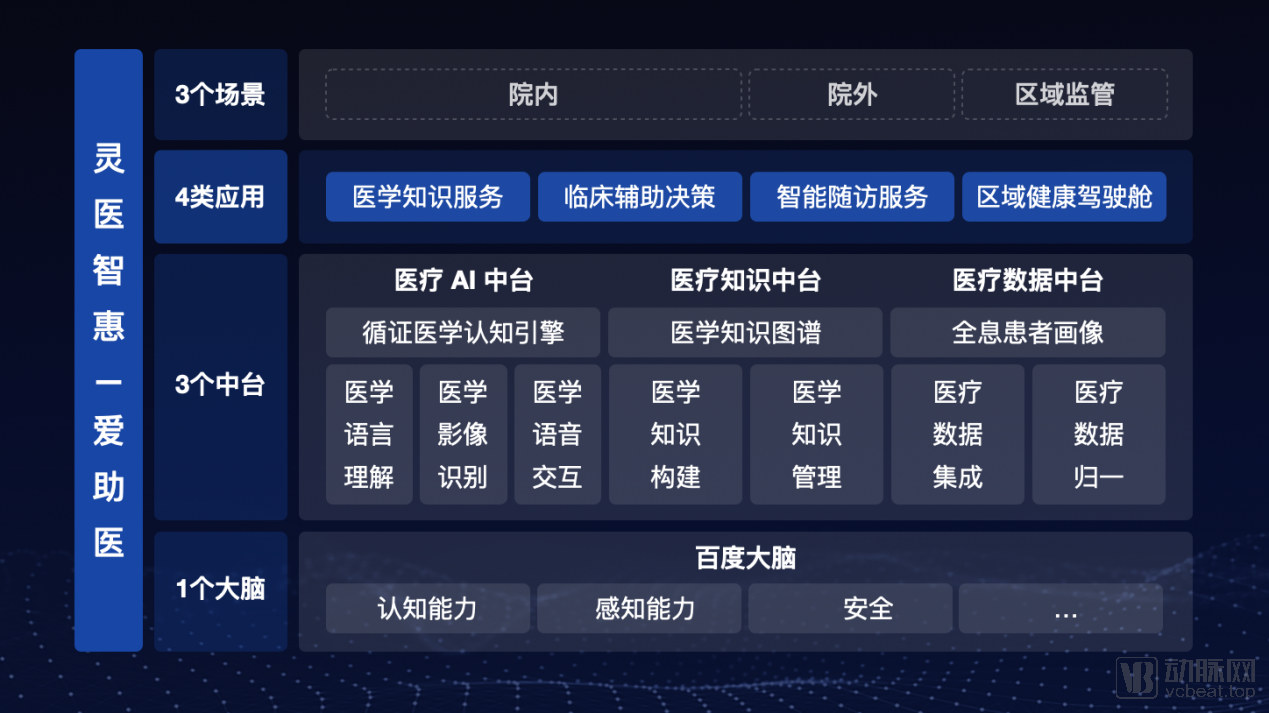
(Lingyi Zhihui "Ai Zhuyi" Solution Overall Architecture)
The synergy across the aforementioned four areas is attributable to the top-level architecture designed by Baidu for the healthcare sector. In fact, the realization of value by Lingyi Zhihui’s “Ai Zhuyi” platform relies on the support of Baidu Brain 6.0, which encompasses three major middle-platform capabilities: the Medical AI Middle Platform, the Medical Knowledge Middle Platform, and the Medical Data Middle Platform. These capabilities constitute a competitive barrier that is difficult for other enterprises to surpass.
The commercial viability of AI products determines their sustainability; therefore, even with Baidu’s backing, Lingyi Zhihui’s “Ai Zhuyi” must truly integrate into healthcare settings and achieve deep alignment with hospital workflows.
The key lies in two aspects: first, product design that aligns with hospital needs; second, the capability to implement solutions after the tendering process is completed.
During the implementation of informatics applications in hospitals, a myriad of issues have emerged, such as inadequate IT infrastructure and difficulties in integrating Hospital Information Systems (HIS) with Electronic Medical Record (EMR) systems. Any single issue has the potential to hinder the final delivery of the application.
“Given the particularly poor state of information infrastructure in medical institutions, we positioned ourselves as both an IT solutions provider and an AI healthcare vendor, delivering comprehensive, turnkey solutions to minimize implementation barriers. However, this model has proven overly idealistic,” Huang Yan told VCBeat.
“Many healthcare institutions operate information systems from multiple vendors. Issues with the systems, workflows, and user habits often prevent us from directly embedding AI products into these environments. In such cases, we must work with each enterprise individually to establish interface integration.”
Over the past two years, Lingyi Zhihui has adopted a steady and pragmatic approach, diligently collaborating with various vendors to gradually establish cooperative relationships. “Whether it is nationwide enterprises such as Neusoft, Haitai, Yixin, and Yihui, or smaller regional health IT vendors, we have established long-term, close partnerships with them. To date, we have completed interface integration with the majority of health IT vendors across China, laying a solid foundation for the hospital adoption of Lingyi Zhihui’s products.”
In less than two years, Lingyi Zhihui has been deployed in over 1,500 primary healthcare institutions across 27 provinces and municipalities, serving tens of thousands of physicians and providing AI-powered medical services to more than 10 million patients. Few companies can match Baidu’s speed in the implementation of informatization applications. Huang Yan attributes this success to two key factors.

First is the recruitment of medical talent. “For an internet company to excel in healthcare, a crucial step is a shift in mindset. The internet industry is ‘fast,’ while the healthcare industry is ‘slow’; knowledge in the internet sector evolves rapidly, whereas medical knowledge requires accumulation before iteration. To adapt to these differences, we have established a team of medical experts led by chief physicians formerly from Grade 3A hospitals. This team maintains ongoing communication with our R&D, operations, sales, and product staff to facilitate a transformation in overall project thinking and position Lingyi Zhihui as a company capable of gaining deep insights into the changes and needs of the healthcare industry,” Huang Yan told VCBeat.
Second, the formulation of AI and its development strategy. “What resources should we select? How should we utilize these resources? What kind of ecosystem should we build? These are questions we must consider before taking action, as they are critical to the strategic development of Lingyi Zhihui. After careful deliberation, we have distilled the core of our AI development into three key points:
First is knowledge. The publication of medical industry knowledge possesses near-monopoly characteristics, and knowledge forms the foundation of NLP;
Second, technology: evidence-based medicine requires interpretable AI algorithm technologies as support;
Third, integrate into the ecosystem. Rather than disrupting, overturning, or rebuilding the existing healthcare ecosystem, AI should embed itself within this medical ecosystem—comprising hospitals, physicians, government entities, knowledge publishers, and data operators—and forge extensive partnerships with stakeholders.
“Every enterprise can seek breakthroughs from these three aspects; however, to truly take off, companies must also rely on ‘hard power.’ For Lingyi Zhihui, artificial intelligence capabilities and internal ecosystem support are its trump cards for breaking through.”
To date, Lingyi Zhihui’s “Ai Zhuyi” product has undergone four iterations, but this is not the end of its development journey. “The healthcare environment is dynamically evolving, and we will adjust our future product roadmap in response to changes in policy and industry development. Regardless of these adjustments, meeting the needs of doctors and patients in primary care settings will always remain our top priority—this is the original mission that founded Lingyi Zhihui.”