

Maternal and Child Health Enters the Era of 'True Service': Public Medical Institutions Face Critical Challenges

Weimai
Digital Health Service Platform Provider
In May, a maternal and child health hospital in Shaanxi Province laid off more than 40 medical staff members at once, sparking public concern. As an established tertiary-care institution, the hospital’s “aggressive layoffs” were driven by specific circumstances. Facing severe operational challenges and a significant decline in overall business volume, the hospital had little choice but to resort to workforce reductions.
Maternal and child health care institutions are a distinct category of healthcare facilities with Chinese characteristics, integrating prevention and treatment. As public medical institutions established by the government, they provide continuous, comprehensive, and compassionate health services for women and children. By 2018, there were 3,080 maternal and child health care institutions, 807 obstetrics hospitals, and 129 children’s hospitals nationwide, employing nearly 640,000 staff members. These institutions handled 400 million outpatient visits and 13.79 million hospital admissions annually, with a total of 338,000 beds.
In the Face of Major Healthcare Reform, Public Hospital Performance Appraisal, and the Upgrading of Maternal and Child Health Services: Where Should Specialized Maternal and Child Health Institutions Head?
“The target patient population is increasingly dominated by individuals born in the 1980s and 1990s, who demonstrate heightened awareness of health, safety, and privacy, and impose higher standards on the quality and environment of inpatient childbirth, maternal care, and child healthcare services.” As experts in health economics have pointed out with precision, amid changing times and a shifting demographic profile, service delivery capability will be the cornerstone of survival for specialized maternal and child healthcare institutions.
Overall, the shift in maternal and child health work from “ensuring survival” to “promoting development” has become an irreversible trend, with the sector now entering the era of “genuine service.”
General Secretary Xi Jinping has stated that the people’s aspiration for a better life is our goal, and he emphasized at the 2016 National Conference on Health and Wellness that attention must be paid to the health of key populations, with safeguards for maternal and child health. Efforts in maternal and child health strive to meet the demands of the times and the expectations of the people,On the premise of fully ensuring maternal and infant safety, strengthen the integration of policy and service resources, and actively promote full-process maternal and child health services.
The Report on the Development of Maternal and Child Health in China (2019) points out that China, as the world’s largest developing country, has the largest population of women and children globally,Comprehensive protection of maternal and child health still faces many challenges, such as unbalanced development and inadequate services,It still fails to meet the growing health needs of women and children. The goal should be to satisfy their aspirations for a better life,Innovate Service Concepts, Expand Service Connotations, and Enhance Service Functions, to achieve comprehensive, full-cycle health protection for women and children, promote their all-around development, and drive overall social progress.
“We also know that maternal and child health services need to be improved, but we are only given targets without a roadmap on how to do it.” Lacking funding, experience, and modern concepts, healthcare institutions often find themselves at a loss when faced with the significant responsibility of improving maternal and child health services.
On the other hand, “service capacity” has become a core mission for specialized maternal and child health medical institutions. The Measures for Performance Evaluation of Maternal and Child Health Institutions specifically highlight the construction and enhancement of “service capacity.” Providing high-quality healthcare services is the central mandate of these institutions, and their effectiveness in improving medical services will be assessed through a range of indicators.
Constrained by systemic and mechanistic issues, truly adopting a patient-centered approach, implementing full lifecycle and whole-course disease management, and improving medical and health services are not the strong suits of public hospitals.
“Improving healthcare services is by no means limited to providing toilet paper in restrooms or hot water in outpatient lobbies; rather, it entails delivering care that genuinely addresses patients’ needs and yields tangible health benefits.” Some medical professionals have pointed out that efforts to improve healthcare services should not be undertaken in a rushed, bandwagon manner, and vigilance is needed against “superficial improvements.”
“In the post-pandemic era, infectious diseases, critical care, and public health will become key areas of focus.” From October 17 to 18, the National Conference on the Development of Smart Maternal and Child Health Institutions was held in Hangzhou. The head of a large public maternal and child healthcare group issued a “warning,” stating that maternal and child healthcare institutions must rapidly transform and evolve to survive.
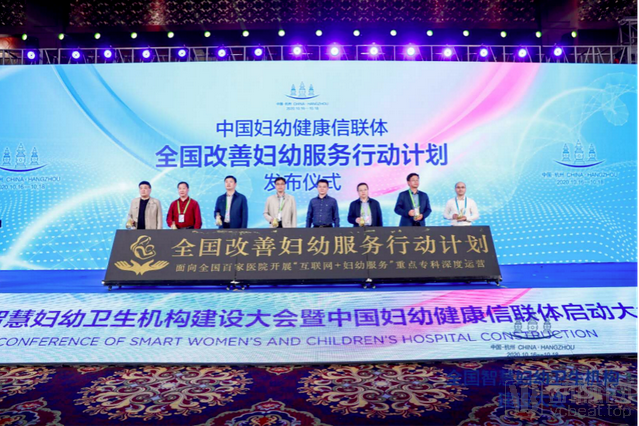
At the conference, the China Maternal and Child Health Information Alliance, the Medical and Health Industry Branch of the China Information Association, and Weimai jointly launched the “National Action Plan for Improving Maternal and Child Health Services” for maternal and child health institutions across China. The plan aims to guide and assist maternal and child health hospitals in leveraging “Internet+” technologies to enrich service offerings and develop specialized innovative services. By optimizing existing resources (“enhancing stock”) while expanding new growth areas (“increasing increment”), the initiative seeks to create additional service value for hospitals and physicians, thereby improving the proportion of service-based revenue in hospital income.
Eight Major Initiatives
1. Establish a smart maternal and child healthcare system based on convenient medical services
2. Centered on the maternal population, provide integrated maternity care services
3. Ensuring Peace of Mind During Postpartum Home Confinement Through In-Home Medical and Nursing Services
4. Extend postpartum management to optimize postpartum rehabilitation services
5. Provide professional abortion care services with a humanistic approach
6. Expand the Scope of Child Healthcare Services with the Goal of Promoting Healthy Growth
7. Promote scientific preconception care for eugenics and healthy childbirth, and enhance the quality of reproductive health services
8. Reduce the incidence of cervical and breast cancer in women, and expand the breadth and depth of screening and follow-up examinations
At the launch ceremony, Cao Yingzhe, Partner and Vice President of Weimai, stated: “The National Action Plan for Improving Maternal and Child Health Services” will initially collaborate with 100 hospitals across China, providing free assistance to these partner institutions in establishing a comprehensive, refined management service system based on the “Internet + Maternal and Child Health” model. This initiative aims to deeply integrate in-hospital and out-of-hospital care, as well as online and offline services, thereby comprehensively enhancing the quality and content of hospital services and improving satisfaction among both healthcare providers and patients. Leveraging its deep understanding of clinical workflows, application of new technologies and methods, and professional local operational teams, Weimai designs and plans an interconnected suite of full-cycle services tailored to the unique periodicity and continuity of maternal and child health needs. Starting with prenatal care as the entry point, this approach effectively drives growth in obstetrics-related gynecology, pediatrics, and child healthcare services.
Song Xin, President of the Medical and Health Industry Branch of the China Information Association, stated that the action plan will help maternal and child health hospitals across China optimize service processes, expand high-quality service offerings, and improve the quality of care through new technologies and methods. This initiative aims to better meet users’ personalized and multi-level service needs, thereby enhancing the healthcare experience for pregnant women, mothers, and children.
Through years of collaborative innovation with numerous public hospitals, Weimai has continuously upgraded its patient-centric service pathways, reconfiguring current medical resources and service scenarios. This approach is delivering services better tailored to the needs of today’s maternal and child health population, while significantly empowering hospitals to enhance quality and improve efficiency.
Practice has shown that once partner hospitals from Weimai’s previous collaborations enter a stable operational phase, Weimai’s refined whole-disease management and operational system can drive direct growth in patient services and boost business performance across related in-hospital departments, while also yielding a significant increase in physicians’ reasonable online income.