

Soyoung Launches 'Public Welfare Rescue' Initiative to Combat Unlicensed Medical Aesthetics and Build a Consumer Protection Barrier
The pursuit of beauty is human nature; everyone desires an attractive appearance to complement their talents, especially now that medical aesthetics are as accessible as a therapeutic massage. As the saying goes, “Thirty percent is determined by fate, seventy percent by hard work.” In today’s era of the rising “beauty economy,” many young people might revise this adage to read: “Thirty percent is determined by fate, seventy percent by hard work, and ninety percent by looks.”
The surge in medical aesthetics has earned it the title of the “fifth major consumer hotspot,” following real estate, automobiles, electronics and telecommunications, and tourism. In an era that emphasizes “beauty,” medical aesthetics has been endowed with greater value.
When we saw 33-year-old Luo Li again, her face was radiant with a confident smile—a stark contrast to her mental state just two months prior. At that time, she was a victim of illegal cosmetic procedures who had written in the registration portal for New Oxygen’s public welfare assistance program: “33 years old, unmarried and childless, with no expectation of having children of my own.” Born with a cleft lip and later suffering from L-shaped implant shrinkage due to botched black-market cosmetic surgery, she jokingly referred to herself as a girl chosen by God to be forever deprived of beauty. In reality, she had delicate features and was a girl who grew more attractive the longer one looked at her. She owned many beautiful clothes, but only ventured out at night to walk her dog.

(Pictured: Luo Li, a victim of illegal aesthetic medicine practices)
In the first public welfare aid project for repairing damage from illegal cosmetic procedures initiated by New Oxygen in China, Luo Li was among the selected recipients. She underwent nasal and oral reconstructive surgery in early September and is set to walk the red carpet at the ELLE Style Awards alongside 80 celebrities.
Luo Li was fortunate. According to statistics from the "China Medical Aesthetics Industry Insight Report," 100,000 people in China suffer from illegal medical aesthetic practices like Luo Li each year. This phenomenon stems from the explosive growth of the medical aesthetics industry, which has attracted an increasing number of unqualified individuals to establish medical aesthetic institutions. Consequently, chaotic practices have proliferated, including non-medical facilities performing medical aesthetic treatments, practitioners operating without formal training, and the use of substandard medical aesthetic products, leading to a rampant crisis of illegal medical aesthetics.
According to statistics from the Chinese Association of Plastics and Aesthetics, there were as many as 20,000 complaints regarding disfigurement caused by medical aesthetic procedures in 2019. The existence of illegal medical aesthetic practices not only harms the interests of individuals seeking cosmetic improvements but also exacerbates the crisis of trust within the entire industry.
In 2020, China's medical aesthetics market reached a substantial size of RMB 250 billion, ranking second globally. Amidst this vast market, how can we promote the positive development of the medical aesthetics industry?
Upon examining the pain points underlying the industry, we find that three levels can be specifically analyzed.
First, the current situation of illegal medical aesthetics is severe. The 2020 "White Paper on Insights into China's Medical Aesthetics Industry" reveals that the domestic medical aesthetics market is plagued by prominent "Five Black" phenomena: illegal medical aesthetics practices, unlicensed institutions, unqualified practitioners, unauthorized venues, and counterfeit injectables. Illegal medical aesthetics operations continue to emerge endlessly, with only 12% of institutions in the industry conducting medical aesthetic procedures in a legal and compliant manner. Approximately 80% of medical aesthetics institutions in the market engage in varying degrees of illegal and non-compliant activities.
Many institutions engage in medical aesthetic diagnosis and treatment without obtaining the necessary operating licenses. These illegal, unregulated providers typically lack surgical suites that meet compliance standards; procedures are often performed in cramped spaces, sometimes cluttered with substantial debris. The air and environment are not effectively sanitized, and essential sterilization equipment and emergency medications are absent, posing a significant risk of infectious disease transmission. Even when drugs and medical devices are available, their sources are often unclear, and their quality is unguaranteed. Preoperative medical examinations are not conducted, and necessary emergency rescue facilities are not provided. Consequently, any intraoperative complications often result in severe harm.
At the product level, iResearch expert surveys indicate that only 33.3% of injectables circulating in the market are authentic, meaning that for every genuine injectable, at least two illicit ones are in circulation. These “black-market injectables” either contain prohibited substances such as carcinogens and hormones, or consist of ineffective products like physiological saline sold at exorbitant prices.
Second, most medical aesthetic institutions prioritize marketing over medical care. With the iterative development of media channels, marketing has become a key source of customer acquisition for these institutions. Many medical aesthetic clinics invest heavily in marketing, often exceeding their spending on actual medical services.
According to a report by iResearch, from the perspective of value distribution (cost structure) in medical aesthetic institutions, the majority of the value generated in the medical aesthetics industry is captured by channels and search platforms, accounting for 30%-50%; medical services and the procurement of pharmaceuticals and medical devices account for only 15%-25% and 10%-20%, respectively.
For many medical aesthetic institutions, customer acquisition and marketing costs are two to three times their medical service costs, which directly leads operators to seek higher profits by compressing expenses related to medical services and internal hospital management.
Third, there is significant disparity in medical qualifications and professional competence, coupled with an acute shortage of qualified physicians. Currently, there are approximately 17,000 compliant practitioners in China’s medical aesthetics industry, whereas the number of unlicensed practitioners exceeds 150,000—nearly nine times that of compliant physicians. “Black-market doctors” who perform medical aesthetic procedures without obtaining proper physician licensure are ubiquitous in the market. According to statistics from the Chinese Association of Plastics and Aesthetics (CAPA), the number of non-compliant “visiting surgeons” operating in violation of regulations within non-compliant medical aesthetic institutions approaches 5,000.
According to the ISAPS report, China ranks third globally in the number of plastic surgeons, but there is still a considerable gap compared with the United States and Brazil, which occupy the top two positions. The number of plastic surgeons in Brazil is more than twice that in China, while the figure in the United States is more than three times higher. In light of China’s large population and the substantial demand for medical aesthetic services, there remains a significant shortage of qualified plastic surgeons.
Medical aesthetics has long been categorized as consumer healthcare, and in the midst of near-frantic market competition, its medical nature is often downplayed. Statistics from the China Consumers Association show that complaints related to the medical aesthetics industry in China increased by more than 13-fold between 2015 and 2019. Jin Xing, CEO of New Oxygen Technology, pointed out, “Medical aesthetics is not consumption; it is still medicine.”

(Pictured: Jin Xing, CEO of So-Young)
A positive trend is that, after years of unregulated growth in the medical aesthetics industry, calls to “return to the essence of medicine” have grown increasingly loud in recent years. The industry is gradually reaching a consensus: only by returning to the core principles of medical practice can the medical aesthetics sector achieve more robust development.
Returning to the Essence of Healthcare Requires Regulatory Oversight and Collaborative Efforts. According to VCBeat, China first classified medical aesthetics as a Level I clinical specialty in 1994. Subsequently, it issued the Administrative Measures for Medical Aesthetic Services, institutional standards, and a tiered management catalog in 2002, 2008, and 2011, respectively. In 2014 and 2015, evaluation standards and detailed rules for medical aesthetic institutions were introduced. In 2017, seven ministries and commissions, including the former National Health and Family Planning Commission, launched a stringent crackdown on illegal medical aesthetic practices and established a “blacklist” system, prompting many regions across China to formulate corresponding local regulations.
In 2019, medical aesthetics policies continued to focus on industry rectification, with strengthened regulatory scrutiny of the qualifications of medical aesthetics institutions and practitioners. The sector also entered its “strictest ever” era for advertising. Under new regulations introduced in Shanghai, prohibited terms were specified down to concrete promotional phrases such as “face-slimming injections,” “skin booster injections,” and “Korean-style double eyelid surgery.”
In April 2020, the National Health Commission, in conjunction with the General Administration of Customs, the State Administration for Market Regulation, and five other departments, issued the “Notice on Further Strengthening Comprehensive Supervision and Law Enforcement in Medical Aesthetics,” which enhances regulatory oversight across four dimensions: self-management by medical aesthetic institutions, industry self-discipline, government supervision, and social supervision.
As can be seen from the above, medical aesthetics regulation has undergone 20 years of development, gradually becoming more refined and normalized, with its intensity continuing to deepen and expand.
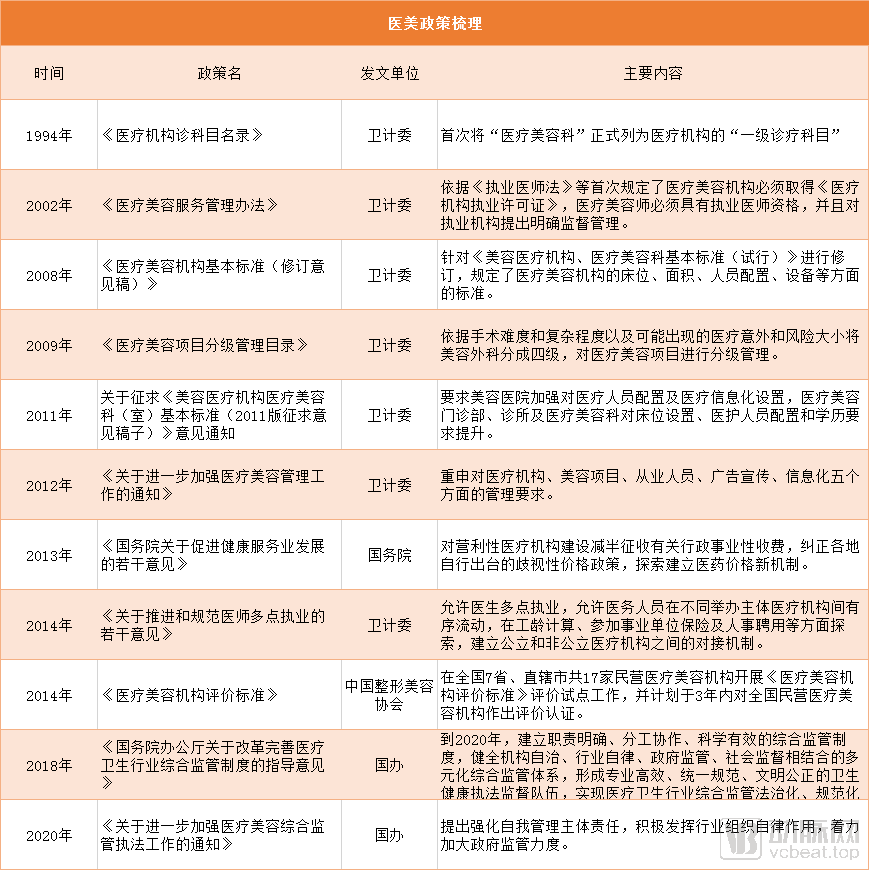
(Figure: Overview of Medical Aesthetics Policies, chart by VCBeat)
The Evolution of the Medical Aesthetics Industry: From Early Exploration and Unregulated Growth to Increasing RationalityOver the years, the medical aesthetics industry has progressed from early exploration through a phase of wild, unregulated growth to its current state of increasing rationality. While policy regulation has provided macro-level oversight, significant areas still require improvement. These include insufficient internal coordination, inadequate external collaboration, unclear legal applicability and industry standards, as well as frequent civil disputes coupled with ineffective remedies.
In particular, the rapid iteration of medical aesthetic services, coupled with lagging development of relevant laws and regulations, has rendered industry standards largely non-operational. Moreover, the significant risk of physical harm associated with medical aesthetic procedures has led to a year-on-year increase in civil disputes. Marked disparities in relief standards and measures across judicial administrative organs in different regions and at various levels have hindered the timely and effective protection of the legitimate rights and interests of the parties involved.
Regulatory Oversight Needs Improvement, and the Situation with Illegal Aesthetic Medicine Is Grave: Who Will Bear the Costs for Those Harmed by Illegal Aesthetic Procedures? Who Can Safeguard Their Rights and Interests? Who Can Offer Them Assistance?
Internet-based medical aesthetics emerged alongside the boom in the mobile market. The advent of internet medical aesthetics platforms has resolved the challenge of information asymmetry in the traditional medical aesthetics industry, addressing key pain points such as an opaque industry structure, low trust, non-transparent pricing, and high marketing costs. These platforms have established a closed-loop ecosystem connecting institutions, physicians, and patients, thereby improving the efficiency of resource allocation.
Internet-based medical aesthetics platforms undoubtedly play a significant role in the current landscape. As the first publicly traded company in the internet medical aesthetics sector, New Oxygen has placed great emphasis on combating irregularities in medical aesthetics consumption and services since its establishment in 2013, while actively promoting the positive development of the industry.
Since the beginning of this year, in addition to rolling out a series of platform governance measures, New Oxygen has also launched the industry’s first public welfare assistance project targeting victims of illegal aesthetic medicine. From a charitable perspective, the initiative aims to support and help those who have previously suffered from illegal aesthetic procedures to return to normal lives.
In the first phase of the project, New Oxygen donated RMB 10 million and joined forces with hundreds of renowned medical aesthetics experts to provide free reconstructive aesthetic treatments to victims of illegal cosmetic procedures across China, as well as patients with facial deformities caused by congenital conditions or accidental injuries. Within just one week of opening the registration channel, the public welfare initiative attracted attention from 420,000 individuals, with over 3,000 people logging into the application portal.
Shen Lin, who lost her nose in an accidental fall at the age of three, became the first beneficiary of the So-Young Public Welfare Assistance Program. With the support of this initiative, she regained the nose she had been missing for 43 years, ending decades of living in hiding and returning to a normal life. In addition to Shen Lin, Luo Li, mentioned earlier, was also a victim of illegal cosmetic procedures. Thanks to the public welfare program’s assistance, both women have reclaimed their “beauty.”
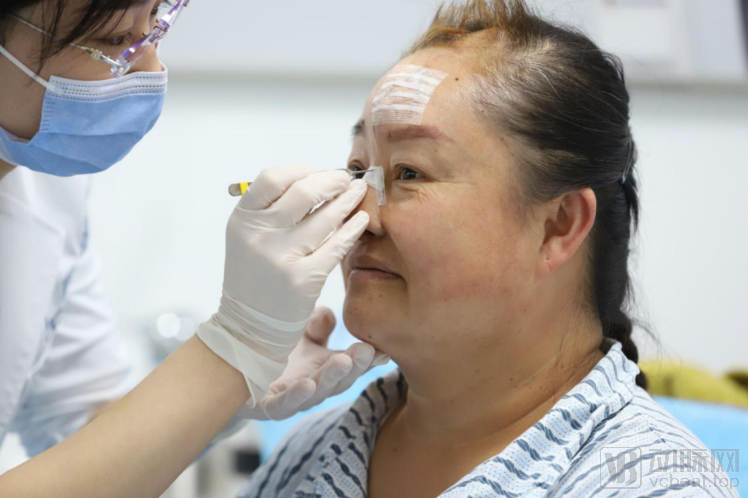
(The image shows Shen Lin, a victim of illegal aesthetic medicine practices)
Within the industry, the New Oxygen Public Welfare Assistance Project has garnered support from institutions and physicians. More than 150 medical aesthetic institutions across China have launched an initiative to support the New Oxygen Public Welfare Assistance Project, thereby extending the reach of this public welfare campaign to a broader population.
Guo Shuzhong, former chairman of the Plastic Surgery Branch of the Chinese Medical Association, has stated that the cost of aesthetic repair surgery is significantly higher than that of primary procedures. This is because the baseline conditions for re-operation are poorer, and the requirements for the lead surgeon are more stringent, leading to higher fees. Consequently, many individuals harmed by illegal aesthetic practices cannot afford the necessary corrective treatments. In light of this, collaborating with specialized hospitals and renowned experts in the field to help victims of illegal aesthetic medicine return to normal life represents another viable approach to combating such illicit practices.
We believe that the existence of public welfare initiatives in the medical aesthetics sector not only protects traumatized consumers and helps them regain confidence in life, but also raises awareness among a broader consumer base about the severe harms of illegal medical aesthetics practices. This heightened awareness enables consumers to make more rational decisions when selecting medical aesthetic services.
For the industry, medical aesthetics charity initiatives have guided the sector toward greater standardization, further improving and strengthening its infrastructure, and playing a significant role in promoting the industry’s development in an “upward, benevolent, and aesthetic” direction. From a broader societal perspective, these charitable efforts raise public awareness about illegal medical aesthetic practices and the vulnerable groups harmed by them, encouraging more institutions and individuals to participate in and support medical aesthetics charity, thereby contributing to the “purification” of the entire medical aesthetics ecosystem.