

Mezcare Pharma Advances Innovative PROTAC Bifunctional Molecules Targeting Undruggable Targets with IND-Enabling Pipeline
In the clinical development of targeted therapies, the underlying logic is to identify biomacromolecules (targets) closely associated with disease onset and progression, and to develop drugs that can block the function of these biomacromolecules, ultimately achieving a cure. While identifying pathogenic targets is relatively straightforward since diseases represent abnormal physiological states, the true barrier in innovative drug development lies in creating corresponding molecular drugs that effectively target these biomacromolecules.
In reality, only a very small fraction of “druggable” targets can be modulated by molecular drugs, while the remaining approximately 80% are considered “undruggable.” As a result, certain “druggable” targets have become a fiercely competitive red ocean for pharmaceutical companies. Firms in the same therapeutic areas are sequentially launching “me-better” or “best-in-class” new drugs and advancing them into clinical trials one after another. It is foreseeable that competition among these agents will be intense once they reach the market.
Why Are So Many Targets Difficult to Target for Drug Development?The reasons are multifaceted, such as the lack of binding pockets on targets that can directly participate in protein function regulation, and the difficulty in developing molecules with strong affinity for these targets. Therefore, if new drugs targeting these "undruggable" targets are successfully developed, they will not only benefit a large number of patients but also promote the development of new drug research technologies.
VCBeat (WeChat ID: vcbeat) recently came into contact with a biotechnology company specializing in the development of targeted drugs for traditionally “undruggable” targets—Shanghai Meizhi Pharmaceutical Technology Co., Ltd. (hereinafter referred to as “Meizhi Pharma”). The company aims to leverage revolutionary target protein degradation technology to develop drugs against traditional difficult-to-drug and undruggable targets.
Driven by a strong interest in new drug development, Shu Yongzhi, the founder of Meizhi Pharma, has consistently kept abreast of cutting-edge technologies in small-molecule drug research and development both domestically and internationally. In 2015, he began to focus on and investigate PROTAC technology, predicting its substantial growth potential in the future. At that time, there was not yet a single company in China dedicated specifically to the research and development of PROTAC technology.
Dr. Shu Yongzhi holds a Ph.D. in Biopharmaceuticals from Fudan University. He previously engaged in the R&D of innovative small-molecule anti-tumor drugs at the Shanghai Institute of Pharmaceutical Industry for many years and was among the earliest researchers in China to work on PROTAC-based novel drug development. In 2017, as PROTAC technology transitioned from academic research to clinical applications, pharmaceutical companies abroad began exploring its use in new drug discovery. Recognizing that the timing was ripe, Dr. Shu collaborated with several experts from renowned academic institutions to establish Meizhi Pharma, pioneering the R&D of innovative PROTAC therapeutics in China. Currently, Meizhi Pharma boasts multiple R&D pipelines, more than 10 patents on PROTAC technologies, and 7 PCT patents.
So, what exactly is PROTAC technology?
To discuss PROTAC (PROteolysis TArgeting Chimera) technology, one must first mention another term: ubiquitin (Ub). Israeli scientists Aaron Ciechanover and Avram Hershko, along with American scientist Irwin Rose, jointly discovered the ubiquitin-regulated protein degradation process, for which they were awarded the 2004 Nobel Prize in Chemistry.
Ubiquitin is a key factor in maintaining protein homeostasis; proteins tagged by ubiquitin are transported to the proteasome for degradation. PROTAC technology leverages the intracellular ubiquitin-proteasome system (UPS) to selectively eliminate denatured, mutated, or oncogenic proteins within cells, representing a novel targeted therapeutic approach.
PROTAC molecules consist of three components: a binder that targets the protein of interest, a binder that recruits the protein degradation machinery, and a linker connecting them, which can be vividly understood as a bifunctional small molecule.
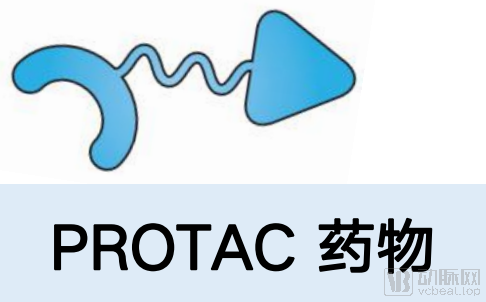
Schematic Diagram of PROTAC Molecules
Upon entering the cell, a PROTAC molecule binds to both the target protein and an E3 ubiquitin ligase at its respective ends, forming a “ternary complex.” Once this complex is assembled, the E3 ligase moiety of the PROTAC mediates the ubiquitination of the target protein by recruiting the E2 ubiquitin-conjugating enzyme. The polyubiquitinated target protein is then recognized and degraded by the proteasome, ultimately achieving the destruction of the disease-causing protein.
During this process, the target protein ligand does not need to occupy the binding site for an extended period, and PROTACs can undergo multiple cycles within cells, functioning similarly to a "biocatalyst."
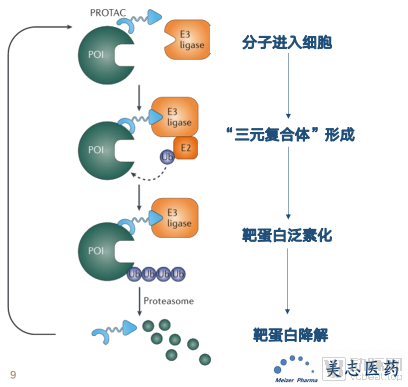
Schematic Diagram of PROTAC Molecule Mechanism
It is precisely based on this unique mechanism of action of PROTAC molecules that they are able to address many of the pain points associated with existing targeted anticancer drugs.
First, PROTAC drugs can address the issue of drug resistance in oncology: The primary cause of drug resistance is mutations in target proteins that reduce the affinity between traditional inhibitors and their targets, thereby failing to effectively inhibit target function and leading to patient drug tolerance. In contrast, PROTAC drugs degrade proteins through catalytic mechanisms, enabling efficient degradation of target proteins without requiring high binding affinity, thus holding promise for overcoming resistance associated with small-molecule inhibitors.
Second, PROTAC drugs can overcome the barriers associated with undruggable and difficult-to-drug targets: Currently, approximately 80% of targets remain “undruggable” or “difficult to drug,” a challenge that traditional small-molecule drugs struggle to address. Leveraging their catalytic properties, PROTACs bypass the need for high-affinity binding as a prerequisite for efficacy, directly engaging target proteins to induce efficient degradation, thereby addressing the challenges in developing therapies for undruggable and difficult-to-drug targets.
Dr. Shu introduced to VCBeat that, since its establishment in 2017, Meizhi Pharmaceutical, as one of the first companies in China engaged in PROTAC technology R&D, has built its own new drug development platform based on PROTAC technology and completed the layout of several core pipelines, covering multiple fields such as hematologic malignancies, prostate cancer, and breast cancer. Among them, the candidate drug MZ-001 for hematologic malignancies demonstrates significant in vitro and in vivo efficacy and favorable druggability. It is currently undergoing preclinical studies and is scheduled to complete its IND filing by the end of 2021.
In terms of financing, Meizhi Pharmaceutical received angel-round investment from the “Zefu” Fund, an innovation guidance fund of Minhang District, in 2019. The company’s new round of financing is currently underway, with the proceeds planned to be used for the Investigational New Drug (IND) applications of its core pipeline.