

Dongfang Qiyin Showcases OST-STAR Therapy Advancements at Harvard-Shenzhen Autism International Forum Ahead of IPO
Autism is characterized by a high incidence rate, poor prognosis, and unclear etiology. According to data released by the U.S. Centers for Disease Control and Prevention (CDC), the prevalence of autism among children under eight years of age in the United States is 1.69%. The total number of individuals with Autism Spectrum Disorder (ASD) nationwide exceeds five million. Overall, only a minority of cases are diagnosed before the age of three, while one-third to one-half of diagnoses occur in children aged six years and older.The diagnosis rate of autism is rising year by year due to broadened diagnostic criteria, increased public awareness, widespread use of screening tools, and a genuine increase in patients driven by biological factors.
Individuals with autism spectrum disorder often exhibit social impairments, restricted interests, and repetitive, stereotyped behaviors. Among them, autistic children with language impairments tend to have more severe social deficits and a poorer prognosis.The etiology of autism is linked to genetic factors, but environmental and immune exposures may also play a significant role.
According to statistical data, as early as 2015, the United States spent as much as $268 billion on children and adults with ASD. It is estimated that the lifetime total disease burden for each individual with ASD ranges from $1.4 million to $2.4 million.
It is precisely for these reasons that autism has become a current hotspot and priority in industry research. To promote communication and exchange among experts and scholars both domestically and internationally, and to raise awareness among parents of children with autism in China, as early as 2015, with the support of Shenzhen’s “Three Famous Projects” initiative in healthcare,Shenzhen Maternity and Child Healthcare Hospital has collaborated with the Autism Research Team at Massachusetts General Hospital, Harvard University, to facilitate industry exchanges on the latest research findings in the field of autism.
On October 24, the two-day 6th Harvard-Shenzhen International Summit on Autism, themed “Explore, Understand, Assist,” kicked off.
At this forum, experts from China and abroad presented some of the latest research advances in the field of autism. For example,Bruce Rosen, Member of the National Academy of MedicineShared advances in ASD brain imaging research, pointing out that structural abnormalities such as cortical thickness appear in infants with ASD as early as 6–12 months of age, which has predictive value for autism diagnosis. Anatomical changes may help patients achieve more accurate diagnoses and receive timely early intervention.Jacob Hooker, Professor of Radiology (Named Chair), Harvard Medical SchoolHis research team focused on the progression of neuroinflammation in ASD and highlighted the association between mitochondrial dysfunction and ASD.
Dr. Xuejun Kong, Massachusetts General Hospital, Harvard UniversityShared emerging pharmacological interventions and clinical trial progress in the field of autism, highlighting drug targets for core symptoms such as imbalance between excitatory and inhibitory neurotransmitters, synaptic dysfunction, neuroinflammation, the gut-brain axis, and genetic abnormalities. It also pointed out targeted medications, including memantine, bumetanide, oxytocin, and vasopressin, and reviewed their clinical research progress.
Dr. Marcy KingsburyShared research on gut microbiota in autism. Studies on the terminal small intestine and ileum in mice found that male offspring of pregnant mice exposed to air pollution and limited nesting space exhibited impaired social abilities and a lack of novelty in social preference. Current research focuses on whether restoring gut structure and gut microbiota can help ameliorate social behavior deficits.Drs. Panisi and Marini of ItalyIt is believed that environmental factors act as switches for autism-related genes, playing a significant role in the development of autism.
Professor Jian Kong, Massachusetts General Hospital, Harvard UniversityThis article introduces the brain regions with functional abnormalities in autism, as well as the current international research progress on transcranial magnetic stimulation, transcranial electrical stimulation, and vagus nerve stimulation for the treatment of autism. It also presents the relevant research findings from their team.
It is evident from the Harvard-Shenzhen International Summit on Autism that concentrated exploration in the field of autism has yielded numerous novel research advances, including studies on gut microbiota, emerging pharmacological interventions, neuroimaging, and treatments such as transcranial direct current stimulation (tDCS) and transcranial magnetic stimulation (TMS). These developments are poised to bring transformative changes to autism treatment.
Professionals attending the conference advocate for evidence-based therapies, among which is the STAR therapy.Dr. Joel Arick, Honorary Professor at Portland State University and founder of the STAR therapy, shared his insights at the conference,The STAR Autism Support program boasts 40 years of research expertise in the field of autism. It operates 2,500 campuses and institutions across the United States, Canada, Australia, and other regions, providing training and support services.The STAR Autism Support program has developed research-based curricula for preschool, elementary, and middle school students.
STAR has an exclusive partnership with Eastern Speech in China.In addition to localizing the STAR curriculum, Oriental Speech has opened nearly 40 centers, introduced foreign technical talent and training mentors, and established its own talent development system.Relevant experts are not merely course instructors, but also mentors providing case-based analysis and guidance. Oriental Speech has also established a comprehensive system encompassing assessment, progress monitoring, and individualized as well as group instruction, enabling long-term continuous follow-up for individuals with autism spectrum disorder.
The STAR therapy primarily involves five aspects, including the application of evidence-based practices, the importance of early intervention, appropriate treatment courses, sufficient intensity, family involvement, and parent training.Currently, this therapy has undergone peer review and continues to demonstrate its value and efficacy through evidence-based practice.For Dongfang Qiyin, key elements in the treatment of individuals with autistic tendencies include intervention for behavioral issues, guidance in language expression, enhancement of social skills, promotion of independence in daily activities, and the step-by-step construction of a knowledge system.
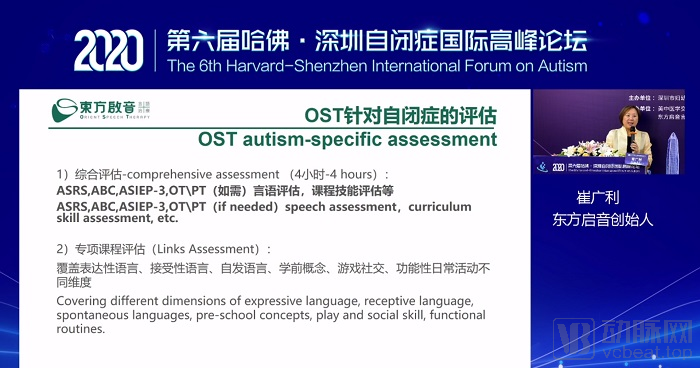
Comprehensive Assessment and Specialized Curriculum Evaluation for Autism by OST
Following the conference, we conducted a follow-up interview with Cui Guangli, founder of KnewSpeech. She stated,Currently, rehabilitation training and education remain the largest market segment in the field of autism treatment.Pharmacological and other therapeutic interventions play a supportive role in the treatment of autism. Furthermore, “I personally oppose electronic IT devices, as they cause children with autism to become addicted to them.”Our goal is to help them engage in social interactions, develop communication skills, and improve life skills, rather than achieving a perfect score in electronic products.”
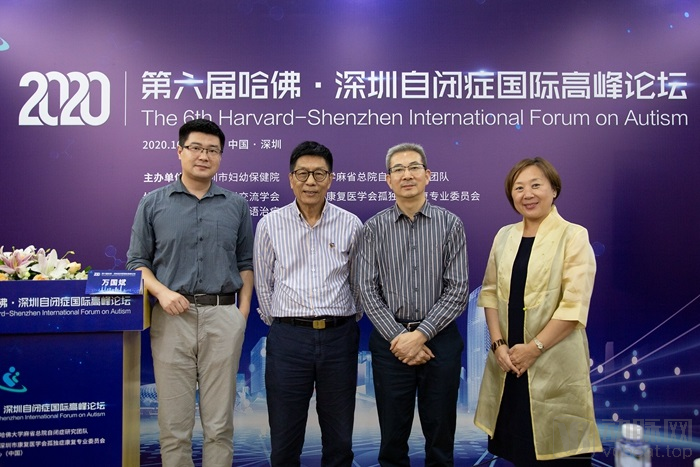 Group Photo: Cui Guangli, founder of OTO Speech, is on the far right.
When asked why speech therapy is so important in the treatment of autism, she stated that Oriental Speech has long provided rehabilitation training services to individuals with speech disorders, among which,Most patients with speech disorders are also autistic.“On the one hand,Autistic children with speech disorders often have cognitive understanding that lags behind their peers., learning tends to lag behind. Speech-language pathologists can help individuals with autism spectrum disorder improve their cognitive comprehension abilities. On the other hand,In expressive language, children with autism often show limited improvement in prognosis.Oriental Speech helps autistic children learn to express themselves through social speech therapists.Furthermore, children with autism face behavioral challenges., which can also be improved through social group sessions involving verbal expression.”
As a role that highly integrates rehabilitation medicine and pedagogy, speech-language pathologists play a crucial role in children's psychological well-being, behavioral development, and language acquisition. However,Although pediatricians are involved in the autism screening programs currently conducted by the Population Foundation and Maternal and Child Health Hospitals, speech-language pathologists are rarely seen participating in these initiatives.
Guided by the original intention of leveraging our strengths and contributing professional expertise,OSTO partners with the Chinese Medical Doctor Association to provide physicians with specialized professional training on autism—the Autism Specialized Training Program. Led by renowned experts in the field of autism from both China and abroad, the program covers the latest advances in the pathophysiology of autism spectrum disorder (ASD), new technologies for screening and assessment, recent progress in clinical diagnosis and treatment, and the latest developments in rehabilitation training.Participants can master diagnostic and therapeutic methods for autism spectrum disorder (ASD) through the training program, while also acquiring relevant knowledge about ASD. Upon completion, they will receive a training certificate from the Chinese Medical Doctor Association (serving as proof of professional competency), thereby enabling them to better serve individuals with ASD.
Cui Guangli believes that to address the current challenges in the field of autism treatment, universities should gradually introduce relevant professional courses and bring in external faculty for student education and training. Furthermore, the recognition of benchmark private institutions will further provide examples of clinical validation.Establishing standards through industry associations and leveraging government support to further integrate hospitals and other institutions into the standardization framework will better facilitate the overall development of the industry.