

Fourier Intelligence Secures RMB 100 Million Series C Funding Led by Vision Plus Capital to Accelerate Global Expansion and Smart Rehabilitation Ecosystem

Vision Capital
Technology Sector Investment Firm

Fourier
Intelligent Robot Developer
Fourier Intelligence, a leader in China’s intelligent rehabilitation industry, recently announced the completion of its C-round financing totaling RMB 100 million. The round was led by Vision Capital, with Qianhai Fund of Funds participating as a co-investor. The proceeds will be allocated to new product development, accelerating the enhancement of its core portfolio of rehabilitation robots, strengthening platforms across the upstream and downstream supply chain, and fostering the establishment of a comprehensive rehabilitation ecosystem.
Fourier Intelligence, established in 2015, is dedicated to the research, development, and industrialization of rehabilitation robots. Serving hospitals, communities, and patients' homes, it provides comprehensive solutions for the construction of a three-tier rehabilitation network and promotes the establishment of an intelligent rehabilitation ecosystem. Its vision is to make rehabilitation accessible to all through intelligent technology. Headquartered in Shanghai, the company has set up subsidiaries in Singapore, Malaysia, Guangzhou, and Zhuhai, with its business reaching globally. Fourier’s rehabilitation robot products have been deployed in more than 20 countries and over 1,000 institutions worldwide, delivering more than 400 million training sessions.
Vision Capital, established in 2015, is composed of experts from core positions at leading internet companies and senior investors from top-tier domestic venture capital firms. Since its inception, Vision Capital has invested in over 100 enterprises, with its investment portfolio spanning digital healthcare, new consumption, enterprise services, and frontier technologies. Tian Min, Partner at Vision Capital, stated, “In the past, China’s rehabilitation medical market was largely in a ‘dormant’ state. However, with the emergence of user demand and advancements in robotics technology, the industry has begun to ‘awaken,’ presenting significant growth potential. As a leader in the rehabilitation robotics sector, Fourier possesses strong core R&D capabilities and a diverse product lineup. Building on this foundation, Fourier has launched the ‘Intelligent Rehabilitation Port,’ a one-stop solution that extends from intelligent manufacturing of rehabilitation robots to rehabilitation medical services. This approach creates a closed-loop ecosystem across products, data, medical institutions, and users. Vision Capital remains firmly optimistic about Fourier’s growth trajectory in the rehabilitation healthcare sector.”
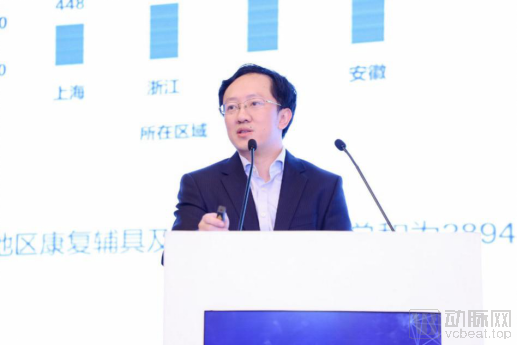
Image Caption: Gu Jie, Chairman of Fourier Intelligence
Gu Jie, Chairman of Fourier Intelligence, stated, “The advent of the digital and intelligent eras has made intelligent rehabilitation an emerging high-growth sector. Intelligence represents the prevailing trend in the development of the rehabilitation field, and the viability of Fourier Intelligence’s business model has been validated. This round of financing injects new momentum into the company. In the future, we will further iterate and replicate our model, entering a period of rapid growth to become an industry-driven platform enterprise, while continuing our efforts toward achieving the strategic goal of ‘rehabilitation services for all.’”
China has a massive base of patients requiring rehabilitation, yet corresponding rehabilitation resources are extremely scarce and severely unevenly distributed. There is a shortage of 300,000 rehabilitation therapists, whose professional competencies also need improvement. As rehabilitation therapy is highly labor-intensive, it is difficult to enhance efficiency. Existing rehabilitation departments are undergoing intelligent transformation and upgrading, while the primary-care rehabilitation market remains to be developed and established. Consequently, the market size of rehabilitation medicine is expected to exceed RMB 100 billion.
According to forecasts by the third-party consulting firm Grand View Research, the broad category of rehabilitation robots is expected to achieve a compound annual growth rate (CAGR) of approximately 37% over the next five years. Within this segment, rehabilitation robots are projected to grow at a CAGR of 21%, while exoskeleton robots are expected to surge at a CAGR of 47%, significantly outpacing the average growth rate of other categories of medical robots.
Confronting the supply-demand imbalance in the rehabilitation industry, which is valued at hundreds of billions, Fourier Intelligence has launched the “Intelligent Rehabilitation Port,” a one-stop solution. Centered on rehabilitation robots, this initiative fundamentally transforms the supply model, seizing the opportunity to deconstruct and reshape rehabilitation service paradigms, thereby establishing Fourier Intelligence as a leader and game-changer in the rehabilitation sector.
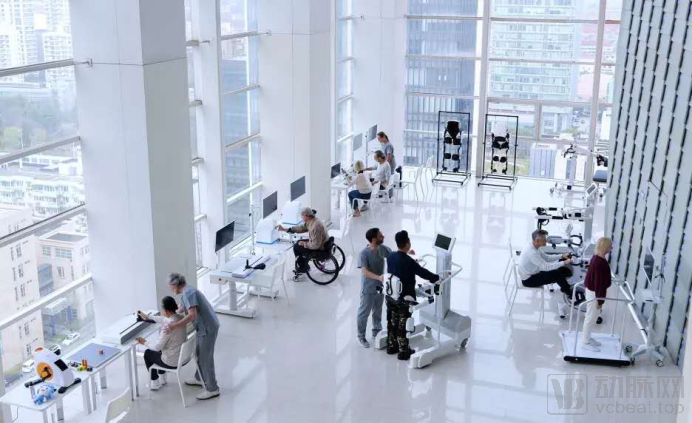
Image Caption: Fourier Intelligent Rehabilitation Hub
Fourier Intelligence centers on the “perception, processing, and response” framework of robotic intelligence. Leveraging globally leading force-feedback algorithms and high-performance motion control cards, it real-time monitors users’ movements, enabling rehabilitation robots to mimic the “force” applied by therapists’ hands and provide users with “just-right” rehabilitative assistance.
At the end of 2018, Fourier Intelligence introduced the concept of the “Intelligent Rehabilitation Port.” It has since established a comprehensive portfolio of intelligent rehabilitation products that cover various parts of the body and address nearly all rehabilitation needs, enabling data quantification. All products share a unified hardware and software architecture platform, integrating data from devices, users, and institutions to create an integrated, precision rehabilitation medical platform. This holistic intelligent rehabilitation solution drives the transformation of traditional rehabilitation medicine toward an information-based, standardized, and intelligent modern model, accelerating the development of rehabilitation departments.
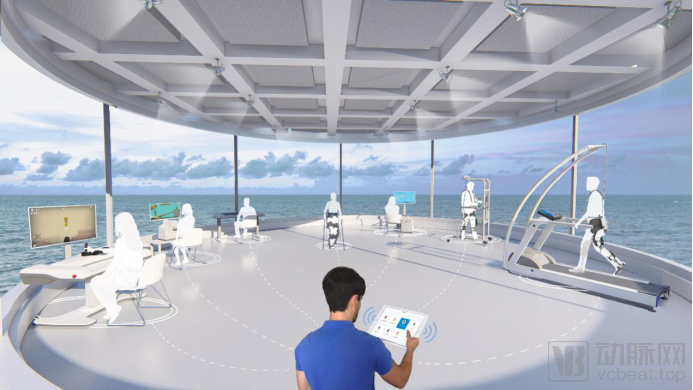
Breaking Through Personnel Efficiency Bottlenecks: By leveraging training scenarios created through the Intelligent Rehabilitation Hub, a single therapist can guide 5–10 patients in simultaneous rehabilitation sessions with robotic assistance. This approach overcomes the traditional reliance on intensive manual labor in rehabilitation, significantly enhancing both patient adherence and therapist productivity.
Restructuring Costs to Lower the Barrier to Entry: Thanks to technological innovations and the modularization of core components, Fourier Intelligence’s high-quality solutions offer significant cost advantages. This not only substantially lowers the procurement threshold for business clients but also paves the way for exploring the feasibility of consumer applications. Gu Jie stated that the future goal is to bring rehabilitation robots into ordinary households.
Intelligent Rehabilitation Prescriptions Enhance Rehabilitation Capabilities: By leveraging a shared hardware and software platform, training data from intelligent rehabilitation robots are collected to construct a deep learning network. Integrated with a recommendation engine, this system ultimately generates intelligent rehabilitation prescription recommendations. This constitutes the stroke knowledge graph research conducted in collaboration between Fourier Intelligence and Shanghai Ruijin Hospital. As an auxiliary tool for rehabilitation diagnosis and treatment, intelligent rehabilitation prescriptions will effectively optimize the quality of primary care rehabilitation services and improve service efficiency.
Fourier Intelligence adheres to a “going global” strategy, achieving remarkable results in expanding its global footprint. The company has established joint laboratories with the Shirley Ryan AbilityLab (ranked No. 1 in rehabilitation in the United States), the University of Melbourne, and ETH Zurich to collaboratively develop innovative robots and robotic control strategies, and to conduct translational research on rehabilitation robots and assistive technologies. Expanding overseas not only signifies that Chinese rehabilitation robotics technology is entering the mainstream global arena, but also reflects the company’s commitment to rapidly commercializing globally leading rehabilitation technologies and bringing them to market.
On the other hand, Fourier Intelligence has expanded its domestic reach by actively penetrating the grassroots market. It acquired Ruihe Kang Medical, a service provider for the construction of three-tier rehabilitation networks, and established the Ruihe Kang Physician Group to enhance resources across the intelligent rehabilitation industry chain. By delivering intelligent rehabilitation products and digital operational services, Fourier Intelligence empowers more primary healthcare institutions, providing patients with more scientific, precise, and effective rehabilitation treatments, thereby accelerating the nationwide implementation of the three-tier rehabilitation network. Ultimately, this enables Fourier Intelligence to transform from a product-focused R&D enterprise into an industry-driving platform company.
Fourier Intelligence’s Smart Rehabilitation Hub solution will enable the rapid replication and expansion of rehabilitation departments by standardizing clinical pathways, service capabilities, technologies, and prescription protocols. “Just as the adoption of central kitchens has enabled chain operations in the food and beverage industry, standardization in the rehabilitation sector will facilitate the widespread establishment of rehabilitation departments across China,” said Gu Jie. “Fourier’s future goal is to establish 50,000 to 100,000 rehabilitation institutions, benefiting 250 million elderly individuals and tens of millions of patients with injuries or chronic conditions, ultimately allowing them to access home-based rehabilitation care.”