

Leqin Health: A Rising Star in Dementia Care, Secures 3,000 Beds Within a Year of Launch
For a long time, China's elderly care service sector has been characterized by the following paradoxical situation:
On the one hand, the number of elderly care beds continues to grow steadily.According to civil affairs statistics, in the second quarter of 2020, there were a total of 35,814 elderly care institutions with 4,501,038 beds; the number of community-based elderly care beds was 3,418,269.The combined total number of beds for both reached 7,919,307.
On the other hand, the seemingly robust demand for elderly care has not truly surged.At the end of 2019, China’s population exceeded 1.4 billion, with 253.88 million people aged 60 and above, accounting for 18.1% of the total population. According to the Fourth National Sample Survey on the Living Conditions of Urban and Rural Elderly in China, as early as 2015, the number of disabled and semi-disabled elderly nationwide had reached 40.63 million, and the number of elderly individuals with cognitive impairment was nearly 10 million, with both figures continuing to rise. Even based on a figure of 50 million,If 20% of elderly individuals with disabilities, partial disabilities, or dementia were to move into nursing homes, the demand for long-term care beds would reach 10 million.However, observations indicate that the actual vacancy rate of elderly care beds is as high as 40%–50%.
Regarding the reasons behind this phenomenon, Cheng Zhifei, co-founder of Shanghai Leqin Health Management Co., Ltd. (hereinafter referred to as “Leqin Health”), believes that it is largely attributable toOverall service quality at elderly care institutions is average.Currently, there is a large number of small-scale elderly care institutions on the market that only provide services meeting basic daily needs. They remain significantly deficient in specialized and high-quality services. On the other hand, these small institutions themselves suffer from issues such as low operational efficiency, non-standardized management, and average staff competency. These factors prevent a large segment of the elderly population from accessing cost-effective, high-quality care.
In light of this, Leqin Health is committed to “enhancing the quality of life for the elderly” by actively developing specialized professional services tailored to seniors with dementia and disabilities.Currently, it is closely focusing on these two core demand groups, building a complete industrial chain ranging from institutional elderly care services to elderly care consulting and derivative products, continuously improving its operational efficiency, refining its service architecture and management system, and achieving rapid expansion and chain operations through the replication of standardized models.
Data show that the prevalence of dementia among individuals aged 65 and older is 5%; after age 65, the prevalence doubles with every five-year increase in age. China is projected to have 12.72 million people with dementia by 2020, and this figure is expected to rise to 18.95 million by 2030, accounting for approximately one-third of the global total.
Leqin Health estimates that the number of people with cognitive disorders in China has exceeded 10 million, while in the Shanghai market where the company operates, the number of patients may reach approximately 300,000.Most families have a strong willingness and need to send their elderly relatives with dementia to nursing homes. Driven by the aging trend and a clear understanding of the market, Leqin Health has actively engaged in this sector: targeting middle- to high-income groups with payment capacity, it provides elderly care services specializing in the care of patients with dementia.
Leqin Health only began operations in late November 2019, with its partners joining successively in late 2019 and the first quarter of 2020. Related business activities were formally launched thereafter. Most members of Leqin Health’s management team came from a well-known domestic elderly care brand that had previously held considerable influence in the industry. Leveraging the team’s inherent advantages and accumulated resources, Leqin Health secured its first project—the Shanghai Xuhui Jiukang Nursing Home, comprising approximately 200 beds—by the end of December 2019. Since then, it has continued to report frequent successes, gradually acquiring multiple high-quality projects in Shanghai and surrounding areas.
Currently,Leqin Health employs 200 staff members, operates and manages seven elderly care facility projects with a total of approximately 3,000 beds, and maintains an overall occupancy rate of around 50%.Of these, four projects have entered the operational phase, while the other three are in the planning or pre-opening stage; most of the key projects are located in Shanghai.
Leqin Health currently focuses its services on the operation of elderly care institutions.Leveraging its extensive operational management experience and mature management systems, the company primarily adopts an asset-light operational model by exporting its management expertise. It has established collaborations with numerous well-known state-owned enterprises, real estate developers, and directly with government entities, achieving mutual benefits for all parties involved.For enterprises new to the elderly care industry or lacking sufficient experience in elderly care management, Leqin Health also provides comprehensive consulting services, converting these clients into entrusted operation partners to deliver direct operational management services.
Leqin Health has also found that there is a lack of high-quality products in the market for elderly care-related services, such as products for elderly nursing and age-friendly products. In particular, there is a significant shortage of quality products that can be integrated with elderly care services.Leqin Health Plan collaborates with third-party companies to jointly develop and launch care-oriented products integrated with nursing services., including hand sanitizers and age-friendly bathing and skincare products; currently, the related projects are in the early stages of research and development and market promotion.
Leqin Health aims to establish an “A+B+N” comprehensive business model. Taking Shanghai as an example, the company plans to operate one or two integrated medical and elderly care facilities, complemented by nursing homes primarily serving seniors with dementia and disabilities, while actively extending its services into community-based and home-care settings to create a networked development structure.Leqin Health plans to cultivate the market in the future through community education and home-based guidance. As public understanding and awareness of dementia and disability care services gradually improve, it will be able to seamlessly integrate the business chain between institutional care and community-based home care.
Currently, its operational and expansion projects are primarily distributed in Shanghai and surrounding regions, including Fujian, Shandong, Jiangsu, and Zhejiang. Leqin Health aims to achieve chain-wide implementation through resource integration. By leveraging its directly operated projects, it seeks to build the Leqin brand and drive continuous upgrading and iteration of elderly care services; meanwhile, through entrusted operation and consulting service projects, it aims to facilitate rapid replication and growth.
Leqin Health has established specialized dementia care zones in all of its operational projects, currently offering approximately 600 dementia-specific beds, which account for 20% of the total. Among these,Building 4 of the Puhui Mingchuan Nursing Home in Pudong New Area, Shanghai, offers more than 140 beds and serves as its largest dementia care program., and it may also be one of the largest dedicated dementia care zones in Shanghai and even the entire Yangtze River Delta region to date. Leqin Health previously participated in the preliminary design and renovation of Building No. 4 at Puhui Mingchuan Nursing Home, integrating its years of operational service experience into the project. The facility is now operational.
LeQin Health’s competitive advantage lies in its profound understanding of dementia, with most team members having professional experience in the field of dementia care, andLeqin Health has established a comprehensive operational and service system centered on dementia care. This system integrates advanced service experience from the United Kingdom, Japan, Sweden, the Netherlands, and China's Taiwan region.and underwent localization. Drawing on the mature experience of overseas dementia care institutions, the project adopts a cluster-based design and comprises nine care units. Each unit has 16 beds, with each small unit functioning as a mini-cluster.
The first floor of the dementia care building features a rehabilitation training area spanning several hundred square meters, with activity spaces for elderly residents located in the center and on both sides of each unit. To encourage outdoor activity and reduce caregiving risks, private rooms are not equipped with en-suite bathrooms or household appliances. This design promotes greater participation in group activities, alleviates feelings of loneliness, and minimizes safety hazards.
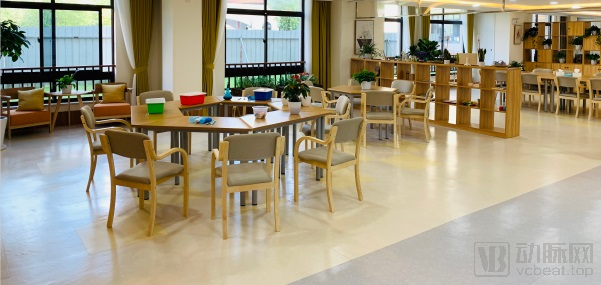
Rehabilitation Training Area, First Floor Lobby, Dementia Care Building, Puhui Mingchuan Nursing Home
Age-friendly design is evident throughout the project, with special features tailored for elderly individuals with dementia.The lobby is equipped with an access control system and a reading corner. The elevator area has been creatively designed as a nostalgia corner. The rehabilitation hall features various training equipment tailored for elderly individuals with dementia. Facilities such as the horticultural therapy zone, pet therapy zone, creative arts and crafts area, and five-senses training room are all available. In the living area, tactile walls and time orientation boards (which display time, date, and season through graphics and photographs to help residents with dementia recognize them) are installed. The social area allows residents to engage in social interactions at any time. Themed rooms, including Military Service, Old Shanghai, and Teacher styles, offer personalized decor for each resident. The care facility encourages residents and their families to bring personal belongings from home to create a familiar, warm, and comfortable living environment, helping residents adapt quickly while reducing anxiety and emotional fluctuations. Meanwhile, residents can access rehabilitation training promptly, regardless of their location within the facility.
Leqin Health has established a comprehensive service system spanning from assessment to case management and care.Comprehensive assessments, including baseline assessment, risk assessment, and personalized care needs assessment, are conducted both before and after an elderly resident’s admission.Prior to admission, LeQin Health’s staff will form a professional assessment team to collect basic information about the elderly resident and evaluate their physical condition, including physical function and activities of daily living (ADLs), while also providing specialized cognitive impairment assessments. Within the first two weeks of admission, further tracking and documentation of the resident’s living and health status will be conducted to complete risk assessments and personalized care needs assessments. A tailored individualized care plan (care case) will be developed within one month. Staff will implement care according to this plan and continuously update it dynamically.
Leqin Health adopts a unit-based care model, with a staff-to-resident ratio of 1:3. Each unit, comprising 16 elderly residents, is comprehensively cared for by a team of five caregivers and one nurse, who jointly manage all aspects of the residents’ daily lives.Unlike other elderly care institutions, staff within each unit are not assigned to provide fixed services to specific residents; instead, care aides and nurses work in close collaboration to deliver enhanced caregiving services.In addition, Leqin Health has also hired dedicated physicians to provide medical services, professional social workers to offer psychological counseling and recreational activities, and specialized customer service staff to interact and communicate with the families of the elderly, collecting their feedback and requests to continuously improve service quality.
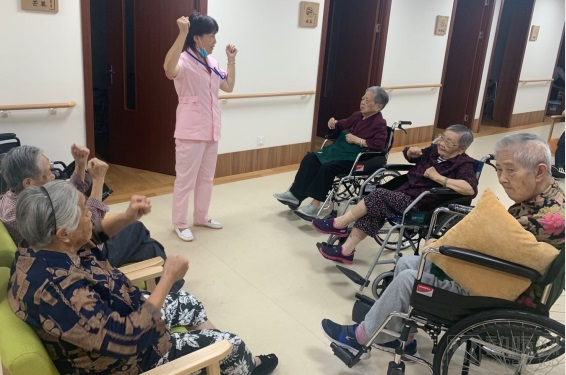
Under the guidance of caregivers, the elderly are practicing finger exercises.
To better serve its clients, Leqin Health is continuously innovating. In terms of activities for the elderly, it has launched the “Le Changzai” initiative to further enrich their later years. Regarding dietary care, the company encourages family members to engage in mealtime interactions with seniors and promotes the provision of personalized service menus tailored to their needs.
It is understood that,The specialized dementia care building at Puhui Mingchuan Nursing Home primarily serves elderly residents with Pudong household registration.Room types include single and double rooms, with monthly fees ranging from 5,000 to 8,000 RMB. This fee covers bed charges, nursing care, meals, and other expenses. Meal charges are typically fixed, while bed charges vary depending on room size and orientation. Nursing care fees encompass both disability care and dementia care costs. Leqin Health determines the final pricing based on assessments of the elderly resident’s activities of daily living (ADL) and the severity of cognitive impairment.
As the population ages and awareness of elderly care grows, an increasing number of enterprises are entering the senior care sector. Leqin Health, a “new yet established” player in the industry, plans to build on its existing projects by refining premium offerings, enhancing service quality, and developing a replicable business model. Meanwhile, Leqin Health will remain anchored in Shanghai, deepen its presence in key cities across the Yangtze River Delta, and gradually expand into East China and coastal regions.
Leqin Health is also actively seeking collaboration with industry peers to jointly pursue development, contribute to China’s elderly care sector, and strive continuously toward the goal of “enhancing the quality of life for the elderly population.”