

Simcere Pharmaceutical Group Reports Over RMB 3 Billion Annual Profit with 24.7% Market Share in Core Therapeutic Areas Ahead of Hong Kong IPO

Simcere
Innovative Drug Developer
Today, Jiangsu Simcere Pharmaceutical Co., Ltd. (abbreviated as Simcere; stock code: 02096) will officially list on the Hong Kong Stock Exchange at an issue price of HK$13.7 per share. The company is offering 260.6 million new shares globally, raising a total of HK$35.75 billion (approximately US$461 million). Following the IPO, the company’s total market capitalization will reach HK$291.3 billion.
However, in the grey market trading on October 23, Simcere’s shares fell by 18.39% to HK$11.18. As another pharmaceutical giant to list on the Hong Kong stock exchange, Simcere’s grey market performance may have disappointed investors, with those allocated shares likely facing losses today.
As early as 2007, Simcere became the first Chinese biopharmaceutical and chemical pharmaceutical company to list on the New York Stock Exchange, before going private in 2013. Following a complex and tumultuous delisting saga, Simcere’s relisting on the Hong Kong Stock Exchange with a renewed corporate identity has drawn significant attention from the industry.
Seven institutional investors, including Hillhouse Capital, Gaoxin (under Jiangbei Industrial Investment), Hongtu (under Shenzhen Capital Group), ClearPool Capital, OrbiMed, Ruizhi Capital, and Jericho Funds, have become cornerstone investors in Simcere Pharmaceutical, subscribing to US$50 million, US$40 million, HK$232.5 million, US$25 million, US$25 million, US$10 million, and US$10 million, respectively, for a total subscription of approximately US$190 million (approximately HK$1.473 billion).
Multiple Restructurings: Hony Capital and Fosun Continue to Increase Investments
Simcere, established in 1995, has undergone several restructurings and multiple changes in its equity structure over the course of 25 years of development.
The final shareholders of Simcere prior to its IPO include:Shangjia Limited、Huangjing Development、Fosun Industrial、Palace Investments、InnoPharma、CITIC Bank Hong KongandCITIC SPC. As Simcere has not publicly disclosed its financing rounds, we have briefly compiled the financing information of the aforementioned investors based on the company’s prospectus.(Note: The specific financing amount was not disclosed.)
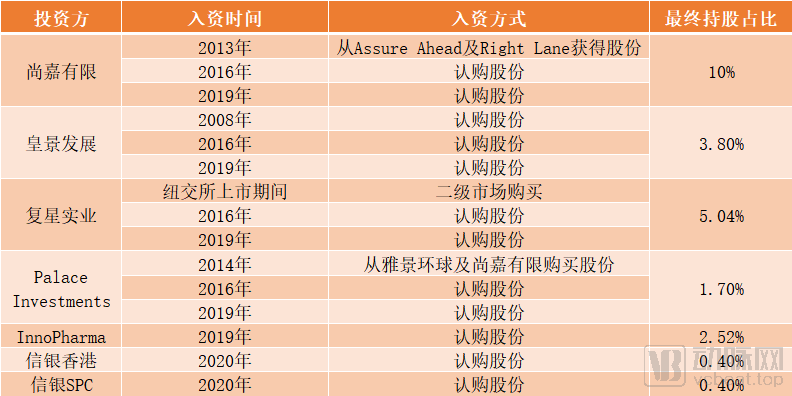
From several equity transactions and subscriptions of Simcere, we can see that Shangjia Limited is the shareholder with the largest direct or indirect shareholding in Simcere, with a shareholding ratio of 10%. Shangjia Limited was registered and established under the laws of the British Virgin Islands on April 11, 2011, and is backed by Hony Capital Fund (Hony Capital) holds an 82.22% equity interest.
An analysis of the timing of multiple capital injections from several investors reveals that Simcere primarily completed two large-scale financing rounds in 2016 and 2019. In 2016, during Simcere’s overseas restructuring phase, existing investors—Shangjia Limited, Huangjing Development, Fosun Industrial, and Palace Investments—all re-subscribed to varying equity stakes as part of this restructuring. In 2019, Simcere underwent another overseas restructuring, during which InnoPharma was introduced as a new investor alongside the existing shareholders.
InnoPharma is an investment firm established in 2019 specifically to invest in Simcere, with its wholly-owned holding company being Trustbridge Partners (Shanghai Trustbridge Partners), a private equity investment fund incorporated in the Cayman Islands, whose investors include globally renowned university endowments and sovereign wealth funds. Notably, the wholly-owned holding company behind Huangjing Development, an existing investor in Simcere, is also Shanghai ZhenCap.
On April 15, 2020, CITIC Bank International and CITIC SPC each purchased over 9.2 million shares of Simcere Pharmaceutical, becoming the last investors to enter prior to Simcere’s IPO on the Hong Kong Stock Exchange.
Relisted After Six Years of Privatization, with Average Annual Revenue Exceeding RMB 3.5 Billion
Simcere was founded by Ren Jinsheng in Nanjing, Jiangsu Province. At that time, the company was primarily engaged in the sales, marketing, and distribution of pharmaceutical products. The founder, Ren Jinsheng, serves as the Chairman of the Board, Executive Director, and CEO, and is primarily responsible for the company’s overall strategy, business operations, and making major business and operational decisions for the Group.
Mr. Ren Jinsheng boasts over 30 years of industry experience, with in-depth knowledge of the pharmaceutical sector and extensive management expertise. Prior to founding Simcere, he worked at Qidong Pharmaceutical Factory and Jiangsu Provincial Pharmaceutical Industry Co., Ltd. He also serves as Vice Chairman of the 9th Committee of the Jiangsu Association for Science and Technology and Vice President of the China Pharmaceutical Innovation Promotion Association.
After 25 years of development, Simcere has grown into a large pharmaceutical enterprise integrating drug R&D, manufacturing, and commercialization. While primarily engaged in the production of generic drugs, the company has been progressively increasing its investment in the research and development of innovative drugs. Nevertheless, the generic drug business remains its core source of revenue.
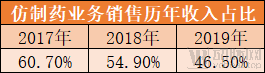
Simcere's Generic Drug Business Sales Proportion Declines Year by Year
From 2017, 2018, and 2019, as well as the six months ended June 30, 2020, the sales revenue from Simcere’s major generic drug products accounted for 60.7%, 54.9%, 46.5%, and 35.5% of its total revenue, respectively. The year-on-year decline in the proportion of its generic drug business reflects Simcere’s gradual increase in the share of its innovative drug operations.
Simcere’s innovative drug business has been strategically laid out since it acquired the controlling stake in Hainan Simcere in 2001. This acquisition enabled the Group to secure pharmaceutical production capabilities and begin independently establishing its innovative drug R&D team.
In 2003, Simcere further enriched its product portfolio and production capacity by establishing a postdoctoral research workstation;
In 2006, the company received strategic investment from Assure Ahead (a holding company of Hony Capital) and simultaneously acquired Shandong Simcere.
In 2007, the Company listed on the New York Stock Exchange, becoming the first biopharmaceutical and chemical pharmaceutical company from China to be listed on the NYSE.
In 2013, Simcere abruptly announced its delisting, with the company presenting a unified external stance that the decision was driven by commercial considerations and unrelated to other factors.
In March of that year, Simcere announced that it had received a takeover offer initiated by Ren Jinsheng, Chairman of the Board and CEO, New Good Management Limited, Assure Ahead Investments Limited, and their affiliated buyer consortium. A merger agreement was signed in August, and the merger was completed in December.
In 2014, Simcere underwent internal restructuring to further refine its strategic deployment;
In 2015, the Company was approved to establish the State Key Laboratory of Translational Medicine and Innovative Drug Development, and successfully registered in Hong Kong;
Innovation centers were established in Shanghai and Boston in 2018 and 2019, respectively.
Overall, after 25 years of development, Simcere has successively acquired four major subsidiaries and established three R&D centers in Nanjing (Jiangsu Province), Shanghai, and Boston (USA), as well as five GMP-certified pharmaceutical production bases, including one in Nanjing (Jiangsu Province), two in Hainan Province, one in Yantai (Shandong Province), and one in Wuhu (Anhui Province). The company currently boasts a team rich in highly qualified talent; among the 756 employees in its R&D department, 331 hold master’s degrees and 116 hold doctoral degrees.
“Combining Imitation and Innovation” to Diversify Moat Building; Market Share Exceeds 24% Across Three Major Segments
The Chinese pharmaceutical market has experienced rapid growth in recent years, with its market size increasing from RMB 1,220.7 billion in 2015 to RMB 1,633.0 billion in 2019, representing a compound annual growth rate (CAGR) of 7.5%. It is expected to continue growing at a CAGR of 6.8% from 2020 to 2024, reaching RMB 2,228.8 billion by 2024.
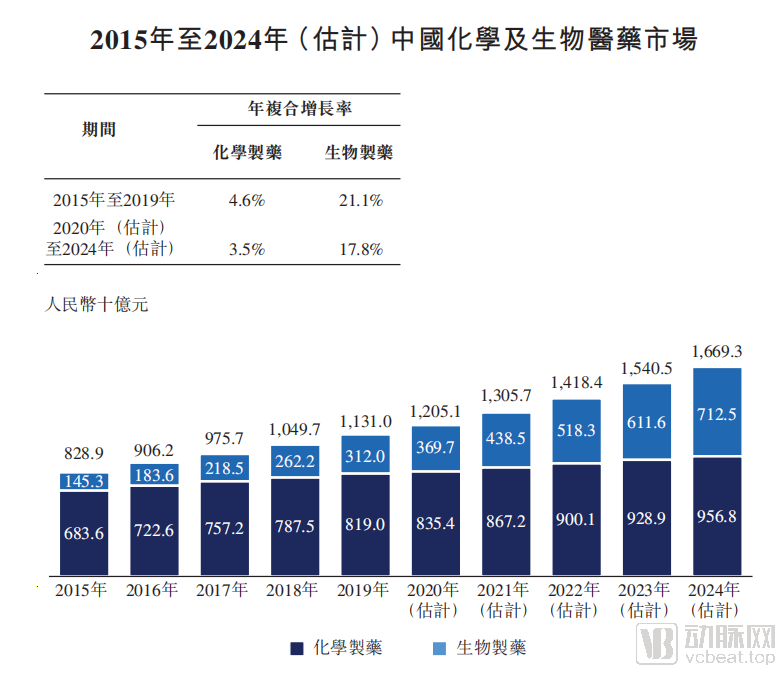
In this market, Simcere’s drug pipeline primarily covers three major therapeutic areas: oncology, central nervous system (CNS) disorders, and autoimmune diseases. The combined market size for these therapeutic agents accounts for 24.7% of China’s pharmaceutical market, representing substantial growth potential.
Among the more than ten new drugs launched by Simcere, four (Endostar, Jiebaishu, Jiebaili, and Zhongren Fu'an) target cancer treatment; two (Aidesin and Yingtaiqing) target autoimmune diseases; two (Anxin and Zailin) target infectious diseases; one (Bicun) targets central nervous system disorders; and one (Shufutan) targets cardiovascular diseases.
These drugs have become the primary source of revenue for Simcere:
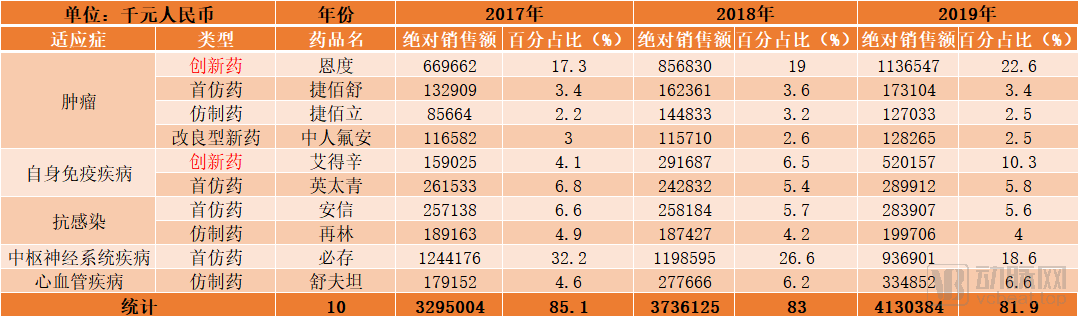
Historical Sales and Proportions of Simcere’s Marketed Drugs
Here is a brief introduction to several representative marketed drugs from Simcere:
Endostar (Recombinant Human Endostatin Injection)—China’s first anti-angiogenic targeted drug, and the only endostatin approved for sale both domestically and internationally. Recombinant human endostatin has been included in the National Reimbursement Drug List since 2017 and is recommended by numerous clinical practice guidelines for oncology issued by the National Health Commission, the Chinese Medical Association, and the Chinese Society of Clinical Oncology as a first-line treatment for patients with advanced non-small cell lung cancer;
Bicun (Edaravone Injection)——A synthetic free radical scavenger, it is the first edaravone injection approved for marketing in China and the second edaravone injection authorized for sale worldwide. Edaravone has been recommended by numerous clinical practice guidelines issued by the Chinese Medical Association, the National Health Commission of the People's Republic of China, the Chinese Stroke Association, the Japan Stroke Society, the American Heart Association, and the American Stroke Association for the treatment of stroke;
Aidesin (Iguratimod Tablets)—A small-molecule antirheumatic drug and the first iguratimod product approved for marketing worldwide. Since 2017, iguratimod has been included in the National Reimbursable Drug List and is recommended as a primary treatment for active rheumatoid arthritis in numerous clinical practice guidelines and pathways issued by the National Health Commission of China, the Chinese Medical Association, the Asia Pacific League of Associations for Rheumatology, and Japan’s Ministry of Health, Labour and Welfare;
Shufutan (Rosuvastatin Calcium Tablets)—A statin medication for lowering cholesterol. Since 2009, rosuvastatin has been included in the National Reimbursement Drug List and incorporated into multiple Chinese clinical practice guidelines as a recommended treatment for dyslipidemia. Meanwhile, it is also recommended as a first-line therapy for managing dyslipidemia in numerous clinical practice guidelines across the United States, Canada, the European Union, and other countries.
Yingtaiqing (Diclofenac Sodium Sustained-Release Capsules/Gel)——A non-steroidal anti-inflammatory drug. Diclofenac Sodium Sustained-Release Capsules have been included in the National Reimbursement Drug List since 2004.
While generics have generated substantial revenue for Simcere, the company is also actively exploring innovative drug development, adopting a dual-engine strategy and “walking on two legs.” Compared with generics, innovative drugs feature higher technical barriers and enjoy first-mover advantages, enabling the company to enhance its brand recognition and market position in relevant therapeutic areas. According to Simcere’s prospectus, the company’s R&D expenses as a percentage of total revenue were 5.5%, 9.9%, 14.2%, and 23.6% in 2017, 2018, 2019, and the six months ended June 30, 2020, respectively, showing a year-on-year increase.
Simcere currently has 17 drugs ready for registration application submission, and nearly 50 independently developed or co-developed innovative drug candidates in its pipeline. These products include small-molecule drugs, large-molecule drugs, and chimeric antigen receptor T-cell (CAR-T) therapies. Among them, more than 10 innovative drug candidates are in clinical trials, have submitted new drug applications, or have received approval for new drug applications and are pending market launch.
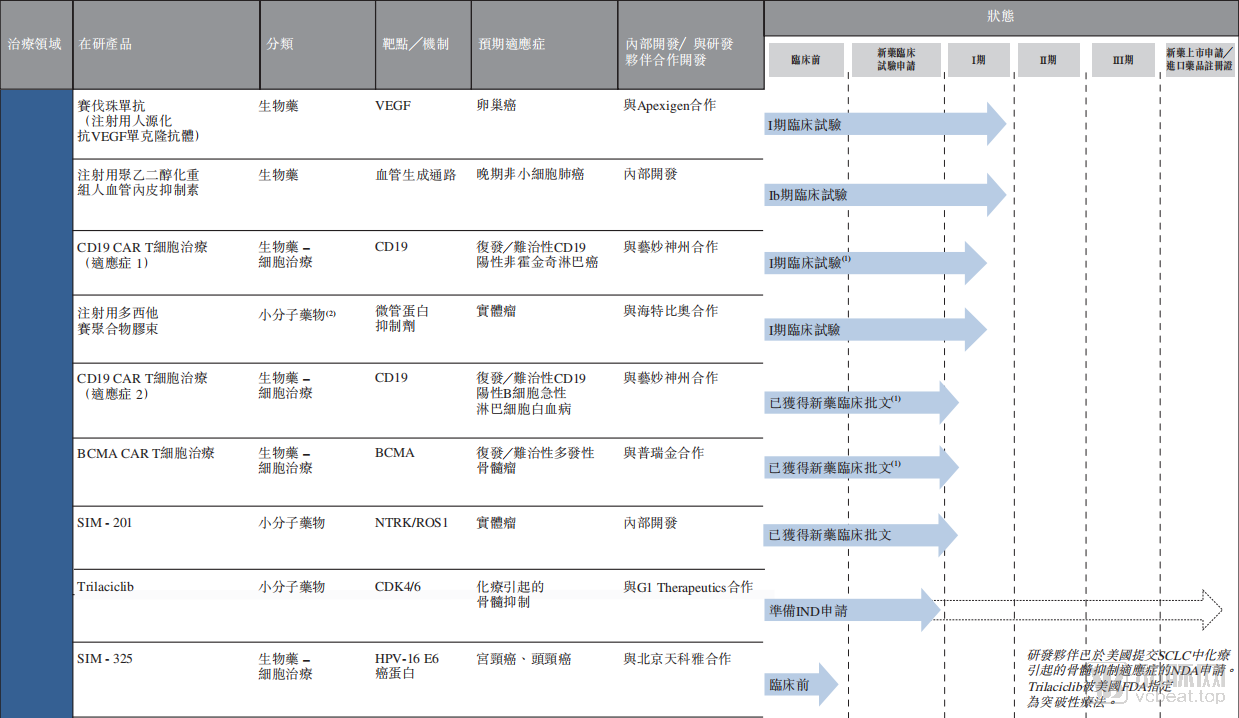
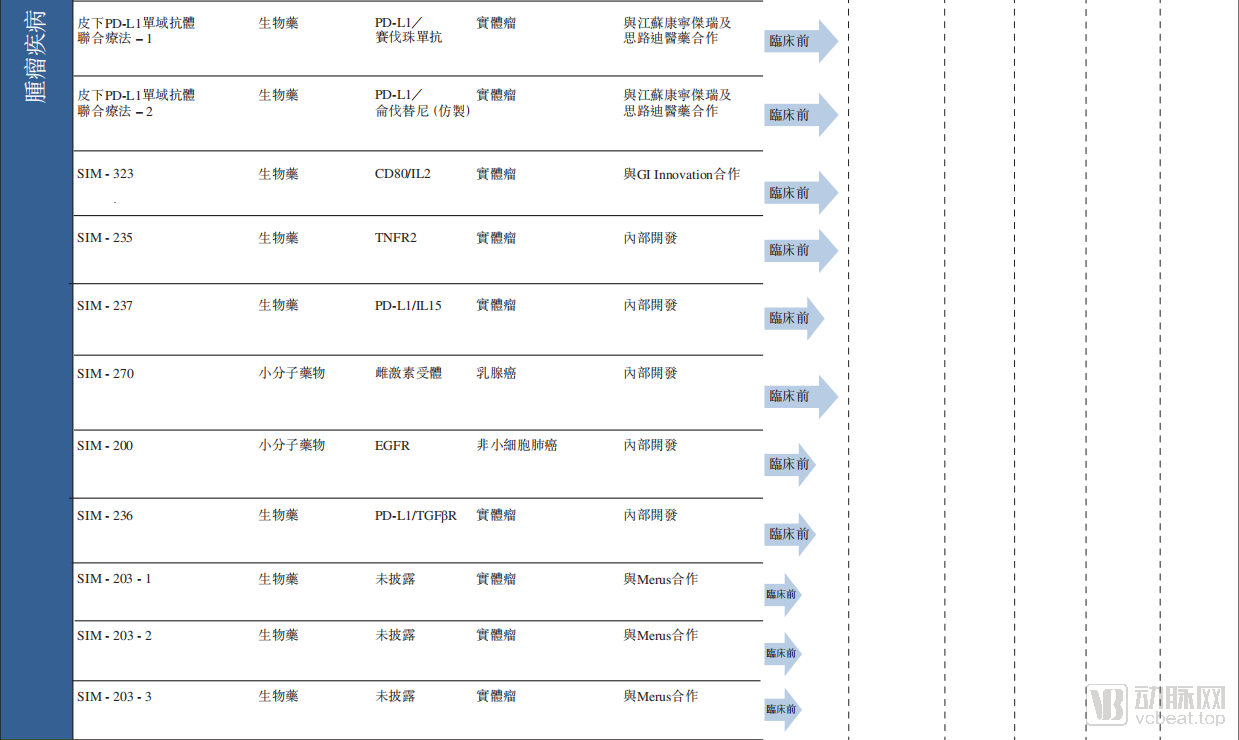
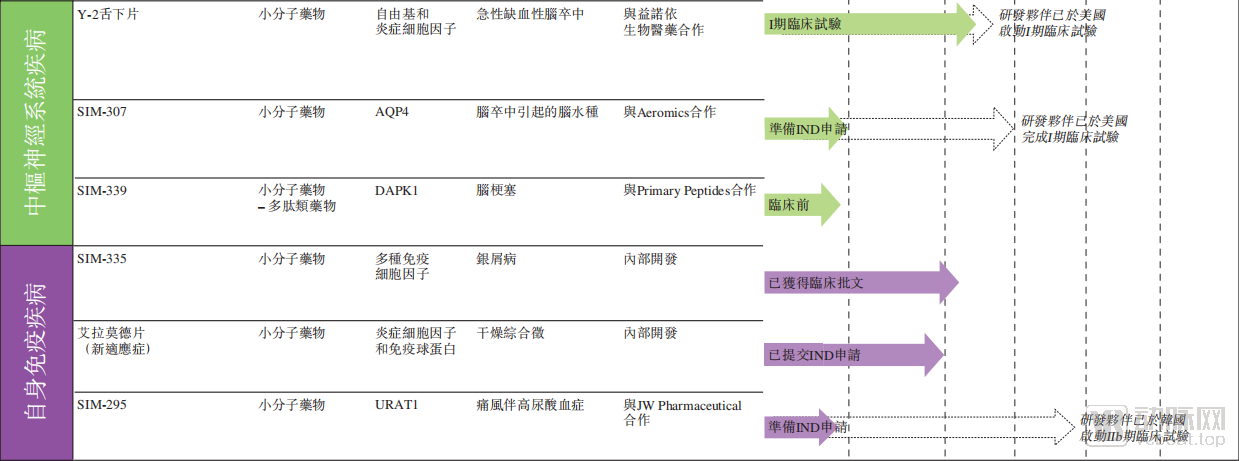
Simcere's Innovative Drug Pipeline
Perhaps achievements are better reflected through national recognition: more than 30 products in Simcere’s existing portfolio have been included in the National Reimbursement Drug List, and over 10 products have been incorporated into more than 40 clinical practice guidelines and pathways issued by government agencies or authoritative professional societies.
According to Simcere’s prospectus, the company generates average annual revenues exceeding RMB 4.5 billion through sales of its in-house manufactured drugs, a minimal portion of third-party pharmaceutical products, and promotional services provided to other pharmaceutical companies, with gross profits reaching over RMB 3.5 billion annually, reflecting a substantial scale.
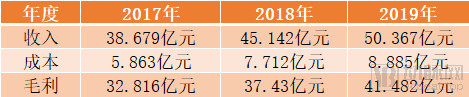
Simcere’s Annual Revenue (Source: Prospectus)
With steadily strengthened efforts in independent innovation and R&D, Simcere has recently launched three newly approved innovative drugs: Enruishu (abatacept injection), Xianbixin (edaravone and dexborneol concentrated solution for injection), and KN035 (envafolimab).
Abatacept InjectionIt is a biologic innovative drug indicated for the treatment of moderate-to-severe rheumatoid arthritis. It is the first and only approved CTLA4-Fc fusion protein in China, as well as the world’s first and currently only T-cell selective costimulatory immunomodulator in the field of autoimmune diseases. The drug was approved for marketing in the second half of 2020, which will further enhance Simcere’s market share in the treatment of autoimmune diseases.
Edaravone and Dexborneol InjectionYongnong Solution is a Class 1 innovative drug with independent intellectual property rights, independently developed by Simcere. According to Frost & Sullivan, it is the only stroke treatment medication approved for marketing globally in the past five years. It features dual mechanisms of action, including enhanced free radical scavenging, anti-inflammatory effects, and improved blood-brain barrier permeability, which can significantly reduce and ameliorate cerebral neuronal injury caused by acute ischemic stroke. The summary indication is also scheduled to be launched in the second half of this year, further consolidating Simcere’s leading position in the treatment of central nervous system diseases in China.
KN035A PD-L1 inhibitor co-developed with Simcere, it is poised to become the world’s first subcutaneously administered PD-L1 monoclonal antibody. Phase II clinical trials for colorectal cancer and other advanced solid tumors, as well as Phase III clinical trials for advanced biliary tract cancer (BTC), are currently underway, while Phase I clinical trials are being conducted in the United States and Japan. The new drug application is expected to be submitted in the second half of 2020, with approval for marketing in China anticipated in 2021.
In the future, Simcere will continue to increase its investment in innovative drugs and independent R&D, with a sustained focus on developing new drugs in its three core therapeutic areas. In anticipation of the growing number of new drug launches in the coming years, the company will also strengthen its sales and marketing capabilities by recruiting professionals with extensive experience in the pharmaceutical industry, thereby enhancing the coverage of its new products across healthcare institutions.
The funds raised from this IPO will further accelerate Simcere’s R&D in the field of innovative drugs, building a product portfolio with core competitive advantages. Although Simcere’s grey market performance was less than satisfactory, can the company gain market recognition and achieve a turnaround by leveraging its own business strengths? Investors can keep an eye on Simcere’s stock movements this morning to get a glimpse of the answer.