

ICU Beds Surge by 16.4% Over Four Years, Signaling a Major Inflection Point for Critical Care Informatics
During major public health emergencies, the Department of Critical Care Medicine garners widespread societal attention and emphasis.
For example, in the early stages of the fight against the COVID-19 epidemic this year, the high mortality rate among critically ill patients caused widespread public panic. At the end of January, the National Health Commission rapidly deployed top critical care specialists from across China to Wuhan, thereby swiftly curbing the progression of critical cases and reducing the case fatality rate. According to data from the National Health Commission,At that time, more than 14,000 critical care medical personnel were dispatched to Wuhan, accounting for 10% of China’s critical care medical workforce.
Beyond leading the charge in major disaster events, the Department of Critical Care Medicine also serves as the final line of defense for sustaining life during routine disease treatment.In hospitals, the Department of Critical Care Medicine is specifically responsible for admitting critically ill patients from various departments. It provides intensive monitoring and effective treatment to these patients with potential life-threatening conditions, helping stabilize their physical condition and thereby reducing the risk of mortality.
Critical Care Medicine is so important, but inHowever, this year’s fight against the epidemic has exposed the insufficiency of critical care medical resources in China.In the early stages of the outbreak, under the government’s coordinated allocation, 46 hospitals were urgently designated to establish intensive care units (ICUs), and two specialized critical care hospitals, Leishenshan and Huoshenshan, were constructed. Furthermore, as indicated in the 2019 article “Guan Xiangdong: Forty Years of Critical Care Medicine in China,” the proportion of ICU beds to total hospital beds was 1.7% in 2015, which still failed to meet the national minimum standard of 2%–8%.
Certainly,The Development of Critical Care Medicine Cannot Be Achieved Overnight. As a shining pearl embodying the achievements of modern medicine, critical care medicine must confront various complex and refractory diseases within limited time frames; thisNot only are highly competent medical professionals required, but support from information systems is also essential.Among them,Critical Care Information System is a necessary and key factor supporting the clinical and research development of critical care medicine.
Recently, at the Third Ice City Critical Care Forum held in Harbin, renowned consulting firm IDC and Neusoft Group jointly released the “Research Report on Development Trends of Critical Care Medicine Information Systems in China.” To explore the report’s key findings, the current state of critical care medicine information systems in China, and their future trends, VCBeat interviewed Li Dong, General Manager of the Clinical Medical Business Division within Neusoft’s Medical Solutions Business Unit, and Xiao Hongliang, Senior Research Manager for the Healthcare Industry at IDC China, aiming to outline the opportunities and challenges facing China’s critical care medicine information systems.
Whenever an emergency patient is wheeled into the ICU, a heavy departmental door becomes particularly conspicuous: inside are ICU medical staff racing against time, while outside stand anxious family members. To save lives, the department’s healthcare professionals engage in a relentless, round-the-clock battle with death, leveraging every available resource to preserve life.
However, in traditional critical care practices, the treatment of critically ill patients relies primarily on clinical experience and limited equipment. This places exceptionally high demands on the competencies of healthcare professionals. Furthermore, the cumbersome processing of various data metrics, coupled with the wide variety of instruments, results in tight timeframes, significant operational difficulty, and substantial uncertainty in delivering critical care. Therefore,Critical care information systems, which streamline workflows and enhance both efficiency and quality of care, are therefore particularly important.
According to IDC's research,For hospitals that have not yet implemented a Critical Care Information System, numerous challenges arise in their daily critical care operations., with the top three major pain points being: first, manual operations are cumbersome and complex, resulting in high workloads for doctors and nurses; second, there is a lack of effective control measures and improvement methods for medical quality during treatment; and third, collaboration between the Department of Critical Care Medicine and other clinical departments remains insufficient.
“Establishing a critical care information system is a prerequisite for addressing these pain points,” Li Dong, General Manager of the Clinical Healthcare Division within Neusoft Medical’s Solutions Business Unit, told VCBeat.Key requirements for establishing a critical care medicine information system encompass three aspects: first, deep integration of clinical data; second, various advanced data-driven applications; and third, regional collaboration based on data.
Addressing these three needs, the aforementioned three major pain points will also be resolved one by one.By integrating patients’ clinical data with monitoring and treatment data from connected medical devices, the burdens of manual processes and concerns regarding data accuracy can be addressed. The adoption of big data and artificial intelligence technologies represents a highly effective approach to establishing medical quality control. This enables timely acquisition of diagnostic and treatment data across all hospital departments, supports advanced applications such as scientific research, facilitates collaboration between the Department of Critical Care Medicine and other specialties, and establishes mechanisms for regional coordination with other hospitals.
It is not difficult to see that,Critical Care Information System is an information system that manages various medical device resources and supports nursing and treatment processes.From an application perspective, the system comprises major modules including physician and nurse workstations for critical care, network management of critical care equipment, critical care research, medical administration, and quality management. As a comprehensive clinical information system for critical care, it supports the clinical, research, and administrative operations of intensive care units.
“Based on our research findings,In hospitals that have not yet established a critical care information system, the Department of Critical Care Medicine continues to rely on the hospital’s core system (traditional HIS) and the electronic medical record (EMR) system.“, although these systems serve certain purposes, they are fundamentally unable to support improvements in the level of critical care treatment or ensure control over the quality of such care,” said Xiao Hongliang, Senior Research Manager for the Healthcare Industry at IDC China.
Why Can’t Hospital Core Systems Achieve This? This IsAs it cannot perform real-time monitoring during use, and requires logging into multiple systems to obtain patients' laboratory and examination data.Moreover, the core system (HIS) is also facing upgrades and replacements, making it unable to support critical care medicine in maintaining high-quality standards continuously. Additionally, development based on the core system (HIS) is more complex and difficult than establishing a specialized system.
Critical care medicine in China emerged in the early 1980s. After more than 30 years of arduous development, its pivotal role in the management of critically ill patients has gained widespread recognition. However,The informatization of critical care medicine is still in its infancy and remains in a phase of exploration and refinement.
Nevertheless,Information technology in critical care medicine still played a significant role in the fight against the COVID-19 pandemic.According to IDC’s survey, among hospitals that have already implemented critical care information systems,61.8% of hospitals underwent renovations and upgrades to cope with the pandemic, adapting to the treatment needs of COVID-19 patients.
“From the perspective of this pandemic, China still needs to accelerate the informatization of critical care medicine. So how can we measure which stage a hospital has reached through continuous construction and upgrading? To this end, we have”The Development of Critical Care Information Systems Has Evolved Across Four Levels“, the four levels progress step by step.” Xiao Hongliang told VCBeat.
Specifically,The first level is the digitalization of critical care treatment tools.: The Department of Critical Care Medicine can achieve automated data acquisition. Currently, some hospitals rely on core systems and electronic medical records (EMR) for this purpose, but an increasing number of hospitals are establishing dedicated Critical Care Information Systems (CCIS) for data collection.
The second level is the informatization of critical care procedures.: By integrating clinical data, medical device data, and a clinical knowledge base, the system provides physicians with a comprehensive 360-degree view of patient clinical data. Ideally, it would integrate a broader range of disease- and health-related patient data, along with clinical research papers and clinical guidelines, thereby establishing a clinical big data center focused on critical care.
The third level is the intelligentization of critical care treatment technologies.: Apply artificial intelligence to big data, utilizing machine learning and deep learning to generate clinical knowledge bases and personalized treatment plans, while implementing telemedicine to advance the development of clinical diagnosis and treatment.
The fourth level is the intelligentization of critical care treatment processes.: By integrating medical equipment and devices with precision medicine databases and global resource repositories, the system enables intelligent departmental solutions. Through human-machine interaction, it delivers more precise treatment and care plans for patients, making therapy smarter, more precise, and more patient-centered. This comprehensively elevates the standard of critical care medicine and facilitates the extension into innovative health management services.
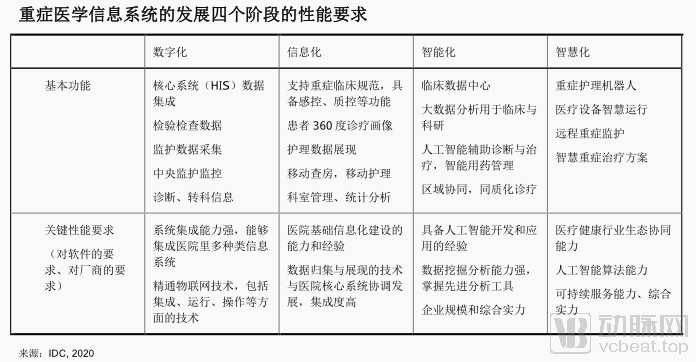
“From the perspective of the current progress of critical care medicine information systems in China, we are currently in a stage of comprehensive informatization construction and transitioning towards intelligence,” said Xiao Hongliang. The development of critical care medicine information systems can be examined from three key dimensions.
First, fromNursing Perspective, the Critical Care Information System enables automated data collection and digitization, automatically imports data from core hospital systems such as the Hospital Information System (HIS), Electronic Medical Records (EMR), Laboratory Information System (LIS), and Picture Archiving and Communication System (PACS), and automatically generates nursing records.
Second, fromFrom a Medical Perspective, enabling a comprehensive and multidimensional overview of the patient’s condition to enhance treatment outcomes and healthcare quality.
Third, fromFrom a Management Perspective, enabling comprehensive oversight of departmental dynamics and statistical data, improving management efficiency and healthcare worker satisfaction, facilitating the establishment of a regional critical care clinical database, sharing medical resources, supporting regional critical care treatment, and advancing clinical research.
“There is still a long way to go in the development of information systems for critical care medicine,” Li Dong told VCBeat. Currently, the critical care information systems used by many hospitals are still at an initial stage of digitalization, meeting only the basic requirements for critical care nursing and treatment, but remaining insufficient for improving the overall level of critical care delivery.
Specifically,For directors or deputy directors of the Department of Critical Care Medicine, the most significant shortcoming of current information systems is “insufficient support for clinical research.”;For intensive care physicians, the most significant shortcoming of current information systems is the "lack of clinical decision support for diagnosis and treatment."。
In addition, the intensive care medicine information system still suffers from insufficient integration with core hospital systems, electronic medical records, and integration platforms.,Issues such as insufficient patient visit data, healthcare professionals in the Department of Critical Care Medicine have not yet achieved proficiency in their daily operations. Additionally,Patient monitoring data and device data have not yet been effectively integrated into the system in a timely manner.。
According to IDC's survey findings,Healthcare professionals in different roles have distinct priorities in their needs.。
First,Director, Department of Critical Care MedicineIn addition to clear demands for “system support for clinical research” and “adoption of artificial intelligence technologies,” strong needs were also expressed for “integration of medical devices” and “implementation of mobile nursing.” Furthermore, intensivists in the Department of Critical Care Medicine exhibited particularly strong demand for “leveraging artificial intelligence technologies to improve treatment outcomes,” with 46% of physicians citing this as their primary requirement. Finally,Head Nurse and Nursesthere is a strong demand for “the use of mobile diagnostic and testing equipment” and “stable large-screen displays.” In addition, hospitals inManaging Family Members of Critically Ill PatientsVisitation also requires greater integration of communication and display devices, as well as audio and video integration.
In response to these market demands, numerous vendors have begun to gradually intensify their efforts in the field of critical care medicine informatics, with three main types currently prevailing.
The first type is comprehensive healthcare information system vendors., this category is dominated by vendors of core hospital systems, which typically possess extensive experience in hospital informatization, as well as capabilities in medical information system integration, medical data management, big data, and artificial intelligence. However, they need to strengthen their capabilities in integrating medical device data. A representative enterprise is Neusoft Group.
Leveraging its extensive accumulation of technology, business expertise, and knowledge over many years, Neusoft Corporation dedicated itself to overcoming key challenges and launched its flagship Smart Critical Care Solution (E-CARE) in 2016. Focused on the field of critical care medicine and centered on patients, this solution integrates critical care medical knowledge with key technologies such as the Internet of Things (IoT), artificial intelligence (AI), and big data across various workflows including diagnosis, treatment, nursing, research, and management. It assists medical staff in achieving precise diagnosis and safe treatment, helps administrators improve departmental management efficiency, and promotes the informatization development of critical care medicine.
The second type is specialized medical information system vendors., such vendors typically provide critical care information systems and networking solutions for intensive care equipment; however, they need to strengthen their capabilities in integrating critical care information systems with other clinical information systems within hospitals, as well as in data analysis and mining.
The third type is medical device manufacturers., these vendors provide medical devices and offer critical care information systems based on such devices. While they demonstrate strong capabilities in intensive care unit (ICU) operations and device management, they need to strengthen the integration of their information systems with other clinical information systems in hospitals, as well as enhance comprehensive data analysis and utilization.
“When selecting a vendor for Critical Care Information Systems (CCIS), it is essential to prioritize their comprehensive capabilities in healthcare information technology. Additionally, preference should be given to vendors with a mature core hospital product architecture, robust data acquisition capabilities, sustainable service delivery, and a clear vision for digital transformation.“, thereby ensuring sustained momentum for the development and application of innovative technologies as critical care information systems evolve toward intelligence and smart capabilities,” said Xiao Hongliang.
The sudden outbreak of the novel coronavirus pneumonia this year has led to growing societal demand for and emphasis on critical care medicine.
According to data from the National Health Commission’s “2019 National Medical Services and Medical Quality and Safety Report,”Intensive Care Unit BedsThe proportion of hospital beds increased from 1.9% in 2014 to 2.2% in 2018,Increase of 16.4%。With the substantial increase in the number of hospital beds, corresponding medical equipment and healthcare informatization will also maintain rapid growth.
Li Dong stated that the informatization of critical care medicine will likely develop in three directions over the next 3–5 years:
First, the deep integration of ICU-related devices and associated IT systems at the front end of the information system, encompassing not only the connectivity of traditional devices such as patient monitors, ventilators, hemofiltration machines, syringe pumps, and blood gas analyzers, but also that of equipment including extracorporeal membrane oxygenation (ECMO), pulse indicator continuous cardiac output (PICCO) monitoring, intra-aortic balloon pump (IABP), and smart hospital beds;For IT systems, it is not only about data interoperability but also business process integration, achieving true interconnectivity within the ICU.
Secondly, the backend of the information system supports the construction of a critical care clinical data platform, forming critical care clinical datasets, disease-specific databases, and disease-specific knowledge bases, thereby providing foundational support for the treatment domain in critical care.With a data platform in place, AI-assisted decision-making in the therapeutic domain has a stage to perform on, enabling it to play a role in the four key areas of diagnosis, treatment, medication, and nutrition. Similarly, supported by a data platform, clinical research and teaching in critical care can be conducted with clear focus and purpose. In particular, for clinical research in critical care, the integration of data platforms with operational platforms can bridge retrospective and prospective studies, thereby enhancing overall research capabilities.
Third, IT vendors’ ecosystem collaboration in the healthcare industryFirst, establish a regional diagnosis and treatment platform for critical care, building a collaborative and efficient referral system to enable shared medical resources within the medical consortium—such as remote consultations, remote teaching, telemedicine, and synchronized diagnostic and therapeutic processes—thereby enhancing the consortium’s clinical capabilities and achieving the goal of early diagnosis and treatment for critically ill patients. Second, collaborate with medical device and pharmaceutical companies, integrating medical equipment, drugs, precision medicine databases, and global resource repositories to make treatment more intelligent, thus realizing the advanced objectives of informatization in critical care medicine.
Leveraging its years of understanding and practical experience, Neusoft has made targeted investments in the aforementioned areas and achieved phased results.
Where there is demand, there is a market; therefore, high-quality products and solutions are even more essential.。“The most prominent feature of the development of modern critical care medicine is hyper-digitization and widespread intelligence.“The future development of critical care information systems will inevitably continue to iterate around these two directions,” said Xiao Hongliang.
Specifically,Super-Digitalization: Digital Critical Care Medicine Encompasses Three Categories of DataFirst, various types of data generated by patients during the diagnosis and treatment process; second, data from various monitoring and therapeutic devices used in critical care medicine; and third, the latest treatment protocols and knowledge from relevant disciplines applied in critical care. Compared with the digitalization of general clinical departments in hospitals, the Intensive Care Unit (ICU) exhibits higher density and greater reliance on these three categories of data.
Comprehensive intelligence refers to the application of artificial intelligence across all aspects and dimensions of critical care, serving as a prerequisite for achieving smart intensive care and representing an inevitable trend in the development of critical care medicine.. Among these, hyper-digitization is enabling the intelligent transformation of monitoring, treatment, and innovation; facilitating the smartification of medical devices and therapeutic modalities; driving innovations in diagnostic and therapeutic methods and technologies; and promoting the digital transformation of work models in critical care medicine.
We firmly believe that as critical care medicine continues to evolve in this direction, the Department of Critical Care Medicine will fortify the last line of defense for life and provide significant support for achieving the goals of Healthy China.
References:
"Research Report on the Development Trends of Critical Care Medicine Information Systems in China"
“Guan Xiangdong: Forty Years of Critical Care Medicine in China”