

Moonshot Against Cancer Drives Standardization of Tumor Mutational Burden (TMB) in China
Recently, the China Tumor Mutational Burden (TMB) Standardization Project, initiated by the National Cancer Center/Cancer Hospital of the Chinese Academy of Medical Sciences, the National Institutes for Food and Drug Control, and the Chinese Anti-Cancer Association, among other organizations,Cancer Moonshot Official Account) was officially launched, aiming to comprehensively evaluate the clinical testing capabilities of Tumor Mutational Burden (TMB) and establish relevant standards, accumulate real-world study data from the Chinese cancer patient population, and provide data support for the standardized clinical application of Next-Generation Sequencing (NGS).
Compared with the projects of two organizations in the United States and Europe, FOCR and QuiP, China’s TMB Standardization Project is currently the largest-scale TMB standardization initiative worldwide, involving as many as 60 industry institutions and 10 medical institutions. As the sole independent data analysis and evaluation institution for this project, ZhiNuoweiSi leverages its extensive experience accumulated over the years in multi-center clinical research projects based on pathological big data, utilizing its Anti-Cancer Moonshot Platform built on multimodal artificial intelligence technology (Cancer Moonshot Official Website), boosting the standardization of TMB in China.
TMB, short for Tumour Mutation Burden (translated as 肿瘤突变负荷 in Chinese), generally refers to the total number of somatic mutations detected per million bases. It is a biomarker that reflects the mutational load within tumor cells. Clinically, TMB was included in the National Comprehensive Cancer Network (NCCN) guidelines for non-small cell lung cancer in 2019 as one of the biomarkers for adjunctive diagnosis in tumor immunotherapy.On June 16, 2020, the U.S. FDA formally approved tumor mutational burden (TMB) as a pan-cancer companion diagnostic biomarker for cancer immunotherapy, to guide the use of immunotherapeutic agents in patients with advanced-stage cancer.
TMB testing mainly has two methods, one is the "gold standard" of TMB testing”, namely high-depth human whole exome sequencing (Whole Exome Sequencing, WES);The other is targeted sequencing with a target region of ≥1 Mb or tumor next-generation sequencing (NGS) that detects more than 300 genes, commonly known as “large-panel” testing.These two testing products feature comprehensive detection panels, complex experimental workflows, and high difficulty in analysis and interpretation, resulting in relatively high market prices. Consequently, TMB testing represents a costly procedure for patients with advanced-stage cancer. Whether precise clinical recommendations can be derived from expensive TMB testing depends on numerous factors, including the quality of the laboratory assay, the precision of the analysis, the accuracy of the interpretation, and the turnaround time for the laboratory report, as well as the comparison against the baseline of patient clinical benefit. However, in China, there is currently a near-total absence of both quality assessment standards for TMB or large-panel testing and established baselines for clinical benefit across various cancer types. The goal of the China TMB Standardization Project is to address these two critical issues by establishing unified evaluation specifications and standards for TMB testing.
Cancer Moonshot—China’s First Big Data Platform for Precision Oncology, Committed to “Linking Data, Smart Cancer Fighting” and Dedicated to Establishing a Standardized Diagnostic System for Next-Generation Tumor Pathology.The 2016 Cancer Moonshot Initiative was supported by Zhang Gaoli, then Vice Premier.[1]attention; in 2018, the Cancer Moonshot Platform supported the Pathology Professional Committee of the China Anti-Cancer Association in launching the “Multi-center Study on Big Data of Tumor Pathology in China” project, aiming to collect pathological diagnosis data for the ten most common malignant tumors in China and to establish a standardized framework for next-generation structured pathology diagnostic reports through big data analysis (2018 VCBeat News:“Cancer Moonshot” Advances Standardization of Oncologic Pathology; ZhiNuovisi Empowers Oncology’s Transition into the Era of Precision Medicine). In fact, through more than two years of efforts, the Cancer Moonshot Platform has assisted the Pathology Professional Committee of the China Anti-Cancer Association in successfully completing this project. Based on the outcomes of this project, the Pathology Professional Committee of the China Anti-Cancer Association will, at the Chinese Congress of Oncology held on November 14, 2020,[2]released the "2020 Edition of the Standardized Framework for Structured Reports in Next-Generation Pathological Diagnosis" and initiated its comprehensive implementation.
Figure Legend: This video was filmed against the backdrop of the multicenter study on big data in liver cancer pathology, which was launched in 2017. In fact, the Cancer Moonshot initiative has already supported the Pathology Professional Committee of the China Anti-Cancer Association in completing data collection and scientific research analysis for multiple types of cancer.
Dr. Ling Shaoping, Founder of the Anti-Cancer Moonshot Platform and CEO/CSO of ZenoVita[3]Statement: The China TMB Standardization Project is the most critical initiative supported by the Cancer Moonshot Platform to facilitate the Chinese Anti-Cancer Association’s Pathology Committee in advancing the standardization of molecular pathology. Jointly launched by the National Cancer Center/Cancer Hospital of the Chinese Academy of Medical Sciences, the National Institutes for Food and Drug Control, and the Pathology Committee of the Chinese Anti-Cancer Association, the project engages GenomiCare as the sole independent data analysis and evaluation institution. Leveraging its extensive experience in organizing and implementing multi-center real-world studies (RWS), GenomiCare conducts data analysis and related assessments in accordance with the principles and standards established by the project working group’s experts. Furthermore, GenomiCare will deploy its proprietary multimodal artificial intelligence technology framework to establish a reusable evaluation system on the Cancer Moonshot Platform. This system comprises the Cancer Genome Testing Analysis (CGTA) platform and the Intelligent Phenome Cloud (IPC) for multi-center research collaboration and phenomic data analysis, as illustrated in Figure 1. Upon completion, CGTA will provide a reusable, standardized analytical and evaluation workflow for TMB testing (or large-panel) products. Meanwhile, IPC will support multi-center studies in establishing baseline drug efficacy benefits or predictive models for TMB and other potential biomarkers, thereby providing data-driven support for clinicians to guide the precise use of immunotherapies in cancer patients.
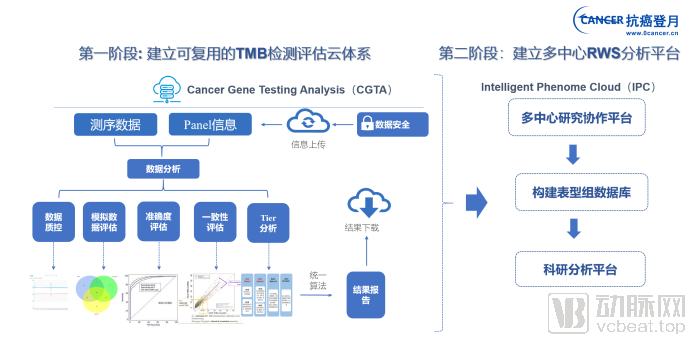
Whether for hospitals, clinical laboratories, pharmaceutical companies, or relevant accreditation bodies, the CGTA platform enables comprehensive evaluation of target TMB testing products (such as tumor large panels or WES), including simulated data assessment of target regions, TMB concordance assessment, and driver gene accuracy assessment. This holds significant importance for the research and development, regulatory submission, technology transfer, and quality control during clinical production of laboratory-developed tests (LDTs) or in vitro diagnostic (IVD) kits in tumor NGS testing laboratories.
The multi-center real-world study (RWS) collaboration and phenomics data analysis platform (IPC), established by the Cancer Moonshot initiative, has assisted researchers from the Cancer Association in conducting multiple RWS projects on liver cancer, lung cancer, and other indications. In the China TMB Standardization Project, the second phase of RWS places greater emphasis on predictive models for the efficacy of tumor immunotherapy and potential TMB benefit thresholds. The platform not only provides information dissemination services for the project, enabling each participating research institution to monitor project progress in real time and engage in academic discussions, but more importantly, allows each center to access its own data and perform relevant data analyses.
Following the project launch meeting, Professor Du Xiang, Chairman of the Pathology Professional Committee of the China Anti-Cancer Association, stated in an interview: “The advancement of precision oncology is inseparable from improvements in pathological diagnosis. We are delighted that AI and big data platforms such as ‘Anti-Cancer Moonshot’ can propel the ‘China TMB Standardization Project,’ assisting the pathology field in establishing much-needed standardized molecular diagnostic criteria based on next-generation sequencing (NGS) technologies for molecular pathology. Over the past three years, the Anti-Cancer Moonshot platform has accompanied us in developing structured reporting standards for pathological diagnoses, progressing from liver cancer, lung cancer, and nasopharyngeal carcinoma to the current ten major cancer types. We have deeply appreciated the empowerment and support that big data and AI technologies provide to the development of pathology. I look forward to the progress of this TMB standardization project and am confident that the Anti-Cancer Moonshot platform will deliver robust technical and data support.”
Under the guidance of the National Cancer Center, the National Institutes for Food and Drug Control (NIFDC), and the Pathology Professional Committee of the China Anti-Cancer Association, the Cancer Moonshot Platform will advance the establishment of clinical application standards for next-generation sequencing (NGS) testing, particularly for large panels; build an open collaborative network for real-world studies; accelerate research on predictive models for the efficacy of tumor immunotherapy; accumulate clinical evidence on the predictive value of tumor mutational burden (TMB) and other potential biomarkers for treatment response; establish a big data support system for precision oncology; and promote the interactive development of industry, academia, and research in China’s precision cancer medicine sector.
The following are the relevant links:
[1] News link regarding Vice Premier Zhang Gaoli: http://www.kejixun.com/article/161017/235680.shtml
[2] Chinese Oncology Congress: https://www.sohu.com/a/422462971_120057660
[3] LinkedIn link: https://cn.linkedin.com/in/shaoping-ling-6a981751/zh-cn?trk=people-guest_people_search-card