

Shandong's Institutional Innovation Drives Rapid Implementation of TCM Internet Projects: Building a Digital Transformation Model for the Traditional Chinese Medicine Industry
Just six months after the launch of Shandong Province’s Internet-based Medical Insurance and Health Services Platform, which issued China’s first electronic medical insurance settlement statement from a platform-type internet hospital, and merely three months after the establishment of China’s first inter-provincial alliance for the procurement of traditional Chinese medicine (TCM) materials, another landmark event in Shandong’s TCM internet innovation unfolded on October 24.
At 9:05 a.m. on that day, a traditional Chinese medicine (TCM) clinic in Jinan placed an online order through the World Traditional Chinese Medicine (Materials) Internet Trading Center, purchasing 500 kilograms of donkey-hide gelatin cubes from Shandong Dong-E-E-Jiao Co., Ltd., with a total transaction value of RMB 1.1 million. After the supplier confirmed the order, the transaction was completed within just a few minutes. This marked the first transaction completed by the World Traditional Chinese Medicine (Materials) Internet Trading Center, signaling that the circulation segment of the TCM industry chain has entered the era of digital trading, and indicating that digitalization is empowering the TCM industry with new momentum in Shandong Province.
On October 24, the 2nd World Conference on Traditional Chinese Medicine (TCM) Internet Industry opened in Jinan, Shandong Province. At the opening ceremony, the World TCM (Herbal Materials) Internet Trading Center and the World TCM (Herbal Materials) Quality Inspection Center were unveiled, addressing two critical aspects: trading methods in the circulation of TCM herbal materials and quality control of these materials.
In the traditional trade of Chinese herbal medicines, the offline market is fragmented, with long distribution chains and numerous intermediate links. This results in low efficiency and difficulties in achieving full-process traceability, thereby compromising the quality of herbal medicines. Meanwhile, variations in cultivation conditions and processing methods (such as Paozhi) significantly contribute to quality discrepancies, leading to inconsistent quality standards across regions and a lack of mutual recognition. These issues severely constrain the development of the Traditional Chinese Medicine (TCM) industry, and the reputation of TCM has been undermined by substandard herbal materials. To enhance industry competitiveness, innovation in these critical areas is imperative.
These two centers are innovative projects that focus on the quality of Chinese herbal medicines and digitally empower every stage of the process. According to Liao Jieyuan, Chairman of Shandong Internet Medical Insurance and Big Health Group, the World Traditional Chinese Medicine (Herbal Materials) Internet Trading Center will establish a full-process traceability system for TCM quality “from the field to the stomach.” It will safeguard customer interests through a third-party commercial insurance compensation mechanism, providing governments, medical institutions, and enterprises with secure and reliable platforms for promotion, quality control, and trading, thereby fostering globally recognized premium TCM brands and price indices.
The World Traditional Chinese Medicine (Materials) Quality Inspection Center will establish quality standards for more than 1,000 commonly used traditional Chinese medicinal materials and decoction pieces across China. It will provide enterprise standards that serve as a market benchmark and exceed national standards, thereby addressing the issue of mutual non-recognition of local standards across different regions. Furthermore, in collaboration with Shandong University of Traditional Chinese Medicine, the Center will conduct joint research to develop tiered standards capable of meeting the medication needs at various levels.
The establishment of the “dual centers” signifies that scientifically sound and rational quality standards and pricing systems are expected to be established, marking a critical step forward in the modernization of traditional Chinese medicine.
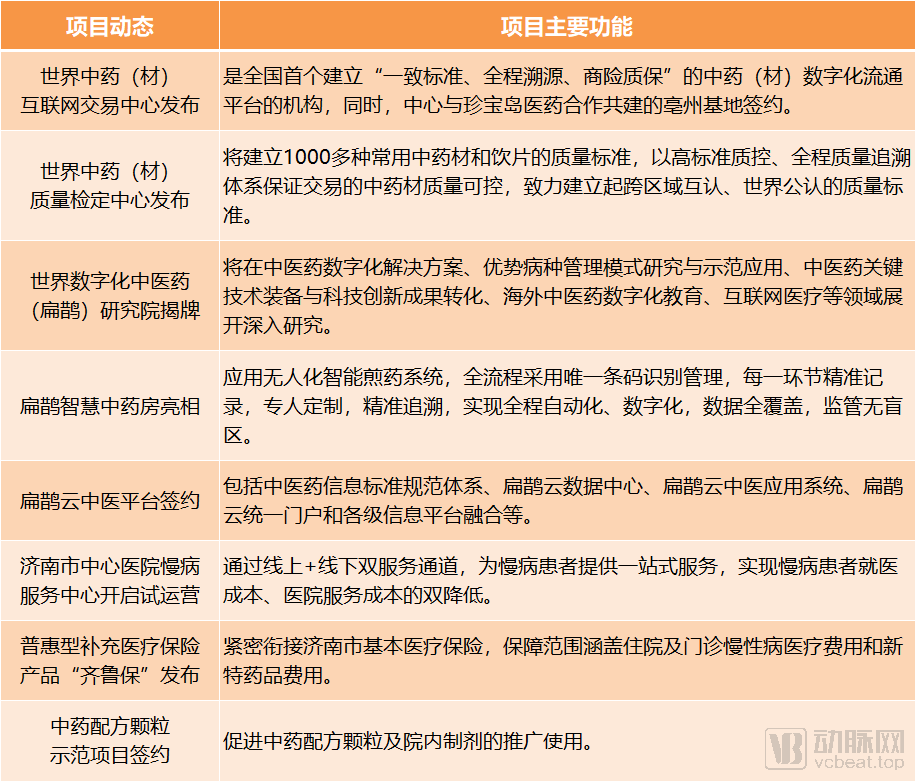
At the conference, in addition to the establishment of the “Dual Centers,” a batch of innovative development projects were centrally signed, unveiled, or launched.
Source: Organizing Committee of the 2nd World Conference on Internet Industry of Traditional Chinese Medicine; graphic by VCBeat
As shown in the figure above, the overall project coverage is extensive. In terms of service segments, it encompasses medical, pharmaceutical, and insurance services. For instance, the Chronic Disease Management Center at Jinan Central Hospital provides one-stop management services for patients with chronic diseases; the Bianque Smart Traditional Chinese Medicine (TCM) Pharmacy has achieved full-chain innovation in pharmaceuticals, logistics, and supply distribution, with its one-stop comprehensive pharmaceutical care services effectively improving the efficiency of hospital pharmaceutical services and enhancing patients’ experience with TCM services; the inclusive supplementary medical insurance product “Qilu Bao” covers hospitalization and outpatient chronic disease medical expenses, as well as costs for new and specialty drugs.
From the perspective of specialized sectors, the initiatives encompass production, academia, and research. For instance, the Trading Center and the Bozhou Base, along with the Demonstration Project for Traditional Chinese Medicine (TCM) Formula Granules, cover the production and distribution industries. The TCM (Bian Que) Research Institute focuses on academia and research, promoting academic scientific research and the translation of achievements in key TCM technologies.
From the perspective of healthcare scenarios, this encompasses both in-hospital and out-of-hospital settings. For instance, the Bianque Cloud Traditional Chinese Medicine (TCM) Platform aims to deepen the informatization of TCM by developing a suite of interconnected application systems, including a TCM clinical decision support system, a TCM specialty disease service system, “Internet+” application systems, a regional smart cloud pharmacy system, and TCM regulatory applications. These systems are designed to serve both medical institutions and regulatory authorities while enabling seamless information interoperability.
It is evident that the innovation of Shandong’s Internet-based traditional Chinese medicine (TCM) industry focuses on key links and has been comprehensively arranged in combination with service processes and industrial chains. This approach enables mutual coordination and promotion among various projects on the B-side, enhancing synergistic innovation; on the C-side, it provides patients with more efficient innovative services, thereby improving their sense of gain.
Shandong boasts a long history and abundant resources in the development of Traditional Chinese Medicine (TCM). As the birthplace of pulse diagnosis, acupuncture, and herbal decoctions, it was here that the renowned physician Bian Que established the foundational principles of TCM through the four diagnostic methods: inspection, auscultation and olfaction, inquiry, and palpation. Furthermore, Shandong is home to approximately 1,500 species of TCM medicinal materials, accounting for over 10% of the total variety found nationwide.
Meanwhile, Shandong Province has a solid foundation for the cultivation of Chinese herbal medicines. The province has established more than 200 specialized cooperatives for Chinese herbal medicine cultivation, built 160 sci-tech demonstration parks for the Chinese herbal medicine industry, developed 70 standardized production bases, set up 10 seed and seedling breeding bases, and fostered 60 leading enterprises above designated size. The total planting area of Chinese herbal medicines in the province is expected to reach 3.3 million mu in 2022, with an output value exceeding RMB 18 billion, ranking among the top nationwide in both area and output value.
Furthermore, Shandong Province has 5,072 traditional Chinese medicine (TCM) health institutions, providing extensive service coverage; it also boasts 14 national- and provincial-level regional TCM diagnosis and treatment centers, demonstrating strong medical capabilities.
Amid the digital wave, these resources, cultural assets, and service networks are being further revitalized through innovation to unlock greater value, particularly in the circulation of traditional Chinese medicine (TCM) materials and TCM research and development.
Institutional innovation has become a key driver of industrial innovation.
It is understood that the Shandong Provincial Committee of the Communist Party of China and the Shandong Provincial People’s Government have incorporated the inheritance, innovative development, and modernization of Traditional Chinese Medicine (TCM) into the province’s overall development strategy and its cluster of ten leading modern competitive industries, making every effort to transform Shandong from a major TCM province into a strong TCM province.
To this end, Shandong Province established a Leading Group for Promoting the Development of Traditional Chinese Medicine (TCM), with Liu Jiayi, Secretary of the CPC Shandong Provincial Committee, serving as its head. On May 9, 2020, the Leading Group held its first meeting, emphasizing the need to accelerate reforms and institutional innovation. It called for deepening systemic and mechanistic reforms in areas such as education and teaching, talent development, medical service systems, scientific research, professional title evaluation and appointment, standardization and identification of Chinese herbal medicines, pricing mechanisms, medical insurance payment, and performance assessment, so as to improve the policy framework and create new institutional advantages.
Shortly after the meeting, the Jinan Municipal Healthcare Security Administration issued the “Several Policy Measures on Promoting the Construction and Development of the ‘Shandong Internet Healthcare Big Data Service Platform,’” explicitly proposing to establish the China (Jinan) Traditional Chinese Medicine Procurement Alliance, build a Traditional Chinese Medicine Procurement and Trading Center in Jinan, and carry out centralized procurement, leveraging the “Healthcare Big Data Platform” as its foundation.
In September 2020, Shandong Province also issued the “Several Measures on Strengthening Medical Security Support for the Development of Traditional Chinese Medicine” (hereinafter referred to as the “Measures”).
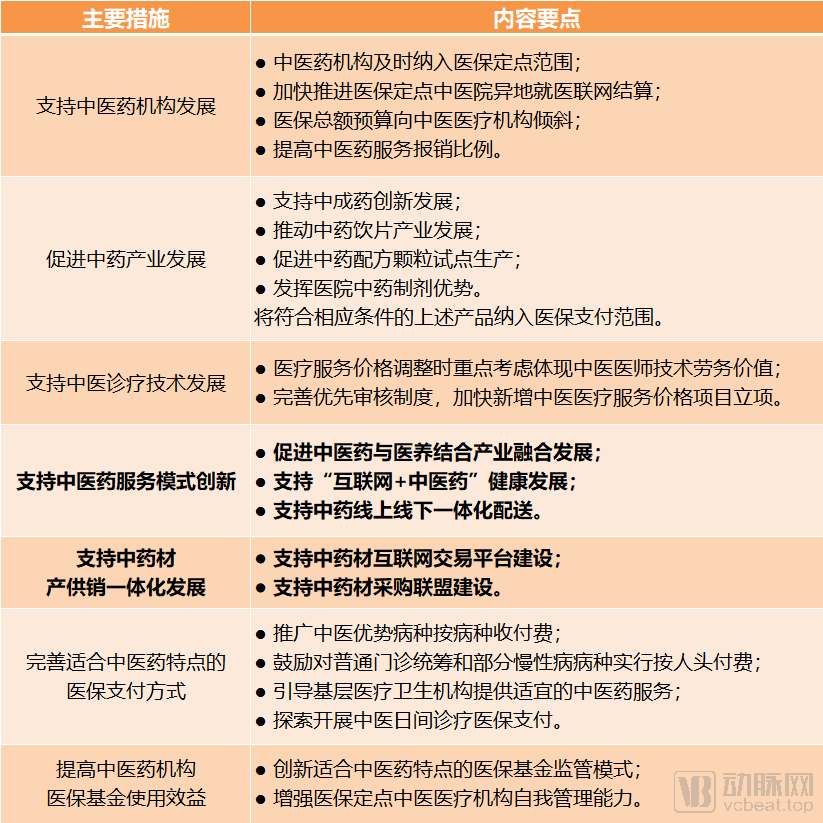
Key Measures of Shandong Province’s “Several Measures on Strengthening Medical Security Support for the Development of Traditional Chinese Medicine” (**Bolded sections indicate content that has already been implemented or is gradually being implemented.**)
Source: Official Website of the Shandong Provincial Healthcare Security Administration; graphic by VCBeat
The “Measures” cover seven areas, including TCM diagnostic and therapeutic techniques, TCM institutions, TCM service delivery models, the TCM industry, production and marketing of Chinese herbal medicines, TCM medical insurance payment methods, and supervision of medical insurance funds, thereby providing comprehensive support for the medical, pharmaceutical, and insurance sectors in the field of Traditional Chinese Medicine.
“Medical” Aspect: Primarily supports the inclusion of eligible diagnostic and treatment technologies, as well as pharmaceutical and medical institutions, into the reimbursement scope, with overall medical insurance budget allocations favoring traditional Chinese medicine (TCM) medical institutions; it also promotes the healthy development of “Internet + TCM.”
Regarding "medicines," the focus is on supporting the inclusion of qualified TCM decoction pieces, TCM formula granules, and hospital-prepared TCM formulations into the reimbursement scope, thereby promoting the development of the traditional Chinese medicine (TCM) industry. Meanwhile, support is provided for the establishment of online trading platforms and procurement alliances for TCM materials, driving the TCM materials industry toward branding, standardization, and intensification, while also supporting integrated online-to-offline distribution of TCM products.
“Insurance” aspect primarily involves improving medical insurance payment methods and fund supervision models that are suited to the characteristics of Traditional Chinese Medicine.
The “Measures” not only strengthen the support for traditional Chinese medicine (TCM) under existing medical insurance policies, but also expand new supportive functions within the medical insurance domain. Meanwhile, jointly issued by the Shandong Provincial Medical Security Bureau, the Shandong Provincial Department of Industry and Information Technology, the Shandong Provincial Department of Finance, the Shandong Provincial Health Commission, and the Shandong Provincial Medical Products Administration, the “Measures” cover administrative management across all sectors, including TCM medical services, the pharmaceutical industry, and pharmaceutical commerce. This multi-departmental collaboration further enhances the comprehensive policy support.
At the press conference for the Measures, Qiu Bingyu, Deputy Director of the Shandong Provincial Healthcare Security Administration, stated that this is the most comprehensive, systematic, and strongly supported policy document on traditional Chinese medicine (TCM) covered by medical insurance in Shandong’s history.
A comprehensive review of the timelines for these initiatives clearly demonstrates that Shandong’s institutional innovations are not only substantial in scale but also remarkably rapid in execution.
Driven by multiple factors such as resources and policies, innovation in Shandong’s traditional Chinese medicine industry has gradually evolved from a conceptual outline to an emerging framework.
On April 25, 2020, the Shandong Internet Medical Insurance and Big Health Service Platform was officially launched. It is China’s first provincial-level internet medical insurance and big health platform jointly established by a provincial government and a national ministry, as well as China’s first open comprehensive service platform operating under the model of “government support, state-controlled holding, integration of advantageous resources, and market-oriented operation.” Positioned at the intersection of “Internet + Medical Insurance + Healthcare + Pharmaceuticals,” and driven by medical insurance payments, the platform has built eight innovative service sectors, including digital traditional Chinese medicine and digital health and elderly care.
In the realms of digital Traditional Chinese Medicine (TCM) and digital health and wellness, the platform plans to leverage Jinan’s TCM development advantages as the “Hometown of Bian Que and a Hub for Health and Wellness.” Adhering to the principle of upholding fundamental traditions while fostering innovation, the platform will drive the integrated development of various sectors through digitalization. These sectors include the excavation and dissemination of Bian Que culture, the inheritance of expertise from renowned veteran TCM practitioners, coordinated procurement for the planting and processing of authentic Chinese herbal medicines, distribution via smart TCM pharmacies, preventive healthcare management, and the development of health and wellness towns.
The establishment and launch of the platform mark that the innovation in the traditional Chinese medicine industry has determined its direction and formed a basic digital framework.
On July 7, China’s first inter-provincial alliance for the procurement of traditional Chinese medicinal (TCM) materials was established in Jinan, Shandong Province. The procurement alliance will establish unified and mutually recognized quality standards, leverage market mechanisms to achieve premium pricing for high-quality products, enhance the quality of TCM materials, and promote non-governmental, market-driven purchasing. Meanwhile, the Shandong (Jinan) Project for Innovative Development of the Traditional Chinese Medicine Industry was launched.
This marks the entry of innovation efforts into a more substantive phase, establishing a project-based approach for planning and implementation, while further integrating industrial resources through procurement alliances.
On October 24, at the Second World Conference on Internet Industry of Traditional Chinese Medicine, the “Dual Centers” for Chinese herbal medicines were established, and a batch of innovative development demonstration projects were announced. This signifies that innovative projects are progressively transitioning from concepts to tangible entities and entering the service phase one after another.
For example, the Bianque Smart Traditional Chinese Medicine Pharmacy, a key innovation project in Shandong’s TCM industry, was unveiled at the conference.
Bianque Smart TCM Pharmacy employs an unmanned intelligent herbal decoction system, utilizing unique barcode identification for end-to-end management. Each step is precisely recorded, achieving full-process automation and digitalization. Through process and technological innovation, Bianque Smart TCM Pharmacy has realized comprehensive innovation across pharmaceuticals, logistics, and distribution supply chains. It also promotes information interoperability among medical institutions at all levels, thereby enhancing efficiency and reducing costs in both traditional Chinese medicine services and health insurance supervision.
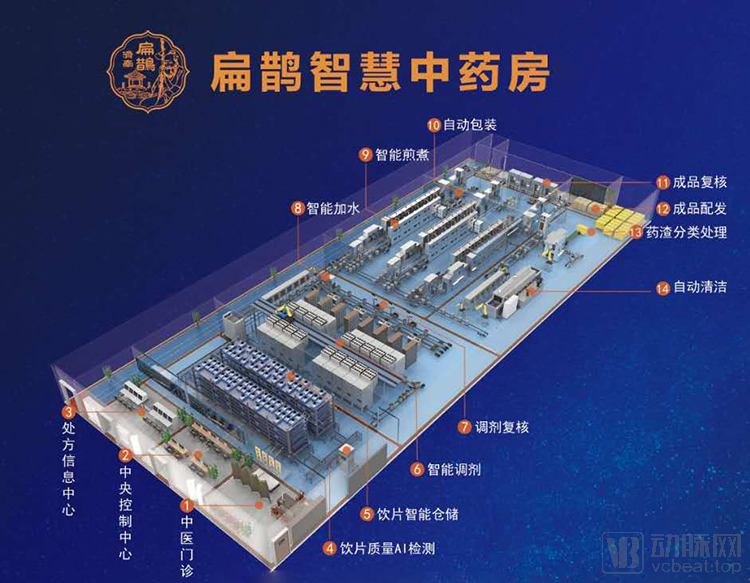
Main Components of the Bianque Smart TCM Pharmacy
The project has established a 2,300-square-meter base in Jinan. At the conference, agreements were signed with four cities—Jinan, Tai’an, Weifang, and Heze—with a total investment exceeding RMB 2 billion. According to the plan, the Bianque Smart Traditional Chinese Medicine (TCM) Pharmacy will achieve coverage across all 16 prefecture-level cities in Shandong Province by 2021, enabling residents throughout the province to access higher-quality and more convenient TCM services.
For another example, during the conference, the Jinan Central Hospital Chronic Disease Service Center, a key innovation project, commenced its trial operation.
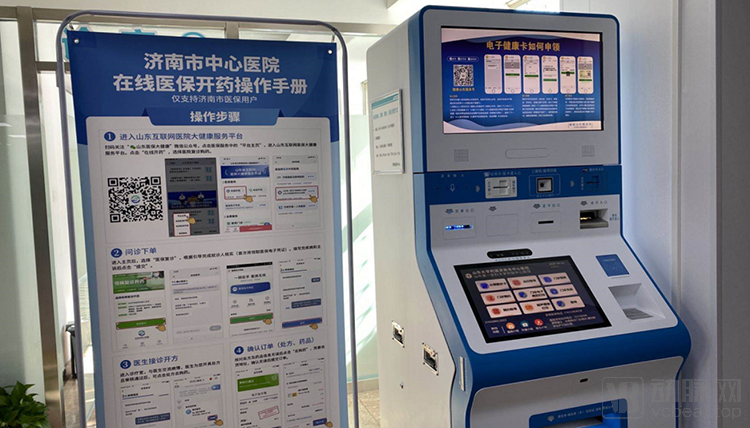
Service Guide at the Chronic Disease Management Center of Jinan Central Hospital
The center has established a centralized service area offline, including chronic disease consultation rooms, chronic disease settlement windows, chronic disease management zones, and chronic disease health education areas, to provide one-stop services for patients with chronic conditions. Online, it offers end-to-end digital services, including online consultations, prescription renewals, medical insurance payments, and medication delivery. By deeply integrating online and offline services, the center achieves cost reduction and efficiency improvement in chronic disease management.
Prior to the trial operation of this center, Shandong Province had already established a similar full-process management model for chronic diseases in Tai’an. Currently, 15 Chronic Disease Service Centers have been built in Tai’an. In the future, upon the completion of the Bianque Smart Traditional Chinese Medicine (TCM) Pharmacy in Tai’an, the integration of these two initiatives will further leverage the value of TCM in chronic disease management.
Innovative initiatives must be goal-oriented and well-paced, and should leverage spatial integration and scaled clustering to achieve complementary advantages, thereby generating a synergistic effect where 1+1>2.
During the conference, the Shandong Health Building, located in Hanyu Jin Valley of the High-Tech Zone in Jinan City, was officially put into use. Currently, digital health institutions and innovative projects that have settled in the building include the Shandong Medical Insurance Big Health Internet General Hospital, Bianque Internet Traditional Chinese Medicine Hospital, the Call Center of the Shandong Provincial Internet Medical Insurance Big Health Service Platform, the Headquarters of the Chronic Disease Service Center, the Shandong Provincial Medical Insurance Intelligent Monitoring and Data Analysis Center, and the Integrated Service Platform for Medical Insurance and Commercial Insurance.
The building will achieve complementary advantages and collaborative support by aggregating industries, concentrating resources, and integrating functions. It will provide services to the government, industry, and the public, meeting the multi-level, multi-field, and diverse health service needs of different groups through a comprehensive healthcare security service system of “Internet + Medical Insurance + Healthcare + Pharmaceuticals.”
Upon commissioning, the Shandong Health Building will continue to attract high-quality resources from China’s digital health industry, fostering an open, shared, and cluster-based development layout.
At the conference, Ma Jianzhong, President of the World Federation of Chinese Medicine Societies (WFCMS), praised Shandong Province for its series of innovative initiatives in the internet-based traditional Chinese medicine (TCM) industry. He stated that by standardizing the application of health and medical big data through the “Internet + Healthcare” model, Shandong has better met public needs, representing a favorable measure that leverages high technology and new business formats to significantly enhance the quality and efficiency of national medical services. As the host of the conference, the WFCMS also presented Jinan with the plaque designating it as the “Permanent Site of the World TCM Internet Industry Conference.”
It is evident from the above analysis that Shandong Province not only boasts a profound cultural heritage and abundant resources in Traditional Chinese Medicine (TCM), but also possesses a solid foundation for industrial development and a comprehensive TCM service system. Furthermore, the province drives industrial innovation through robust institutional innovations, implements point-to-area innovation strategies relying on innovation development projects and industrial clusters, and leverages the regular World Internet Conference on the TCM Industry to aggregate global TCM industrial resources.
Given the intensity and pace of existing policy support, as well as the speed at which projects have been implemented, Shandong Province has fostered a robust innovation ecosystem for the internet-based traditional Chinese medicine (TCM) industry. It is anticipated that further measures will soon be rolled out, with new projects becoming operational. By empowering traditional industries with digital capabilities, Shandong is also poised to create a high-quality model for the inheritance and innovation of TCM.