

Yrobot Secures Pre-A Funding from BV, Hillhouse Capital, and Linear Ventures to Advance China's First Muscle Exoskeleton

Yrobot
Developer of Next-Generation Intelligent Muscle Exosuits
VCBeat has learned at the earliest opportunity that, at the15th World Stroke Day – On October 29, Yrobot (Yuanye Technology), developer of China’s first exoskeleton for extracorporeal muscle assistance, announced the completion of its multi-million-dollar Pre-A financing round, with investment from BV Baidu Ventures, Hillhouse Venture Capital, Linear Capital, Qiaobei Capital, and Zhihui Jishi Investment.
Dr. Ding Ye, CEO of YuanYe Tech, stated, “The Muscle Exoskeleton is a novel wearable robot independently developed by us, designed to serve individuals with mobility impairments and help them regain the freedom to walk. The funds raised in this financing round will be allocated to the continued R&D of the Muscle Exoskeleton, multi-center clinical trials, device certification, market launch preparations, and market expansion.”
Across the field of intelligent rehabilitation, it is rare for a company like Yuanye Technology to secure investment from top-tier firms in its early funding rounds. So, what kind of company is Yuanye Technology? And why has it garnered the favor of leading investors?
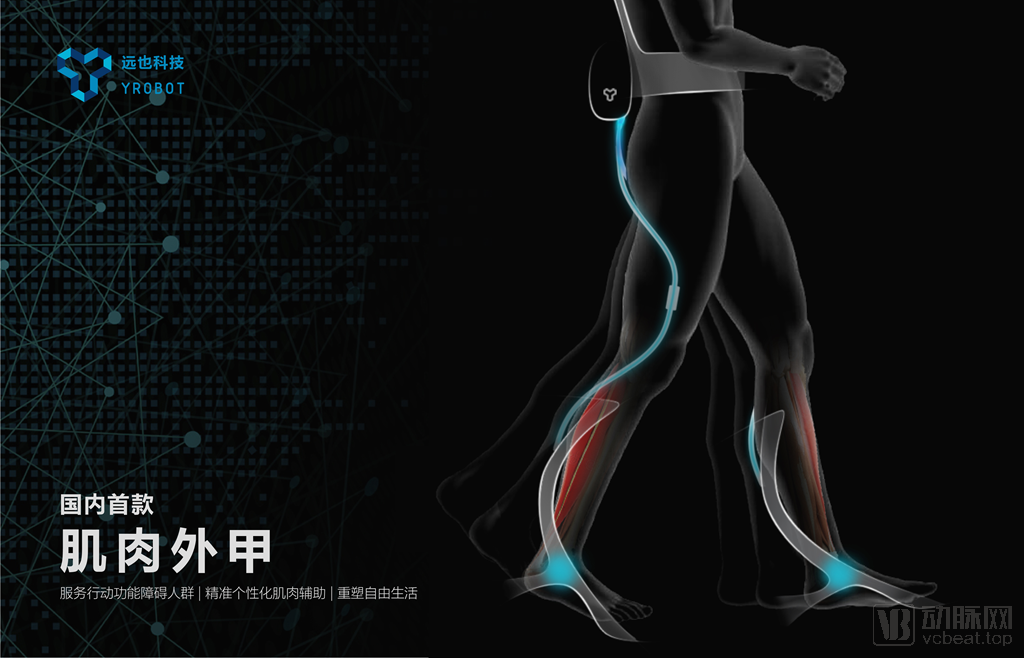
According to reports, YuanYe Tech is a cutting-edge technology company founded by a team of PhDs and master’s graduates from Harvard University and the Massachusetts Institute of Technology (MIT). The company is dedicated to empowering individuals with motor function impairments through robotics, thereby improving their quality of life. Its independently developed exomuscle system features easy wearability and autonomous learning capabilities, providing users with personalized gait assistance and adjustment solutions. By leveraging robotic support, the system helps users accelerate rehabilitation and enjoy the freedom of walking.
(Image provided by the company)
In terms of technology, YuanYe Tech has integrated artificial intelligence algorithms, robotics, flexible material design, and human biomechanics to develop the world’s first muscle exoskeleton system that is the most flexible, lightweight, and intelligent. This muscle exoskeleton system leverages machine learning to predict users’ movement intentions, highly coordinates limb movements, and provides real-time, precise muscular assistance, enabling users to perform physical actions with greater stability, ease, and accuracy. During training, patients gradually enhance their muscle control and strength, thereby improving rehabilitation outcomes and shortening recovery time.
Regarding the team, Ding Ye, Founder and CEO of YuanYe Technology, holds a Ph.D. in Engineering Sciences from Harvard University, serves as a Career Development Mentor at the Peking University Artificial Intelligence Innovation Center, and is recognized as a Leading Entrepreneurial Talent in Suzhou Industrial Park. During his doctoral studies at Harvard, Dr. Ding specialized in robotic mobility assistance technologies. His research has been published in top-tier academic journals and conferences, including Science Robotics, Journal of NeuroEngineering and Rehabilitation (JNER), IEEE Transactions on Neural Systems and Rehabilitation Engineering (TNSRE), ICRA, ICORR, and IROS, accumulating over 1,200 citations. The core team at YuanYe Technology comprises multiple Ph.D. and Master’s graduates from Harvard, MIT, and other prestigious universities, along with a group of senior engineers with decades of deep industry experience. Team members are exposed to cutting-edge global concepts, have studied under leading academic figures, and possess broad perspectives as well as extensive R&D expertise.
This groundbreaking exoskeleton technology has a wide range of application scenarios and can be effectively utilized in numerous fields, including healthcare, industry, military, and outdoor activities. However, Yuanye Technology is initially targeting stroke patients and middle-aged to elderly individuals.
Dr. Ding Ye, CEO of YuanYe Tech, stated, “Liberating a stroke patient is equivalent to liberating an entire family. We aim to initially target stroke patients—a large population with urgent needs who are the most in need of intelligent muscle exoskeleton technology—with the hope of helping them improve their quality of life.” According to the Report on Cardiovascular Health and Diseases in China 2019, there are approximately 13 million stroke patients in China, among whom 9 million suffer from lower-limb impairments, with about 2 million new cases added annually. This substantial patient population has generated significant unmet rehabilitation needs and fostered a market opportunity worth hundreds of billions of yuan.
Stroke patients require extensive gait training during rehabilitation to regain neuromuscular control. If rehabilitation is not undertaken or proves ineffective during the critical recovery window, patients may develop disuse atrophy of the lower limbs and maladaptive compensatory movement patterns, severely impairing their activities of daily living and potentially leading to long-term dependence on caregivers. Therefore, rehabilitation during the critical recovery period after stroke, particularly the quality of such training, is paramount. However, numerous challenges persist in clinical rehabilitation practice during this critical phase.
For example, there is a scarcity of rehabilitation professionals, and stroke patients receive insufficient training duration. According to public data, fewer than 20,000 professionals are engaged in rehabilitation work in China, with a shortfall of at least 300,000 rehabilitation therapists. This shortage prevents therapists from providing prolonged care to individual patients, resulting in inadequate training time for patients and ultimately compromising their rehabilitation outcomes.
Addressing the pain points in rehabilitation medicine, the market has seen the emergence of wearable robots represented by “exoskeleton robots,” aiming to alleviate challenges such as the scarcity of rehabilitation therapists and low training efficiency. However, in terms of gait assistance, the bulky structure of “exoskeleton robots” fails to provide patients with free and flexible mobility support. Patients are passively guided along predetermined movement trajectories at a slow pace, and such passive gait training yields only limited rehabilitative outcomes.
In comparison, the muscle exoskeleton independently developed by YuanYe Tech assists patients in performing precise, active gait rehabilitation training. By leveraging machine learning to analyze each patient’s gait, the system delivers optimal assistive force at the most appropriate timing, continuously and proactively adjusting to the patient’s strength requirements throughout the process. This provides positive feedback and facilitates more effective active training, ultimately enabling independent, unassisted walking.
For stroke patients, there are three core needs during the rehabilitation process: First, patients desire to engage in active training. Second, they aim for movements that are as complete as possible. Third, they require sufficiently long training sessions. YuanYe Technology’s muscle exoskeleton precisely meets these patient needs.
Commonly available "exoskeleton robots" on the market operate on the principle of supporting the patient's body weight through metal frames and using actuators to drive limb movements. In contrast, the core concept of Yuanye Technology’s Muscle Exosuit is to work in synergy with the human body, providing precise assistance to target muscles and facilitating limb movements that align with the patient’s voluntary intent. The device functions like an external muscle that “understands” the wearer, delivering precise power assistance exactly when needed. Through this approach, the Muscle Exosuit enables patients to engage in active gait training, thereby enhancing rehabilitation outcomes.
To achieve these objectives, YuanYe Tech employs multi-sensor technology to capture patients’ body posture in real time and leverages signal fusion and machine learning to predict their movement intentions. At the moment of movement initiation, the exoskeleton’s drive system responds within milliseconds to assist target muscles. Meanwhile, it adjusts robotic assistance by integrating built-in motion posture models with real-time feedback on the patient’s body posture, thereby helping patients perform movements more effectively. The system also incorporates personalized algorithms that actively learn and adjust the internal motion models and assistance strategies based on individual patients’ gait patterns, providing more targeted, precise, and personalized support.
Notably, the lightweight bionic carbon fiber frame independently developed by YuanYe Tech, combined with a high-power-density drive unit, minimizes the weight of the MyoSuit exoskeleton, significantly enhancing the wearing experience. The lightweight design, coupled with intelligent synergy algorithms, allows patients to wear and use the device without any prior training. Dr. Ding Ye stated, “The complete MyoSuit system weighs no more than 2.5 kg. Patients with mild mobility impairments can don it independently within one minute and walk comfortably, even on their first use.” This lightweight design enables patients to incorporate the MyoSuit into their daily lives, greatly expanding its range of applications, such as gait assistance for middle-aged and elderly individuals in everyday settings, mobility support for patients with lower-limb disabilities, and lower-limb rehabilitation training.
Zhang Yuhao, Executive Director of Baidu Ventures (BV), also stated, “The health and elderly care market represents a substantial area of inelastic demand driven by demographic shifts. Within this sector, sports rehabilitation constitutes a primary need. However, traditional sports rehabilitation products have low technical barriers and fail to adequately address the personalized rehabilitation needs of stroke patients and the elderly. The team at YuanYe Technology has pioneered an intelligent muscle exoskeleton platform that enables precise dynamic motion capture and muscular assistance, providing personalized, full-cycle rehabilitation treatment plans tailored to the clinical needs of diverse stroke patients and older adults. BV has long been optimistic about and supportive of the team’s efforts to commercialize technological products in this sector, and we look forward to the company’s intelligent rehabilitation products benefiting society in the near future.”
Dr. Ding Ye told VCBeat, “As China’s first exoskeleton robotics company, YuanYe Technology aims to bring a more positive, joyful, and independent life to more people through this cutting-edge technology, helping individuals with mobility impairments improve their quality of life and enjoy the freedom of walking. In the future, YuanYe Technology will leverage big data, cloud computing, and other technologies to develop personalized, scientifically grounded gait training programs for stroke patients and middle-aged and elderly individuals across hospitals, communities, and homes. By adopting a ‘technology + internet + rehabilitation’ model, we seek to alleviate the caregiving burden on families of those with mobility impairments.”
(Provided by the company)
About BV Baidu Ventures
BV (Baidu Ventures) is an independent venture capital firm initiated by Baidu and managed by a professional team. Its limited partners include Baidu as well as other leading industrial and financial institutions. BV currently manages three funds denominated in USD and RMB, with a total asset under management of $500 million. Operating simultaneously in Beijing and San Francisco, BV is committed to becoming a world-class VC in the AI era. Dedicated to building a more efficient intelligent world, BV has invested in over 100 AI companies to date.
About Hillhouse Capital
Hillhouse Ventures is a venture capital fund under Hillhouse that focuses on early-stage innovative companies, primarily investing in four key sectors: biopharmaceuticals and medical devices, software and hard tech, consumer internet and technology, and emerging consumer brands and services.
# About Linear Capital
Linear Capital, established in September 2014, is a professional investment firm focused on Data Intelligence and frontier technology sectors. It primarily targets investment opportunities in Data Applications, Data Infrastructure, and applications of frontier technologies. The firm maintains offices in Shanghai and Beijing. Its initial investments are mainly led from the angel stage to Series A, with continued support throughout the entire lifecycle to foster the growth of outstanding portfolio companies. To date, Linear Capital has invested in over 80 startup teams, including Horizon Robotics, Tongdun, Kujiale, Sensors Data, Tezign, Rokid, Guandata, Spirit AI, and WM Motor, with the combined valuation of its portfolio companies reaching approximately $15 billion.
About Qiaobei Capital
Qiaobei Capital is a private equity investment fund with an investment banking background, focusing on hard technology and the biopharmaceutical industry. Adhering to a boutique investment style, Qiaobei Capital advocates a comprehensive post-investment service philosophy. Leveraging 20 years of expertise and resources in investment banking, it fully supports and accompanies portfolio companies in their growth, serving as a significant shareholder and long-term partner. To date, Qiaobei Capital’s invested companies include Quectel Wireless Solutions, Video++, DeepVision Technology, Nengxun Semiconductor, Guangtong Tianxia, Yrobot, Yinhang Biotechnology, Xinwan Biotechnology, Obio Technology (Shanghai), Nearshore Protein, Epu Biotechnology, Yiyi Co., Ltd., and Weineng Technology, among others.
About Smart Cornerstone
Wisdom Cornerstone is an incubator and investment firm dedicated to early-stage artificial intelligence startups. In just a few years, it has incubated and invested in dozens of AI companies spanning numerous industries, including healthcare, education, finance, and entertainment robotics. More than 30% of these portfolio companies have emerged as leaders in their respective sectors. Lei Ming, founder of Wisdom Cornerstone Capital, is one of Baidu’s “Seven Swordsmen,” the founder of Kuwo Music, and the Director of the Peking University Artificial Intelligence Innovation Center.