

Dunlee Advances Integrated Solutions and Localization Strategy to Expand Market Reach

Dunlee
Innovative Component R&D and Manufacturing for Imaging Solutions
On October 19, 2020, the 83rd China International Medical Equipment Fair (Autumn) (hereinafter referred to as CMEF) kicked off at the National Exhibition and Convention Center in Shanghai. The imaging section stood out with its unique presence, occupying two exhibition halls, where a large number of medical imaging devices such as CT and MR systems were on display.
The surge in demand for medical imaging equipment has been driven by the pandemic. As a critical tool for diagnosing COVID-19 patients, CT and DR systems played an irreplaceable role during the outbreak, with their market penetration expanding continuously from tertiary hospitals down to lower-tier institutions.The increased utilization frequency of medical imaging equipment has become an intrinsic driving force, leading to a rise in demand for high-value consumables such as CT X-ray tubes. To meet the urgent needs of the Chinese market, Dunlee, a supplier of core components for medical imaging equipment, rapidly adjusted its production plans to help domestic imaging equipment manufacturers address supply chain challenges.
At this year’s CMEF, Dunlee made its scheduled appearance. As an upstream supplier to major medical imaging companies, Dunlee showcased a range of components and integrated solutions for CT, DR, and MR imaging equipment at its booth. Taking CT component offerings as an example, the portfolio spans entry-level to high-performance X-ray tubes, including the CTR1600 series, CT5000, CT8000, DA200 series, and replacement tubes for the S532/Akron series. Additionally, the company displayed its product combinations Xpert-CT8000, Xpert-CT6000, and Xceed-CT4000, along with 2D tungsten anti-scatter grids.
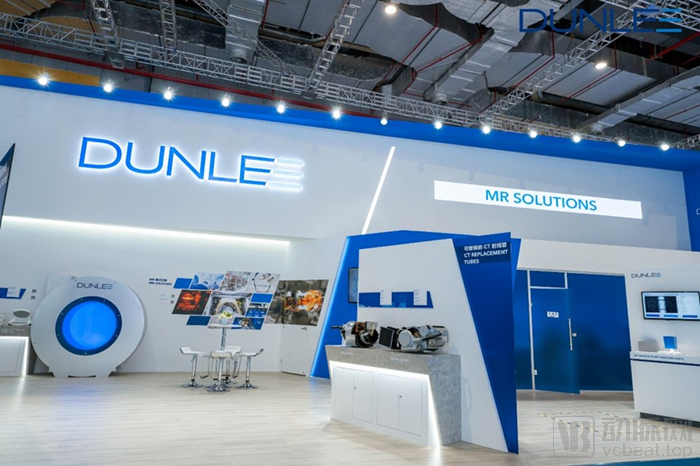
Panoramic View of the Dunlee Booth at CMEF
To gain deeper insights into the current state of the supply chain in the medical imaging equipment sector and to explore production capacity issues for imaging devices under the new public health defense system, VCBeat interviewed Deng Kai, Sales Director for Dunlee China, at the CMEF.Mapping the Current State of Core Components in Imaging Equipment: Insights from a Century-Old Enterprise
Transformation and Development: Dunlee Explores Pathways to Breakthrough
Dunlee, a U.S. company founded in 1946, boasts a long and storied history. Since its inception, it has successfully developed and manufactured X-ray imaging tubes, thereby gaining entry into the high-end CT market. Despite numerous market fluctuations, Dunlee has continued to transform and develop along its own strategic path.
The transformation began in the first year of the 21st century. In 2001, Dunlee was acquired by Philips Healthcare and continued to strengthen its presence in the field as a subsidiary. Philips Healthcare’s leadership in X-ray tube technology further empowered Dunlee, enhancing its capabilities in tube research and development.
Benchmarking against the market and implementing timely strategic upgrades has been a key factor enabling Dunlee to maintain its long-term market presence. In 2017, Dunlee decided to undertake another round of integration by closing its factory in Aurora, United States, and transferring its operations to Philips’ X-ray tube facility in Germany. Meanwhile, Philips also pursued strategic upgrades, continuing to advance large-scale medical imaging equipment such as CT, MRI, ultrasound, and cardiovascular systems, while actively expanding its components and modules business to further broaden its market reach. The Chinese market represents a critical component of this strategy.
When the pandemic struck and numerous factories faced shutdowns, Dunlee promptly relayed market demand to its German facility and arranged for the timely resumption of operations at its Suzhou plant, thereby addressing the challenge of insufficient X-ray tube production during the outbreak.
Dunlee’s China Sales Director, Deng Kai, stated: “At present, Dunlee is placing increasing emphasis on localization. We recognize that localization is a critical factor for success in the Chinese market. However, localization extends beyond manufacturing; it primarily involves localizing personnel and services. In terms of production, we will continue to shift the manufacturing of more products to our Suzhou manufacturing center. Regarding personnel and services, we aim to enable Chinese customers to communicate with local sales and service representatives without time zone differences or language barriers, thereby receiving their support. This approach allows our local team members to engage early in the initial stages of customer projects, collaborating with customers on project development to better understand and meet their needs.”
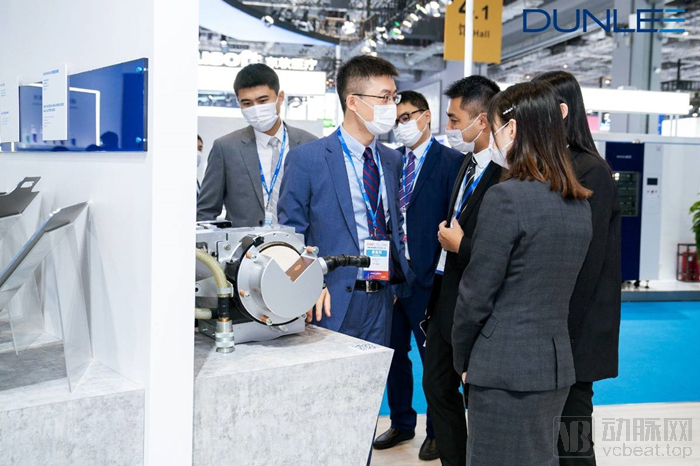
Dunlee’s Sales Director for China, Deng Kai, introduces products to customers at the Dunlee booth during CMEF.
From positioning itself in the high-end segment to expanding its product line, and from focusing on overseas markets as its primary target to establishing a presence in China, a review of Dunlee’s development trajectory clearly reveals its well-defined strategic planning and its ambition to achieve a leading position in the X-ray tube market.Its strategic shifts in the research, development, and manufacturing of core components for medical imaging equipment will influence the development trajectory of this field. Dunlee’s emphasis on product localization at this exhibition underscores its determination to deepen its presence in the Chinese market.
So, in the face of market changes, how has Dunlee been able to accurately execute strategic pivots and identify a development path aligned with the conditions of the Chinese market?
First, Dunlee proposed a collaborative philosophy transitioning from product supplier to total solution provider.Dunlee stated, “This concept emerged in response to evolving market and customer demands. We are increasingly observing a trend: Chinese customers’ expectations for imaging equipment, particularly in terms of demand patterns and R&D speed, have diverged from those in other international markets. Therefore, we cannot focus solely on relatively mature markets; instead, we must seek survival through collaboration. Specifically, Chinese customers not only require us to enter the market rapidly, but their needs are also shifting from entry-level devices to high-end, cutting-edge imaging systems. Dunlee must explore pathways to break through amidst these changes.”
Secondly, Dunlee also reduces barriers to adoption for customers by providing comprehensive solutions for the entire imaging chain, thereby shortening product time-to-market and meeting China’s growing demand.
However, a comprehensive strategic layout alone, without a practical commercial implementation system, is insufficient to support Dunlee’s ambition to continuously expand its market boundaries.
In establishing its business model, Dunlee has carved out a unique positioning.The company does not limit itself to providing individual components for imaging equipment; instead, it builds on its capability to deliver comprehensive imaging chain services, offering personalized CT, MR, and X-ray imaging solutions tailored to customers’ specific needs and the characteristics of their imaging devices.
Meanwhile, Dunlee has also launched its comprehensive solution, Dunlee Solutions+, providing support to customers across four key stages—definition, integration, production, and operations—and safeguarding the entire development and manufacturing process of customer equipment. With the support of Solutions+, customers can access customized components and component integration services during the initial phase of product development, while also receiving technical support from Dunlee for parts maintenance and upgrades during the production phase and upon system delivery. This approach ensures smooth product implementation, effectively shortens time-to-market, and maintains competitiveness among similar products.
Deeply Addressing Pain Points to Build a Robust Product Pipeline
In building its product portfolio, Dunlee has adopted a strategy of expanding outward from its core X-ray tube equipment.Dunlee has established a high-end product portfolio, represented by the CT8000 Xpert combo kits, enabling rapid integration of imaging solutions for equipment customers while delivering both superior image quality and wide coverage. Keeping pace with industry trends and aligning with China’s healthcare reform objectives of universal coverage and basic care assurance, Dunlee has launched a range of high-quality, multi-tiered medical products—including MRI magnets, Invivo coils, 3D-printed anti-scatter grids, and other general components. These offerings lower market entry barriers and help address the practical needs of a broader patient and provider base, thereby accelerating time-to-market.
Leveraging its years of experience in MR integrated solutions, Dunlee also offers a range of related products.
At this year’s CMEF, Dunlee showcased its portfolio of products specifically designed for various anatomical regions, elemental quantification, field strengths, and imaging applications, including Invivo MRI coils for breast, lung, neurology, cardiac, and orthopedic imaging.
It is evident that although Dunlee has extended its product line to some extent, CT remains its core focus. Leveraging a century of technological and product expertise in the CT field since its origins as an X-ray tube manufacturer, Dunlee offers a comprehensive portfolio spanning entry-level, mid-performance, high-end, and ultra-high-end systems. This complete product range enables Dunlee to meet diverse customer needs, which will undoubtedly help the company further expand its market presence.
Secondly, in the field of MRI, Dunlee is no longer just a single magnet supplier but has expanded its business scope to include the integration of “Invivo” coil solutions. As a next step, Dunlee will continue to launch gradient amplifiers and RF amplifiers, as well as other components for MRI imaging equipment.
In addition to the two major segments of MRI and CT, Dunlee is also making further strategic moves in the market by exploring solutions for radiotherapy and other sub-segments.
Overall, Dunlee is expanding its footprint in the medical imaging sector by evolving from its established expertise in CT to providing corresponding solutions for MRI, with plans to cover the majority of needs across the imaging chain.
“Product price is undoubtedly a very important factor, but we place greater emphasis on the total cost of ownership or maintenance costs for customers over the product’s entire lifecycle,” said Deng Kai.
Dunlee has its own perspective on pricing strategy.When engaging with customers, Dunlee places greater emphasis on the total cost of ownership throughout the entire lifecycle of imaging equipment, from manufacturing to clinical use. During the pandemic, CT utilization in China surged significantly, leading to corresponding changes in the wear-and-tear rates of X-ray tubes, a high-value consumable component within CT scanners. Wear necessitates replacement; given the large patient volume and high scan throughput in China, there are heightened demands on the service life of X-ray tubes in medical imaging equipment. Consequently, rather than focusing solely on the unit price of consumables such as X-ray tubes, Dunlee aims to reduce costs by optimizing the entire lifecycle process of high-value medical imaging consumables, from production to end-use.
Meanwhile, to address the unmet needs of the grassroots market, Dunlee has also launched entry-level products, which are developed and priced based on market demand.Dunlee stated, “Entry-level products do not imply a compromise in performance; rather, they are fully capable of meeting the needs of primary healthcare facilities. There is no need to pursue excessively high specifications, as high-end products often exceed actual requirements, leading to performance redundancy and waste in hospitals. Therefore, controlling the initial cost of our products significantly helps reduce the total system cost, thereby providing more options for primary hospitals and medical institutions.”
“Full-Chain” Layout Lays the Foundation for Market Expansion
A review of the products and concepts presented by Dunlee at this CMEF reveals that the company has begun to strategically position itself in the medical imaging sector with high-value consumables spanning the entire imaging chain, offering corresponding product portfolios and solutions. Dunlee is not merely a single-modality imaging equipment supplier; rather, leveraging integrated internal resources, it provides its own product portfolios and solutions for a broader range of imaging equipment.
However, as Deng Kai stated, “Domestic companies are currently more focused on achieving breakthroughs in specific areas and still lack the ability to provide comprehensive, mature solutions.” It can thus be seen that Dunlee’s “full-chain” layout represents an alternative strategic approach amid changes in the market landscape.