

How WangHai KangXin's 'Five-Optimization' Supply Chain Solution Empowers Hospitals to Navigate the 'Year of Economic Management'
Supply chain management has always been a focal point and a significant challenge in hospital administration. In particular, the sudden outbreak of the COVID-19 pandemic at the beginning of this year dealt a severe blow to hospital supply chains, profoundly impacting hospital operational management in unprecedented ways. In response, in June, the National Health Commission and the National Administration of Traditional Chinese Medicine jointly issued the "Notice on Launching the 'Year of Economic Management' Campaign in Public Medical Institutions." The Notice explicitly requires public medical institutions to firmly embrace the concept of "practicing strict austerity," strengthen the integration of business and finance, and standardize the management of supplies and consumables. This has imposed substantial disruption and considerable challenges on hospital supply chain management.
How will these new policies impact hospital supply chain management? How can hospitals leverage their supply chains to achieve the management goals of cost reduction, quality improvement, and efficiency enhancement? What is the promotional value of the Unique Device Identification (UDI) system, which is being vigorously promoted by the state? On October 23, the academic symposium on “Hospital Supply Chain Management in the Context of the Economic Management Year,” hosted by the China Association of Medical Equipment and the First Affiliated Hospital of Guizhou University of Traditional Chinese Medicine, and co-organized by Beijing Dongruan Wanghai Technology Co., Ltd., was held in Guiyang. At the conference, numerous scholars and experts shared their insights and perspectives.
Dr. Zhang Liang, Chief Supply Chain Consultant at Wanghai Kangxin and co-author of the Peking University First Hospital case study, believes that the pain points in hospital supply chain management can be primarily summarized into three aspects.
First, hospital supply chain management faces the pain point of cost control. In the past, medical consumables, which carried a markup, became an important source of revenue for hospitals. Against the backdrop of the earlier elimination of drug markups, the proportion of medical consumables in hospital revenue has surged unexpectedly, making them the largest component of hospital income.
However, with the implementation of DIP and DRG payment systems, along with the elimination of markups on medical consumables, these items have shifted from being a source of hospital revenue to a component of hospital costs. To achieve surpluses under bundled payment models, hospitals will inevitably impose stricter controls on the use of medical consumables. Meanwhile, maintenance and depreciation expenses for large-scale medical equipment, which account for a significant proportion of hospital costs, will also receive heightened attention.
In this regard, Duan Chenghui, Chairman and CEO of Beijing Dongruan Wanghai Technology Co., Ltd., also noted at the seminar that, based on the operational data of over 3,000 hospital clients since 2017, nearly 70% of a hospital’s annual costs are incurred in supply chain operations, including equipment depreciation and logistics. Despite this, hospitals cannot crudely or simplistically reduce procurement and supply costs; instead, they must strike a balance between cost control and the effectiveness of clinical services. Hospitals require scientifically grounded, specialty-specific cost management approaches supported by reasonable and objective evidence. This underscores that supply chain cost control represents a significant pain point and challenge for hospitals.
Second, evaluating the utilization of hospital consumables and equipment is also a major challenge in supply chain management. Have these consumables and devices met their initial procurement objectives? How can their effectiveness be assessed based on data? This is critically important for hospitals, yet it remains a difficult task to accomplish.
For example, requests for internal hospital equipment and consumables are initiated by clinical departments. In most cases, these departments submit requests based on limited information, incurring virtually no cost. However, from the perspective of operations management and medical administration, evaluating these demands requires significant labor costs. Meanwhile, such assessments often lack adequate data support.
Wu Xiaodong, Director of the Equipment and Materials Department at West China Hospital of Sichuan University, also stated that, against the backdrop of the “Year of Economic Management,” hospitals urgently need supply chain management to internally integrate information on physicians, patients, and departments, and externally connect information from manufacturers and suppliers. By streamlining end-to-end data processes, this approach aims to support clinical services and provide robust evidence for hospital governance and decision-making, ensuring that data speaks objectively and truthfully.
“This data actually presents a challenge for hospitals in terms of data extraction and analysis for management purposes, but it also serves as an important basis for later procurement evaluations, repeat purchases, or procurement decision-making,” Zhang Liang told VCBeat.
Meanwhile, against the backdrop of cost control, evaluating the effectiveness of consumables and equipment facilitates lean management in hospitals. For instance, although some consumables are relatively expensive, they make significant contributions to reducing the proportion of pharmaceutical costs within specific disease groups and improving hospital bed turnover rates. Overall, the use of such consumables proves more cost-effective for patients, hospitals, and physicians’ clinical practice alike.
“Therefore, following the implementation of DIP or DRG, supply chain management for medical consumables needs to become more rational. This requires data support, particularly through close integration with clinical data. Hospitals need to establish this linkage and let data speak, thereby determining the true cost of consumables when combined with clinical practice under DRG payment.” Zhang Liang believes that after the implementation of DIP or DRG, data can help hospitals better assess the utilization effectiveness of medical consumables.
Third, hospital consumables management also faces pressure from various compliance inspections, such as unannounced medical insurance audits and financial audits, which impose significant burdens. According to management requirements, every consumable or piece of equipment received into the hospital inventory must undergo standardized acceptance inspection. However, in practice, hospitals occasionally experience non-compliance in the inbound acceptance process due to errors or omissions arising from manual data entry.
Meanwhile, due to imperfections in the hospital’s existing management mechanisms and oversights caused by the heavy workload of clinical staff, there may be a significant disconnect between clinical departments and logistics management regarding the documentation of medical supply usage. This issue will become a key focus of health insurance compliance audits, placing immense pressure on hospitals. To ensure procedural compliance, clinical departments must expend considerable effort on medical supply management, often with suboptimal results.
Finally, hospital material management, which includes the management of consumables and equipment, not only involves a vast quantity but also encompasses an extensive variety of categories and specifications. This results in extremely high complexity and significant difficulty in managing hospital supply chains. “Some consumables are high-value, while others are low-value; some require sterilization, while others do not; and some even require cold-chain logistics. Therefore, hospital supply chain management is particularly complex, with highly intricate management processes and models tailored to different types of consumables,” stated Zhang Liang, emphasizing that hospital supply chain management is a highly complex undertaking.
Wanghai Kangxin’s “Five-Optimization” Supply Chain Solution enables optimal selection, procurement, supply, management, and evaluation of medical consumables and suppliers. By integrating with Internet of Things (IoT) technology, the solution achieves real-time response for inbound and outbound inventory movements and end-to-end traceability throughout the entire process. Compared to the traditional annual cost accounting approach, this solution facilitates real-time cost calculation, accurately reflecting hospital expenses and significantly enhancing the accuracy and timeliness of hospital cost accounting.
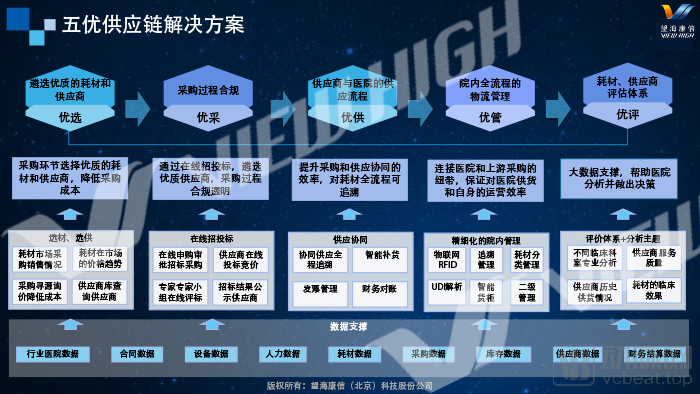
Wanghai Kangxin’s Five-Excellence Supply Chain Solution (Image from Wanghai Kangxin)
Addressing the pain points in hospital supply chain management regarding inventory consistency and surplus stock oversight, Beijing Dongruan Wanghai Technology Co., Ltd.’s Wuhai Kangxin Five-Excellence Supply Chain Solution leverages information technology and the Internet of Things (IoT) to achieve efficient collaboration and precise distribution throughout the procurement process. For instance, procurement supports mobile office operations via PAD devices, enabling approvals anytime and anywhere, thereby significantly enhancing approval efficiency. Medical supplies are managed using barcode systems for scanning during inbound and outbound processes and record-keeping, which reduces the inefficiencies of manual entry, enables full-process traceability, and prevents non-compliant practices. Qualification certificate management offers online administration and expiration date alerts, effectively resolving critical pain points in hospital supply chain management.
“We have integrated the entire process from tendering and procurement to final clinical workflows, extending our reach to various entities across different supply chains. With the national rollout of UDI (Unique Device Identification), if coverage extends to manufacturers, we will be able to trace products back to their sources. In this way, we cover all key stakeholders, including manufacturers, suppliers, hospitals, hospital departments, physicians, and patients. This represents a comprehensive enhancement in overall supply chain coverage for hospitals,” stated Zhang Liang, noting that Wanghai Kangxin’s Wuyou Supply Chain Solution has successfully streamlined the end-to-end process.
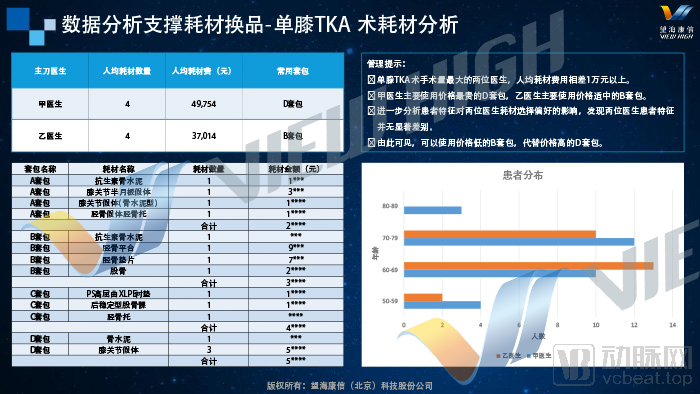
Wanghai Kangxin’s Five-Excellence Supply Chain Solution Enables Precise Control of Disease-Specific Costs (Image source: Wanghai Kangxin)
Most critically, by analyzing cost accounting data, hospitals can precisely control the costs incurred by disease groups and optimize clinical pathways. Taking unilateral total ankle arthroplasty (TAK) as an example, cost accounting reveals significant variations in the cost of consumable kits used by different physicians. From the perspective of patient age and gender alone, hospitals could replace high-cost consumable kits with lower-cost alternatives. Further in-depth analysis of the economic performance of these consumables would provide more precise leverage for consumables management.
The First Affiliated Hospital of Guizhou University of Traditional Chinese Medicine has recently upgraded to the Wanghai Kangxin Wuyou Supply Chain Solution. Tao Wanju, Chief Accountant of the hospital, stated that in recent years, the increasingly stringent unannounced inspections and routine checks conducted by the National Healthcare Security Administration have compelled hospitals to comprehensively upgrade and innovate their internal operational management. This supply chain upgrade has not only transformed the hospital’s supply chain management model and effectively achieved the goals of cost reduction and efficiency improvement, but also created room for structural adjustments by squeezing out “costs” from the supply chain. These measures have significantly promoted and facilitated the recognition of healthcare professionals’ value and the practice of value-based healthcare.
Of course, data must still defer to physicians’ clinical judgment. As Duan Chenghui, Chairman and CEO of Beijing Dongruan Wanghai Technology Co., Ltd., stated: “I believe that treatment protocols will inevitably become a key competitive advantage for every hospital and every specialty. Hospitals that can optimize clinical pathways based on cost data will certainly gain a strategic edge. However, this does not mean that cheaper is always better; rather, the focus should be on rational medication and appropriate treatment. A less expensive regimen that results in a prolonged recovery period or even complications—keeping a patient hospitalized for 20 days—is clearly inferior to a more costly option that may allow discharge within five days. Therefore, from the patient’s perspective, only physicians are best positioned to determine which treatment plan is optimal.”
Another advantage of Wanghai Kangxin’s Five-Excellence Supply Chain Solution is the establishment of a closed-loop system, encompassing both a small intra-hospital loop and a larger overall loop for medical consumables.
The "small closed-loop" within the hospital refers to completing an internal closed-loop within the medical engineering department, encompassing the entire process from clinical inventory inbound and outbound operations to purchase, sales, and inventory management, thereby facilitating management and traceability. The "large closed-loop" for consumables as a whole refers to the clinical utilization of consumables, economic evaluation, and the application of evaluation results. Examples include performance assessment of hospital procurement activities and decision-making closed-loops for subsequent procurement.
“I believe that implementing a closed-loop system is a crucial step we are currently taking to further refine the hospital supply chain framework. It is quite pioneering. On a macro level, we have initially achieved a closed loop that spans from customer requisition and purchase order placement with suppliers, through inventory management (inbound, outbound, and stockkeeping) and clinical utilization, to post-use evaluation, with the evaluation results subsequently informing procurement decisions. Of course, as this is a new solution, certain details still require refinement.” Zhang Liang stated that the closed-loop mechanism is a major advantage of Wanghai Kangxin’s “Wu You” (Five Excellences) Supply Chain Solution.
Leveraging years of experience serving top-tier hospitals and real-world hospital data, Wanghai Kangxin has developed a data model for hospital supply chains and, based on this, proposed a five-level supply chain maturity framework. Furthermore, Zhang Liang stated that as coverage of hospital supply chain entities expands and integration deepens, the solution will continue to broaden its supply chain scope and achieve closer integration with clinical operations, thereby facilitating the optimization of hospital supply chains.
“Changes in healthcare payment methods are akin to a butterfly effect: from the broader healthcare system and insurance companies to individual doctors, nurses, and patients, all relevant stakeholders and institutions must adapt.” This was UH’s prediction regarding U.S. healthcare reform 16 years ago, and it remains relevant today; over the next 16 years, this scenario is highly likely to be replicated in China.
As a dedicated provider of information technology and data services for lean hospital operations, Beijing Dongruan Wanghai Technology Co., Ltd. has accumulated over a decade of experience in hospital supply chain operation and management since its inception in 2003. Against the backdrop of the “Year of Economic Management,” which places significant emphasis on cost control, Wanghai Kangxin’s “Wuyou” (Five-Excellence) Supply Chain Solution aligns with reform trends and hospital needs by integrating advanced management concepts, IT technologies, and data services. It is poised to become a new engine driving healthcare institutions toward efficient development, actively empowering hospitals in their pursuit of lean management.