

Post-Pandemic 'Grand Review': The Future Trajectory of China's High-End Medical Equipment Industry

United Imaging
High-end Medical Device Developer
“The world is currently undergoing profound changes unseen in a century.” On October 14, General Secretary Xi Jinping emphasized at the ceremony marking the 40th anniversary of the establishment of the Shenzhen Special Economic Zone: “The new situation calls for new responsibilities and new initiatives.”
From the once “wildly growing” tide of commodity economy to today’s “new development pattern of dual circulation,” forty years of dramatic changes have witnessed the courageous advance, as well as the divergent paths of success and failure, of a generation of Chinese tech entrepreneurs. It is becoming increasingly clear who is capable of shouldering the heavy responsibility of “new accountability and new achievements.”
In 1984, in a 12-square-meter guardroom at the Institute of Computing Technology of the Chinese Academy of Sciences, 40-year-old Liu Chuanzhi laid the foundation for his business by distributing imported PCs from IBM and other brands. Three years later, in the autumn of 1987, 44-year-old Ren Zhengfei established Huawei, struggling to get started in Shenzhen by distributing analog switches imported from Hong Kong. Under immense competitive pressure from the influx of foreign capital, Lenovo rejected Academician Ni Guangnan’s technical roadmap for chip development, opting instead to prioritize capturing market share through economies of scale and cost advantages, with plans to invest in R&D only after accumulating sufficient resources. Lenovo later acquired IBM’s PC division and ascended to the throne of global PC dominance, but gradually declined amid the tide of the times due to a lack of subsequent innovation. In contrast, Huawei went all-in on independent R&D, breaking through barriers along the way, and ultimately emerged as the undisputed leader in China’s technology sector.
The same story has played out repeatedly in the field of high-end medical equipment. As a typical capital- and technology-intensive industry, medical imaging features products with high technological content, substantial upfront investment, and high profit margins, while establishing market share requires a considerable amount of time. Leveraging centuries of accumulated expertise, overseas companies have easily monopolized the global market for medical imaging equipment.
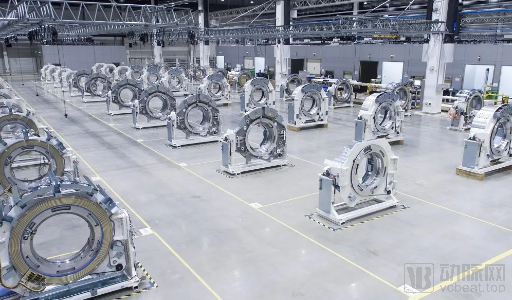
At this point, the question of whether to prioritize “trade-industry-technology” or “technology-industry-trade” no longer requires an answer.In the field of high-end medical equipment, technology reigns supreme.
“Domestic Substitution” is a term that has emerged in recent years, but tracing its origins reveals that pioneers already grasped its underlying logic as early as the onset of China’s reform and opening-up.
Rewind to Shenzhen 40 years ago: A large cohort of local medical device enterprises emerged rapidly in the wake of China’s opening-up policy. However, compared with capital- and knowledge-intensive large-scale equipment, most companies either opted to distribute imported devices or started with product categories featuring low technological barriers. In the face of an influx of foreign industry giants, their room for survival has become increasingly constrained.
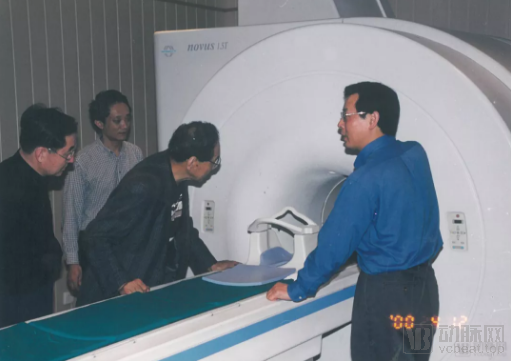
In 2000, at Shenzhen Meditech, Xue Min introduced China’s first 1.5T superconducting MRI system to experts.
In 1991, Li Xiting and several ambitious young professionals left Anke, known as the “Whampoa Military Academy” of China’s medical device industry, to found Mindray Medical. After rapidly rising through distribution businesses, Mindray began to comprehensively focus on independent research and development. In 1998, Xue Min returned to China with a group of overseas-educated scholars and established Shenzhen Meditech, successfully developing China’s first 1.5T superconducting magnetic resonance imaging (MRI) system, thereby ending the country’s lack of domestic capabilities in the field of superconducting MRI.
The path of entrepreneurship is fraught with peril, and independent innovation is even more riddled with obstacles. While many have amassed wealth in the market economy by leveraging price and channel advantages, taking the next step forward proves exceedingly difficult. Medtronic, an emerging player, was forced to sell a majority of its equity to an international giant due to its dependence on foreign suppliers for core components, thereby becoming a key foundation for the giant’s comprehensive expansion in China.
Years later, the drive for innovation compelled Xue Min to start anew, determined to build a world-class high-end medical equipment enterprise based on independent innovation across its full product portfolio and core components. “This is the most difficult path, but also the only one that can lead to success,” stated Xue Min, Chairman of United Imaging Group, on multiple occasions.
The sudden outbreak of the epidemic has served as both a baptism for the medical equipment industry and a trial for United Imaging Group and many other supporters of “national heavyweights.”
In the early stages of epidemic prevention and control, the shortage of primary healthcare resources was fully exposed. Masks and protective suits were in critically short supply, while CT scanners and ventilators were extremely scarce. The emergency response capabilities, product innovation capacities, and supply chain coordination abilities of medical enterprises faced severe tests.
At the critical moment, the momentum accumulated over many years through the state’s vigorous promotion of the revitalization of the high-end medical equipment industry was rapidly converted into substantial kinetic energy. The increasing completeness of upstream and downstream supporting supply chains, the growing maturity of industrial clusters, and continuous breakthroughs in technological barriers have enabled a large number of domestic enterprises to seize this opportunity and stage a remarkable turnaround.
Data from Ipsos, a globally renowned market research firm, shows thatIn the first half of 2020, United Imaging, a leading domestic manufacturer, surged to the top spot in sales of clinically practical CT and MRI systems in China, far surpassing multinational giants that had long held the lead. Mindray, the veteran player in the medical device industry, saw its ventilators and chemiluminescence immunoassay analyzers rise to the number one position in domestic market share.
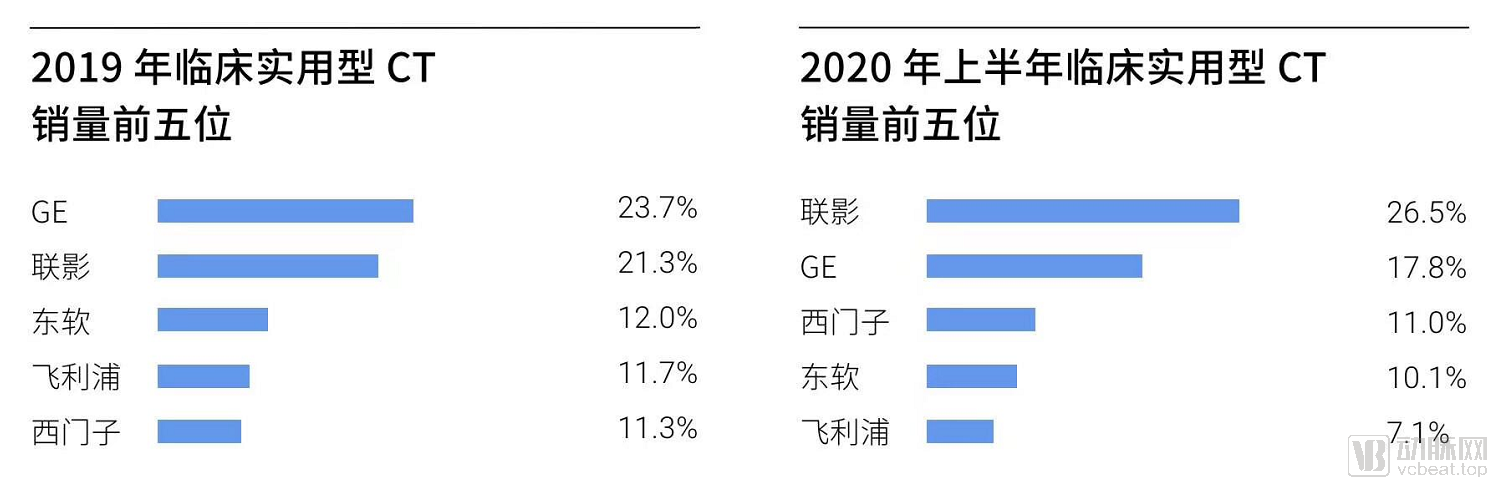
CT Market Share (Data Source: Ipsos)
Small and medium-sized imaging enterprises have also held their ground, as a robust wave of localization for core components of imaging equipment sweeps across the industry. Numerous companies are actively developing proprietary X-ray tubes, generators, and magnetic coils, ushering the medical imaging equipment sector into an era of comprehensive domestic production across the entire industrial chain.
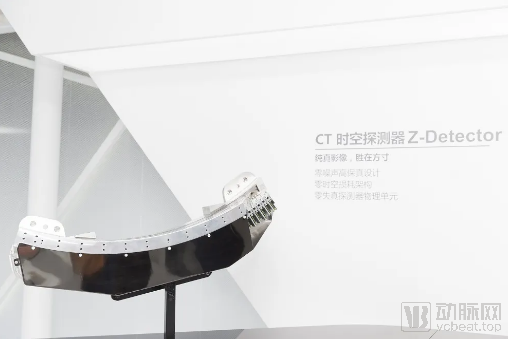
As early as a few years ago, domestic manufacturers of high-end medical equipment had already begun showcasing their independently developed core components at the CMEF.
The emergence of the pandemic has further fueled the momentum for domestic substitution, igniting nationwide enthusiasm for strengthening public health infrastructure. The Ministry of Finance, the National Healthcare Security Administration, and the National Development and Reform Commission have successively allocated over RMB 80 billion in subsidies to enhance medical services and emergency response capabilities. Provincial and municipal development and reform commissions have also rolled out three- to five-year development plans, announcing more than 1,300 healthcare-related projects with a total investment of RMB 6.3 trillion, aimed at constructing, upgrading, and renovating medical institutions at all levels.This has been followed by the procurement of key medical devices, with continuous introduction of national support policies. Nearly 30 provinces, municipalities, and autonomous regions across China, including Shanghai, Guangdong, and Sichuan, have responded in succession by explicitly supporting domestically produced equipment.
The achievements of domestic substitution were evident at the recently held CMEF. In addition to the continuous emergence of numerous emerging domestic brands bringing innovative, clinically practical products, leading Chinese manufacturers have long moved beyond the outdated paradigm of “domestic substitution,” launching a series of industry-leading, original innovations.
At the United Imaging exhibition booth, China’s first 9.4T ultra-high-field animal MRI scanner has attracted significant attention. This “in vivo microscope for animals” leverages its ultra-high field strength to precisely visualize the structural and functional information of living animal tissues, providing a powerful research platform for translational medicine. This, in turn, advances the exploration of fundamental life science questions, such as those related to the brain and cognition, as well as medical challenges including tumors and neurological disorders.
“The advancement of medicine is inseparable from basic experimental research in the life sciences, for which life science instruments serve as essential tools. For a long time, none of the top 20 global life science instrument companies were Chinese enterprises, and the poor service quality resulting from this monopoly has long been a major source of frustration for researchers at major national scientific institutions such as Peking University and the Chinese Academy of Sciences,” said a senior industry insider. “The rise of domestic companies now gives us greater confidence in conducting scientific research.”
Domestic substitution was originally a trade measure, but under the current circumstances, the efforts of many enterprises have been endowed with additional significance.
As if overnight, a cohort of China’s most prominent enterprises—including Huawei, Tencent, Douyin, and SMIC—suffered severe blows. High-quality economic development has become deeply intertwined with technological offense and defense as well as national strategic security. The competition, once confined to market share and technological prowess, is escalating into a contest over national destiny that will shape the future global order.
Chips, 5G, AI, information technology... the battlefront is rapidly expanding into frontier tech sectors. High-end medical equipment, as a critical pillar of public health systems, has also become a focal point of major-power strategy.
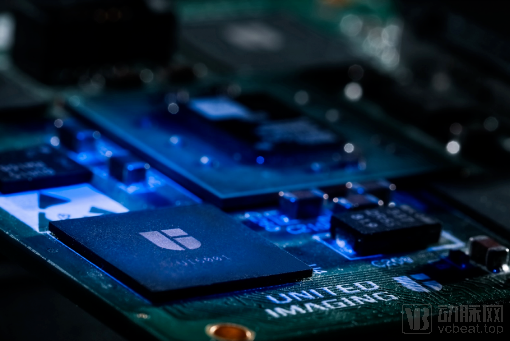
An analysis of the Fortune Global 500 list also reveals that among the five core strategic industries where the United States holds a dominant advantage—namely, ICT (Information and Communications Technology) manufacturing, medical devices and pharmaceuticals, military-industrial and aerospace, machinery, and automotive—China lacks heavyweight contenders in the “medical devices and pharmaceuticals” sector. Although China has become the world’s second-largest medical device market, it remains heavily reliant on imports for high-end medical equipment.
The temporary disruption of global supply chains during the pandemic has made all countries acutely aware of the significant risks associated with dependence on external sources. On March 2, President Xi Jinping, while inspecting scientific and technological research efforts for COVID-19 prevention and control in Beijing, specifically emphasized: “We must accelerate efforts to address weaknesses in China’s high-end medical equipment sector, step up breakthroughs in key core technologies, overcome bottlenecks in these technical areas, and achieve self-reliance and controllability in high-end medical equipment.”
Perseverance yields lasting results. Today, a growing number of Chinese enterprises recognize the importance of independent research and development, accelerating breakthroughs in core technologies to achieve domestic substitution of clinically practical products in terms of performance and technology. As an industry leader, United Imaging is making strong strides in ultra-high-end CT, PET-CT, and high-field MRI, carving out new frontiers in more forward-looking scientific research.
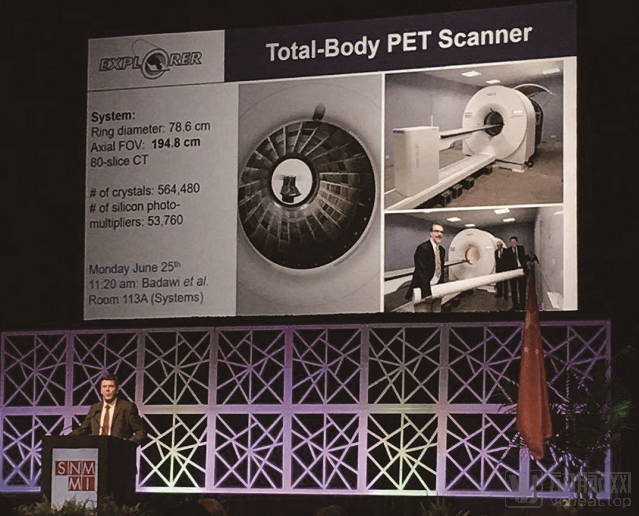
At the SNMMI (Society of Nuclear Medicine and Molecular Imaging) Annual Meeting, the largest and most influential academic conference in the field of nuclear medicine worldwide, leading U.S. molecular imaging experts presented the latest research findings based on United Imaging’s Total-Body PET-CT to a global audience, sparking significant excitement within the industry.
In September this year, the Brain and Intelligence Technology Research Institute of Shanghai Zhangjiang Laboratory, together with United Imaging, took the lead in organizing a launch event for the Chinese Human Brain Atlas Research Sci-Tech Innovation Platform. The initiative united four top-tier institutions—Shanghai Jiao Tong University, Huashan Hospital Affiliated to Fudan University, Zhongshan Hospital Affiliated to Fudan University, and the Second Affiliated Hospital of Zhejiang University School of Medicine. By leveraging United Imaging’s advanced hardware and software technologies, the newly established sci-tech innovation platform aims to advance frontier brain science research and ensure the autonomy and controllability of national major scientific research infrastructure.
Meanwhile, as a global leader in science and technology, the United States is making every effort to maintain its competitive edge. On October 15, the U.S. White House National Security Council released the “National Strategy for Critical and Emerging Technologies,” aimed at sustaining American leadership in key strategic technological domains. Among the redefined list of 20 “critical and emerging technologies” are medical and public health technologies, biotechnology, and advanced manufacturing.
The curtain rises on a race toward the future, with every medical device manufacturer in the spotlight. Under the weight of national destiny, they are all striving to provide their own answers...