

Wearable-Based Lifestyle Intervention Improves Body Composition and Prognosis in Stage I-III Breast Cancer Patients Post-Surgery: A Joint Study by Fudan University Shanghai Cancer Center and Zepp Health
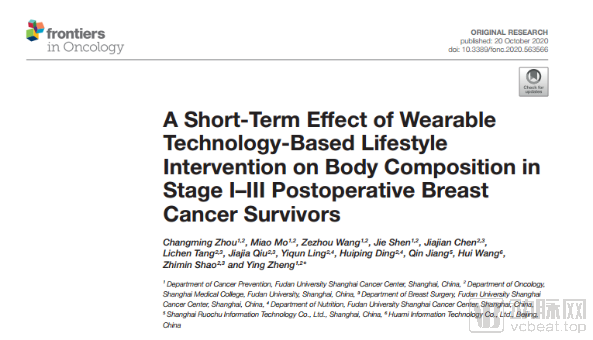
Recently, the joint research findings of Fudan University Shanghai Cancer Center and Huami Technology (NYSE: HMI), titled “Impact of Wearable Device-Based Lifestyle Interventions on Body Composition in Postoperative Patients with Stage I–III Breast Cancer,” were published in Frontiers in Oncology. Leveraging intelligent wearable technology and health cloud services, this study implemented comprehensive interventions for postoperative breast cancer patients, effectively helping them control weight, improve body composition, and reduce body fat, thereby improving prognosis and lowering the risks of disease recurrence, metastasis, and mortality.
Breast cancer is the most common malignant tumor in women, with over 2 million new cases diagnosed globally each year. Thanks to advances in early screening technologies and treatment modalities in recent years, patient survival rates for breast cancer have improved significantly. The five-year survival rate for breast cancer among Chinese women has reached 83.2%, while the five-year survival rate for patients treated at Fudan University Shanghai Cancer Center exceeds 90%.
Improved survival rates have shifted the focus from merely prolonging life to enhancing quality of life for breast cancer patients. Previous studies have shown that overweight, and particularly obese, breast cancer patients face a higher risk of mortality, with each 5 kg/m² increase in body mass index (BMI) associated with a 17% increase in the risk of death.
This study enrolled postoperative patients with stage I–III breast cancer who received treatment at Fudan University Shanghai Cancer Center. A baseline assessment of their dietary status, body composition, and quality of life revealed that although 65% of the patients had a body mass index (BMI) within the normal range, 71.68% had a body fat percentage exceeding 30%, and 41.59% exhibited low skeletal muscle mass.
The study implemented a comprehensive intervention by having participants wear smart bands equipped with health cloud services, combined with synchronized online and offline dietary and exercise guidance. The results revealed considerable changes in participants' body composition after three months of intervention: weight, BMI, fat mass, body fat percentage, basal metabolic rate, and visceral fat area all decreased significantly. The most notable reduction was observed in visceral fat area, with the mean value decreasing from 91.01 cm² at baseline to 84.15 cm². These significant declines in indicators demonstrate improvements in patients' body composition and local microenvironment, which may reduce the risk of disease recurrence, metastasis, and mortality in these patients in the future.
Professor Zheng Ying, Director of the Department of Cancer Prevention at Fudan University Shanghai Cancer Center and corresponding author of this paperIt was stated that with the rapid development of information technology, there is a growing demand for refined management throughout the entire rehabilitation process for cancer patients. The use of intelligent wearable devices to provide personalized lifestyle management for recovering patients will gradually become a trend. This type of lifestyle intervention is applicable not only to breast cancer but also to other cancers, such as colorectal cancer, prostate cancer, and early-stage lung cancer. Patients with these cancers often have long-term survival, and their prognosis is closely linked to lifestyle factors.

Zheng Ying, Corresponding Author of the Paper and Director of the Department of Cancer Prevention at Fudan University Shanghai Cancer Center
It is understood that intervention studies based on smart wearable devices have only gradually emerged in recent years. A staff member from Huami involved in the study stated that traditional exercise interventions typically rely on telephone calls or interviews and often involve high-intensity regimens, which some patients cannot tolerate. In contrast, adopting an integrated intervention approach based on wearable devices and health cloud services can significantly save on labor, material, and time costs, thereby effectively reaching a larger patient population.
The research team also stated that they will continue to conduct nationwide, multicenter intervention studies on lifestyle interventions, biomarkers associated with patient prognosis, and their impact on long-term patient outcomes.