

Ruijin Hospital's CDSS Enables Whole-Admission Cycle Risk Management for Inpatients: Insights from Professor Zhang Ruiyan
“Cardiovascular disease patients often present with multiple comorbidities. It is extremely challenging for each physician to accurately identify and assess disease risks and provide appropriate treatment; therefore, the application of intelligent management tools is essential.” On October 27, at the “Ruijin Hospital Smart Practice Symposium,” hosted by Ruijin Hospital and co-organized by Huimei Technology and other entities, Zhang Ruiyan, Director of the Department of Cardiology at Ruijin Hospital, used the hospital’s applications in atrial fibrillation management and dyslipidemia management as examples to introduce the efficacy of Clinical Decision Support Systems (CDSS) in providing end-to-end risk control for hospitalized patients.
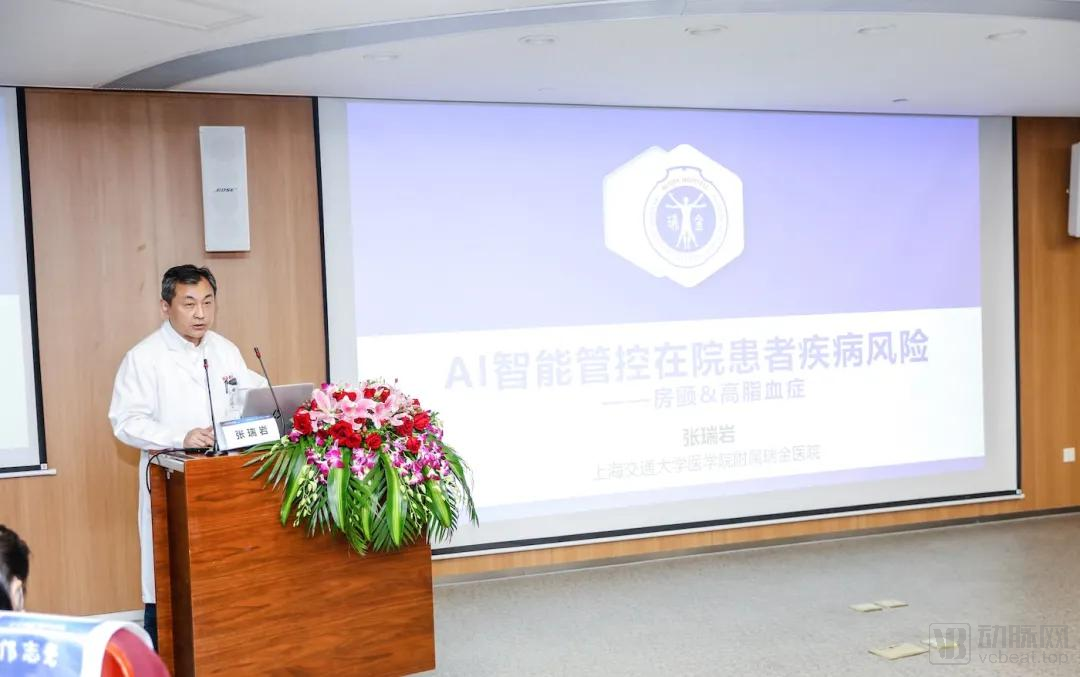
Director Zhang Ruiyan Delivers Keynote Presentation
Potential disease risks in hospitalized patients are a significant contributor to poor prognoses. To enable early identification and prevention, the medical field has established disease prediction models through long-term clinical practice to estimate patients’ probability of developing specific conditions, thereby guiding physicians in delivering targeted treatments.
However, can disease prediction models, as significant achievements in the medical field, effectively function when incorporated into clinical guidelines? “Patients present with multiple overlapping risk factors, requiring a balance between ‘timely’ and ‘accurate’ assessment, yet clinicians may not always interpret these models correctly,” said Zhang Ruiyan. He noted that comprehensive risk stratification of patients often requires the use of two prediction models, making disease prevention and control efforts cumbersome and complex.
To enhance early identification and intervention of disease risks, Ruijin Hospital has implemented the Huimei Clinical Decision Support System (CDSS) to enable integrated management of risk prediction and intervention for hospitalized patients. “In disease risk management, diagnostic accuracy, predictive accuracy, and treatment rationality are the primary concerns for physicians. The advantage of artificial intelligence lies in its ability to identify disease characteristics, screen patients for analysis of their risk of onset, and then provide intervention recommendations,” said Zhang Ruiyan.
Atrial fibrillation increases the risk of stroke by four to five times, making stroke prevention the primary goal of atrial fibrillation management. Zhang Ruiyan stated that patients with cardiovascular diseases are not only treated in the cardiology department; therefore, atrial fibrillation management should be implemented hospital-wide. This involves utilizing Clinical Decision Support Systems (CDSS) to predict stroke risk throughout the entire hospitalization period and implementing “stratified” management based on the prevention and treatment needs of different departments.
Intervention for stroke risk in atrial fibrillation (AF) begins with the identification of AF patients. The Clinical Decision Support System (CDSS) “captures” indicators of AF from patients’ clinical data and intelligently prompts clinicians to supplement the AF diagnosis, thereby strengthening AF risk management at its source. While identifying AF patients, the system automatically performs risk stratification for both stroke and bleeding risks, enabling “stratified” management based on the assessment results. For example, it recommends that patients with non-valvular AF at high thrombotic risk receive long-term anticoagulation therapy, with novel oral anticoagulants (NOACs) as the first-line agents; for patients unsuitable for anticoagulation, alternative interventions (such as left atrial appendage closure) are recommended.
For non-cardiologists lacking experience in anticoagulation therapy, the system provides a one-click option to request a specialist consultation. “We aim to leverage this intelligent system to enhance early disease management and standardized treatment, promote inter-departmental collaboration, and reduce complications among patients with cardiovascular disease,” stated Zhang Ruiyan. The system enables “stratified” management at both the patient and departmental levels, allowing hospital administrators to monitor clinical prevention and control measures in real time through the system’s data statistics platform.
“Control of lipid levels is crucial for cardiovascular physicians,” stated Zhang Ruiyan. Dyslipidemia is a major risk factor for atherosclerotic cardiovascular disease (ASCVD), and effective management of lipid levels can significantly reduce the risk of ASCVD events, such as myocardial infarction and stroke. The application of Clinical Decision Support Systems (CDSS) enables accurate risk stratification of patients, guiding clinicians in developing individualized and standardized intervention strategies.
Dyslipidemia management emphasizes a patient-centered approach. The Clinical Decision Support System (CDSS) analyzes and synthesizes hospital-wide medical data to stratify all inpatients by disease risk probability. It then determines personalized, precision lipid management strategies based on their lipid levels, specifically low-density lipoprotein cholesterol (LDL-C). For instance, lifestyle interventions are recommended for patients at low or moderate risk. For ultra-high-risk patients with LDL-C levels below 1.4 mmol/L, lifestyle intervention is recommended if statin therapy has not been initiated; for those already receiving statin therapy, a combination of both interventions is recommended.
“Since patient treatment adherence and sustained achievement of target lipid levels are central to management, the CDSS generates personalized recommendations based on individual patient profiles. These recommendations are delivered through printed materials and digital platforms such as WeChat to facilitate lifestyle interventions, thereby addressing disease risk at its source. ‘Overall, since implementing the CDSS, our treatment target attainment rate has significantly improved compared with before,’ said Zhang Ruiyan.”
Watch the Live Replay:http://live.mdweekly.cn/app/index.php?i=3&c=entry&time=1&rid=876&do=index&m=wxz_wzbagent&code=011GOR000C19AK15rC300oGtwh1GOR0m&state=STATE
Expert Profile:
Zhang Ruiyan, Director of the Department of Cardiology and Director of the Cardiac Catheterization Laboratory at Ruijin Hospital, Shanghai Jiao Tong University School of Medicine; a Leading Talent in Shanghai. His primary research focuses on the prevention and treatment of coronary heart disease and atherosclerosis. He currently serves as a Standing Committee Member of the Cardiovascular Branch of the Chinese Medical Association, a Standing Committee Member of the Cardiovascular Physicians Branch of the Chinese Medical Doctor Association, Vice Chairman of the Cardiovascular Society of the Shanghai Medical Association, Vice President of the Cardiovascular Branch of the Shanghai Medical Doctor Association, and an Editorial Board Member for several academic journals, including the Chinese Journal of Cardiology.