

Medtronic Empowers Chinese Medical Innovation Through Strategic Investment and Ecosystem Collaboration

Medtronic
Investment Institutions in the Medical Technology Startup Field
Since the turn of the 21st century, China’s wave of medical innovation has continued to surge forward. Across both the pharmaceutical and medical device sectors, as well as the healthcare services landscape, innovative enterprises have emerged in steady succession, with new technologies and business models proliferating endlessly.
Faced with the vast opportunities hidden in the wave of innovation, numerous investment institutions have entered the fray, channeling substantial capital into the healthcare sector.According to the “Q3 2020 Global Healthcare Industry Capital Report” jointly released by VCBeat and VBInsight, China’s total healthcare industry financing in Q3 2020 reached a record high for any third quarter, amounting to RMB 44.1 billion across 215 transactions.
ButInnovation is driven not solely by capital; market dynamics, supply chains, and technology are all indispensable elements.. Consequently, investment institutions—including investment funds, large corporations, and their corporate venture capital arms—are continuously expanding their capabilities to provide greater support for innovative enterprises. Among them,Multinational healthcare enterprises, leveraging their advanced technologies, channel resources, and international experience, are playing an increasingly important role in China’s wave of medical innovation.
As a global pioneer in medical technology, innovation, services, and solutions,MedtronicMedtronic has been committed to introducing advanced international medical technologies while promoting local innovation.How is Medtronic strategizing and deeply engaging in China’s rapidly evolving medical innovation market? How does it assess the trajectory of medical innovation in China? To address these questions, VCBeat conducted an exclusive interview with Shi Yonghui, Managing Director and Head of Corporate Development, Venture Capital, and Innovation Incubation for Medtronic Greater China.
China is the only market where Medtronic has established a separate investment platform.
Chinese startups are gradually shifting from follower innovation to original innovation, and an increasing number of healthcare companies are evolving from single-product entities into platform-based enterprises.“Whether it is the experience and capabilities of entrepreneurs, or the flexibility of policies and the abundance of capital, all have seen significant improvements. Based on this, Medtronic is very optimistic about the future of China’s healthcare industry.”
The atmosphere for innovation is becoming increasingly vibrant, and the investment ecosystem is also becoming more robust.For instance, the establishment of Hong Kong’s biotechnology sector and the STAR Market has expanded exit channels for investors. Moreover, healthcare entrepreneurs are becoming increasingly active in the capital markets, demonstrating a growing willingness to accept external funding and resources.
In this process,Large companies with first-mover advantages, including many industry players such as Medtronic, have decided to adopt more flexible incubation models and integrate with capital to unlock the potential of innovators to a greater extent.
“Medtronic places great emphasis on innovative therapies, cutting-edge technologies, and China’s uniquely large market., such as surgical robots, digital applications, and ambulatory surgery, we hopeExploring the most cutting-edge medical technologies through an “investment + collaboration” model.“Shi Yonghui stated that Medtronic’s objective in pursuing external investments and collaborations is to create greater clinical and long-term economic value.”Prioritizing clinical utility, adhering to value investing, avoiding short-term speculation, and refraining from seeking quick profits are Medtronic’s investment principles.
To this end,Medtronic conducts extensive research during the early stages of investment and leverages its industry investment map to assess the market penetration rate of each therapy in China, thereby identifying companies in their early development phases.Unlike most investment institutions,Medtronic typically invests in only one company per sector, thereby providing comprehensive and targeted support to the enterprise throughout its development.。
Since entering China,Medtronic has been actively exploring investment and cooperation with local enterprises.。Medtronic Greater China can engage in strategic investments, venture capital, and incubation partnerships based on the development stages and needs of its partners.Since 2008, Medtronic has successively engaged in strategic investments and business collaborations with multiple leading medical device companies, including Weigao Group, LifeTech Scientific, and Nuopu Medical. It also strategically acquired a controlling stake in Kanghui Medical, transforming it into a global platform for spine and trauma products serving patients worldwide.
At the end of 2015,Medtronic, Sequoia Capital, and Suzhou Industrial Park jointly established a venture capital fund primarily targeting innovative medical technology and healthcare services.. Over the past four years since its establishment, Medtronic China Fund has invested in multiple companies (the following is compiled based on public information).
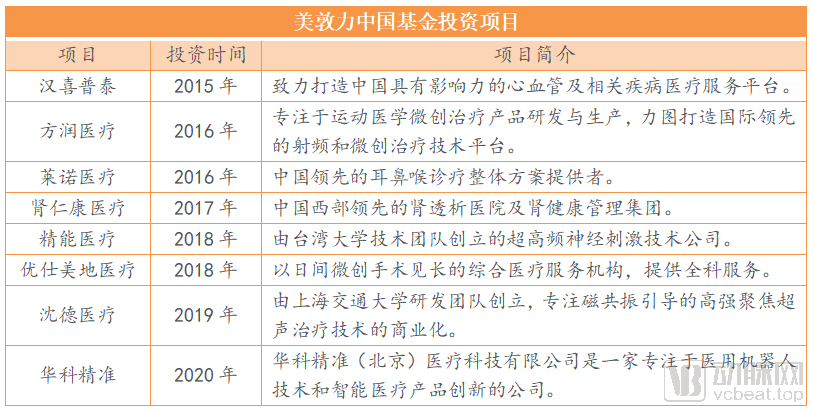
From an investment perspective, the Medtronic China Fund is primarily disease-centric, selecting projects based on the clinical pathways of several diseases that have a significant impact on public health in China.“Technological products with significant clinical market potential and those addressing unmet needs are our key focus,” said Shi Yonghui.
Taking Huake Jingzhun, invested in this year, as an example, as a leading domestic developer of neurosurgical surgical robots,Huake Precision’s robotic surgical planning software and surgical navigation software are widely used, with the number of related procedures exceeding 10,000 cases.. Importantly, Huake Jingzhun's surgical robots rank among the top in terms of clinical application rates in China.Among these applications, robotic assistance has the highest penetration rate in stereotactic electrode implantation surgery for epilepsy, exceeding 80% in major epilepsy centers in China.
For example, the investment made in 2016Leno Medical, the company has built a diversified product portfolio in the fields of cardiovascular and ENT (ear, nose, and throat) specialties, andBy adopting the global license-in model, along with technology licensing and mergers and acquisitions, to effectively and low-risk capture market share in selected therapeutic areas.Notably, when the Medtronic China Fund made its inaugural investment in Lenor Medical, China’s ENT field was relatively underserved, and the penetration rate of innovative device-based therapies remained low.After more than four years of development, Lenor Medical has grown into the company with the largest market share in its niche sector in China and completed its fourth round of financing in 2019.。
Beyond investment support, Medtronic also provides innovative enterprises with comprehensive assistance spanning from product research and development to post-market stages.. In 2019,Medtronic Launches Medical Innovation Accelerator in Shanghai, providing innovative healthcare companies with leased access to advanced laboratory equipment at the Medtronic China R&D Center, along with professional consulting services in prototyping, testing, and quality control during product development. Select high-quality projects may also receive guidance on clinical trials and market registration, as well as solutions for manufacturing and clinical training.
“With regard to localization, Medtronic has been conducting R&D and manufacturing in China for many years. Innovations such as coil products and portable dialysis products are closely aligned with the clinical needs of local patients,” said Shi Yonghui.Medtronic also collaborates globally with numerous venture capital firms and industry incubators, including the recently launched mitral valve repair product co-developed with the U.S.-based Foundry incubator.
Not only that,As a key initiative to expand Medtronic’s open innovation, the Medtronic China Fund partnered with Baidu Ventures to host the “Medical Robotics Innovation Competition.”. This innovation competition aims to identify and support outstanding entrepreneurial teams and projects in China’s medical robotics sector through a competitive format, thereby accelerating the translational application of medical robots and meeting the healthcare needs of more local patients.
From funding to incubators and industry competitions, Medtronic has established a clear path for empowering the medical innovation ecosystem in China, which will undoubtedly provide significant support for the development of high-quality, cutting-edge medical projects in the country.Looking to the future, Shi Yonghui stated that the Medtronic China Fund and Innovation Accelerator will continue to dedicate themselves to collaborating with China’s most innovative clinicians, scientists, and engineers, supporting them in developing original, innovative technologies.
We believe that, buoyed by the favorable winds of policies promoting independent innovation, and as multinational corporations such as Medtronic bring greater capital, resources, and ecosystem support to China’s frontier technology enterprises, the seeds of medical innovation in China will surely blossom and bear abundant fruit.