

BridgeHealth Secures $40 Million Series A Funding to Reduce Surgical Costs by 30%-60%

BridgeHealth
Surgical Facility Inquiry Service Provider
During the COVID-19 outbreak, the U.S. medical community faced immense challenges: on one hand, it needed to assume a leadership role in guiding the nation’s pandemic response; on the other, it had to address the backlog of tens of thousands of surgeries accumulated due to the crisis. At a time when healthcare administrators were overwhelmed, BridgeHealth provided a solution that resolved this pressing issue.
BridgeHealth, established in 2007, is a healthcare service provider that, throughEstablish a systematic and comprehensive operational framework that closely connects patients with healthcare institutions.
In building the service system, we adopt a patient-centric approach, striving to enable patients to access high-quality surgical services at affordable prices. From the physician’s perspective, we establish a “safeguard” mechanism that increases patient volume while reducing surgical liability risks. Through coordinated collaboration between both parties, we achieve a mutually beneficial “win-win” outcome.
BridgeHealth boasts a high-caliber leadership team, with all executives possessing over ten years of experience in the healthcare industry.
CEO Jamie Hall (Jamie Hall) is responsible for the company's overall development and strategic leadership. He previously served atWith 20 years of experience in the healthcare industry at the Blue Cross Blue Shield Association, his extensive industry expertise and corporate management capabilities enable him to provideThe Driving Force Behind BridgeHealth’s Continuous Advancement。
To enhance professional capabilities,BridgeHealth is Hiring at Competitive SalariesTerry Fouts and Donna JohnsonM.D.Establish a medical leadership team to build a comprehensive service system.
BridgeHealth is easy to understand, as its name offers a clue. First, “Bridge” translates to “bridge,” serving as a platform that breaks down barriers and facilitates efficient connectivity between parties.
Secondly, “Health” is translated as “健康,” which represents the ultimate goal. Through this “Bridge,” patients and healthcare institutions are spared a series of “red tape” during surgical procedures.Make communication smooth and effective, make services precise and valuable, and make health goal-oriented.
When surgery is mentioned, the first word that comes to many people’s minds is “expensive.” This deeply ingrained “knee-jerk reaction” is not difficult to explain.
On the fee schedule, minor surgeries generally range from 10,000 to 100,000 yuan, medium-sized procedures cost approximately 100,000 to 500,000 yuan, and certain major surgeries can reach as high as one million yuan. Such “astronomical figures” deter many people. Since there is a reason for everything, one cannot help but ask: Why are surgical costs so “prohibitively high”?
Due to differences in market systems, China and the United States exhibit diametrically opposite patterns in the proportion of surgical costs.
In China, a surgery costing RMB 50,000 can be broadly broken down into four cost components: preoperative examinations account for over RMB 10,000; medications comprise RMB 7,000–8,000; medical devices represent the largest share, priced at approximately RMB 20,000–30,000; and finally, the surgical fee itself is surprisingly low, at only RMB 3,000–4,000.(Data source: "Call a Doctor")
Even more unimaginable is that, out of this meager sum of three to four thousand yuan, doctors and nurses each receive only a few dozen to a few hundred yuan in compensation.
Why Has This Awkward Situation Arisen? We Must Look to the Root Cause. In China, many high-end, cutting-edge medical devices are imported from abroad at considerable cost, and these expensive device prices indirectly drive up surgical fees to prohibitive levels.
Many people may wonder, “Can’t China produce it domestically?” The answer is yes.However, there is still a gap in the quality of some products compared to those from abroad.China is unlikely to achieve breakthroughs in R&D and production in the short term, leaving it reliant on imports, with pricing power largely controlled by foreign enterprises.
In the United States, however, this situation has been reversed during a surgical procedure,Physicians are identified as the most critical factor., and the remuneration received is also quite substantial. However, the problem remains: how can patients accurately find the right surgeon to perform their operation?Driven by demand, BridgeHealth was born.
Source: BridgeHealth official website; graphic by VCBeat
Douglas Rubbelke, Executive Director of the National Labor Alliance (NLA), which represents more than 6 million insured members across the United States, has givenBridgeHealth Highly Rated,“They have a long-standing history of connecting union members with top-tier hospitals and surgical centers. Their solutions effectively help us keep our members’ surgical costs low, creating the win-win outcome that everyone desires.”
During this pandemic, the number of compression surgeries performed across the United States exceeded one million, resulting in significant supply-demand tensions, but BBridgeHealth leverages its strengths to continuouslyIncreasing the availability of local outpatient facilities to the public has helped hundreds of patients receive timely treatment.
“We know that surgical delays caused by COVID-19 can have catastrophic consequences. Over the past two months, our core focus has been on expanding access to high-quality ambulatory surgery centers across China, helping our members safely receive the care they need.”CEO Jamie Hall (Jamie Hall) said, “We have the capability to initially direct members to local ambulatory surgery centers, which means we can help reschedule their surgeries and provide them with the high-quality, affordable care they need as soon as possible.”
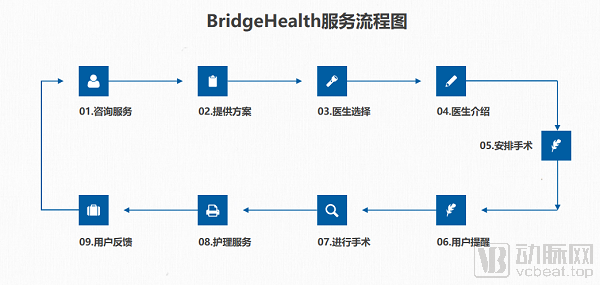
How does BridgeHealth achieve these results, and how do its operational trajectories unfold? A closer look at its service process provides the answers.
·Consulting Services:Provide the user with a detailed explanation of the overall procedural workflow, document their surgical requirements, and assign a dedicated caregiver to accompany them throughout the entire process.
· Proposed Solution:BridgeHealth provides a comprehensive, systematic treatment plan by integrating diverse data resources and leveraging the expertise of medical professionals, tailored to each patient’s condition.
· Physician Selection:After confirming the plan with the user, viaThe Center of Excellence (COE) selects suitable physicians for users.
· Doctor Introduction:Provide a detailed introduction to the selected physician, covering key information such as educational background, professional experience, qualifications, and honors.
· Schedule Surgery:After coordinating with the user, BridgeHealth will communicate with the selected physician to finalize the surgical schedule.
· User Reminder:Send a surgical confirmation letter to the patient, outlining preoperative preparations and addressing any questions they may have during this period.
· Perform surgery:Following a series of preoperative examinations, the designated surgeon will perform the procedure on the patient.
· Nursing Services:Post-surgery, patients will receive high-quality follow-up care services.
· User Feedback:Upon the user’s recovery, BridgeHealth will conduct a follow-up visit and administer a satisfaction survey to continuously improve its service system.
Source: BridgeHealth official website; graphic by VCBeat
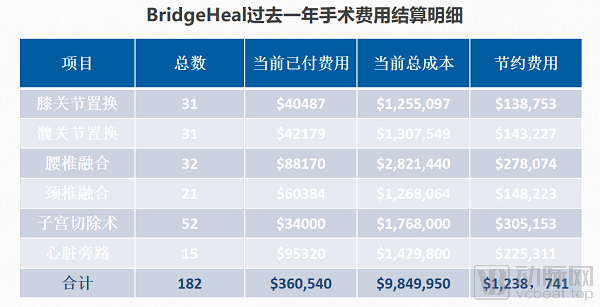
BridgeHealth connects patients with the nation’s top physicians to deliver a superior experience and greater value, making surgery less isolating and no longer out of reach.
For users, theyNot only do you receive high-quality services, but you also achieve substantial cost savings in both time and money.
Under the BridgeHealth service model, patients no longer need to seek medical consultations from various sources, thereby eliminating the substantial upfront costs associated with finding a physician. Regarding surgical fees, BridgeHealth develops detailed, optimized treatment plans tailored to each patient’s condition, significantly reducing medical expenses in a fully transparent manner.
“A user who received BridgeHealth services said, ‘I feel a sense of relief, knowing I can rely on someone to help me handle all the details of my surgery. My care coordinator always emails or calls me to provide real-time updates on my progress, clarify details, or answer my questions. I have never experienced the level of care and consideration that BridgeHealth has shown me. I felt respected; no matter how small or simple my questions were, the care coordinator always answered them patiently. This has been the best experience of my life.’”
For collaborating physicians, theyThe result is a steady stream of customers, along with significant reductions in management costs and surgical claim risks.
BridgeHealth pioneeredCenter of Excellence (COE)System, which gathers the most outstanding physicians across the United States; to gain entry, one must first passThe strict regulations established by BridgeHealth have, to a certain extent, ensured the standardization and credibility of its services.
Signed a cooperation agreement with BridgeHealth, officially enteringWith the Center of Excellence (COE) system, physicians, like the broader user base, enjoy a range of benefits brought by the new service model.
They do not need to spend huge amounts of money on attracting foot traffic, becauseBridgeHealth will refer a large volume of users to them. Furthermore, they no longer need to proceed with surgeries “apprehensively,” as BridgeHealth shares the liability risk for surgical claims with them. In this beneficial environment, physicians can eliminate all external distractions and devote their full attention to the surgical procedure, thereby delivering high-quality services to patients.
BridgeHealth'sOur primary mission is to provide users with high-quality surgical services at a low cost.
SinceJamie Hall (Jamie Hall) Since taking office in 2018, BridgeHealth has repositioned its sales, marketing, product, and business development teams with a new value system to achieve growth and scalability.
Dave Calone, Chairman of the Board of BridgeHealth, stated, “Jamie has placed the company on a steep growth trajectory, driven strategic initiatives, and facilitated significant expansion in the large employer market. Arguably, Jamie is leading BridgeHealth into its most critical growth phase to date.”
Over the past year, BridgeHealth has made significant strides in the market, with its membership surpassing one million for the first time. For four consecutive years, it has been recognized by Company magazine as one of the fastest-growing private companies.
The vast membership base has also enabled BridgeHealth to establish a substantial profit network. Its revenue streams are primarily composed of two major value systems:Patient Enrollment and Physician Onboarding。
On October 22, 2020, BridgeHealth announced its merger with Transcarent, a consumer digital health company, as$40 Million Series A Financingpart of.
In the future, BridgeHealth will remain dedicated to research and development, continuing to provide users with a higher-quality self-insured group health plan platform. Leveraging Transcarent’s technology as its foundation, it will also launch new high-tech navigation services and comprehensive solutions.
President and CEO of BridgeHealthJamie Hall (Jamie Hall)stated, “We are delighted to collaborate with such an outstanding team of innovative healthcare entrepreneurs, investors, and thought leaders. Together with Transcarent, BridgeHealth will continue to deliver exceptional healthcare experiences for users and provide measurable value to our plan sponsors, as we embark on a significant expansion of our solutions marketplace.”
The influx of substantial capital signifies strong societal recognition of BridgeHealth’s business model, reflects the public’s urgent demand for this innovative operational concept, and provides a solid foundation for BridgeHealth’s future development. We are confident that BridgeHealth will continue to refine and optimize its offerings on the existing basis, delivering higher-quality services to users in the near future.