

Shukun Technology Secures First-Ever AI+CTA Class III Medical Device Certification in China, Paving the Way for Commercialization
Before 2020, the AI boom was in full swing, with capital firms rushing to invest in AI-powered medical imaging, even though no one knew when regulatory approvals would be granted. After 2020, there was a surge in approvals for imaging AI: within just seven months, five AI imaging software products obtained Class III medical device certificates from China’s National Medical Products Administration (NMPA). However, investor interest cooled dramatically during this period, with only a handful of AI imaging financing deals recorded over the entire year.
This contradiction has shrouded the seemingly straightforward and clear field of medical imaging AI in uncertainty. Is the commercialization of healthcare AI truly viable? What is the actual level of technological maturity? These pressing questions demand answers through the actions of AI enterprises.
Recently, Shukun Technology’s “AI+CTA” medical device received Class III certification approval from the Center for Medical Device Evaluation (CMDE), an event that may offer clues to resolving the aforementioned issues.
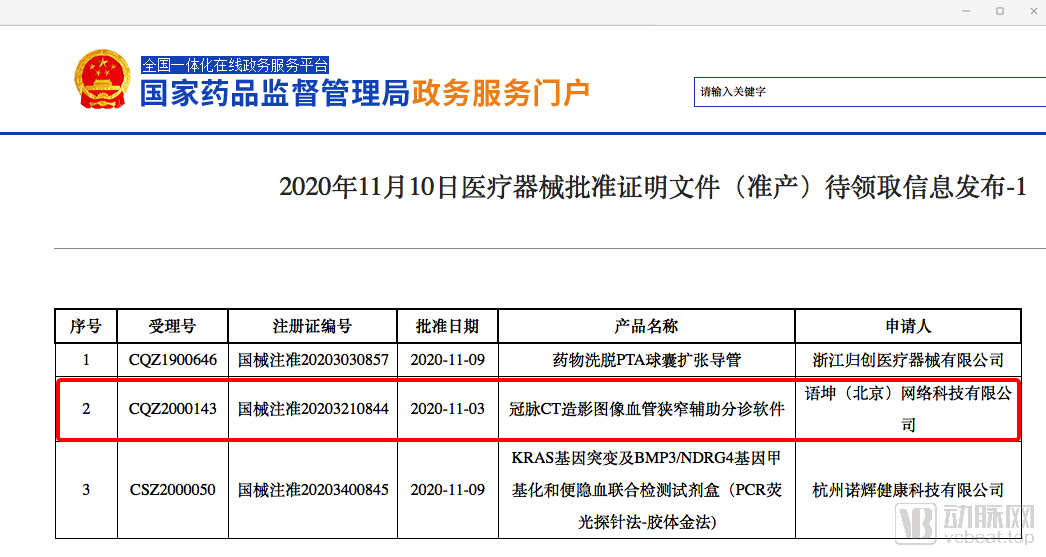
In fact, Shukun Technology’s coronary CTA product had already entered numerous hospitals through models such as clinical research collaborations, with its efficacy long recognized by multiple top-tier hospitals. This demonstrates that AI products meeting clinical needs can indeed carve out their own viable commercialization pathways.
Furthermore, given that the development of cardiac CTA is slightly more challenging than that of other common applications, its recent approval by the Center for Medical Device Evaluation (CMDE) signals that China’s medical imaging AI sector has entered a more advanced stage, with this field still holding immense potential.
So, why does Shukun Technology’s Class III medical device certification carry such significance? What exactly is the relationship between device commercialization and clinical approval? With these questions in mind, VCBeat conducted an in-depth interview with Shukun Technology to seek answers behind the approval process.
Let us first discuss Shukun Technology as a company. In June 2017, when Shukun Technology entered the field of medical AI imaging, it was already somewhat late to the game. Although no company had yet successfully commercialized solutions in the pulmonary nodule segment, the large number of participants had already turned it into a red ocean. Therefore, Shukun Technology adopted a differentiated R&D strategy, starting with the less-explored cardiac domain to pioneer the intelligent analysis of coronary CTA.
Compared with pulmonary nodules, coronary CTA presents a significantly higher barrier to entry. First, to develop a high-quality coronary CTA product, it is essential to engage senior experts in cardiology who can assist algorithm researchers in dissecting cardiac anatomy and clarifying regional and vascular segmentation of the heart. Second, unlike the approach for pulmonary nodules, algorithm researchers cannot simply transfer existing computer vision algorithms; instead, they must iteratively develop deep learning-based model reconstruction methods through exploratory research. Finally, and most importantly, whereas conditions such as pulmonary nodules and fundus diseases benefit from numerous large, publicly available datasets, coronary CTA data are limited, fragmented, and unstructured. This necessitates collaborative efforts between enterprises and physicians to build standardized databases that can serve as the essential fuel for AI development.
Over the course of two years of exploration, Shukun Technology systematically addressed the aforementioned three challenges, refining its coronary CTA solution into a mature and stable product that seamlessly integrates into hospital clinical workflows, thereby transforming past obstacles into robust technical barriers.
Recognition from the capital market further underscores the value of this technological barrier. According to data from the VCBeat Orange Database, as of August 24 this year, there were a total of 130 financing events in the global medical AI sector. Among these, imaging AI-related investment transactions totaled 19—10 overseas and 9 in China—with a combined amount of RMB 1.56 billion. Shukun Technology alone raised more than one-quarter of the total global financing for imaging AI this year.
Leveraging the dual advantages of a differentiation strategy and ample capital, Shukun Technology has rapidly advanced its product depth. In 2019, Shukun’s software for analyzing vascular stenosis in coronary CT angiography images was included in the Special Review Procedure for Innovative Medical Devices. A year later, Shukun successfully obtained its first Class III medical device registration certificate for coronary CTA.
For AI-based medical imaging technologies to gain regulatory approval, demonstrating non-inferiority and superiority in clinical trials is an inevitable yet extremely challenging hurdle.
When evaluating the efficacy of clinical trials, non-inferiority trials are designed to test whether one drug is not inferior to another. These trials are frequently used in clinical studies with objective efficacy endpoints, such as clinical outcomes for antimicrobial agents, adverse events in cardiovascular therapy, and death or disease progression in oncology treatment. In contrast, superiority trials are designed to test whether one drug is superior to another; this design is commonly employed in placebo-controlled trials.
In the regulatory approval of AI-based medical devices, while the definitions of non-inferiority and superiority differ in form, they are similar in essence. To demonstrate either superiority or non-inferiority, an AI product must prove its clinical utility or show advantages over existing products. Therefore, clinical trial design undoubtedly becomes a critical step in securing regulatory approval.
Shukun Technology’s coronary CTA product clearly meets the requirements for superiority. Its artificial intelligence automates processes such as 3D reconstruction, interpretation, assessment, and report review of coronary CTA images, reducing the manual post-processing time by radiologists from 30–40 minutes to just a few minutes without human intervention, thereby improving imaging department efficiency several-fold.
Improved efficiency not only means that more patients can receive timely examinations, but also enhances medical operational efficiency in specific scenarios. Taking short-stay inpatients at a certain hospital as an example, if a CTA (Computed Tomography Angiography) examination is required on an ad hoc basis during hospitalization, AI will improve the hospital’s operational effectiveness from multiple perspectives.
From an efficiency perspective, given that the revenue for a single disease type is positive, issuing CTA examination results previously required three days. With AI integration, patients can obtain results in just half a day, which means the hospital stay for each patient will be shortened by two days, allowing hospitals to admit more patients within the same time frame.
From a quality perspective, the high reconstruction accuracy enabled by AI+CTA provides physicians with richer clinical decision-making information, indirectly improving the quality of their decisions, reducing patient readmission rates, and thereby lowering the per-condition treatment costs for hospitals.
Driven by the implementation of Diagnosis-Related Groups (DRGs) and the pressure of performance evaluations, AI ultimately helps hospitals better meet assessment targets. This technology facilitates horizontal comparisons among hospitals by the National Health Commission, prompting hospitals to consciously leverage technology to improve treatment efficiency for individual diseases, thereby creating a larger market for AI+CTA.
In addition to the aforementioned benefits, Shukun Technology’s CTA solution liberates physicians from labor-intensive reconstruction and report documentation tasks, thereby reducing their workload and affording them greater flexibility in scheduling.
Amid the harsh winter, Shukun Technology has managed to advance on both financing and product implementation fronts, establishing its own competitive moat. This success is naturally attributable to its unique strategy. One key aspect is that, while refining its CTA products, the company has not ceased its exploration of product depth and breadth.
Let us first discuss depth. When Shukun Technology’s first-generation product was launched, its AI could only measure the degree of vascular stenosis and perform corresponding post-processing. By the second generation, functional assessments such as calcium scoring and plaque analysis were gradually incorporated, enabling Shukun to provide physicians with more comprehensive data references. In the third generation, Shukun attempted to extend the role of AI into surgical navigation and consumable selection, achieving the leap of artificial intelligence from “diagnosis” to “diagnosis and treatment.”
This deep integration of AI into single scenarios is built upon Shukun’s extensive development experience, with its broad-based deep capabilities gradually evolving into specialized, vertical development expertise.
Specifically, after completing the design of its cardiovascular AI products, Shukun Technology has acquired advanced image processing algorithms and extensive AI design experience. Leveraging these technologies, Shukun Technology can develop new products for other disease scenarios, such as pulmonary nodules, at a speed several times faster than that of its cardiovascular AI development.
Under this logic, Shukun Technology has developed a pneumonia diagnosis system in response to the needs arising from the pandemic, while also expanding its R&D focus from cardiovascular to cerebrovascular applications. This shift is grounded in the medical understanding that coronary heart disease is not solely related to the heart and its associated vascular tissues; patients often exhibit corresponding neurological symptoms as well. Shukun Technology aims to effectively address the challenge of stroke screening among Chinese residents.
Shukun subsequently developed the Intelligent Auxiliary Diagnosis System for Head and Neck CTA and the Intelligent Analysis System for CT Brain Perfusion, expanding its application scenarios to pursue more precise diagnostics.
To date, in addition to its existing intelligent CT-based fractional flow reserve (CT-FFR) measurement system and intelligent auxiliary diagnostic system for the aorta, Shukun has developed an intelligent auxiliary diagnostic system for head and neck CT, expanding the scope of its AI applications from cardiovascular to the entire vascular system.
In October 2020, the study on head and neck CTA reconstruction conducted by Professor Lu Jie’s team at Xuanwu Hospital of Capital Medical University in collaboration with Shukun Technology was published in a Nature subsidiary journal. The study utilized a dataset of 18,259 head and neck CTA cases, performing AI-based annotation and segmentation on over 100 million vascular regions.
The results showed that the AI achieved a reconstruction accuracy of 93.1% on the independent test set. Compared with 152 cases of manual reconstruction, the AI reconstruction pass rate reached 92.1%. Furthermore, the vascular boundaries in the AI-reconstructed VR images were smoother than those in manually reconstructed images, and the bone removal effect in the Maximum Intensity Projection (MIP) images was superior.
In terms of efficiency improvement, AI has also demonstrated excellent performance. After the system was implemented at Xuanwu Hospital, the average post-processing time for medical images decreased from 14.22 ± 3.64 minutes to 4.94 ± 0.36 minutes, reducing the time to one-third of the original duration. Meanwhile, the number of clicks required by technicians dropped rapidly due to AI integration, decreasing from 115.87 ± 25.9 clicks to just 4 clicks.
Furthermore, after five months of implementation, the number of CTA post-processing technicians at Xuanwu Hospital was reduced from three to one. Guo Ning, Head of the Clinical Research Institute at Shukun Technology, stated, “The reduction in technician headcount reflects the growing capabilities of AI. At the outset of the pilot, AI-generated results still required manual correction and verification by physicians. However, as the model matured, physicians were able to delegate the majority of routine tasks to AI, allowing them to redirect their efforts toward more meaningful analysis and research. At this stage, AI technology has become deeply integrated into clinical workflows.”
Of course, Shukun Technology’s transformation achievements are not limited to the expansion of its CTA offerings; the company has also made significant progress in enriching its product portfolio.
During the pandemic, Shukun’s AI-assisted diagnostic product for COVID-19 was deployed at Wuhan Central Hospital in early February. This AI system can rapidly read chest X-rays, identify inflammatory lesions and perform segmentation and localization within 2–3 seconds, accurately delineate infected areas, and provide quantitative assessment of lesion regions. It effectively assisted Wuhan Central Hospital in evaluating patients’ conditions and facilitating triage processes.
The Regional Smart Medical Imaging Cloud Platform is a key product through which Shukun Technology supports the transformation of China’s public health prevention and control system toward proactive prevention. For residents within the region, there is no longer a need to visit central hospitals for initial consultations regardless of illness severity; they can access “expert-level medical services” at nearby healthcare facilities. With fewer errands, shorter waiting times, and enhanced health protection, Shukun AI enables the general public to truly benefit from intelligent, continuous, and high-quality medical care.
In retrospect, Shukun Technology’s success offers many valuable lessons, compelling us to re-examine the relationship between Class III medical device certifications and artificial intelligence.
For a long time, many people have conflated the Class III medical device certification with the commercialization of artificial intelligence, but in reality, the two are not equivalent.
Admittedly, obtaining Class III medical device certification is sufficient to demonstrate the superiority or non-inferiority of an AI product, but this does not necessarily translate into physicians’ demand for purchasing the product. In contrast, the coronary CTA product that recently received approval not only meets the rigorous technical standards (“hard metrics”) but also accurately addresses the genuine needs of hospitals, thereby enabling scalable commercialization immediately after securing Class III certification.
From this perspective, companies must strengthen clinical collaborations to develop innovative AI products with demonstrable clinical value, while also securing Class III medical device registration approval in accordance with the regulatory requirements for AI-based devices set forth by the Center for Medical Device Evaluation (CMDE). Both elements are indispensable. Obtaining Class III certification will accelerate the commercialization of AI products that address genuine, critical clinical needs.