

Expansion of Internet-Based Diabetes Management: Strategies for Penetrating the Billion-Dollar Non-Pharmaceutical Market
Today is World Diabetes Day 2020. Faced with a vast patient population, diabetes management has become a hot sector in the healthcare market, particularly internet-based diabetes management solutions that efficiently connect physicians, patients, pharmaceuticals, and smart hardware.
Traditional diabetes management is roughly equivalent to providing patients with “food blacklists” and “exercise checklists” and requiring them to comply, resulting in low patient adherence. If internet-based diabetes management merely augments traditional approaches with technological tools, it will still struggle to alter its inherently “counter-human” nature.
In light of this, VCBeat, in collaboration with the JD Health Diabetes Center, released the “2020 World Diabetes Day Survey Report,” based on JD’s big data and insights from a survey of 1,985 JD Health users tagged as having diabetes, to explore the core elements and trends in internet-based diabetes management.

In the "Core Information on Diabetes Prevention and Control" released during the 2020 World Diabetes Day thematic campaign, the National Health Commission of China proposed a comprehensive treatment approach for patients with diabetes, encompassing four key aspects:
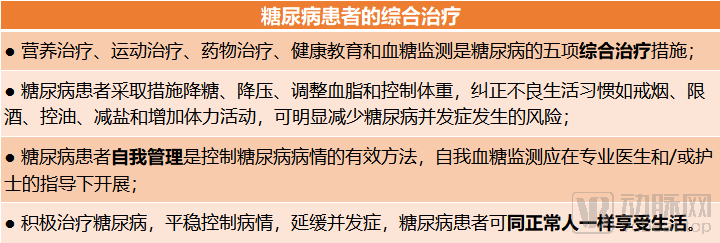
Comprehensive Treatment for Patients with Diabetes, Source: Official Website of the National Health Commission, Graphic by VCBeat
From the above content, we see three key points: comprehensive treatment, self-management, and enjoying life just like anyone else.
For internet-based diabetes management, “comprehensive treatment” means efficiently integrating various therapeutic measures to provide an online-offline integrated service spanning health education, exercise prescriptions, nutritional prescriptions, medication prescriptions, and monitoring tools. “Self-management” signifies a patient-centered approach that leverages technology to match patients with the most suitable and comprehensive resources, thereby enhancing their motivation to take action. “Enjoying life like anyone else” reveals the ultimate goal of diabetes management: to help patients maintain a normal life to the greatest extent possible, rather than making “inhumane” dietary restrictions the norm.
This survey examined dimensions such as patients’ disease types, frequency of medical visits, methods for blood glucose control, and reasons for suboptimal glycemic outcomes. It revealed that the needs of diabetes patients are multifaceted. In addition to conventional pharmacological treatment, they frequently encounter everyday challenges, including difficulty with dietary restraint, inconvenience when dining out, and uncertainty about how to plan balanced meals.
Therefore, enhancing diabetes management capabilities on internet platforms should encompass three levels: meeting patients’ daily medication needs through efficient pharmaceutical services; addressing their routine healthcare needs through intelligent monitoring and resource matching; and fulfilling their daily living needs through diabetes-specific foods and health supplements.
The survey findings precisely corroborate the three key points mentioned earlier; next, we will examine how these key points should be implemented.
This survey indicates that over 60% of patients with diabetes do not have complications. The main complications include cardiovascular complications, ocular complications, diabetic nephropathy, and diabetic foot. For patients with stable diabetes, medical needs primarily consist of routine consultations and regular follow-up visits for prescription refills.
In consultation scenarios, the Internet can fully leverage its advantages to enhance the efficiency of doctor-patient communication. For platforms with qualifications for internet hospitals or online diagnosis and treatment, they can also provide follow-up consultations and prescribe medications, thereby integrating the entire process of consultation, prescription, and medication delivery. Thanks to the rapid implementation of internet healthcare policies in the past two years, these services have become basic service offerings for internet-based diabetes management platforms.
During the pandemic this year, internet-based chronic disease management platforms, and indeed the entire internet healthcare industry, have demonstrated significant value. With certain hospital outpatient services suspended and the general public under home quarantine, routine follow-up visits and prescription refills for patients with chronic diseases were disrupted. In this context, internet-based chronic disease management platforms provided a timely solution to these urgent needs.
However, it was precisely during this period that the critical importance of offline infrastructure supporting online healthcare services became fully evident. Some time after the outbreak began, patients with chronic diseases in Wuhan faced medication shortages due to traffic controls and closed-off residential communities. In response, several internet platforms launched initiatives to help these patients secure their medications. For instance, JD Health initiated its Chronic Disease Care Program, receiving 17,000 requests for assistance online. By leveraging the advantages of JD Pharmacy, JD pharmaceutical warehouses, and JD Logistics, the program successfully addressed 80% of these medication-related appeals.
The trials brought by the pandemic have demonstrated that high-efficiency internet-based services cannot be confined to the online realm; they require robust offline service support to maximize their value. Specifically, in diabetes management, it is essential to deeply integrate online follow-up consultations and prescription issuance with offline medical visits and pharmaceutical supply chains, thereby providing patients with more comprehensive and continuous care.
Taking the JD Health Diabetes Center as an example, online, endocrinologists provide patients with a range of services including prescription issuance, medication guidance, dietary advice, exercise recommendations, and personalized health plans, with medical assistants supporting to enhance service efficiency; offline, rapid delivery is enabled through pharmaceutical warehouses, JD Logistics, partner pharmacies, and cold-chain distribution, achieving next-day delivery for 80% of medication orders and “211” time-definite delivery for non-medication orders.
Meanwhile, the JD Health Diabetes Center also collaborates with hospitals, endocrinology departments, and individual physicians to jointly build a comprehensive diabetes management service platform. This initiative not only provides digital solutions for its partners but also addresses patients’ needs for in-person consultations and treatment regimen adjustments.
Technologies such as the Internet of Things (IoT), big data, and artificial intelligence have been widely applied in the field of internet-based chronic disease management. During the early stages of internet-based diabetes management, specifically from 2014 to 2015 amid the “Hundred Glucose Wars,” a large number of companies entered the market, leveraging these technologies to provide patients with services including blood glucose monitoring, medication monitoring and reminders, health education, and data recording and analysis. However, users demonstrated a lack of willingness to pay for these services, leading to challenges in commercial monetization.
VCBeat’s Eggshell Institute stated in the “2020 Digital Innovation Report on Diabetes Management” that digital innovation in diabetes management has entered a new phase, imposing higher demands on enterprises’ innovation and management capabilities. A key challenge to be addressed is how to empower hospitals or endocrinology departments, acquire a stable, large-scale user base, and integrate B-side resources from pharmaceutical and medical device companies to deliver high-quality, integrated services to C-side users.
This survey indicates that mainstream blood glucose control methods include taking hypoglycemic medications, dietary management, exercise regulation, and insulin injections. Among these, patients with type 2 diabetes primarily rely on oral hypoglycemic agents supplemented by diet and exercise control; patients with type 1 diabetes mainly use insulin therapy; and pregnant individuals predominantly focus on lifestyle modifications.
This indicates that patients with diabetes have diverse personalized needs. Only by leveraging technology to match patients with the most appropriate medical resources and tailor individualized management plans can their self-management be adequately supported, thereby delivering high-quality services.
For example, the JD Health Diabetes Center integrates diverse scenarios—including corporate channel traffic acquisition, internet-based family doctor distribution, main-site consumer profiling, and screening programs by Centers for Disease Control and Prevention—to leverage big data and artificial intelligence for precise matching between physicians and patients, thereby enabling patients to find the most suitable doctors. Patient data are collected and uploaded via smart devices to automatically generate health reports, based on which physicians optimize management plans in real time.
In terms of B-side resource integration, JD Health connects pharmaceutical and medical device companies with non-pharmaceutical/medical-device enterprises—such as those specializing in foods for special medical purposes (FSMP) and nutritional supplements—to jointly provide product and service support for patients.
Conversely, JD Health can provide its partners with six key value-added capabilities: brand enhancement, online traffic redirection, supply chain empowerment, professional operational support, big data empowerment, and hospital-based research support.
While serving consumer-end users is undoubtedly the ultimate goal of internet-based diabetes management platforms, a single value proposition is insufficient to sustain their long-term development. A superior model leverages data and technology to meet the needs of multiple stakeholders and facilitate efficient matching among all participants.
Our survey reveals that the lifestyle needs of diabetic patients, extending from the “Five Carriages” framework, are highly fragmented. These seemingly trivial details are often closely linked to ultimate management outcomes and should not be overlooked.
For example, nearly half of patients with diabetes believe that their blood glucose control is suboptimal, citing poor dietary management, irregular daily routines, emotional instability, and a lack of understanding of blood glucose regulation patterns as contributing factors. Among these, inadequate dietary control is the primary cause.
Regarding dietary control, the greatest challenge is curbing appetite, followed by issues arising from dining out on weekdays and uncertainty about proper meal composition. For patients requiring insulin therapy, additional difficulties involve insulin administration, primarily due to the inconvenience of carrying or storing insulin while away from home.
These issues are widespread and frequently encountered in daily life, particularly concerning dietary control. The desire for food is inherent to human nature; traditional diabetes management has largely focused on restriction rather than satisfaction. The need to enable patients to “enjoy life like anyone else” must not be overlooked.
Within the service framework of the JD Health Diabetes Center, patients not only receive personalized dietary plans and assessment methods but also have direct access to purchase low-calorie ready-to-eat meals, healthy snacks, and nutritional supplements. This integrated approach addresses the inconveniences of daily dining while satisfying patients’ desire for enjoyable food.
It is not difficult to see that diabetes management should be diversified, as long as patients have actual pain points. In this way, patients can obtain a life close to that of normal people and have more health choices under the guidance of professional doctors.
The Diabetes Prevention and Control Action under the Healthy China Initiative (2019–2030) proposes that by 2022 and 2030, the awareness rate of diabetes among residents aged 18 years and above shall reach at least 50% and 60%, respectively; and the rate of standardized management for diabetic patients shall reach at least 60% and 70%, respectively. This indicates that diabetes management requires continuous in-depth development and standardization.
In recent years, the demographic of individuals with diabetes has shown a trend toward younger ages. Meanwhile, as time progresses, those born in the 1980s are increasingly becoming part of the high-risk population for diabetes (Note: According to the "Core Information on Diabetes Prevention and Control" issued by the National Health Commission, individuals aged 40 and above meet the criteria for being classified as high-risk for diabetes). This group is highly familiar with and heavily reliant on the internet in their daily lives, thereby creating a larger user base for internet-based diabetes management.
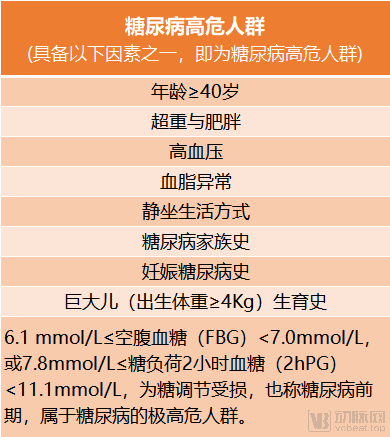
High-Risk Groups for Diabetes. Data source: Official website of the National Health Commission; graphic by VCBeat.
It is undeniable that internet-based diabetes management holds broad market prospects; however, patients have increasingly higher expectations for personalization and quality of life. How to enable patients to transition from being educated and managed to being understood and cared for, from inconvenience to convenience, and from going against human nature to aligning with it, remains a key area for continuous exploration by internet-based diabetes management platforms. Expanding the scope of diabetes management to meet patients’ frequent and ongoing daily living needs, and gradually penetrating the non-pharmaceutical market—valued at hundreds of billions—from the pharmaceutical market, represents another significant trend in the development of internet-based diabetes management.