

Diality Secures $12.5M Series B Funding to Redefine Home Hemodialysis with Smart, Portable System

Diality
Developer of Intelligent Dialysis Machines
Home-based healthcare is regarded as the future of medical services, a trend that is even more pronounced in the management of chronic kidney disease.
At the beginning of this year, due to the impact of the pandemic, some patients experienced interruptions in dialysis treatment, bringing home dialysis models back into the public spotlight.
The heightened attention has also led to high expectations from all sectors of society for home hemodialysis devices, and Diality serves as the “touchstone” for realizing these expectations. By developing an intelligent, flexible, and portable hemodialysis machine, it not only meets patients’ personalized treatment needs but also significantly improves the quality of life for those with kidney disease.
In 1963, the first case of home hemodialysis emerged in Boston, United States, formally ushering in a new era of renal therapy.
Constrained by limitations in R&D technology and health insurance policies, the advancement of home hemodialysis was quite slow; by 1980, its market share was less than 5%, bringing it to the brink of obsolescence.
In 2019, Trump issued a presidential executive order encouraging patients to undergo home hemodialysis, which is expected to gradually replace in-center dialysis. After waiting for nearly half a century, this treatment method has once again come into public view.
Home Hemodialysis is a treatment modality based on hemodialysis equipment, conducted by patients themselves or with the assistance of family members or caregivers, under the guidance of professional medical personnel.
Compared with the traditional in-center dialysis model, home hemodialysis offers numerous advantages, primarily reflected in the following five aspects:
· Longer or more frequent dialysis can be provided at home;
· Better long-term dialysis adequacy;
· The relative shortage of nephrologists and hemodialysis nurses will continue to worsen; home dialysis can help alleviate the burden on healthcare professionals.
· Patients undergoing home hemodialysis have higher survival rates than those receiving conventional hemodialysis;
· Studies have shown that patients experience reduced erythropoietin requirements, improved appetite, and alleviated symptoms of fatigue and pruritus.
Home hemodialysis holds promising prospects; however, given the inherent complexity of hemodialysis and the significant differences between home and clinical settings, its widespread adoption will take time.
Patient
Patients undergoing home hemodialysis, along with their family members and caregivers, must complete appropriate training to acquire foundational knowledge of hemodialysis, achieve proficiency in the operation of hemodialysis machines and associated equipment and consumables, fully understand the risks associated with hemodialysis, be capable of promptly addressing common issues arising during treatment, and strictly adhere to the guidance provided by professional healthcare personnel.
Family Socioeconomic Status
Home hemodialysis requires patients to have a solid financial foundation and adequate hygiene conditions, as well as the ability to provide a dedicated space in the home for the hemodialysis machine and its ancillary equipment. This is particularly important because the water treatment system occupies considerable space and requires the installation of dedicated plumbing.
Medical Support
FamilyHemodialysis must be supported by professional medical institutions. Medical institutions should evaluate whether patients are suitable for home hemodialysis, taking into account the patients’ own preferences. Medical institutions should conduct regular patient training and continuously perform dynamic assessments of patients’ capabilities. Medical institutions should designate dedicated personnel to provide technical support during patient treatment. Medical institutions should establish a quality control system for home hemodialysis and develop corresponding operational standards.
Home Hemodialysis Devices
Home hemodialysis devices require product design that fully accounts for the home use environment, target users, and core functionalities, integrating ergonomics and usability principles. The use environment must address essential conditions such as space, ambient factors (temperature, humidity, etc.), electrical requirements (power supply, electromagnetic compatibility, etc.), and water quality. Target user considerations should encompass the demographic characteristics of patients, their families, and caregivers, employing user-friendly interface designs and providing comprehensive instructions for use. The core functionalities of home hemodialysis devices should include necessary hemodialysis treatment modes, along with features such as automatic priming and disinfection, as well as remote monitoring and support capabilities.
Currently, home hemodialysis devices available on the market are not yet capable of addressing these challenges. However, as technology continues to advance, these interim issues will be resolved one by one in the future, and Diality is dedicated to research in this field.
Osman Khawar, CEO of Diality, stated, “Currently, among the nearly 470,000 dialysis patients in the United States, only about 12% receive home dialysis. However, with rising costs of in-center dialysis and the recently issued executive order on the ‘Advancing American Kidney Health Initiative,’ the proportion of patients undergoing home dialysis continues to rise.”
Driven by the compelling incentives of market mechanisms, Diality is poised to seize unprecedented development opportunities.
Diality is a medical device company based in Irvine, California. Founded in 2018, it is dedicated to developing patient-centric portable, simple, and intelligent dialysis machines. Its goal is to reduce barriers associated with home hemodialysis equipment, thereby enabling patients to receive continuous, high-quality treatment at home or while traveling.
As an innovative company, Diality currently has 36 employees, all of whom are outstanding talents with exceptional capabilities in their respective fields, providing a continuous drive for the company's rapid development.
Osman Khawar, CEO, graduated from the University of Glasgow, where he earned his M.D., and later obtained a master’s degree from Johns Hopkins University. Osman is a board-certified nephrology specialist with a strong passion for home dialysis. Additionally, he is an experienced clinical researcher and entrepreneur who has operated multiple businesses in the dialysis industry, demonstrating exceptional practical expertise.
Chief Technology Officer Clayton Poppe is an experienced systems engineer and technology manager who worked on Aksys Ltd.’s first home hemodialysis machine. Clayton holds a Bachelor of Science in Mechanical Engineering from Duke University, as well as a Master of Science in Systems Engineering and an MBA from MIT.
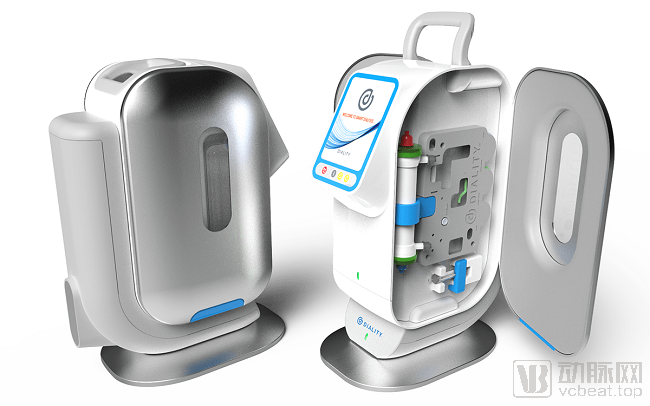
Image sourceHuman API Official Website
“Our mission is to build a home hemodialysis machine that addresses convenience, flexibility, and ease of use, thereby meeting patients’ personalized treatment needs and significantly improving their quality of life,” said CEO Osman Khawar.
Unlike traditional home hemodialysis machines on the market, which are bulky, cumbersome to operate, and complex in procedure, the home hemodialysis machine developed by Diality offers greater practical value.
Operability
The setup process is simple and can be operated independently after minimal training, fundamentally addressing patients’ concerns.
Flexibility
The automatic calibration procedure effectively mitigates potential errors arising from manual operations, thereby ensuring the precision of treatment.
Convenience
The design is more rational, with a footprint reduced by nearly half compared to similar machines, significantly enhancing its portability.
Founded less than two years ago, Diality has raised $59.5 million in funding. These figures reflect the capital markets’ strong confidence in the prospects of its core product, as well as the pressing societal demand for it.
On October 20, 2020, Diality announced that it had completed a $12.5 million Series B financing round. The funds will be used to support the ongoing development of its portable acute and chronic hemodialysis system.
Dr. Osman Khawar, CEO of Diality, stated, “To meet the needs of physicians and their patients who prescribe dialysis in acute, chronic, and home settings, portable machines must also be capable of delivering a broad range of dialysis doses. Addressing this persistent market gap, we aim to develop a truly portable system that can provide not only lower-intensity doses suitable for more frequent dialysis but also the high-efficiency dialysis doses commonly used by patients typically undergoing thrice-weekly treatments.”
Furthermore, Diality is not content with merely redefining home hemodialysis; it also focuses on kidney patient care by adopting scientific approaches to alleviate the caregiving burden on patients and improve their quality of life. Meanwhile, it provides physicians with comprehensive, personalized dialysis treatment prescriptions to facilitate optimal patient care.
Currently, Diality is focused on obtaining 510(k) clearance from the U.S. Food and Drug Administration (FDA) for its hemodialysis system, laying the foundation for product commercialization.
We have reason to believe that home hemodialysis will become the norm in the near future, providing tangible benefits to patients with kidney disease.