

Breaking Down Data Silos: Can Human API Realize the Dream of Full Human Digitization?

Human API
Medical Health Data Platform

Samsung Ventures
Samsung Ventures
Let us boldly envision a future where our physical conditions and medical experiences are connected to healthcare services via the internet. Could it be possible that, in the future, every individual’s entire life journey—from birth to death—could be recorded as a data trail?
In that case, it will bring not only greater convenience in seeking medical care, improved self-management, and personalized treatment, but also comprehensively drive advances in scientific research within the healthcare sector. And now, such a vast trove of healthcare big data is approaching us at an astonishing pace.
As the “Internet Plus” concept gradually permeates the healthcare sector, a brand-new model of medical and nursing care services is undergoing a thorough transformation from the inside out. Medical big data, as the quintessential manifestation of this process, will lead the healthcare industry into a new historical stage.
Healthcare big data encompasses the entire human life cycle, representing an aggregation and collection of data that includes personal health as well as multiple domains such as pharmaceutical services, disease prevention and control, health security, food safety, and wellness and healthcare.
How Will Big Data Transform Healthcare Delivery? Ms. Wang, a 50-year-old patient with cardiovascular disease, can complete basic medical tests at home using electronic devices and upload the data. She can select a hospital, register for an appointment online, with scheduling precision down to the minute. When she sits down with the doctor, her comprehensive electronic health record—including recent bowel movement details—is already displayed without her needing to say a word. She pays via mobile phone, test results are uploaded in real time, and while picking up her medication, she also books her follow-up appointment.
Furthermore, physicians can access Ms. Wang’s medical records anytime and anywhere, eliminating the need to sift through piles of paper charts. This system enables single-entry, multi-user access, facilitating case discussions with colleagues within or across departments and comparative analysis with other medical records to identify optimal treatment strategies based on subtle details. Additionally, physicians can remotely monitor the progression of Ms. Wang’s condition, receiving real-time updates on her status. Leveraging dynamic, authentic health data, doctors provide her with truly personalized medical care.
The future always exceeds our imagination. The rise of mobile phones occurred only after the turn of the 21st century; during the era of the “brick-sized” devices, discussing their camera capabilities was merely a joke. Yet today, with functionalities such as video recording, internet access, photography, and gaming, various apps have rendered mobile phones nearly omnipotent. As the phones we carry with us become health monitors, the integration of healthcare and digital technology has become humanity’s expectation for the future.
Tech enthusiasts who love trying out new gadgets, have you ever considered integrating the monitoring data from your Apple Watch, Xiaomi Mi Band, and other wearables with data from your smart medical monitoring devices? What are the correlations between these datasets? How do your physical activities or medical treatments impact these health metrics?
It is evident that, due to technical and other constraints, we are currently unable to integrate all available data to gain a clearer and more accurate understanding of our health status. For data trapped within isolated devices, it is difficult to generate value that is beneficial to human health.
In reality, many people have already begun attempting to integrate these data sets, with some even developing personal software to consolidate all their information. Andrei Pop also recognized the value of integrating human health data; his startup, Human API, successfully graduated from AngelPad, the largest incubator in the United States, in 2013.
Human API is a health network company dedicated to enabling users of healthcare-related institutions to securely share their health data with institutional applications, granting users real-time access to digitized, structured medical records and health data from thousands of clinics, laboratories, pharmacies, devices, and applications.
Human API boasts a core team with robust technical capabilities and deep professional expertise. Deeply committed to improving people’s health and quality of life through data liquidity, the team is working to pioneer a platform that will power the next generation of health applications and services.
Andrei Pop, CEO and Founder, is a graduate of Columbia University, a world-renowned institution. After graduation, Andrei embarked on his entrepreneurial journey, founding the advertising agency Ideahack Digital in 2010. In 2014, he turned his focus to the field of data integration and established the health network company Human API. His visionary perspective, exceptional execution capabilities, and outstanding business acumen have laid a solid foundation for the company’s development.
According to Andrei’s vision, Human API will collect and organize all data anytime and anywhere, such as health data from wearable devices, exercise data, dietary data, patients’ medical records, and genetic data. Human API will standardize the collected data to facilitate healthcare professionals in analyzing patients’ health status, enable ordinary users to monitor their own health conditions at any time, and provide more entrepreneurs with the infrastructure to deliver health services.
As Joannem Foody stated, “The innovation in healthcare models lies in introducing electronic information technology into medical practice; the most intuitive change is the provision of more efficient, transparent, and accurate healthcare to patients, ultimately enabling self-monitoring and self-feedback.”
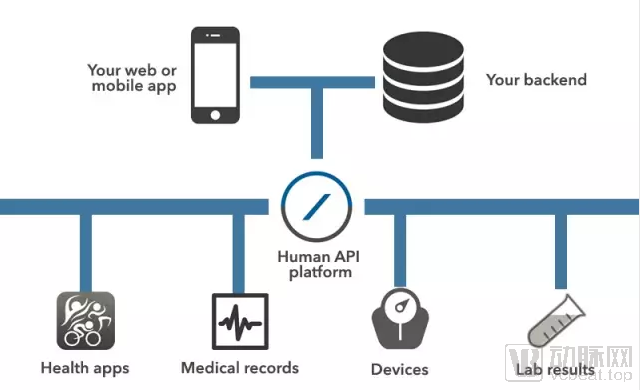
Image SourceHuman API Official Website
Simply put, Human API is a platform that allows users to import various types of personal data (from wearable devices, medical records, and genetic tests) into the Human API platform. With user authorization, third-party health applications can access this standardized data, enabling health app developers to create more health-related applications based on the platform’s data types.
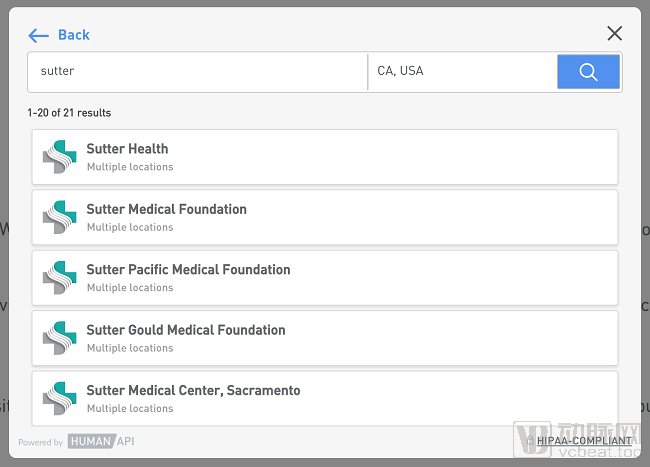
Image SourceHuman API Official Website
Importing data via Human API is straightforward: after registration, simply select the types of data you wish to share and click to authorize.
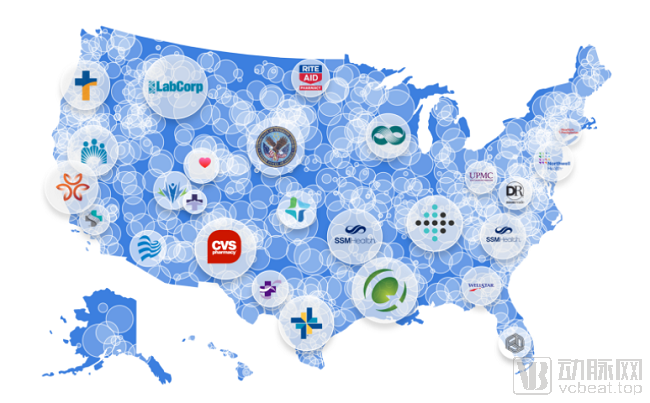
Image sourceHuman API Official Website
Human API’s data sources fall primarily into two categories. The first is traditional medical data. With user consent or authorization from the U.S. Department of Health and Human Services (HHS), Human API can access medical records from more than 1,000 hospitals and clinics across the United States. These records include allergy histories, physical function assessments, test results, and follow-up visit notes. Currently, this segment of medical data is available exclusively to enterprise clients. The second category is health data, such as physical activity metrics, blood pressure, blood oxygen saturation, blood glucose levels, body mass index (BMI), and genetic information covering over one million single-nucleotide polymorphisms (SNPs). This data is mainly sourced from home-use medical devices and health applications. To date, Human API has established partnerships with nearly 10,000 app developers in 35 countries.
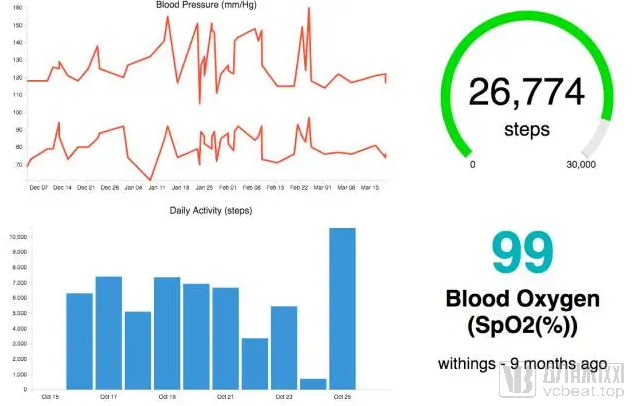
Image SourceHuman API Official Website
After user data is imported into Human API, all data can be visualized using the Chart API. This allows users to intuitively understand the data from all monitoring devices. When a user selects any time point on the chart, the data for that specific time point will be displayed.
Paolo DeMartin, CEO of SCOR Global Life, stated, “Human API’s ‘one-stop’ health data can help companies unlock new possibilities within enduring consumer engagement models. They are truly ushering the industry into a new era of innovation.”
On October 29, 2020, Human API announced the completion of its Series C financing round, raising over $20 million. The round was led by Samsung Ventures, CNO Financial Group, Allianz Life Ventures, and Moneta VC, with participation from existing investors BlueRun Ventures, SCOR Life and Health Ventures, and Guardian Life Insurance Company.
Andrei Pop, founder and CEO of Human API, stated, “With this funding, we will fully drive the evolution of Human API into a digital transformation platform that unifies data from diverse sources and modules. Meanwhile, we are accelerating our research efforts in the insurance, clinical trial, and health plan markets, as well as in areas such as COVID-19 screening.”
In the future, Human API will be guided by the expansion of new products and services, allocating funds to support modules such as new product design, refined risk stratification, optimized clinical trial recruitment, population health management, automated patient monitoring, and the digitalization of chronic disease management, thereby driving continuous industry advancement.
In fact, at a time when wearable smart device technology still needs breakthroughs and medical data requires further digitization and standardization, Human API has not yet garnered widespread attention, but its importance is self-evident.
In his new book The Inevitable, Kevin Kelly states that he has witnessed numerous explosions of technological power and distilled from them twelve verbs, one of which is “flowing.” Today, as new technologies sweep across the globe, the power of “flowing” is gradually becoming more prominent. What Human API aims to do is standardize individual data “silos,” enabling them to “flow” under users’ control.
However, as we envision a bright future, a survey report by Rock Health reveals that “consumers are unwilling to share their health information with technology companies.” Such “conservatism” will pose significant obstacles to medical data aggregation companies like Human API.
This presents a dilemma that remains unresolved at this stage: while users expect their data to yield valuable health insights, they are reluctant to make it publicly available. However, data companies require access to large volumes of user data to perform accurate analysis and predictions.
It is undeniable that the digitalization of human healthcare will inevitably be realized in the future. However, there is still a long way to go before this comes to fruition, and Human API is precisely the explorer forging ahead on this journey.