

Prescription Drug Online Sales Face New Regulatory Framework: Is Spring Coming for Pharma E-commerce?
During the pandemic this year, internet healthcare fully leveraged the advantages of the internet, playing a significant role in online consultations, external prescription dispensing, medical insurance payments, and home delivery of medications, thereby facilitating medical visits and drug purchases. Over the past six months, internet healthcare has received continuous and intensive policy support, leading to an increasingly deep integration of internet technology and healthcare services.
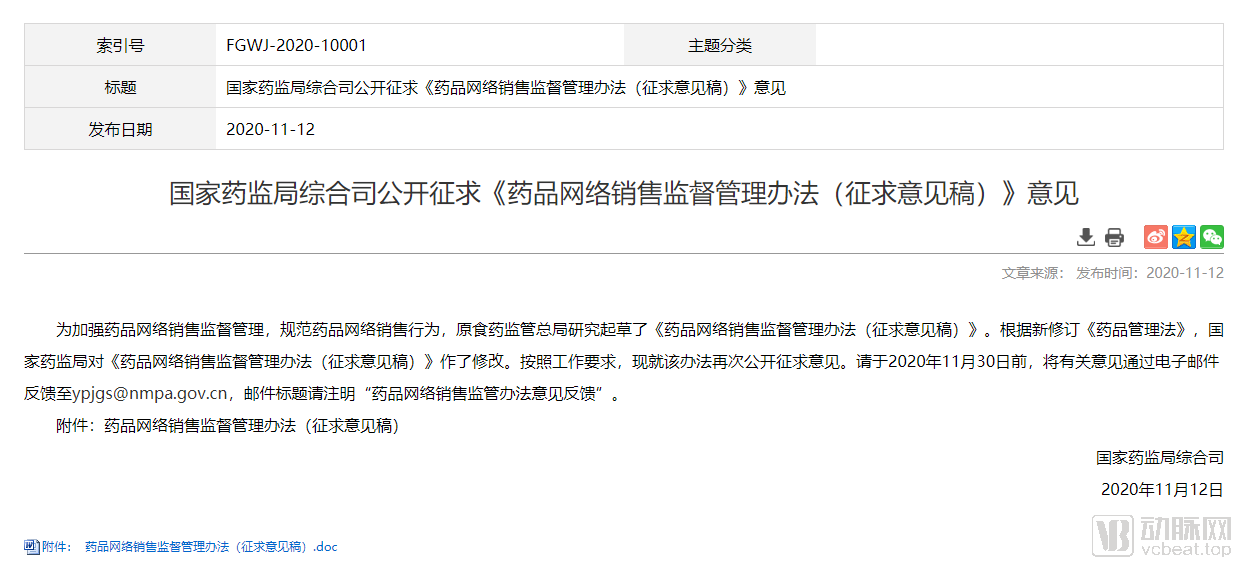
On November 12, the pharmaceutical e-commerce sector received a significant boost as the General Office of the National Medical Products Administration (NMPA) publicly solicited comments on the “Administrative Measures for the Supervision and Regulation of Online Drug Sales (Draft for Comments),” formally charting the course for online prescription drug sales by permitting both the sale and display of prescription drug information online.
Vaccines, blood products, narcotic drugs, psychotropic substances, medicinal toxic drugs, radioactive pharmaceuticals, and drug precursor chemicals—pharmaceuticals subject to special state management that were previously prohibited from online sales—remain banned from being sold via the internet.
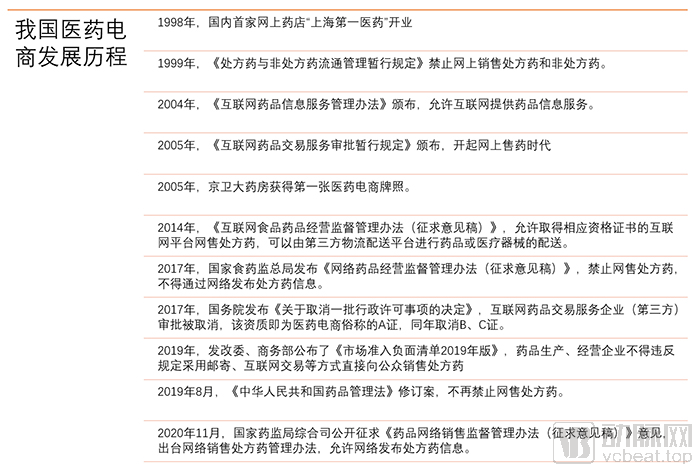
Whether prescription drugs can be sold via the Internet has been a hot topic of discussion in recent years.
In the two versions of the "Measures for the Supervision and Administration of Online Drug Sales (Draft for Comments)" released in 2017 and 2018, it was explicitly stipulated that prescription drugs shall not be sold online, and websites selling drugs to individual consumers are prohibited from publishing information on prescription drugs via the internet. This regulation has had a significant impact on pharmaceutical e-commerce, particularly online pharmacies, subjecting online sales of prescription drugs to a blanket regulatory ban. The industry has long anticipated the lifting of restrictions on the online sale of prescription drugs.
On August 26, 2019, the newly revised Drug Administration Law of the People's Republic of China was promulgated, and prescription drugs were not included in the list of medicines prohibited from online sales.
Some deputies to the National People’s Congress (NPC) argued that online sales of prescription drugs should be strictly prohibited, while others contended that a one-size-fits-all approach should not be applied. In the subsequent press conference, the NPC listened to opinions from various stakeholders and adopted an inclusive and prudent stance toward the online sale of prescription drugs.
Yuan Jie, Director of the Administrative Law Office of the Legislative Affairs Commission of the Standing Committee of the National People's Congress, addressed the issue of online sales of prescription drugs. Director Yuan stated that online drug sales must comply with relevant regulations governing pharmaceutical operations, and that the online sale of prescription drugs must adhere to the principle of consistent standards for online and offline channels under integrated supervision. The National People's Congress has authorized the State Council’s drug regulatory authority, in conjunction with the State Council’s health department and other relevant agencies, to formulate specific implementation measures.
Liu Pei, Director of the Department of Policies and Regulations under the National Medical Products Administration (NMPA), stated that, in accordance with the general principles of the Drug Administration Law, entities selling prescription drugs online must first be physical enterprises that have obtained a Drug Operation License. Only those with an offline license are permitted to sell prescription drugs online. In view of the particularities of online prescription drug sales, stricter requirements have been imposed. For instance, the drug sales network must be interconnected with the information systems of medical institutions to enable information sharing. This is primarily to ensure the authenticity of prescription sources and safeguard patients’ medication safety. Additionally, distribution processes must comply with drug quality standards.
Subsequently, the revised Drug Administration Law of the People’s Republic of China officially came into effect on December 1, 2019. This means that the online sale of prescription drugs is not explicitly prohibited; however, specific regulatory measures are still being drafted by the relevant authorities.
Nevertheless, “online shopping” has become one of the primary modes of daily consumption for residents in China. The acquisition of pharmaceuticals via the internet is particularly favored due to its convenience and efficiency. On the day following the 2020 Singles’ Day shopping festival, the National Medical Products Administration (NMPA) published the Measures for the Supervision and Administration of Online Drug Sales (Draft for Comments), revised in accordance with the latest Drug Administration Law, to solicit public feedback. This marked the long-awaited implementation of new regulatory measures for online drug sales.
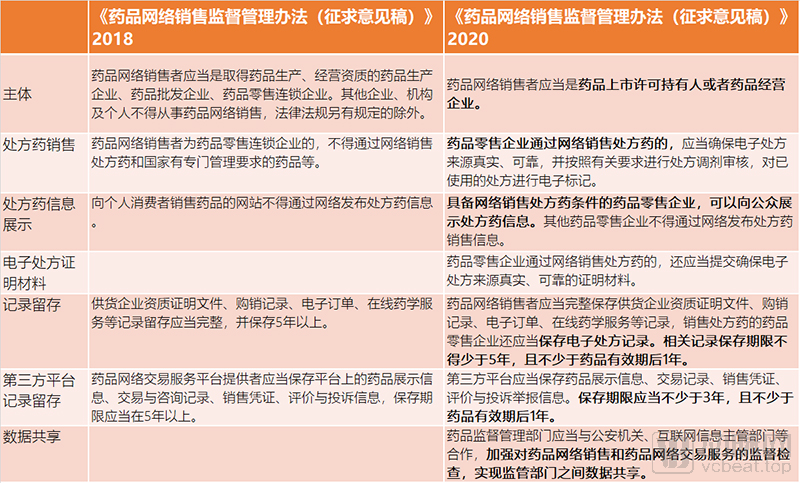
The draft for public comment is divided into six chapters: General Provisions, Management of Online Drug Sales, Platform Management, Supervision and Administration, Legal Liability, and Supplementary Provisions, comprising a total of 48 articles. The previous prohibitions related to the sale of prescription drugs have all been revised in the new Draft.
First, allow the online sale of prescription drugs under the premise of ensuring that the source of electronic prescriptions is authentic and reliable;
Article 9 of the Draft Opinion states that pharmaceutical retail enterprises selling prescription drugs via the internet shall ensure the authenticity and reliability of electronic prescriptions, conduct prescription dispensing reviews in accordance with relevant requirements, and electronically mark prescriptions that have been used. Pharmaceutical retail enterprises selling drugs via the internet are prohibited from providing prescription drugs and Class A non-prescription drugs to the public through promotional schemes such as “buy drugs, get drugs free” or “buy products, get drugs free.”
The previous ban on the online sale of prescription drugs was implemented by regulators due to safety concerns. The regulation of online drug sales differs from offline oversight; it is difficult to verify the authenticity of prescriptions online, and regulatory responsibilities are unclear. Furthermore, the virtual, concealed, and cross-regional nature of online drug sales has made it challenging for regulators to collect evidence and enforce penalties. Media outlets have previously exposed that some pharmaceutical e-commerce platforms were able to bypass audits and sell prescription drugs using fake photos.
Therefore, the new "Draft Guidelines" require verification of prescription authenticity to ensure its genuineness.
Second, drug retail enterprises that meet the conditions for online sales of prescription drugs may display prescription drug information to the public.Online drug sellers shall display drug information that is truthful, accurate, lawful, and valid, and clearly indicate the drug approval number. Drug retail enterprises qualified to sell prescription drugs online shall prominently display risk warnings such as “Prescription drugs must be purchased and used under the guidance of a licensed pharmacist with a valid prescription” when presenting prescription drug information to the public.
Previous administrative measures stipulated that websites selling pharmaceuticals to individual consumers were prohibited from publishing information on prescription drugs online. In the absence of a social environment conducive to the liberalization of online prescription drug sales, regulatory authorities were required to take a holistic approach to ensuring safe medication practices. At that time, although many pharmaceutical e-commerce platforms claimed not to engage in online sales, they displayed prescription drug information on their webpages, thereby engaging in borderline practices to facilitate the sale of prescription drugs.
And with the improvement of Internet regulatory measures and methods, online sales of prescription drugs can be gradually liberalized.
The draft for public comment also provides clear stipulations on online drug sellers, the scope of online sales, obligations of online sellers, third-party platform management, drug distribution, and legal liabilities.
The "Draft for Comments" clarifies the various requirements for the online sale of drugs. Entities engaged in the online sale of drugs shall be drug marketing authorization holders (hereinafter referred to as "holders") or licensed pharmaceutical enterprises; such online sales must not exceed the enterprise’s approved business model and scope of pharmaceutical operations.
Drugs subject to special state control, including vaccines, blood products, narcotic drugs, psychotropic substances, medicinal toxic drugs, radioactive pharmaceuticals, and drug precursor chemicals, shall not be sold online. Online drug sellers shall take measures such as suspending sales, recalling, or retrieving drugs that have quality issues or safety hazards, and promptly publish relevant information on their websites or main pages of business operations.
Article 16 of the Draft Opinion also stipulates requirements for data record retention. When selling drugs to individuals, sales vouchers shall be issued in accordance with relevant regulations. Such sales vouchers may be issued in electronic form. Online drug sellers shall fully retain records including supplier qualification documents, purchase and sales records, electronic orders, and online pharmaceutical service records.Drug retail enterprises selling prescription drugs shall also retain electronic prescription records. The retention period for such records shall be no less than five years and no less than one year after the expiration date of the drug.
In terms of pharmaceutical distribution, online drug sellers shall be responsible for the quality and safety of distributed drugs, ensuring that storage and transportation processes comply with the relevant provisions of the Good Supply Practice (GSP) for Pharmaceutical Products. Appropriate transport vehicles and temperature control methods shall be selected based on factors such as the quantity of drugs, transportation distance, transit time, and temperature requirements, to ensure that the transportation process meets regulatory standards and that the entire distribution activity is fully traceable.
The "Draft for Comments" points out that third-party platforms shall review the qualifications of drug online sellers applying for entry; establish and implement systems to ensure drug quality and safety; set up drug quality management institutions to undertake drug quality management work; establish systems for transaction record retention, complaint management and dispute resolution, and collection of adverse drug reaction information; and establish and implement distribution quality management systems.
Third-party platforms shall retain information on drug displays, transaction records, sales vouchers, and data related to reviews, complaints, and reports. The retention period shall be no less than three years and no less than one year after the expiration of the drug’s validity period. Third-party platforms shall adopt technical measures such as electronic signatures, data backup, and failure recovery to ensure the authenticity, integrity, and security of documents, information, and data, and shall facilitate the self-retention of the aforementioned data by drug online sellers hosted on the platform.
As one of the key application scenarios and business models in internet healthcare, the development of the pharmaceutical e-commerce sector has long been affected by policy uncertainty. Domestic policies regarding the online sale of prescription drugs have remained inconsistent.
It was not until the new version of the Drug Administration Law was released last year that the uncertainty caused by policy risks was eliminated. According to IQVIA’s data projections, as the separation of prescribing and dispensing advances, the scale of outflow of prescription drugs is estimated at RMB 400–500 billion, with the retail market size accounting for approximately RMB 300 billion. The lifting of restrictions on online sales of prescription drugs has created substantial market opportunities for pharmaceutical e-commerce, while the “Internet Plus” development of chain brick-and-mortar pharmacies has further removed barriers.
Dr. Yu Gang, Co-founder and Executive Chairman of 111.com, stated in an interview with VCBeat: “The renewed public consultation on the ‘Measures for the Supervision and Administration of Online Drug Sales (Draft for Comment)’ underscores the government’s rigor and emphasis on regulating online drug sales. This is a positive development for the internet healthcare industry, facilitating its long-term standardized growth and encouraging enterprises to better leverage new technologies to provide convenient pharmaceutical and health services to the public.”
“Compared with the original draft for public comment, the National Medical Products Administration (NMPA) has carefully considered feedback from industry enterprises represented by 1yao.com. Significant improvements have been made to the provisions concerning the display and sale of prescription drugs, which not only align with the operational realities of the industry but also ensure medication safety for the public, thereby providing clear guidance for the sector.”
During this year’s pandemic prevention and control efforts, internet-based pharmaceutical and healthcare companies played a significant role, earning recognition from both society and the state, while substantially increasing public acceptance of online pharmaceutical and healthcare services and, to a large extent, driving policy advancements. Dr. Yu Gang believes that future policies will become more open.
With the implementation of the Measures for the Supervision and Administration of Online Drug Sales (Draft for Comment), the online sale of prescription drugs will operate transparently under regulatory oversight, which will help standardize the market and promote healthy development. The online sale of prescription drugs complements a range of policies, including the outflow of prescriptions from hospitals, the separation of prescribing and dispensing, controls on the drug-to-revenue ratio, and cost containment within medical insurance programs. Online and offline channels are both competitive and complementary. It is believed that pharmaceutical e-commerce enterprises will usher in a new era of growth under the guidance of the new regulatory measures.