

Ten Years of Perseverance: Julikang's Commitment and the Standardization of China’s Third-Party Medical Sterilization Supply Industry
2020Year11Month10On [date], Julikang officially announced its name change: Starting today, Shanghai Julikang Investment Co., Ltd. has been formally renamed toShanghai Julikang Investment Co., Ltd.。
Julikang has two primary considerations for the name change. Since its establishment in 2010, Julikang has undergone ten years of development. This decade of experience has enabled the management team to clarify and strengthen their strategic focus: to continue deepening its presence in the healthcare sector. Furthermore, Julikang will advance technological development by integrating technical innovations into the sterile supply industry, thereby further enhancing its professional capabilities and service quality.
Therefore, the new name “Shanghai Julikang Medical Technology Group Co., Ltd.” includes the two key terms “medical” and “technology,” which also represent the future path that Julikang will take.
To envision the future, we must first look to the past. Over the past decade, the third-party sterile supply industry has transitioned from a lack of regulatory oversight to proactive compliance, from ambiguous positioning to formal recognition as medical institutions, and from tentative experimentation to robust policy support. Today, the sector is finally entering its golden age of development. Throughout this period, innovation by leading enterprises has played a pivotal role in driving industry progress, with Shanghai Julikang Investment Co., Ltd. standing out as a prime representative.
Over the past decade, Julikang has remained dedicated to medical sterilization supply services, committed to providing healthcare institutions with safe, efficient, and trustworthy medical disinfection and sterilization solutions on a consistent basis. To date, Julikang has established independent third-party medical sterilization supply centers in multiple provinces and municipalities, including Shanghai, Tianjin, Guangzhou, Anhui, Fujian, Shaanxi, Chongqing, Liaoning, and Henan, serving hundreds of healthcare facilities.
Since 2010, the Julikang team has continuously improved quality in the design, production and supply, and logistics of sterile supply centers, proactively cooperated with regulatory authorities, and built and upgraded traceability platforms. Julikang’s multi-faceted innovations have gradually gained recognition from hospitals and infection control experts, steadily promoting the development of China’s third-party medical sterile supply industry.
So, how did third-party sterile supply centers emerge from nothing and grow from small to large over the past decade? How has Julikang promoted the development of the third-party sterile supply industry? What is the future path for third-party sterile supply centers? And how will Julikang strategize to further drive industry growth?
To address these questions, VCBeat (WeChat ID: VCbeat) conducted an exclusive interview with Xu Jing, General Manager of Julikang, and compiled this article.
Based on relevant policies and industry development trends, we categorize the third-party sterile supply industry into three developmental stages: the initial stage, the exploratory stage, and the growth stage.
During the initial stage, China’s Sterile Supply Departments (CSSDs) were predominantly public institutions, primarily funded by fiscal appropriations and led by regional benchmark hospitals, while third-party CSSDs gradually emerged and began to penetrate the market. In the exploratory phase, policies encouraged pilot initiatives; third-party CSSDs continuously explored business models and educated the market, resulting in slow growth. In the development phase, policies clearly defined the status of third-party CSSDs as medical institutions and established industry standards, driving their rapid expansion fueled by policy support, technological advancements, and capital investment.
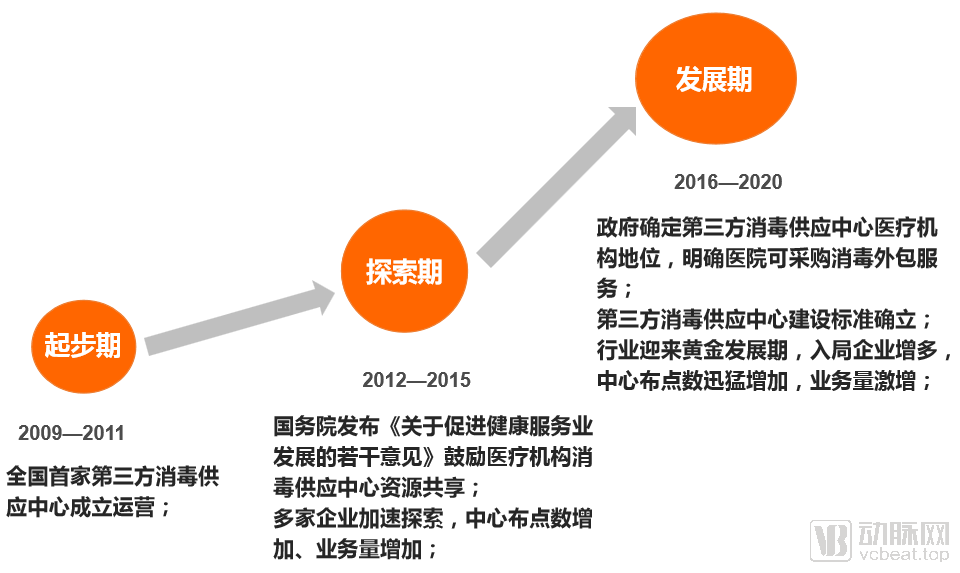
(Chart by VCBeat)
2009–2011, Pioneering and Accumulation: Third-Party Central Sterile Supply Departments Enter the Chinese Market
Prior to 2009, all Central Sterile Supply Departments (CSSDs) were publicly owned and managed through administrative approaches, lacking innovation. In 2010, Julikang Shanghai CSSD was established, becoming the first third-party CSSD to operate in China.
During this phase, although private and foreign-funded enterprises began to enter the medical sterilization supply industry, public-sector entities still dominated in terms of market share. For Julikang, the key themes of this period were “pioneering” and “accumulation.”
When establishing its first third-party sterile supply center, Julikang, like other third-party sterile supply service providers, faced numerous questions: What benchmarks does Julikang adhere to? How is the market evaluated? Does the establishment of a third-party sterile supply center comply with standards? Is the quality qualified? Who will conduct technical supervision? What are the differences between a third-party sterile supply center and a hospital’s sterilization department?
Xu Jing told VCBeat, “During the startup phase, Julikang continuously reflected on and learned from these concerns, striving to provide reasonable solutions. In fact, these concerns have motivated Julikang, enabling us to go further.”
For example, Shanghai Julikang Investment Co., Ltd. conducted an in-depth analysis of the 2009 industry standards for Sterile Supply Departments (SSD) and consulted with industry experts to understand the requirements for establishing such facilities. Meanwhile, the company visited and studied the SSDs of renowned domestic hospitals, including Grade IIIA general hospitals and teaching hospitals, while benchmarking against advanced SSDs in countries such as the United Kingdom and Germany. After incorporating advanced technologies and experience from both domestic and international sources, Shanghai Julikang adapted its approach to local conditions during implementation, establishing a distinctive third-party sterile supply center operated under a corporate business model.
Compared with public sterilization centers, corporatized third-party sterile supply centers offer higher management efficiency and lower operating costs. Moreover, these third-party centers help healthcare institutions free up medical space and release professional talent, enabling hospitals to access high-quality sterilization services at a reasonable cost.
Gaining the trust of hospitals and infection control experts presents another significant challenge. Julikang has addressed this by strengthening regulatory oversight, implementing a traceability platform, and establishing standard operating procedures (SOPs). First, it proactively invites health supervision authorities and provincial or municipal Centers for Disease Control and Prevention (CDCs) to oversee its central production environment and operational processes. Second, it has built an intelligent traceability platform that provides video monitoring of the entire disinfection and sterilization process and transmits data to hospitals, enabling them to monitor in real time key traceability information such as production workflows and physical parameters. Third, it develops tailored SOPs based on the specific items handled for each client hospital, setting strict standards across all stages—including collection, cleaning, disinfection, and distribution—to ensure service quality. Finally, it delivers innovative, customized service solutions to meet hospitals’ stringent requirements, while continuously enhancing its service capabilities and quality.
After a series of coordinated initiatives, Julikang finally earned the trust of hospitals and the recognition of infection control experts. In 2011, the third-party sterile supply center established by Julikang passed ISO 9001 quality management system certification and undertook its first hospital sterile supply contract. This significant step forward for Julikang also marked a major breakthrough for China’s third-party sterile supply industry.
2012-2015, Exploration and Innovation: The number of third-party sterile supply centers gradually increased
In April 2011, Julikang undertook its first specialized hospital project in Shanghai, marking the initial step in its venture into outsourced sterile supply services. A brand-new 3,000-square-meter center, staffed by head nurses and nurses recently transitioned from clinical care roles, along with newly hired operational workers, commenced busy operations. Julikang defined this phase as the “human-machine adaptation period for new centers.” During this time, Julikang possessed compliant hardware infrastructure and professional equipment and facilities, while all regional workflow processes, standard operating procedures (SOPs) for item handling, and personnel training adhered strictly to academic standards.
During its service to hospitals, Julikang faced nothing but setbacks and skepticism. Questions on implementation and hospital liaison arose daily from hospital quality control meetings. “Complaint feedback and continuous improvement” ceased to be mere lip service; that period marked a critical juncture for Julikang, characterized by hospital-led training and education alongside its own profound transformation.
Xu Jing stated, “Our processes, systems, and product quality were driven by the demands of hospitals; without their exacting requirements and rigorous scrutiny, we would not have achieved our subsequent transformation and development.”
As the volume of sterilization and supply services handled by various medical institutions increased in the later stages, and the number of national centers continued to grow, the third-party sterilization and supply industry began to take shape. However, due to the absence of relevant qualifications and the lack of national regulatory policies, although operating within the healthcare services sector, it remained outside the oversight of health supervision and quality control authorities. Consequently, the third-party sterilization and supply industry is still in its nascent, unregulated phase of development.
Fortunately, in September 2013, the State Council issued the “Several Opinions on Promoting the Development of the Health Service Industry,” explicitly encouraging the development of third-party health and medical services. In June 2015, the State Council released the “Notice on Several Policy Measures to Accelerate the Development of Socially Operated Medical Institutions,” encouraging cooperation between public and private medical institutions.Resource Sharing in Central Sterile Supply Departments of Healthcare Institutions Under the Premise of Ensuring Medical Safety and Fulfilling Core Medical Functions。
This has been a “long-awaited boon” for third-party sterile supply centers. With policy support, hospitals at all levels have become willing to outsource sterilization services, and numerous companies have dared to boldly explore and innovate. During this phase, the number of third-party sterile supply center locations and the volume of services they handle have gradually increased, propelling the industry into a period of rapid growth.
Taking Julikang as an example, between 2012 and 2015, the company successively established third-party sterile supply centers in Tianjin, Shenyang, and Changsha. Additionally, its third-party sterile supply center in Shanghai successfully undertook sterile supply services for multiple Grade A tertiary hospitals, achieving profitability in 2014.
Shanghai Julikang Investment Co., Ltd. has established third-party sterile supply centers in Tianjin, Shenyang, and Changsha following comprehensive market research and assessment. After the release of the 2009 edition of the Hospital Sterile Supply Center Standards, some medical institutions encountered obstacles such as site limitations, construction requirements, and funding constraints when upgrading their sterile supply centers. However, sterilization and disinfection remain essential needs for hospitals, directly impacting patient safety.
Therefore, Julikang submitted an application for establishment approval to the local Health Commission, seeking to construct a third-party sterile supply center and provide sterilization services to medical institutions within the region. Following market assessment and incorporating recommendations from hospital infection control experts, the local Health Commission recognized Julikang’s professional competence and technical capabilities, granting approval for the construction of the third-party sterile supply center.
Currently, these three sterilization supply centers provide sterilization and disinfection services to medical institutions at all levels within the region, addressing the challenge of establishing in-house sterilization centers for local hospitals while mitigating regulatory and operational risks. For instance, the third-party sterilization supply center in Changsha boasts the widest logistics and distribution coverage nationwide, serving multiple county- and city-level people’s hospitals and township health centers in surrounding areas such as Ningxiang, Yiyang, Changsha County, and Xiangtan. This has resolved compliance issues related to sterilization supply and infection prevention and control management for prefecture-level cities and suburban county hospitals in the vicinity.
Xu Jing told VCBeat, “As a practitioner in the healthcare industry, Julikang upholds the professional responsibility expected of medical professionals. Whenever market assessments reveal local demand, Julikang spares no effort to promote and introduce third-party sterile supply centers. We proactively assume social responsibility without a profit-driven motive, providing high-quality, compliant sterile supply services to medical institutions at all levels locally.”
This sense of responsibility also laid the foundation for Julikang’s rapid growth in the years that followed.
2016–2020, Compliance and Development: Third-Party Sterile Supply Centers Enter a Golden Age of Growth
In 2016, the "Standards for Central Sterile Supply Department (CSSD) in Hospitals (2016)" were released.Public medical institutions are explicitly permitted to adopt outsourced sterilization and supply services.
In 2017, the "Notice on Deepening the Reform of 'Delegating Power, Improving Regulation, and Upgrading Services' to Stimulate Investment Vitality in the Medical Field" was released, adding five new categories of independently established medical institutions, including sterilization supply centers.Disinfection Service Enterprises Now Hold the Status of Medical Institution Practice Licenses。
In 2018, the "Basic Standards for Medical Disinfection and Supply Centers (Trial)" and the "Management Specifications for Medical Disinfection and Supply Centers (Trial)" were released, providing detailed regulations on departmental setup, staffing, infrastructure, and other aspects.Third-Party Medical Sterile Supply Centers Are Becoming More Standardized。
The release of the aforementioned policies ushered in a golden era for the third-party sterile supply industry. An increasing number of medical institutions began to adopt outsourced sterile supply services, while more enterprises entered this sector, leading to the emergence of third-party sterile supply centers across China. This period also marked the fastest and smoothest phase of development for Shanghai Julikang Investment Co., Ltd.
For example, Julikang established and operated the Xiamen Center, Hefei Center, and Foshan Center in 2016. In 2017, it established and operated the Shanghai Julikang Dongmao Center and completed its Series A financing. In 2018, Julikang established and operated the Chongqing Center, Nanyang Center, and Xi’an Center, and was ranked among the Top 5 Third-Party Medical Service Providers on the “2018 Future Healthcare 100” China List, organized by VCBeat and VBInsight. In 2019, Julikang established and operated the Guangxi Center and Zhumadian Center, and completed its Series B financing. In the same year, Julikang received multiple honors, including the “2019 Most Watched Green Finance Enterprise Award” and the “Era Contribution Award.”
The rapid establishment of new centers across China is attributable to Julikang’s sense of responsibility as a healthcare provider. Driven by this commitment, Julikang conducted comprehensive market research and strategic planning nationwide, enabling it to swiftly select sites and commence construction when opportunities arose. Another key factor is financing; the injection of capital has provided a strong foundation for Julikang’s expansion of new centers.
Xu Jing stated, “Each fundraising round initiated by Julikang was carefully considered. The Series A financing was launched to facilitate rapid expansion and market deployment, thereby enhancing Julikang’s competitive advantages in hardware, management, and other areas. The Series B financing was undertaken to upgrade existing third-party sterile supply centers and construct new ones. Every round of financing was designed to achieve a specific, clearly defined objective set by Julikang, while the injection of capital ensured the company’s high-speed growth.”
In addition to upgrading hardware facilities, Julikang has also optimized its traceability platform and obtained the source code certificate for the Sterile Supply Department Traceability Management Software. Xu Jing stated, “Through multiple updates to the sterile item traceability management platform and the hospital traceability client, hospitals can now log in via computer or mobile devices to scan barcodes on the exterior of item packages, enabling traceability queries for each individual item. Furthermore, the traceability client achieves closed-loop, end-to-end traceability management—from central production operations through distribution to final linkage with clinical patients—seamlessly integrating with the platform for infection control management of sterile items. Real-time query and monitoring capabilities empower hospital administrators and infection control experts to ensure that ‘while sterilization services are outsourced, quality monitoring remains in-house,’ thereby maintaining autonomous control over quality assurance.”
It is worth noting that, during its period of rapid development, Julikang has maintained a high degree of industry self-discipline and continuously enhanced its professional capabilities. For instance, on November 7, 2020, the national group standard “Logistics Distribution Management for Regional Sterile Supply Centers,” drafted and compiled with the participation of Julikang, was officially released. This standard provides regulation and guidance for the logistics, transfer, and distribution management of reusable medical devices, ensuring their safe, timely, quality-assured, and quantity-guaranteed delivery to healthcare institutions at all levels.
It is perhaps this very self-discipline that has enabled Shanghai Julikang Investment Co., Ltd. to advance steadily in full compliance with regulations, working hand in hand with industry experts and peer enterprises to drive the gradual growth of the third-party sterile supply industry.
Looking Back on the Past Decade: The Third-Party Sterile Supply Industry Has Weathered Storms, Evolving from Initial Corporate Investment to a Golden Age of Development. Looking Ahead: The Industry Boasts Broad Prospects and Represents a Blue Ocean Market.
Judging from the major trends in healthcare reform, outsourcing hospital sterilization has become an accepted model of professional third-party service outsourcing. The market for sterilization and disinfection services holds immense growth potential, while third-party sterile supply centers demonstrate strong competitiveness due to their advantages in management efficiency, operational costs, and service radius.
We anticipate that the third-party medical sterilization supply industry will enter a mature phase in the future. Standardized and compliant operational service models will be increasingly adopted by healthcare institutions. Third-party sterilization supply centers, represented by Julikang, will establish nationwide service networks, with standardization, chain operations, and branding becoming their distinguishing features.
Standardization across all aspects, including business processes and equipment and facility development, will ensure that service levels meet hospital requirements. Chain management enables enterprises to leverage complementary internal strengths, reduce operational and management risks, and achieve economies of scale. Branding serves as an endorsement for the enterprise, enhancing its market competitiveness.
Xu Jing stated, “For Julikang, we will uphold industry self-discipline, implement rigorous professional quality control and quality management systems, and ensure specialized services with safe, high-quality standards. We will continuously enhance our service capabilities and quality, strengthen the company’s professional image, and leverage the brand influence of Julikang to attract more hospitals to adopt the third-party sterile supply model, thereby driving industry development.”
In addition, Julikang will leverage third-party sterile supply platforms in its future development to deeply cultivate the operating room ecosystem, develop operating room-related products, and integrate upstream, downstream, and peripheral enterprise resources to build an operating room supply chain platform, providing hospitals with supporting supplies of sterile items for operating rooms.
In fact, Julikang has already made strategic moves in this area. By forging deep collaborations with specialized manufacturers and leveraging the R&D-driven innovation spirit of a medical technology enterprise, it is committed to transforming from a disinfection and sterilization service provider into a comprehensive operating room collaborative management service provider.
We look forward to seeing what surprises the third-party sterile supply industry will bring in the future.