

InferVision Secures China's First Class III AI Certification for Pulmonary Nodule Detection, Paving the Way for High-Throughput Clinical AI Adoption

Infervision
Artificial Intelligence Product Developer
The National Medical Products Administration (NMPA) has explicitly stated that the risk level of diagnostic software is determined based on factors such as the risk, maturity, and transparency of the algorithms employed, rather than solely on the type of data processed (e.g., medical images of cancers or malignant tumors). If diagnostic software uses algorithms to automatically identify lesions and provides clear diagnostic prompts, it is considered to have a relatively high risk level and is regulated as a Class III medical device. This regulation has effectively excluded many AI-assisted diagnostic products from the market.
On November 13, the National Medical Products Administration (NMPA) published on its official website the first medical device approval certificate for CT imaging auxiliary software for pulmonary nodules based on deep learning technology. This marks the first Class III medical device certification issued by the NMPA for an AI-based pulmonary nodule detection system, which was granted to Infervision, a company headquartered in Beijing.
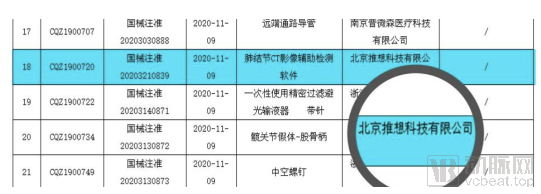
Infervision was among the first batch of startups in China to enter the AI medical imaging sector. In 2015, the Infervision team pioneered the use of AI technology for automated detection of pulmonary nodules in medical images, at a time when the AI imaging market was still a blue ocean. Subsequently, hundreds of companies scrambled to acquire scarce pulmonary nodule datasets, making the market landscape increasingly complex and opaque. Today, however, many enterprises have foundered due to commercialization hurdles, including failures to obtain regulatory approvals.
“Ten years of honing a sword, one moment to reveal its edge.” Infervision emerged at the critical juncture.
Among the various artificial intelligence applications, AI software for pulmonary nodule detection with Class III medical device certification is undoubtedly the one with the highest volume and greatest value. This is because chest CT scans account for the largest proportion of imaging examinations in healthcare institutions, far surpassing other imaging modalities in scale. Furthermore, pulmonary nodules, particularly subtle ones, are difficult to identify, making this the clinical scenario where physicians most require decision support. More importantly, this technology addresses China’s most severe public health challenge: lung cancer.
The latest national cancer statistics released by the National Cancer Center in January 2019 show that malignant tumors account for 23.91% of all resident deaths, with lung cancer deaths exceeding one-quarter of the total. This is because the vast majority of patients with early-stage lung cancer are asymptomatic or present with only mild symptoms, often causing them to miss the optimal window for treatment. Even when lung cancer is diagnosed at an advanced stage, the five-year survival rate is only approximately 12%.
Early Detection and Early Surgical Intervention Are the Most Effective Methods for Reducing Lung Cancer Mortality.
“The government has long sought to mitigate the impact of lung cancer on public health through treatment or screening, but implementation proved difficult due to constraints such as medical devices and personnel shortages. Now, however, we have laid the necessary foundation,” Chen Kuan, Founder and CEO of Infervision, told VCBeat.
Under the tiered diagnosis and treatment system, an increasing number of primary healthcare institutions are equipping themselves with CT scanners. The pandemic this year has further accelerated the adoption of large-scale medical imaging equipment. Meanwhile, the integration of artificial intelligence addresses human resource challenges by providing effective imaging diagnostic support to healthcare institutions and reducing treatment costs. The combination of these two factors establishes the physical foundation for widespread early screening of lung cancer. AI for pulmonary nodules is attempting to address China’s lung cancer burden through a new model.
Another aspect is the issue of survival. Not every enterprise possesses the scale of Infervision, which can generate profits through various channels by leveraging a diverse product portfolio. For companies with a more concentrated product focus, pulmonary nodules represent a critical offering. Once Infervision paves the way, other enterprises can at least see a glimmer of hope.
From scenario selection, product design, and model development to clinical trials, product deployment, and post-deployment maintenance of workstations, every stage requires substantial corporate commitment to deliver a qualified product. In this regard, Infervision has dedicated five years.
Step 1 is to select the scenario. An analysis of demand reveals that China ranks first globally in both the annual number of new lung cancer cases and the annual number of lung cancer-related deaths, resulting in robust demand for early screening; low-dose spiral CT is being widely promoted. In terms of image quality, chest CT images feature thin slices, a clear field of view, minimal interference, and discernible patterns in lesion characteristics, making them an ideal application for intelligent image interpretation. Coupled with the scarcity of radiologists in China and strong support from national policies, there is indeed substantial market demand for pulmonary nodule detection.
Once the direction was set, the next step was product development. Initially, the AI for pulmonary nodules had very limited functionality, with unsatisfactory sensitivity and specificity. “When we first unveiled it, even we ourselves were hesitant to look at the results,” Chen Kuang once joked self-deprecatingly.
Balancing specificity and sensitivity is challenging, yet both are indispensable for truly assisting physicians. After all, AI must maintain sufficient sensitivity to avoid missing nodules, while also improving specificity to prevent false alarms from unnecessarily increasing clinicians’ workload.
Infervision’s AI capabilities were enhanced incrementally. Hundreds of Infervision engineers took turns working onsite at hospitals, collaborating with physicians daily to deepen their understanding of pulmonary anatomy and train the model to recognize subtle differences. The resulting AI system for pulmonary nodules can not only detect “dark spots” smaller than 5 mm in diameter—often imperceptible to the naked eye—but also characterize them qualitatively. Only by achieving this level of performance can the technology provide genuine clinical value to physicians.
Revisiting Clinical Trials. On one hand, Infervision has successively obtained CE certification from the European Union, PMDA certification from Japan, and FDA clearance from the United States since February 2020. These developed countries and regions maintain stringent regulatory and market entry barriers for medical products, with fewer than 100 AI-based products globally having achieved such certifications. Obtaining approvals across multiple global regions has enabled Infervision to accumulate extensive experience in regulatory review and approval processes.
On the other hand, Infervision’s AI product for pulmonary nodules has collaborated with multiple top-tier Grade 3A hospitals in China to conduct rigorous clinical trials. The trial adopted a prospective multi-reader multi-case (MRMC) clinical design, benchmarked against international standards. Under this framework, Infervision achieved compelling clinical results.
Infervision now holds four regulatory approvals, enabling its AI products to simultaneously meet the market access requirements of four major regions—a testament to the capabilities of its products. Furthermore, these four certifications not only cover China, the United States, the European Union, and Japan—the world’s largest, most advanced, and most stringently regulated healthcare markets—but also serve as important references for market access in other countries and regions worldwide.
To date, Infervision has successively established teams in Japan, North America, and Europe. Its AI products have collaborated with over 60 medical institutions overseas, spanning countries and regions with the most advanced healthcare systems, including Switzerland, Germany, the United States, Canada, Japan, France, and Italy. For Infervision, securing market access certifications in the four major medical markets officially ushers in the globalization of Chinese medical AI enterprises, allowing Chinese medical AI products to enter the global stage with a renewed presence.
What Does It Mean to Obtain the First Class III AI Medical Device Certificate for Pulmonary Nodules?
Infervision’s emergence as the leader from a pool of nearly 100 competitors is a testament to the profound expertise of this established AI company specializing in pulmonary nodule detection. With its high-throughput AI product having secured the Class III medical device certification, Infervision’s existing market share and diverse product portfolio position it for even greater growth opportunities post-approval. Next, Infervision can focus on securing inclusion in pricing catalogs. By gradually monetizing its vast accumulated market presence, Infervision is poised for a new wave of explosive growth.
The industry has also benefited from this. The greater the volume, the more cautious the approval process becomes, and the greater the difficulty. Therefore, the issuance of the first Class III medical device certificate for AI-based pulmonary nodule detection undoubtedly carries unique significance—it signifies that the National Medical Products Administration (NMPA) has endorsed one application of AI technology in a key clinical scenario, thereby recognizing the quality of AI as well as its safety and efficacy in large-scale applications.
The capital market has also benefited extensively. In just three years, medical AI has gone from "overheated" to a "deep freeze." According to the VCBeat Orange Database, 2017 marked the peak for medical AI, with 121 global financing rounds raising a total of RMB 14.085 billion. Both figures declined in 2018, and by November 2020, there had been fewer than 10 financing deals for domestic medical imaging AI companies.
Overheating often leads to inflated valuations, but sustained declines can also cause the market to be undervalued. Judging by this year’s trends, numerous companies have secured regulatory approvals, and Infervision’s approved solution for pulmonary nodules is undoubtedly one of the most valuable applications, providing a significant confidence boost to investors.
Furthermore, the medical imaging AI market, having weathered significant hardships, has reached sufficient maturity; the era of securing financing based solely on concepts is long gone. As rationality returns, companies whose value is recognized will reap the benefits. Perhaps in the coming year, as more capable medical imaging AI firms obtain regulatory approval and enter the market, the industry will shift toward high-quality competition, which may in turn drive the return of capital investment.
Recently, the “Proposal of the Central Committee of the Communist Party of China on Formulating the Fourteenth Five-Year Plan for National Economic and Social Development and the Long-Range Objectives Through the Year 2035” was released. It stated that “self-reliance and self-strengthening in science and technology should be taken as the strategic support for national development,” and emphasized the need to “strengthen basic research, prioritize original innovation, optimize the layout of disciplines and R&D, promote interdisciplinary integration, and improve the supply system for generic foundational technologies.” It also called for targeting frontier fields such as artificial intelligence, quantum information, integrated circuits, life and health, brain science, biological breeding, aerospace and aviation technology, and deep earth and deep sea exploration, and implementing a batch of forward-looking and strategic national major science and technology projects.
In the 14th Five-Year Plan, artificial intelligence and life health are both listed as priorities in the field of frontier science and technology, which will inevitably bring about a new round of development in China's artificial intelligence and life health sciences.
Medical AI spans these two heavyweight sectors. How to leverage advanced technology to continuously improve life and health is a challenge that medical AI companies, represented by Infervision, must address.
Going forward, Infervision’s strategy will expand along a matrix of horizontal and vertical dimensions: vertically, it will provide comprehensive, end-to-end solutions for each disease; horizontally, it will extend its coverage to common high-incidence conditions, such as cardiovascular and cerebrovascular diseases and breast cancer.
"Moving forward, Infervision will deepen its collaboration with global medical institutions to combat diseases that threaten human health and build a shared future for humanity's well-being."