

Wuhan University and Tencent Establish Joint Laboratory for Big Data and Health Security to Advance Evidence-Based Medical Insurance Decision-Making
Currently, medical insurance has become an important component of China's social security system and a key mechanism for reducing residents' out-of-pocket healthcare expenditures. However, due to various factors, the medical insurance industry in China still faces certain shortcomings.
To advance medical insurance innovation, the inaugural “Luojia-Tencent Medical Insurance Innovation Forum,” jointly organized by the Social Security Research Center of Wuhan University and Tencent’s Healthcare Division, was recently held at Wuhan University.
At the forum, Wuhan University’s Social Security Research Center and Tencent’s Healthcare Division jointly unveiled the “Joint Laboratory for Big Data and Health Security” and released the Blue Book on Smart Medical Insurance, titled “Technology for Social Good: Intelligent Access to Medical Insurance.” Drawing on multiple dimensions, including practice and application, the publication offers insights to stakeholders involved in building smart medical insurance systems, thereby advancing the realization of universal health coverage under the Healthy China initiative.
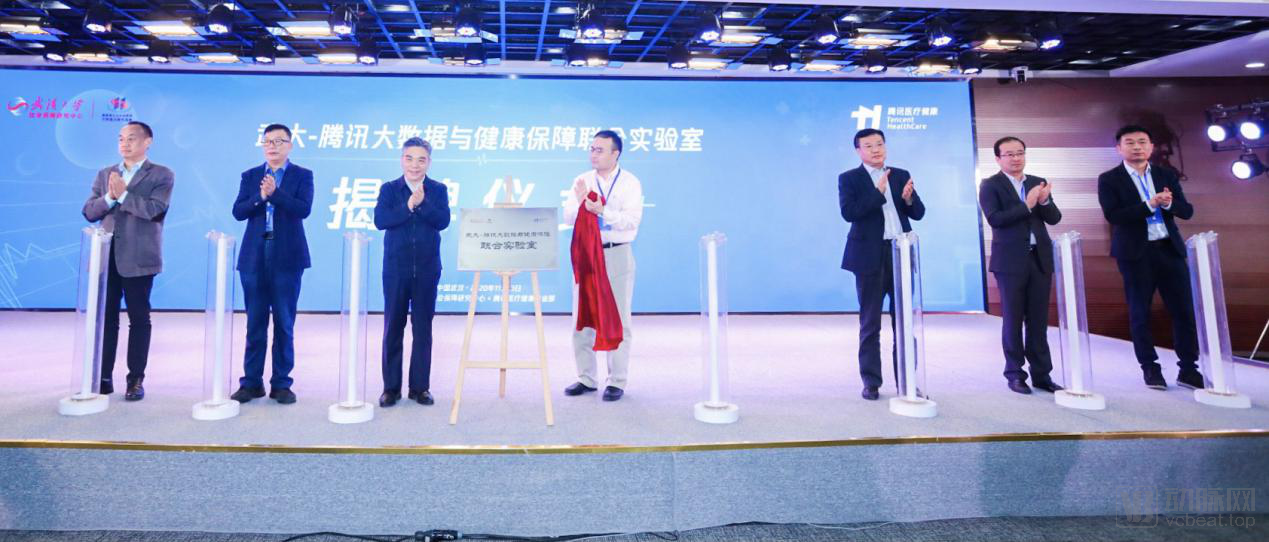 Guests including Tang Qizhu, Vice President of Wuhan University, and Ni Jianwen, Vice President of Tencent Healthcare, unveiled the plaque for the joint laboratory.
It is reported that the “Blue Book on Smart Healthcare Security: Technology for Good, Intelligent Access to Medical Insurance,” released at this forum, represents a phased achievement of the Joint Laboratory. This work was jointly completed by numerous experts and covers macro policies, smart medical insurance, technological products, application cases, as well as prospects and reflections on the development of smart medical insurance systems.
Healthcare insurance innovation has consistently been a focal point of attention for the government and society. At this year’s “Luojia–Tencent Healthcare Insurance Innovation Forum,” experts and scholars from academia, industry, and research institutions engaged in discussions and offered forward-looking insights on cutting-edge topics, including innovative design of health security systems, innovative applications of digital technologies, integrated development of the healthcare insurance ecosystem, and the construction of a credit system for medical security.
“Social security is a key focus area for Wuhan University, which has made significant efforts in discipline development, talent team building, and the recruitment and cultivation of high-level professionals,” said Tang Qizhu, Vice President of Wuhan University. The Center for Social Security Studies at Wuhan University hosts the nation’s only national-level key discipline in social security, the country’s sole national-level innovation platform for social security research, and serves as a key research base for humanities and social sciences under the Ministry of Education, boasting substantial professional talent resources. The establishment of a joint laboratory by the Center for Social Security Studies at Wuhan University and Tencent will facilitate greater collaborative exploration in healthcare insurance innovation and contribute to the development of China’s public health infrastructure.
Tang Daosheng, Senior Executive Vice President of Tencent and President of the Cloud and Smart Industries Group, stated, “Leveraging its technological expertise in cloud computing, artificial intelligence, big data, and information security, as well as its resource advantages in mobile internet, Tencent will collaborate with Wuhan University to jointly advance innovations in health security system design and digital technology applications, thereby supporting the national Healthy China strategy.”
“Since the establishment of the National Healthcare Security Administration, various reforms have been rapidly advanced, with continuous innovations in the allocation, payment, supervision, administration, and settlement of healthcare security funds. From a policy perspective, there are currently three shifts: first, a transition from high-speed growth to high-quality development; second, a shift from focusing on incremental expansion to optimizing existing resources; and third, a move from extensive management to refined management,” stated Ying Yazhen, Deputy Dean of the National Healthcare Security Research Institute, at the conference. She noted that the establishment of the joint laboratory offers three key benefits.
First, leveraging informatization, digitalization, intelligence, and standardization can ensure the authenticity and reliability of medical insurance data. Second, with informatization as a prerequisite and big data as support, combined with research into various operational scenarios, performance evaluation and payment outcomes in medical insurance will become more scientific and precise. Finally, through scientific forecasting, trends in the operation of medical insurance funds can help make the medical insurance system more pragmatic and refined.
Regarding the collaboration with the Center for Social Security Studies at Wuhan University, Ni Jianwen, Vice President of Tencent Healthcare, stated: “Tencent currently provides a range of capabilities—including a cloud platform for medical insurance, public services, electronic medical insurance vouchers, AI-driven medical insurance solutions, and Internet-plus medical insurance payment—to the National Healthcare Security Administration, provincial and municipal healthcare security bureaus, 1.3 billion insured individuals, and tens of thousands of healthcare institutions. These offerings deliver technical support and sustained innovative capacity across all areas of medical security, including multi-tiered coverage, investment and operations, medical insurance payments, and oversight of medical insurance funds.”
For instance, WeChat’s electronic medical insurance certificate currently covers 31 provinces and more than 150 cities where it can be used for payments, enabling “one-code access” and card-free medical consultations and medication purchases. It also applies blockchain technology to prescription circulation and chronic disease management services, leveraging “big data” to drive prescription transfers and facilitate convenient medication purchases. Meanwhile, Tencent provides end-to-end services spanning from medical consultation to reimbursement, ensuring that the entire process of invoice generation, transmission, storage, and reimbursement is recorded on the blockchain. This bridges the “last mile” of internet healthcare in the medical insurance settlement process, making medical reimbursement hassle-free.
In the future, the “Wuhan University–Tencent Joint Laboratory for Big Data and Health Security” will leverage their respective strengths to advance research and practical innovation in areas such as big data, medical insurance, health security system design, and health policy evaluation. By selecting core entry points for collaborative breakthroughs in healthcare security strategies, the laboratory will provide evidence-based analysis of health policies, strategic rationale, and decision-making support grounded in big data. This will help inform the direction, key policies, and implementation details of China’s next phase of the Healthy China Strategy, ultimately contributing to reduced healthcare costs, enhanced levels of health security, improved quality of medical services, and the realization of the Healthy China vision.
Following the conference, VCBeat interviewed Deng Dasong, Director of the Academic Committee at Wuhan University’s Social Security Research Center, and Zheng Xiao, General Manager of Tencent Smart Healthcare Insurance, to discuss the release of the Blue Book on Smart Healthcare Security: “Technology for Good, Intelligent Access to Health Insurance” and the future direction of healthcare insurance innovation in China.
In terms of healthcare insurance innovation, the establishment of big data systems for medical insurance is still in its early stages, facing challenges such as the standardization and uniformity of data sources, as well as data silos. Deng Dasong stated that the authenticity of data often determines the magnitude of big data’s impact. Therefore, addressing issues related to data sources is a high priority for all stakeholders involved. Moreover, data cleaning, governance, and analysis are indispensable components of this process.
“From the perspective of technological maturity, big data is already capable of empowering industries to drive substantial technical innovation,” stated Zheng Xiao, General Manager of Tencent’s Smart Medical Insurance division. He noted that due to challenges concerning data authenticity and standardization, the development of big data platforms necessitates the establishment of numerous industry standards—including national and international ones—to progressively standardize healthcare-related data, enhance its quality, and facilitate more efficient analytical applications.
In terms of standards, there are currently several different tiers, such as industry standards, national standards, and international standards. Tencent is actively participating in the development of these standards.
Zheng Xiao stated that in developing its industrial internet business, Tencent aims to build three key elements within the industry: “roads,” “fuel,” and “vehicles.” “Roads” refer to infrastructure, such as the cloud computing, 5G, and Internet of Things (IoT) systems currently under construction. With the “roads” in place, “vehicles” are needed to run on them; these represent solutions or products tailored to different service recipients. Meanwhile, data serves as the “fuel” that powers the vehicles during their operation.
Therefore, from the perspective of building a healthcare ecosystem, Tencent’s empowerment is mainly reflected in three layers. For example, when a city builds a city-level smart health insurance system, Tencent helps construct large-scale basic network infrastructure such as the city’s 4G cloud computing platform. On this foundation, Tencent establishes big data centers and data middle platforms.
“Further up the stack involves building a wide array of applications, which correspond to various types of vehicles, customized to meet diverse user needs,” said Zheng Xiao. “At the application level, these vehicles fall into two categories. The first is fully integrated vehicles, which are products or services independently developed by Tencent. The second is assembled vehicles, where Tencent may provide core components such as the engine, while other parts like wheels and seats are developed through collaborative systems with numerous partners. This represents how we integrate our ecosystem capabilities.”