

Keling Health Files for IPO: Empowering Pharma with Integrated Digital Solutions for Out-of-Hospital Patient Management
2014 marked the inaugural year of the mobile health boom. The founding team of Shanghai Carelinker Medical Technology Co., Ltd. recognized that large pharmaceutical companies were beginning to establish a presence in the prescription drug retail sector, while several major pharmacy chains were simultaneously going public. These trends collectively signaled the emergence of a new strategic opportunity within the healthcare industry. Four like-minded healthcare professionals decided to seize this moment for innovation and entrepreneurship, jointly establishing Shanghai Carelinker Medical Technology Co., Ltd. and launching the brand under “Lanxinkang.”
Among the four co-founders are a CEO with a postdoctoral background from Harvard Medical School, a CTO specializing in Internet and IT technologies, and a business partner with years of deep expertise in hospital prescription drug channels. Together, they formed the initial founding team of Carelinker Medical. Leveraging their complementary skills and collaborative roles, the quartet analyzed the development of the pharmaceutical market at the time and unanimously recognized the institutional opportunities in the out-of-hospital market driven by the outward flow of prescriptions. In its subsequent development, Carelinker Medical entered the market by providing digital chronic disease management solutions for chain pharmacies. Its business model gradually evolved into a digital integrated marketing and patient service platform based on multiple online and offline out-of-hospital scenarios, which has been systematically implemented over the past six years.
The separation of pharmaceutical dispensing from medical services and the outflow of prescriptions are major trends of our time. Since the establishment of the National Healthcare Security Administration in 2018, prescription outflow has further accelerated a new round of healthcare reform.
“Following the implementation of the ‘4+7’ volume-based procurement policy, many prescription drugs have shifted to out-of-hospital channels, and the business model has transitioned from being physician-centric to patient-centric. How pharmaceutical companies strategize their direct-to-consumer (To C) approach is therefore critical. However, in the current models of offline pharmacies and pharmaceutical e-commerce, operations are largely driven by traffic and promotions, resulting in significant deficiencies in patient management and a lack of professional pharmacist guidance. These gaps present opportunities, and we are focused on addressing these two key issues,” said Chen Qi, Vice President of Marketing at Shanghai Carelinker Medical Technology Co., Ltd.
Meanwhile, with the growing emphasis on primary healthcare, the strengthening of medical alliances and medical consortia, and pharmaceutical companies’ channel decentralization following volume-based procurement, Shanghai Carelinker Medical Technology Co., Ltd. entered the market early and proactively established an out-of-hospital patient management system for primary care.
The founding team of Carelinker Medical recognized the market demands and pain points, but which niche segment should they choose to enter the market? Chen Qi introduced to VCBeat the potential opportunity they identified—the out-of-hospital retail market.
Taking offline retail pharmacies as an example, five years ago, traditional pharmacies had largely not yet implemented systematic and professional chronic disease management for patients. They only provided basic blood pressure and blood glucose testing, and the post-test data was neither standardized nor managed electronically, nor was it leveraged for additional value. As a result, patient testing remained limited to isolated “points,” making it difficult to form valuable data chains.
Moreover, ordinary pharmacies lack professional pharmacists, exhibit insufficient knowledge of prescription drugs and disease understanding, and fail to provide post-discharge patient services.
In response to the current state of pharmacies, Carelinker Medical proposesDual-End Co-DevelopmentThis approach, on one hand, assists chain pharmacies in building a specialized talent system by providing pharmacist training in areas such as disease knowledge, service capabilities, and chronic disease management; on the other hand, it establishes digital patient management methods, including an online-to-offline (O2O) CRM system and an automated pharmaceutical care system. The integration of these two elements has effectively helped pharmacies enhance customer stickiness and average transaction value, while improving the efficiency of patient management for both pharmacists and pharmacy chains.
As patients increasingly fill their prescriptions outside of hospitals, this trend has not only driven rapid growth in both online and offline retail sales of prescription drugs but also presented pharmaceutical companies with a new challenge: how to build a patient-centric business model for out-of-hospital prescription drug services. Leveraging its years of expertise in pharmacy-based chronic disease management and patient services, Shanghai Carelinker Medical Technology Co., Ltd. provides pharmaceutical manufacturers with comprehensive “hospital-to-home” patient service solutions, facilitating integrated online and offline marketing strategies.
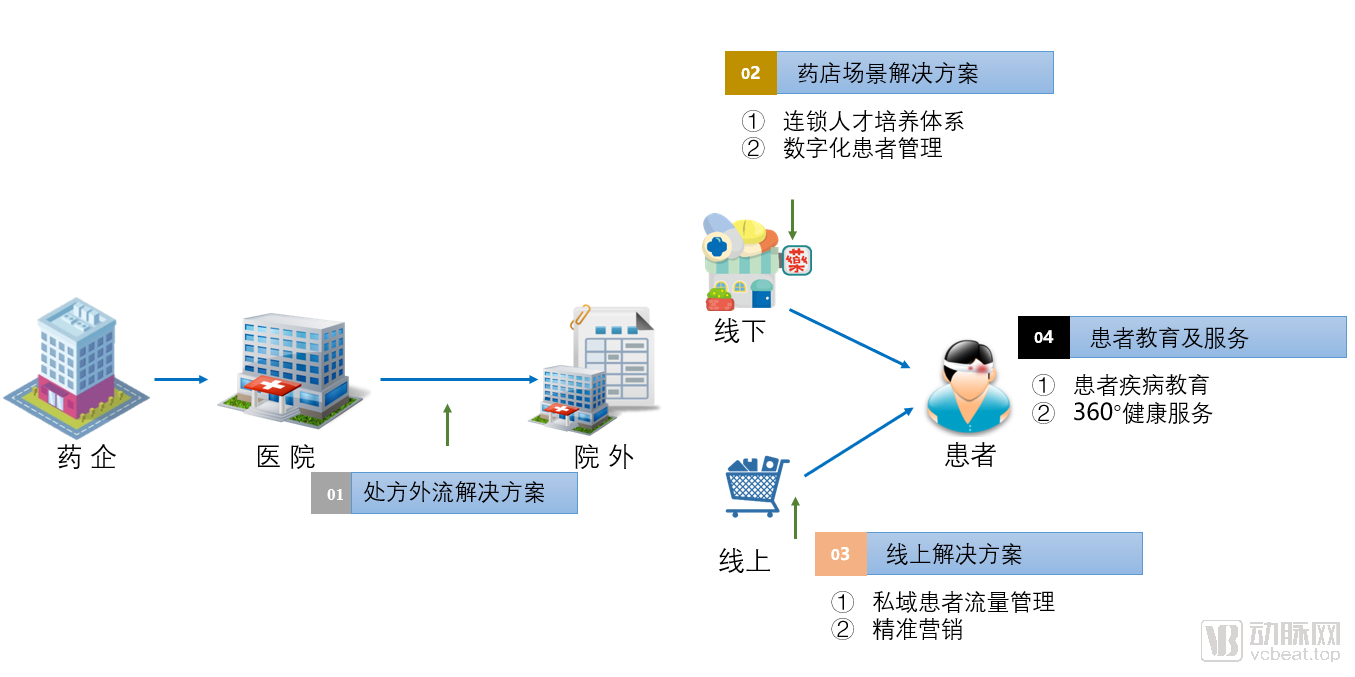
The Business Model of Carelinker Medical's Pharmaceutical Enterprise Services
For drugs sold in out-of-hospital settings, Carelinker Medical providesPrescription Outflow PlatformPatients first complete their initial consultation offline and, under the guidance of their physicians, join a follow-up care platform. Subsequently, patients can consult with their doctors through this platform, and physicians may issue prescriptions via an internet hospital based on ongoing patient needs. Patients can then pick up medications at nearby pharmacies or have them delivered. This approach greatly facilitates patient care by meeting treatment needs while eliminating the burden of travel for medical visits, and it also helps physicians build a long-term patient base.
Empowering pharmacies remains a crucial component of Carelinker Medical’s out-of-hospital pharmaceutical business. Regarding the enhancement of pharmacists’ professional competencies, Chen Qi told VCBeat that Carelinker Medical provides both online and offline training for pharmacists. In the six major areas of common chronic diseases managed in community pharmacies, Carelinker Medical, in collaboration with pharmaceutical companies, has conducted over 1,000 training sessions for pharmacists at various levels. These programs cover chronic disease specialist training, internal trainer development, and the establishment of chronic disease management teams, enabling pharmacists to enhance their patient care capabilities through diverse learning pathways and assessment modules.
Poor patient adherence is a pain point in the prescription drug business model of pharmaceutical companies. Patient education plays a crucial role in improving patients’ disease awareness and enhancing adherence. Shanghai Carelinker Medical Technology Co., Ltd. introduces physicians into pharmacy settings through in-store mini patient education programs, guiding patients to better understand their conditions and manage their health. With the trend of diseases affecting younger populations and elderly patients becoming more familiar with internet technologies, an increasing number of patients are obtaining medication-related information online through searches and other methods. The company also leverages tools such as hospital Wi-Fi and disease-focused WeChat official accounts to provide patients with accurate knowledge about diseases and medications.
Starting from patient consultation and medication purchasing behaviors, Carelinker Medical further enhances the services provided to pharmaceutical companies, such as market research and health mall operations. The company aims to integrate hospitals, pharmacies, and homes; bridge offline and online channels; and connect patient services with drug sales, thereby building a comprehensive solution for omnichannel digital marketing and patient services outside hospital settings. Within this closed loop, data is integrated and circulated to guide business operations, helping pharmaceutical companies better optimize resource allocation, formulate market strategies, and evaluate campaigns and business performance, thus forming a truly integrated online-offline digital marketing solution.
Currently, Carelinker Medical has established long-term collaborations with multiple renowned international pharmaceutical companies. With the outflow of prescriptions, the gradual liberalization of online prescription drug sales, and the maturation of internet healthcare, the company will continue to focus on serving pharmaceutical enterprises in the future, increasing its investment in multi-channel marketing outside hospitals, patient management services, and its internet healthcare layout.