

Dr. Xie Xiaobing of the First Affiliated Hospital of Hunan University of Chinese Medicine: POCT Nucleic Acid Testing Holds Great Promise in Clinical Applications
POCT nucleic acid testing has rapidly developed during the global COVID-19 pandemic due to its rapidity, simplicity, and ease of use. Currently, the epidemic situation abroad continues to worsen, with no turning point in sight; although the domestic epidemic is largely under control, vigilance must be maintained in pandemic prevention and control efforts.
The “2020 China POCT Annual Conference,” hosted by the Point-of-Care Testing (POCT) Branch of the China Association for Medical Device Industry and the People’s Government of Jiangbei District, Chongqing Municipality, was grandly held at the Century Jinyuan Grand Hotel in Chongqing on November 13–14, 2020.
Under the slogan “BeiDou + 5G, Building the Dream of China’s POCT” and themed “Precision Epidemic Control, Health for All,” the forum covered topics including applications of point-of-care testing (POCT), nanozymes and POCT, ultrasound detection, POCT and primary healthcare, and POCT and the Six Major Centers. The event featured a main conference, thirteen specialized academic forums, and an exhibition of corporate products.
On the 14th, at the Subforum on Rapid Point-of-Care Testing in Nucleic Acid Quantification, Dr. Xie Xiaobing, Chief Technician and Director of the Clinical Laboratory at the First Affiliated Hospital of Hunan University of Chinese Medicine, delivered a presentation titled “Discussion on the Clinical Application of Nucleic Acid Testing POCT.” VCBeat has compiled his key insights.
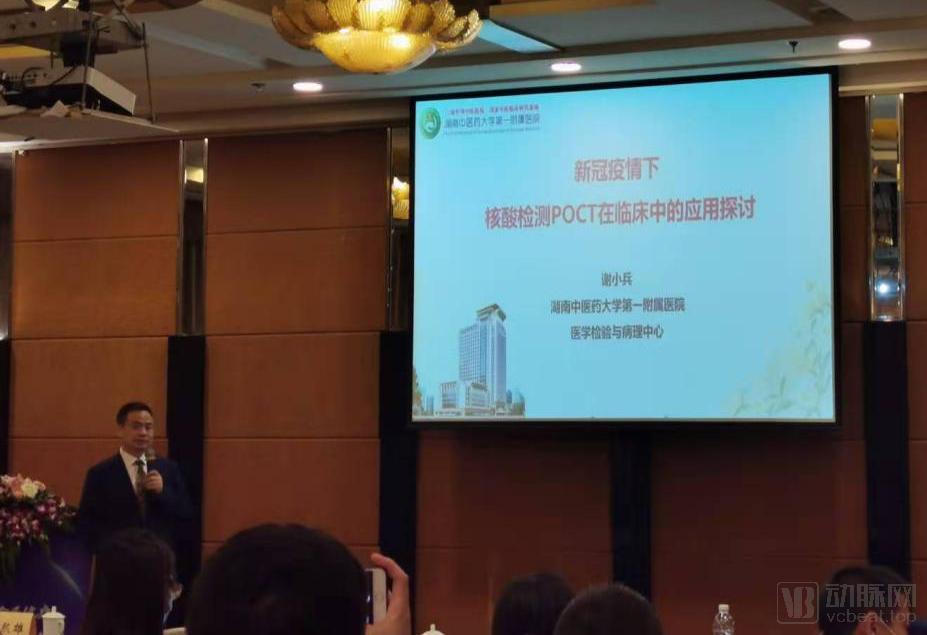
Xie Xiaobing: M.D. from Wuhan University, Chief Technologist, Professor, and Master’s Supervisor; selected as a high-level health talent under Hunan Province’s “225” Project. With over 20 years of experience in clinical laboratory medicine, he serves as Director of the Center for Laboratory Medicine and Pathology at the First Affiliated Hospital of Hunan University of Chinese Medicine. His professional affiliations include Vice Chairman of the Committee on Laboratory Medicine of the China Association of Integrative Medicine, Member of the Branch of Laboratory Physicians of the Chinese Medical Doctor Association, Standing Committee Member of the Branch for Standardization of Primary Care Laboratory Technology of the China Health Promotion Association, Chairman of the Committee on Laboratory Medicine of the Hunan Association of Traditional Chinese Medicine and Integrative Medicine, and Vice Chairman of the Committee on Laboratory Medicine of the Hunan Medical Association. He has published nearly 100 academic papers, including 50 as first or corresponding author and 7 indexed by SCI; authored or co-authored 12 books; and presided over or participated in 14 research projects, such as the National High-Tech Research and Development Program (“863” Program), the National Natural Science Foundation of China, and the Hunan Provincial Natural Science Foundation. He serves as Standing Editorial Board Member of Journal of Laboratory Medicine and Clinics, Corresponding Editorial Board Member of Chinese Journal of Laboratory Medicine, Editorial Board Member of Chinese Journal of Clinical Laboratory Management (Electronic Edition), and Peer Review Expert for Chinese Journal of Clinical Laboratory Science.
Currently, the epidemic situation in China has basically stabilized, while the overseas situation remains uncontrollable. Since October, a second wave of outbreaks has been confirmed abroad. Strictly preventing imported COVID-19 cases continues to be a major challenge for China. To prevent a resurgence of the epidemic domestically, epidemic prevention and control measures must be normalized.
Researchers at Harvard University developed a viral transmission dynamics model using U.S. data on HCoV-OC43 and HCoV-HKU1 from 2014 to 2019. By integrating SARS-CoV-2-related data into the model, they estimated the annual infection rate and peak prevalence of SARS-CoV-2 between 2019 and 2025. The latest research indicates that the novel coronavirus may remain with humanity until 2025.
In China, to prevent a resurgence of the epidemic, national requirements for epidemic prevention and control have been continuously escalated. Over three consecutive months—July, August, and September—the government issued successive notices urging medical institutions to accelerate the enhancement of their SARS-CoV-2 nucleic acid testing capabilities.
However, traditional nucleic acid testing still faces significant challenges: the workflow of conventional PCR-based nucleic acid testing is cumbersome and operationally complex, requiring centralized sample submission; PCR laboratories are divided into three to four separate zones, necessitating dedicated rooms, ample space, and a full complement of equipment, resulting in high construction costs and substantial investment; stringent qualifications are required for operating personnel; and the lengthy testing turnaround time precludes the issuance of results within four hours.
Rapid and convenient nucleic acid testing has become a widespread demand, and the state has also introduced relevant policies to support the research and development of rapid nucleic acid testing products for the novel coronavirus.
Director Xie believes that over the extended course of humanity’s fight against the novel coronavirus, the country must normalize epidemic prevention and control measures. The frontline defense not only requires rapid nucleic acid testing capabilities to meet the demand for timely results, but the primary healthcare system also needs basic nucleic acid testing capacity to establish a national joint prevention and control mechanism.
The exploration and discussion of rapid nucleic acid testing methods align with the strategic directive issued by national leaders to leverage technological capabilities for disease prevention and control.
Currently, a range of rapid nucleic acid testing instruments has emerged in China. These devices are lightweight and portable, have minimal site requirements, and can be operated without the need for a dedicated PCR laboratory.
Rapid nucleic acid testing leverages the principle of isothermal amplification, enabling exceptionally fast reaction speeds. In terms of amplification time, conventional PCR instruments require at least approximately 100 minutes, whereas rapid nucleic acid testing analyzers complete amplification in only about 42 minutes. For strongly positive samples, the entire process from nucleic acid extraction to amplification can be completed in as little as 15 minutes.
Therefore, rapid nucleic acid testing instruments can complete the entire workflow—from extraction and release of nucleic acids in the sample to final detection and report generation—within a very short time, and their test results show good concordance with those obtained using conventional PCR instruments.
Rapid Laboratory Testing Protocols vs. Conventional PCR Laboratory Protocols: Distinct Application AdvantagesMobile PCR container laboratories, equipped with automated molecular nucleic acid extraction systems and PCR instruments, are better suited for high-throughput testing. In contrast, rapid nucleic acid testing can be conducted indoors using biosafety cabinets, making it more appropriate for emergency testing scenarios.
Widespread Clinical Applications of POCT Nucleic Acid Testing: Beyond SARS-CoV-2, POCT nucleic acid testing can be employed for the detection of various pathogens, including those causing common respiratory and gastrointestinal infectious diseases, as well as other infectious agents. Additionally, POCT nucleic acid testing can be utilized for detecting human genetic targets, thereby facilitating precise and rational medication use.
In this context, rapid nucleic acid testing instruments can be deployed in the emergency departments and fever clinics of large public hospitals to improve the efficiency of urgent diagnosis and treatment; they can also be utilized in private hospitals with lower patient volumes to help enhance their nucleic acid testing capabilities. Furthermore, primary care hospitals, due to their relatively limited medical infrastructure and various constraints, represent an ideal application scenario for point-of-care testing (POCT) of nucleic acids.
In addition, nucleic acid testing is not limited to the detection of SARS-CoV-2; it can also be used by hospitals for the differential diagnosis of respiratory pathogens, gastrointestinal infectious diseases, and other infectious agents.
Director Xie stated that rapid nucleic acid testing holds significant importance for grassroots prevention and control: it can facilitate tiered diagnosis and treatment by rapidly equipping primary healthcare facilities with nucleic acid testing capabilities.
Due to the relatively weak medical infrastructure, insufficient laboratory space, and low volume of nucleic acid testing samples in primary healthcare institutions, these facilities face the dilemma of struggling to balance input-output ratios.
Due to their compact size, ease of operation, and relatively low cost, rapid nucleic acid testing instruments are not constrained by many factors such as medical infrastructure and testing environments. They enable secondary hospitals and county/district-level or primary healthcare institutions—which have relatively weak medical foundations and currently lack the capacity for SARS-CoV-2 nucleic acid testing—to rapidly establish simple molecular laboratories. This perfectly meets their needs for nucleic acid testing, thereby facilitating rapid and effective epidemic prevention and control.
The rapid nucleic acid testing instruments can meet the basic testing needs at the grassroots level through multiple application scenarios, such as conducting nucleic acid tests for common respiratory and gastrointestinal infectious diseases and pathogens. They can even perform nucleic acid testing for early cancer screening and personalized medication safety, thereby enhancing the sustainability of nucleic acid testing capabilities and supporting the improvement of precise diagnosis and treatment in primary healthcare institutions.