

Trividia Health Envisions Empowering Primary Care Chronic Disease Management through Liquid-phase iPOCT Platform

Sinocare
Rapid Detection of Chronic Disease: Product R&D, Production, and Sales
Sinocare is the earliest domestic manufacturer of blood glucose monitoring systems, with its main products being rapid blood glucose meters and corresponding test strips. The company’s blood glucose testing products are distributed across many countries and regions worldwide and have gained widespread recognition. According to the product revenue composition in 2018 and 2019, blood glucose meters accounted for 75.66% and 77.87% of total revenue, respectively.
Building on its blood glucose management business, Sinocare is continuously expanding its product portfolio for patients with the “Four Highs” (hyperglycemia, hypertension, hyperuricemia, and hyperlipidemia), striving to create a one-stop solution for chronic disease management. The company has successively launched multiple product solutions, including POCT and lipid/uric acid testing lines.
The “2020 China POCT Annual Conference,” co-hosted by the Point-of-Care Testing (POCT) Branch of the China Association for Medical Device Industry and the People’s Government of Jiangbei District, Chongqing Municipality, was held in Chongqing on November 13–14, 2020. Under the slogan “Beidou + 5G: Building the Dream of China’s POCT” and themed “Precise Epidemic Control, Health for All,” the conference featured a plenary session, thirteen academic sub-forums, and an exhibition of corporate products.
At the corporate product exhibition area, Sinocare’s latest research achievement—the iCARE-2000 portable, fully automated, multifunctional analyzer, developed based on liquid-phase POCT technology—drew significant attention from numerous attendees. To gain insights into Sinocare’s strategic layout in the liquid-phase POCT niche and the substantial value that liquid-phase POCT brings to the primary care chronic disease management market, VCBeat conducted an exclusive interview with Liu Ping, Deputy Director of Sinocare’s Product Department.
As China enters an aging society, chronic disease management has become a major challenge in the field of public health. Data show that there are currently 240 million adult patients with hypertension, 120 million with diabetes, and 140 million with chronic kidney disease in China. Chronic diseases account for approximately 86% of disease-related mortality and 76% of the disease burden domestically.
Primary care is the main battlefield for chronic disease management. A large number of patients with chronic diseases are concentrated in primary care settings. Aging is more pronounced in rural areas than in cities; in 2018, the proportion of the population aged 60 and above in rural areas was 4.33 percentage points higher than in urban areas, creating substantial demand for chronic disease management. Furthermore, compared with urban hospitals, primary healthcare institutions are more numerous but account for a smaller share of clinical visits, indicating significant untapped potential in medical service delivery.
In recent years, China has been gradually establishing a three-tier chronic disease prevention and control system, with tertiary hospitals providing guidance, community health centers serving as the core, and community health stations forming the foundation. This structure aims to create a multi-faceted, three-tier network for the screening, prevention, treatment, management, and research of chronic diseases.
However, Liu Ping, Deputy Director of the Product Department at Sinocare, noted that primary healthcare institutions lack adequate capacity for managing patients with chronic diseases due to limited funding and a shortage of professional personnel. Furthermore, although POCT devices are low-cost, rapid, convenient, and easy to operate—unconstrained by time, location, or operator expertise—and thus represent the most suitable technology for the primary care chronic disease management market, they still suffer from pain points such as limited testing parameters, severe product homogenization, low levels of informatization and automation, and concerns regarding accuracy.
In response to the market demand for chronic disease management at the primary care level and addressing the pain points associated with POCT devices, Sinocare has leveraged its core liquid-phase iPOCT reaction technology to develop the iCARE-2000 portable, fully automated, multi-functional analyzer. The company aims to promote chronic disease management in primary care settings by capitalizing on the platform’s advantages, including its compact size, low cost, full automation, and portability.
Most POCT products developed to date are based on solid-phase reactions (such as colloidal gold technology and immunofluorescence technology). Liquid-phase POCT is more conducive to instrument automation and offers advantages in accuracy, stability, precision, and transportation and storage, making it the preferred choice for hospitals.
Liu Ping stated that liquid-phase detection technology has matured, relying primarily on large-scale equipment with high costs, which limits its application to major hospitals and hinders its deployment at the primary care level. Sinocare has introduced significant innovations to liquid-phase detection technology. By leveraging a liquid-phase iPOCT reaction system, the company developed the iCARE-2000, achieving full automation, portability, and miniaturization, thereby greatly facilitating the adoption of liquid-phase POCT in primary healthcare settings.
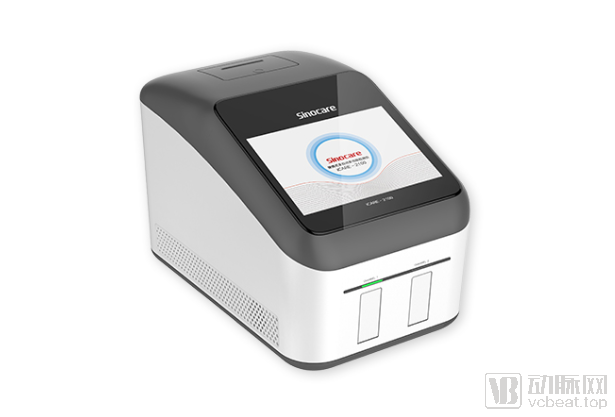
iCARE-2000 Portable Fully Automatic Multifunctional Analyzer
The iCARE-2000 is designed for laboratory and clinical departments in primary healthcare institutions. It features accuracy, ease of use, speed, and cost-effectiveness. With 16 reagent cartridges supporting 37 test parameters, it covers the majority of testing needs in primary care settings, including inflammation markers, indicators related to the “four highs” chronic diseases, routine biochemical parameters, and cardiovascular and cerebrovascular disease markers. This system addresses the limitations of traditional chronic disease monitoring devices, such as glucometers and blood pressure monitors, which can only measure single parameters and lack multi-parameter testing capabilities. By doing so, it significantly enhances the diagnostic and treatment capabilities of primary care physicians and improves the patient healthcare experience.
To address the issue of unstable accuracy in POCT, the iCARE-2000 employs a liquid-phase iPOCT reaction system. Its methodology is consistent with that of large-scale laboratory equipment, delivering accuracy comparable to traditional laboratories and ensuring test results align with those from conventional central labs.
“Following the launch of the iCARE-2000, installation rates have been remarkably rapid, with projected installations expected to exceed 10,000 units next year,” stated Liu Ping. “Within just one year of its release, the iCARE-2000 has garnered extensive positive feedback from customers. It has demonstrated outstanding performance, achieving high acceptance and recognition at the primary care level. Its user-friendly design allows for quick adoption, effectively meeting the testing needs of the vast majority of patients with chronic diseases.”
Liu Ping described the iCARE-2000 as “a platform with unlimited scalability.” Moving forward, Sinocare will add more testing parameters to the iCARE-2000 based on market demand, such as electrolytes and cardiac markers, thereby covering a broader patient population.
Meanwhile, Sinocare is also expanding its presence in the field of information technology. “While the iCARE-2000 addresses only testing issues, effective management remains a persistent challenge for chronic disease management at the primary care level.” To address this, the company has launched the iPOCT Information Management System and standardized testing laboratories, aiming to align basic diagnostic and treatment processes at the primary care level with those of tertiary hospitals through standardized equipment, testing procedures, reporting, and diagnostics. “In the future, we will also leverage information technology to enable remote monitoring of test indicators and remote management of chronic diseases.”
Liu Ping believes that the future development of POCT will inevitably trend toward greater portability, compactness, and ease of use. He hopes that manufacturers will remain committed to innovation, focus on methodological advancements, and drive industrial upgrading to further enhance diagnostic and treatment capabilities at the primary care level. “I am confident that POCT will gain increasingly widespread application and recognition in primary care settings. However, two key issues must be addressed to promote the rapid and healthy development of the POCT industry.”
First is the issue of standardization. POCT is a nascent field with immature development. It is hoped that the state will issue relevant documents and national guidelines to regulate product performance indicators and promote the standardized and regulated development of the industry.
Secondly, there are issues such as an unsound quality management system. Weak quality control awareness, the proliferation of testing platforms, and insufficient personnel training have long contributed to significant result errors, posing persistent challenges to POCT quality management. It is hoped that the POCT quality management system will be continuously improved to guide manufacturers and user institutions in implementing effective quality control measures, thereby ensuring more accurate and reliable test results.