

Tencent AI Lab’s Novel Protein Structure Prediction Method Published in Nature Communications

Tencent Healthcare
Developer of Digital Healthcare Products

On November 17, Tencent announced new progress in AI-powered drug discovery.
By leveraging Tencent’s proprietary novel method for enhancing the accuracy of protein structure prediction, the joint research team has, for the first time, elucidated the three-dimensional structure of type II 5α-reductase (SRD5A2). This breakthrough reveals the inhibitory mechanism of finasteride, a drug molecule used to treat hair loss and benign prostatic hyperplasia, against this enzyme, thereby facilitating deeper investigation into the pathological mechanisms of related diseases and the optimization of therapeutic agents.
In this instance, Tencent AI Lab employed a “de novo folding” approach for protein structure prediction to help elucidate the crystal structure of SRD5A2. By leveraging its self-developed AI tool, tFold, the lab significantly improved the accuracy of protein structure prediction, playing a pivotal role in achieving this scientific breakthrough. Beyond its application to SRD5A2, this methodology can be extended to related research on protein molecules and pathological mechanisms.
This joint research achievement was recently published in Nature Communications, a prestigious subsidiary journal of Nature. The paper, titled “Structural Study of Human Type II 5α-Reductase and the Antiandrogen Drug Finasteride,” was collaboratively completed by Associate Professor Zhiyi Wei’s group from the Department of Biology at Southern University of Science and Technology (SUSTech), Professor Cheng Zhang’s team at the University of Pittsburgh, Research Fellow Hao Fan’s group at the A*STAR Institute in Singapore, and Dr. Junzhou Huang’s team at Tencent AI Lab. The publication has received high acclaim from this authoritative academic journal and its reviewers, further validating the innovative value of this work for drug development.
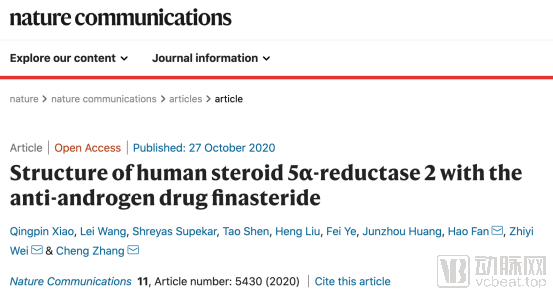
Paper link: https://www.nature.com/articles/s41467-020-19249-z
It is reported that the tFold tool has maintained its weekly champion status for six consecutive months in the international assessments conducted by CAMEO (the world’s only automated evaluation platform for protein structure prediction). Currently, the public beta version of tFold is openly accessible via the official website of Tencent’s “Yunshen Zhiyao (iDrug)” platform. Official website link: https://drug.ai.tencent.com/console/cn/tfold
““De Novo Folding” New Approach Cracks Crystallography Challenge
In the human body, sex hormones promote the maturation of sexual organs, the development of secondary sexual characteristics, and the maintenance of sexual function.
Dihydrotestosterone is the most potent androgen known in the human body. It plays a crucial role in human development and physiological activities, yet its levels must be maintained within a reasonable balance. On one hand, dihydrotestosterone regulates the development of male sexual organs; insufficient levels can lead to defects in male secondary sexual characteristics. On the other hand, excessive levels are the primary culprit behind benign prostatic hyperplasia and hair loss.
Synthetic sex hormones depend on steroid reductase, and dihydrotestosterone (DHT) is synthesized via catalysis by SRD5A2. Therefore, when patients experience benign prostatic hyperplasia and hair loss due to elevated DHT levels, inhibiting SRD5A2 can reduce their DHT levels. As a potent inhibitor of SRD5A2, finasteride is widely used in the treatment of these conditions.
Despite the important physiological role of SRD5A2, high-resolution structural information remains scarce, leaving the mechanism by which SRD5A2 catalyzes dihydrotestosterone synthesis and the mechanism by which finasteride inhibits SRD5A2 enzymatic activity unclear.
This is due to the unique seven-transmembrane structure of SRD5A2, which differs significantly from all known human protein structures, making it difficult to obtain an initial conformation via “template-based modeling” to interpret crystallographic data. Furthermore, as SRD5A2 is a multi-pass transmembrane protein, the traditional “heavy-atom derivatization” method for obtaining phase information in protein crystallography is also ineffective.
To address this challenge, the research team at Tencent AI Lab employed the more demanding “de novo folding” approach to predict the three-dimensional structure of the SRD5A2 protein, and used it as the initial model for “molecular replacement” (MR) to solve the crystallographic data.
“Ab initio folding” is a protein structure prediction method that stands in contrast to “template-based modeling.” While template-based modeling is currently the most prevalent approach for predicting protein structures, it has a prerequisite: a structurally similar protein must exist in the human-known Protein Data Bank (PDB); otherwise, the method cannot be applied. In contrast, the “ab initio folding” method adopted by Tencent AI Lab overcomes this limitation, enabling protein structure prediction without reliance on templates.
However, previously, the accuracy of protein structures predicted by the “de novo folding” method was not high enough to meet the precision requirements for crystal data analysis. With the support of Tencent’s tFold tool, high-accuracy “de novo folding” structural models were generated, providing phases for molecular replacement and thereby enabling the determination of the SRD5A2 crystal structure at an atomic resolution of 2.8 Å.
This result can directly advance our understanding of various diseases caused by dysregulated SRD5A2 activity in vivo, thereby providing more valuable reference information for structure-based drug development targeting SRD5A2.
A reviewer for Nature Communications gave high praise to this innovative approach: “It is very interesting that the authors were able to determine the crystal structure using predicted molecular replacement (MR) models. This reviewer considers the technique truly outstanding, and the entire X-ray crystallography community will benefit greatly from this method.”
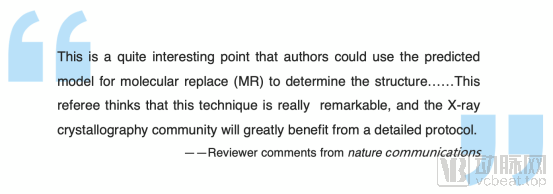
Excerpt from the original peer review comments in Nature Communications
Self-Developed Championship-Level tFold Tool Breaks Through Protein Structure Prediction Accuracy
Tencent AI Lab’s proprietary tFold tool is the key to solving the critical challenge of deciphering the protein structure of SRD5A2. To enhance the accuracy of the “de novo folding” method (also known as “free modeling”), tFold has achieved a significant improvement in protein structure prediction precision through three technological innovations.
First, the laboratory developed “multi-source fusion” technology to mine co-evolutionary information from multiple sequence alignments (MSA).
Then, by leveraging the “Deep Cross-Attention Residual Network” (DCARN), the prediction accuracy of important 2D structural information of proteins (such as residue-pair distance matrices) can be significantly improved.
Finally, a novel “Template-based Free Modeling” (TBFM) method effectively integrates structural information from 3D models generated by Free Modeling (FM) and Template-based Modeling (TBM), thereby significantly improving the accuracy of the final 3D modeling.
In terms of research, the tFold platform has demonstrated its innovative value and effectiveness on CAMEO, the most authoritative internationally recognized benchmarking platform. Tencent AI Lab registered the automated protein structure prediction server, tFold server, on the CAMEO platform in early 2020 and has maintained weekly (Figure 1), monthly, quarterly, and semi-annual championships since June 2020. The tFold server outperforms industry-leading methods by more than 6% on standard cases and by over 12% on challenging cases.
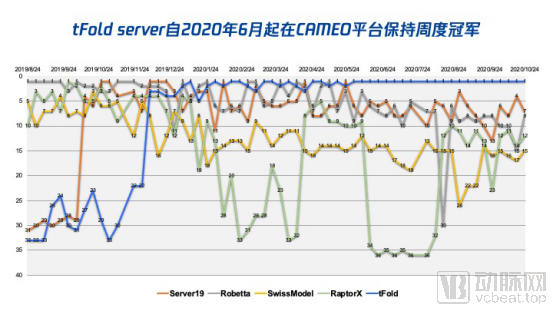
In terms of application, the public beta version of the tFold server has also been released on Tencent’s “Yunshen Zhiyao” platform. Users can manually input the amino acid sequences to be predicted or upload FASTA-formatted sequence files from their local devices. After a certain period of computation, users will obtain high-precision protein structures predicted using the “ab initio folding” method (see figure below).
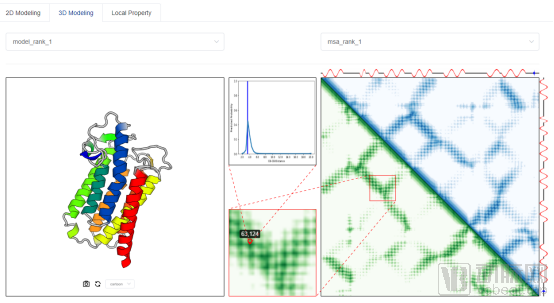
3D Modeling Output Page of the tFold Server. The left panel displays the 3D protein model obtained from ab initio folding; the right panel shows the deviation of this 3D model under the given predicted residue-pair distance matrix.
Tencent’s “Cloud Deep Intelligent Drug Discovery” Continuously Empowers Drug Discovery with AI
Leveraging advanced technologies such as big data mining and machine learning, Tencent is committed to driving the deep integration of AI with the healthcare industry, thereby helping to elevate the overall standard of medical care in society.
It is understood that “Cloud Deep Intelligent Drug Discovery” is Tencent’s first AI-driven drug discovery platform. By integrating the strengths of Tencent AI Lab and Tencent Cloud in cutting-edge algorithms, optimized databases, and computational resources, the platform is dedicated to helping users significantly reduce the time and cost involved in identifying potential active compounds.
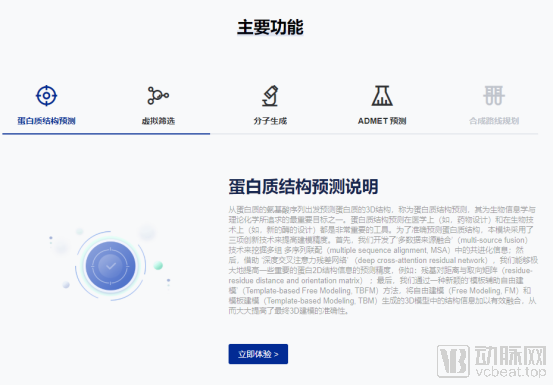
Key Features of Tencent’s “Cloud Deep Intelligent Drug Discovery” Platform
“Yunshen Zhiyao”’s five major modules cover the entire preclinical new drug discovery process, with each functional module currently undergoing continuous improvement and upgrades. In addition to protein structure prediction, the platform has also launched a molecular generation module. The AI-driven molecular generation model is one of the important tools for assisting small-molecule drug design; it not only accelerates the drug discovery process but also inspires medicinal chemists to look beyond existing molecular libraries and explore a larger chemical space. This module also integrates ADMET property prediction functionality, enabling real-time property screening of newly generated molecules.
Furthermore, the platform’s retrosynthesis algorithm has made significant progress and is scheduled for launch next year. Other functional modules for small-molecule and macromolecular drug discovery will also be rolled out gradually.
In addition to drug development, Tencent AI Lab is also continuously exploring multiple medical fields such as imaging screening and pathological diagnosis, constantly expanding and deepening its research and applications.
In the realm of AI-assisted medical technology, the laboratory, in collaboration with multiple partner organizations, developed China’s first intelligent microscope to help physicians improve work efficiency. In October 2020, building upon its capabilities for immunohistochemistry (IHC) sample analysis, the intelligent microscope added functions for microscopic image observation, screening, and annotation of clinical specimens from liquid-based cervical cytology (TCT). It has since received approval certification from the National Medical Products Administration (NMPA).
In the field of pathological research, Tencent AI Lab has also developed world-leading cutting-edge algorithms, such as the algorithm that won first place in the MICCAI 2020 CPM-RadPath Challenge. This algorithm can accurately differentiate and grade various subtypes of gliomas (the most common brain tumors), holding promise for addressing issues such as low efficiency and significant subjective bias in manual diagnosis.
Furthermore, earlier this year, Tencent AI Lab collaborated with Nanfang Hospital to publish a paper titled “Development and Interpretation of a Prediction Model for Microsatellite Instability in Colorectal Cancer Based on Pathological Images.” This algorithmic model assists pathologists in screening for microsatellite instability subtypes in colorectal cancer, lowers the technical thresholds for such screening, and enables more local hospitals to perform these tests.