

Ping An Healthcare Ecosystem Empowers China's DRG/DIP-Based Integrated Medical Insurance Payment Reform

Ping An
Integrated Financial Group
On November 4, 2020, the National Healthcare Security Administration (NHSA) issued the "Notice of the National Healthcare Security Office on Printing and Distributing the List of Pilot Cities for Global Budgeting Based on Regional Points and Diagnosis-Intervention Packet (DIP) Payment." The notice announced a list of 71 pilot cities for the implementation of global budgeting based on regional points and Diagnosis-Intervention Packet (DIP) payment. DIP, having recently emerged, was rapidly rolled out for implementation, signaling that the reform towards composite healthcare insurance payment methods is underway.
So, what role can information systems play in the reform of composite payment methods for medical insurance? On November 17, Professor Cai Jiangnan, founder and executive chairman of the Shanghai Chuangqi Health Development Research Institute, and Yang Weidong, Deputy General Manager and CTO of Ping An Medical Insurance Technology, provided answers at the Ping An Medical Ecosystem Sharing Experience Meeting.
As China rapidly transitions into an aging society and experiences declining birth rates, the basic medical insurance system has faced persistent deficits with expenditures outpacing revenues, resulting in substantial financial pressure. For several consecutive years, the growth rate of medical insurance fund revenues has remained below that of expenditures.
According to statistics, in 2019, the revenue of the medical insurance fund reached RMB 2.3334 trillion, exceeding the expenditure of RMB 1.9945 trillion for the same year; however, the growth rate of expenditures (13.28%) was higher than that of revenues (10.64%). If this trend is not curbed, the medical insurance fund will face a deficit in the future.
For this reason, the “13th Five-Year Plan for Deepening the Reform of the Medical and Healthcare System” proposed measures such as “deepening the reform of medical insurance payment methods” and “encouraging the implementation of Diagnosis-Related Groups (DRGs) payment.” In 2018, following the establishment of the National Healthcare Security Administration, adjustments to the medical insurance fund payment mechanism were immediately initiated to construct a composite medical insurance payment reform, thereby promoting the transformation of healthcare service models and achieving more substantial cost containment.
The core principle of Diagnosis-Intervention Packet (DIP) or Diagnosis-Related Groups (DRG) is to implement bundled payment based on a complete clinical case or a disease group. This approach reflects the rational pricing and refined management of medical services by health insurance providers, shifting the payment model from the previous volume-based fee-for-service system to a value-oriented bundled payment system for specific diseases or disease groups. This transition will have a profound impact on hospital behavior.
“Under DRG or DIP payment models, each hospitalization incurs a fixed fee. This creates strong incentives for hospitals to reduce costs, thereby avoiding and reversing previous practices of overprescribing medications, overusing medical supplies, and ordering excessive tests, while also shortening patients’ length of stay. Hospitals must further enhance their management capabilities to contain medical expenses, all while maintaining unchanged quality of care.” Professor Cai Jiangnan believes that the reform toward composite health insurance payment methods will provide substantial incentives for hospitals.
“Health insurance management must evolve from the original Version 1.0, which focused solely on cost containment, to Version 2.0. This entails not only controlling the overall health insurance expenditure but also optimizing the cost structure to make it more rational. For instance, inefficient and easily substitutable drugs and medical consumables should be phased out to create room for innovative medical technologies,” Professor Cai Jiangnan further added.
Meanwhile, as performance evaluation tools, DRG or DIP enables direct comparison of cases within the same group and, after weight adjustment, comparison across different groups. This provides a relatively scientific and objective basis for comparing the quality of medical care among hospitals, departments, and physicians. By integrating DRG or DIP with corresponding performance appraisal systems, hospitals will place greater emphasis on medical quality.
With enhanced cost awareness and the transformation of operational models in hospitals, medical quality will be improved. Patients will no longer have a vague understanding of hospitalization costs, and short-term hospitalization expenses will achieve a controllable decline. The expenditure of medical insurance funds will be effectively controlled. Ultimately, a win-win situation for hospitals, medical insurance, health authorities, and patients will be realized.
The “Technical Specifications for National Healthcare Security DRG Grouping and Payment,” issued by the National Healthcare Security Administration in 2019, explicitly stipulates that the implementation of DRG-based payment must meet several conditions, among which three elements closely related to informatization are required: unified basic codes, compliant medical record quality, and interconnected information systems. Therefore, it can be stated that informatization is a prerequisite for the effective implementation of the DRG payment system, particularly for hospitals.
Hospital and Health Insurance Empowerment: Enrollment Rate Increased from 60% to 93.8%
In Changzhou, Jiangsu Province, Ping An Health Insurance Technology is collaborating with the Changzhou Healthcare Security Administration and 16 hospitals to jointly advance the development of an “integrated bureau-hospital” model. The DRG Comprehensive Management Platform is playing an increasingly significant role in these hospitals. Developed by Ping An Health Insurance Technology, this platform primarily comprises three functional modules: medical record quality control, performance evaluation, and cost monitoring.
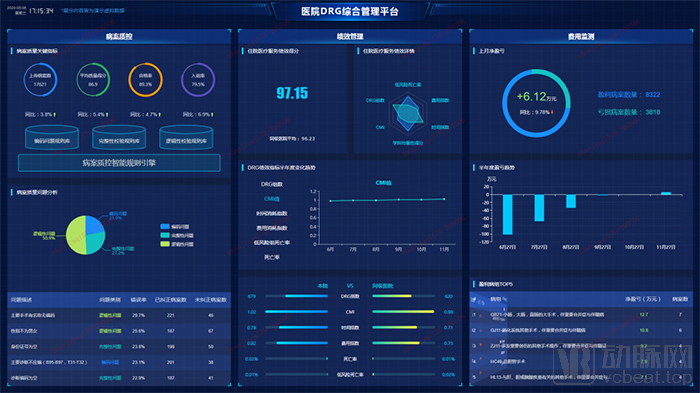
Ping An Health Insurance Technology DRG Integrated Management Platform (Image from Ping An Health Insurance Technology)
Whether for Diagnosis-Related Groups (DRG) or Big Data Diagnosis-Intervention Packet (DIP), clinical information is sourced from the medical record face sheet. Meanwhile, the accuracy and completeness of the data entered on the face sheet directly determine the correctness of case grouping. Errors in documentation may result in hospitals failing to receive due reimbursement. Consequently, hospitals have placed increasing emphasis on quality control of medical record face sheets in recent years.
However, over the past decade, the usability of hospital medical records in China has shown a declining trend, with many records failing to objectively and accurately reflect the actual quality of clinical care. On one hand, the responsibility for medical record documentation has shifted from attending physicians on duty to resident physicians. This group primarily consists of medical students, visiting scholars, and residents in standardized training programs, who generally lack clinical experience. On the other hand, hospitals commonly face a shortage of professionals specialized in coding quality control, and medical records departments remain chronically overburdened, still falling far short of meeting requirements.
Given that manpower alone cannot meet the hospital’s demand for improved medical record quality, support from information technology becomes particularly crucial. The Medical Record Quality Control Module of Ping An Health Insurance Technology’s DRG Comprehensive Management Platform leverages artificial intelligence technologies such as an intelligent coding engine, natural language processing (NLP), and medical knowledge graphs. It provides pre-emptive reminders for medical record documentation and real-time quality management during the documentation process, offering physicians reference guidance for DRG grouping while they are writing electronic medical records, thereby addressing issues at the source. Additionally, it features post-hoc medical record quality control analysis, which effectively reduces common problems in the completion of medical record face sheets—such as incomplete data, non-standardized entries, arbitrary additions, deletions, modifications, or substitutions of data standards, and logical inconsistencies—through intelligent review.
Following the implementation of bundled payment for disease groups, hospitals must effectively control the costs associated with these groups; any overspending will result in financial losses. Traditionally, hospitals could only obtain precise cost data upon patient discharge and settlement. This posed no significant issue under the previous fee-for-service payment model, but it is too late for prepaid systems such as Diagnosis-Related Groups (DRG) and Big Data Diagnosis-Intervention Packet (DIP). Therefore, the immediate priority for hospital cost containment is the ability to acquire accurate, real-time case cost information.
Ping An Healthcare Technology’s DRG Integrated Management Platform features a cost monitoring module that provides overspending alerts. It captures case costs in real time and issues warnings when there is a risk of exceeding budget limits, thereby enabling more timely and precise hospital cost control. Additionally, the disease group profit-and-loss analysis function evaluates the financial performance of various disease groups, helping hospitals adopt differentiated strategies based on the specific conditions of each group.
For dominant disease groups, hospitals may incorporate them into the performance workload accounting and assessment of various disciplines, providing key support and incentive preferences. For potential disease groups, hospitals need to continue to cultivate and expand the patient source and increase the number of diagnoses and treatments on the basis of continuously doing a good job in hierarchical diagnosis and treatment and cost control. For key disease groups and disadvantaged disease groups, hospitals should first conduct a cost-benefit evaluation, accurately analyze the main factors and key links of losses, and take targeted control measures.
In addition to cost control, DRG or DIP can also provide an objective evaluation of departmental or physician performance. Due to the previous lack of appropriate tools, hospitals have historically struggled to compare the performance of departments or physicians based on data. With consistent assessment criteria and clearly visible indicators, DRG or DIP offers transparency. Therefore, whether used for hospital-wide performance evaluation or specialty-specific assessment, DRG-based performance evaluation serves as a relatively objective and fair management tool.
The performance evaluation module of Ping An Health Insurance Technology’s DRG Integrated Management Platform can extract hospital-wide DRG case-mix information. By conducting comparisons across departments, disease groups, peer benchmarks, and industry standards, the platform provides DRG-based performance rankings for both departments and physicians. Additionally, it offers key specialty analysis and supports customized indicator analysis within the hospital, enabling decision-makers to make data-driven decisions based on objective and precise data, thereby achieving lean operational management.
Following the system’s launch, the 16 hospitals implementing the program demonstrated significant improvements across multiple indicators compared to 2019. The overall case-mix enrollment rate increased from just over 60% during the initial simulated payment phase to 93.8%. The upward trend in average length of stay was effectively controlled, the growth rate of cost efficiency gradually slowed, and the complexity of cases treated by the hospitals substantially increased. These outcomes indicate that the DRG Integrated Management Platform has achieved its implementation objectives, comprehensively enhancing hospital management standards and operational performance.
DRG and DIP are important components of the composite healthcare payment reform, but they do not represent the entirety of it. Therefore, after gaining a profound understanding of the spirit of the reform, Ping An Healthcare Technology has also provided hospitals with an additional hospital cost control and medication management platform. The platform adopts a three-pronged approach across the pre-diagnosis, intra-diagnosis, and post-diagnosis stages. Centered on an intelligent risk control engine, it provides physicians with medication recommendations that comply with risk control standards, manages medication use through rule-based controls, and offers features such as early warnings and post-consultation prescription analysis.
Compared with hospital-side DRG systems, the payer-side DRG platform is significantly more complex. It requires integration with hospital-side DRG platforms and the development of various rules and tools centered around DRG grouping logic and business applications. Therefore, this constitutes a large-scale and sophisticated engineering endeavor, imposing high demands on the implementing enterprise’s capabilities in integrated development and operations and maintenance.
Changzhou, Jiangsu Province, did not start its DRG payment system reform particularly early. After Ping An Health Insurance Technology won the bid, it completed delivery in just five months, with the basic system going live on March 30, 2020. The local grouper was developed and implemented based on the CHS-DRG national standards, and was evaluated and confirmed by both national and local expert panels. Following implementation, medical record quality improved, service efficiency and capacity were enhanced, and the health insurance fund was effectively controlled.
Empowerment from the Health Commission: Big Data Supervision Ensures Medical Quality
“In essence, the relationship between medical insurance authorities and health commissions is that of demand-side and supply-side stakeholders. Under the diagnosis-related group (DRG) bundled payment model, hospitals may face cost pressures that could lead to under-provision of care, thereby compromising healthcare quality. Reforms in composite medical insurance payment mechanisms must not incentivize providers to reduce quality in an effort to cut costs. Therefore, it is imperative for the government to leverage data for quality oversight, ensuring that patients do not suffer adverse consequences as a result. In this process, we can see that information technology enterprises equipped with such capabilities can play a significant role.” Professor Cai Jiangnan believes that informatization can also contribute to the supervision of healthcare quality.
To address regulatory requirements, Ping An Health Insurance Technology has launched an intelligent prescription review cloud platform. The platform is capable of reviewing over 65 million prescriptions annually. It achieves microsecond-level response times in its review process, with a cumulative database exceeding 100 million records. Leveraging this extensive and comprehensive database, the platform provides full coverage of medical data statistical categories, enabling statistical analysis of various data generated by prescription behaviors.
By leveraging intelligent technologies for automated prescription review, the platform addresses the critical challenges of inconsistent pharmacist competency and uneven distribution of pharmacist resources. It ensures medication safety, efficacy, and cost-effectiveness, while providing health regulatory authorities with a medical quality supervision and management platform, and offering healthcare institutions a medical quality risk monitoring platform.
Furthermore, Ping An Health Insurance Technology integrates its various systems to create a unified platform that provides effective decision-making tools for the government. Leveraging big data technology, Smart Healthcare’s Jianquan Shitong enables data interoperability and boasts strong compatibility, offering multi-dimensional analytical services for macro-level decision support. Relevant government departments can utilize this platform to conduct performance analysis of healthcare institutions within their jurisdictions, facilitate the coordinated development of medical care, health insurance, and pharmaceuticals (“Three-Medical Linkage”), monitor healthcare reforms, regulate internet hospitals, perform prescription reviews, and collect and analyze health management data. The platform displays the outcomes of healthcare reforms in real time, meeting the needs for data-driven platform management ranging from micro-level monitoring to macro-level supervision.
Ping An HealthCare Technology has built the Chongqing Health and Medical Big Data Platform for Chongqing Municipality, which collaboratively integrates medical data across the city through real-time transmission and AI-driven governance, achieving comprehensive, real-time aggregation and standardization of medical data resources. Currently, the platform covers all 38 districts and counties as well as two economic development zones in Chongqing, encompassing a total of 226 public hospitals.
“The Chongqing Health and Medical Big Data Platform we implemented in Chongqing integrates data from 228 hospitals across the city, updating more than 1,100 fields every ten minutes on average. This type of middle-end platform is a first in China, ensuring the timeliness and authenticity of the data. Additionally, we employ a unique reverse simulation technology that inputs desired outcomes from the result end; AI-powered computers can then simulate current status and identify necessary adjustments. We hope this will provide greater assistance in the future.” Yang Weidong demonstrated the practical application of Huiyi Jianshi Tong (Smart Healthcare Holistic View).
Practice has demonstrated that Chongqing’s “Healthcare Big Data Application” solution, which adopts a public-private operational model combining government and market forces, has been highly recognized by relevant authorities such as the State Council’s Office of Healthcare Reform. This approach not only provides the government with advanced decision-support tools and efficient management mechanisms but also offers hospitals diverse options for refined management, while delivering improved experiences in medical care and health insurance services to local residents.
Since its establishment, Ping An Healthcare Technology has focused on key areas of healthcare payment system reform. Leveraging five core strengths—technology-driven innovation, data empowerment, medical ecosystem integration, insurance expertise, and financial services—the company has built an integrated smart healthcare payment platform featuring “systems + services + operations.” It is committed to providing precise, efficient, and convenient comprehensive solutions for healthcare payments to healthcare security administrations at all levels, assisting the government in implementing healthcare payment reforms. To date, the Ping An DRG Comprehensive Payment Management Platform has been deployed in eight cities, including Shenzhen, Changzhou, Ji’an, Anshan, Liaocheng, Qingdao, Sanya, and Weifang.
Behind the impressive achievements of Ping An Health Insurance Technology lies Ping An Group’s deeply entrenched healthcare ecosystem. This strategic ecosystem comprises 12 subsidiary entities, including Ping An Good Doctor and Ping An Smart Healthcare, and focuses on five key pillars—government, users, service providers, payers, and technology—to empower all stakeholders. After 23 years of development, the ecosystem has fully taken shape and is positioned as one of Ping An Group’s long-term core strategies.
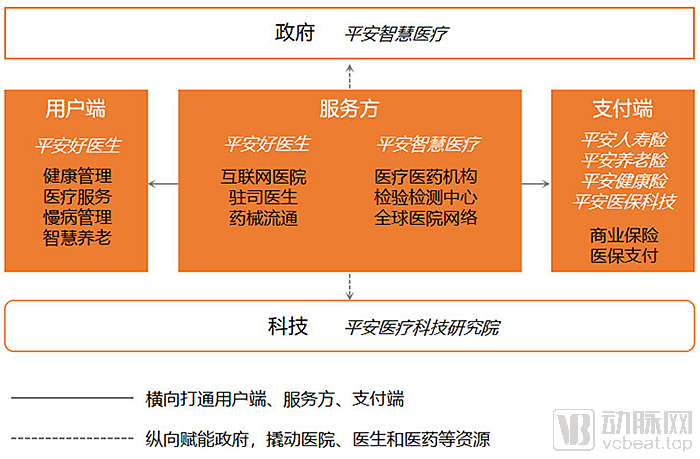
Compared with other enterprises that focus solely on a single scenario and operate in isolation, Ping An Group holds distinct competitive advantages in both the accuracy and breadth of its data. By engaging in bidirectional interaction with external parties, it has established more reliable and competitive barriers to entry.
Ping An Health Insurance Technology’s Smart Medical Insurance Platform has facilitated data integration among the Healthcare Security Administration, the National Health Commission, and healthcare institutions. Drawing on experiences from other countries and regions, leveraging these valuable data through mining and providing them to the commercial insurance industry after de-identification will significantly enhance actuarial science, risk management, and product design capabilities. This will enable reverse management across all stages from the payment end to the front-end medical services, helping commercial insurers reduce costs and improve efficiency.
Meanwhile, given the significant value demonstrated in epidemic prevention and control as well as chronic disease management, internet healthcare is poised for further development amid future reforms in composite medical insurance payment models. Internet healthcare platforms, led by Ping An Good Doctor, will receive substantial impetus. Ping An Smart Healthcare can leverage its technological innovations to empower every link in the healthcare chain with advanced technology, thereby enhancing the quality and efficiency of diagnosis and treatment across institutions at all levels. Its data resources will complement and intersect with those of other enterprises within the Ping An healthcare ecosystem, such as Ping An Good Doctor and Ping An HealthTech, ultimately enabling Ping An to deliver superior insurance services.
This is also the best practice of Ping An’s “Finance + Ecosystem” strategy, where “technology empowers the ecosystem, and the ecosystem feeds back into finance.”