

Barley Micro-Needle Hair Transplant: A Differentiator in the Industry with Over 600,000 Served
According to the survey data on hair loss released by the National Health Commission in 2019, the number of people suffering from hair loss in China has exceeded 250 million, with a male-to-female ratio of approximately 2:1. Individuals under the age of 35 account for 63.1% of this population, indicating that hair loss is no longer solely a concern for "middle-aged men."
Accompanying hair loss is the eye-catching barrage of hair transplant advertisements. Whether on subways, in elevators, on buses, or across online social platforms, ads from various hair transplant clinics are ubiquitous, constantly fraying modern nerves and leaving individuals oscillating between enduring their condition and opting for a hair transplant.
In the increasingly competitive hair transplant industry, Damai Micro-needle Hair Transplant has continuously expanded its market presence through its brand, technology, and reputation, emerging as a leading enterprise in the sector. To date, it has established 33 directly operated branches both domestically and internationally.
So, what technical services does Damai Micro-Needle Hair Transplantation offer to patients? How is the brand built? How is a distinctive service system established? With these questions in mind, VCBeat interviewed Dr. Li Xingdong, founder and dean of Damai Micro-Needle Hair Transplantation.
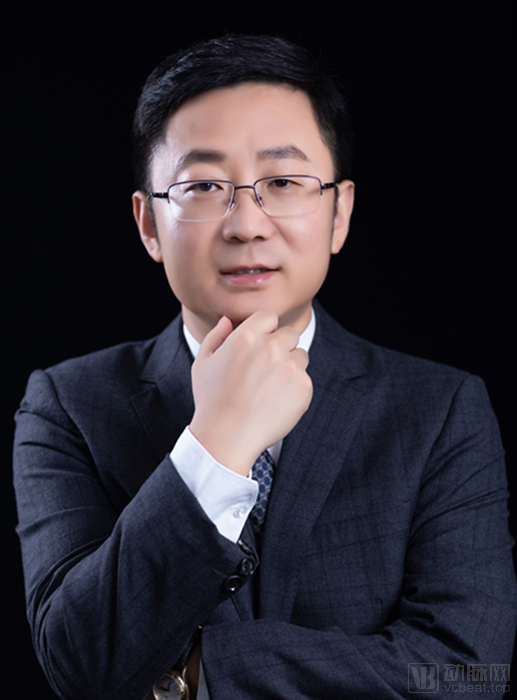
President Li Xingdong, Founder of Damai Micro-Needle Hair Transplantation
Upholding the Essence of Healthcare, Deeply Cultivating the Industry for Over 20 Years
In the early days, hair transplantation was merely a subspecialty within the plastic surgery departments of public hospitals, with its scope largely confined to therapeutic applications. Li Xingdong, who has a medical background, began his career in hair transplantation at a hospital in his early years.
For physicians, hair transplantation involves a heavy workload and prolonged surgical duration, leading many senior and experienced doctors to shy away from it. However, for patients suffering from burns and scalds, hair transplantation is a crucial means of transforming their appearance and rebuilding self-confidence. Given the medical nature of hair transplantation, Li Xingdong has encountered numerous such patients, which has motivated him to remain in this field.
In 1997, Li Xingdong established a hair transplant hospital in Beijing and founded the brand “Kefayuan” (later renamed “Daimai Micro-needle Hair Transplant”). To date, Daimai Micro-needle Hair Transplant has grown into a well-known directly-operated chain medical group in the hair transplant industry, having served over 600,000 patients.
"Throughout, Li Xingdong has adhered to returning to the essence of medical practice, emphasizing standardized training and development for physicians, and participated in establishing relevant physician expert alliances and non-governmental organizations to ensure the quality of hair transplantation."
When expanding its chain of clinics, Daimai Micro-needle Hair Transplantation deploys experienced hair transplant physicians from existing branches to form the medical team for new outlets in target cities. Simultaneously, the company recruits external professional hair transplant physicians and provides training, gradually transitioning the team composition while ensuring medical quality.
Precision Positioning in Micro-Needle Hair Transplantation: Achieving Differentiated Technological Development
The entire hair transplant procedure comprises two core stages: hair harvesting and hair implantation. Typically, based on the method of harvesting, hair extraction techniques are categorized into FUT (Follicular Unit Transplantation) and FUE (Follicular Unit Extraction).
In the field of hair transplantation, relevant technologies are continuously innovating. Currently, the primary hair transplantation techniques available on the market include traditional forceps-based hair transplantation and implantation pen-based hair transplantation (also known as micro-needle hair transplantation).
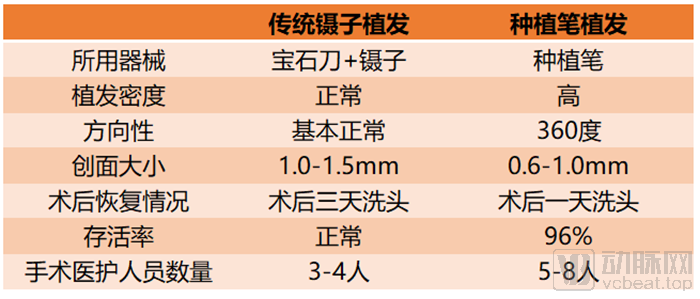
In addition to the two common hair transplantation methods mentioned above, many hair restoration clinics have recently adopted the "stick-and-place" technique, which combines injector needles and forceps. Compared with traditional forceps-based transplantation, this method results in smaller incisions and less bleeding; however, from an operational perspective, it still falls under the category of conventional hair transplantation.
Compared to these two traditional hair transplantation techniques, micro-needle hair transplantation is a technique recommended by the 2017 World Hair Transplantation Conference (ISHRS). The diameter of the micro-needle used ranges from 0.6mm to 1.0mm and can be adjusted according to the thickness of each individual's hair. During the procedure, the separated hair follicles are placed into the slot at the tip of the micro-needle pen, and then directly delivered subcutaneously via an automatic spring mechanism inside the pen. This process creates smaller wounds while establishing pore channels, reducing incision size by one-third compared to traditional hair transplantation.
Due to the minimal incisions created during micro-needle hair transplantation, recovery is faster, with patients able to wash their hair as early as 24 hours post-operation. Additionally, micro-needle implantation offers greater precision and density, while allowing 360-degree control over graft orientation, resulting in a more natural hair growth pattern.
Since its introduction of international micro-needle hair transplantation technology in 2006, Damai Micro-Needle Hair Transplantation has undertaken five iterative upgrades to the technique, taking into account the differences in follicle size and hair texture between Asians and Europeans/Americans. All five iterations have been granted corresponding national patents.
Following the completion of its name change in 2019, “Micro-needle Hair Transplantation” became a key term for the Daimai brand. This not only demonstrates Daimai’s technical prowess and confidence in micro-needle hair transplantation but also clearly highlights its technological advantages by integrating the technique into the brand identity. This approach differentiates Daimai from other hair transplant providers, precisely reflecting the brand’s positioning and technological differentiation, while avoiding entanglement in the industry’s homogeneous competition and price wars.
The Industry Landscape Behind Hair Transplantation: Building an Integrated “Transplant, Nourish, and Stabilize” Service Model
In Li Xingdong’s view, hair transplantation is merely one of the approaches to treating hair loss, not the sole option. Furthermore, it represents only one component of the overall treatment process. For patients with hair loss, post-procedural hair care and maintenance are equally important alongside transplantation.
After more than 20 years of development, Damai Microneedle Hair Transplantation has established a service model centered on an integrated, lifelong “transplant–nurture–stabilize” approach to hair loss treatment, comprehensively meeting customer needs.
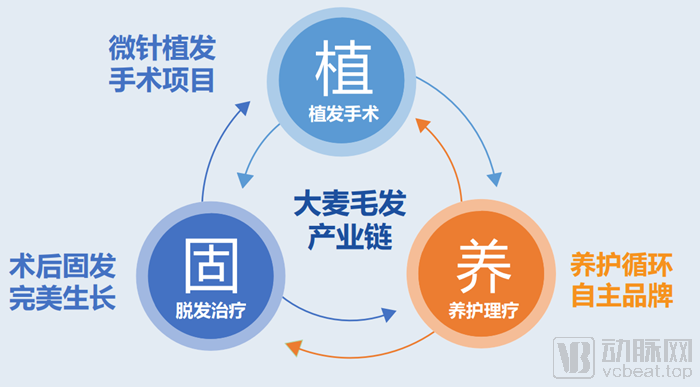
The term “implantation” refers to the hair transplant procedures offered by Daimai Micro-needle Hair Transplant. Post-operatively, Daimai also provides clients with hair stabilization services, including comprehensive care such as promoting wound scabbing and healing, as well as scalp health management.
Damai’s maintenance services can be understood as skincare treatments commonly offered in beauty salons. In fact, not all cases of hair loss require hair transplantation for resolution; some patients can effectively manage their condition through long-term treatment and care using oral or topical medications, injections, and laser therapy. These non-surgical approaches can significantly alleviate hair loss symptoms. Moreover, given the limited number of available hair follicles, an individual cannot undergo hair transplantation multiple times. Therefore, for patients who have already had a hair transplant, ongoing hair care serves as an appropriate protective measure.
Furthermore, as a hospital-qualified institution, Damai Micro-needle Hair Transplantation provides customers with medical hair care services and rational medication management, which is significantly different from the basic hair care services offered by common hair care institutions.
Compared to hair transplantation, hair care is a higher-frequency activity. By providing valuable hair care services, not only can patients benefit, but institutions can also better achieve customer management.
Brand: The Key to Customer Acquisition, Aiming for Global Expansion
“Hair transplantation has a notable characteristic: the surgical outcomes are highly visible,” said Dr. Li Xingdong, Dean of the Hospital.
The transformation from having “no hair to style” to a full head of lustrous hair is hard not to draw attention. Damai Micro-needle Hair Transplant initially built a strong reputation among consumers through superior patient experience and outcomes, while keeping advertising and marketing expenditures relatively low, primarily within 15% of its revenue.
In 2017, capital inflow into the hair transplant industry spurred its rapid development; correspondingly, Damai Micro-needle Hair Transplant increased its marketing investment. In Li Xingdong’s view, the primary purpose of marketing is not customer acquisition, but rather to strengthen brand building, as brand reputation and word-of-mouth are the key drivers for acquiring customers.
To advance its global brand development, Damai Micro-needle Hair Transplantation established a branch in Chicago, United States, in 2018. In its foray into overseas markets, the company places greater emphasis on technological exchange and collaboration with research institutions, ensuring the continuous updating and improvement of its existing technologies through ongoing learning.
The rebranding not only highlights technological differentiation but also aligns with global expansion strategies. Li Xingdong stated, “Whether in China or abroad, ‘Damai’ as a common noun is easier to remember.”
Limited Impact from the Pandemic, Steady Progress in Market Layout
During the COVID-19 pandemic, Daimai Micro-needle Hair Transplantation, which primarily relies on offline services, did not suffer severe setbacks like other offline industries such as catering and retail. This resilience was largely attributable to Daimai’s medical qualifications, while a significant portion of potential consumers also had ample time during the pandemic to learn about hair transplantation procedures.
It is understood that although Damai temporarily closed its domestic clinics in February and March in response to epidemic prevention and control requirements, it still received a substantial volume of inquiries and appointment requests. As the epidemic situation was effectively alleviated, the operations of Damai Micro-needle Hair Transplantation had largely returned to normal levels by June and July, with even synchronous growth achieved in certain key performance indicators.
As living standards improve, contemporary individuals’ demand for aesthetic appearance continues to rise, and the hair transplantation industry remains in a growth phase. In the future, Daimai Micro-needle Hair Transplantation will continue to expand its presence in the Chinese market by opening branch clinics in major cities across the country.
It is reported that in November alone, Daimai Micro-needle Hair Transplant will open new (renovated) branches in multiple cities, including Shenyang, Shenzhen, and Zhengzhou.