

Accelerating Healthcare Reform: New Opportunities in Smart Medical Insurance Construction
On November 2, the National Healthcare Security Administration issued the “Guiding Opinions on Actively Promoting Medical Insurance Payment for ‘Internet+’ Medical Services.” The “Opinions” require enhancing the informatization management level of medical insurance, “accelerating the construction of a nationally unified medical insurance information platform, improving the development of information modules such as identity verification, review of conditions for follow-up visits, electronic prescription authentication, and prescription circulation platforms, and accelerating the promotion and application of electronic medical insurance vouchers and medical insurance information business coding.”
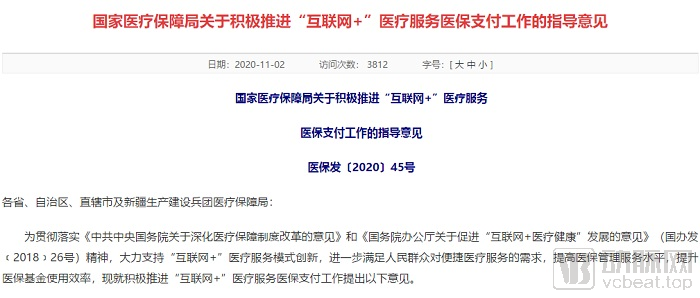
Meanwhile, the “Opinions” also emphasize the supervision of medical services, requiring“Medical insurance handling agencies shall comprehensively leverage technological means such as big data and the Internet, and employ intelligent medical insurance audit and monitoring systems to conduct real-time supervision of information including settlement details for ‘Internet+’ medical services, pharmaceuticals, medical consumables, medical service items, and outpatient medical records.”
Undoubtedly, the “Opinions” will further promote the continuous development of the medical insurance informatization platform. What is the current state of medical insurance informatization? And what opportunities do the new “Opinions” bring?
China's medical insurance information system, for a long period of time, hasFacing Three Major Challenges:
1. Inconsistent standards and lack of mutual recognition of data hinder the formation of big data at national and regional levels, thereby preventing effective data analysis based on such big data;
2. Fragmented systems hinder data sharing. Nearly 400 pooling areas across China have independently developed their own information systems, which are dispersed across different departments such as Human Resources and Social Security, Civil Affairs, and Health Commission, making interoperability between these systems difficult.
3. Regional silos and severe isolation. Medical insurance data in each pooling area is managed in a closed manner, making every pooling area an "information island."
In this context, how to build a unified national healthcare insurance information system from the top down has become an issue that needs to be considered.
In March 2018, the National Healthcare Security Administration was established, marking the establishment ofThe Core Position of Medical Insurance as the “Super Buyer” in Healthcare Reform.Subsequently, it was further clarifiedNational Overall Planning and Deployment for Healthcare Security Informatization: “Build One System, Establish Two-Tier Platforms, Enhance Three Levels of Capability, and Highlight Four Types of Applications”, the construction of a nationally unified medical insurance information platform has been rolled out in phases.
In October 2019, the National Healthcare Security Administration issued the “Notice on Printing and Distributing the Information Business Coding Rules and Methods for Designated Medical Institutions under Medical Security,” along with attachments such as the “Information Business Coding Rules and Methods for Ten Items Including Designated Medical Institutions under Medical Security” and the “Medical Security Fund Settlement List.” This move signified the formal establishment of the relevant standards.
During the process of informatization construction for medical insurance,Supervision of Medical Insurance FundsIt is of paramount importance. In June 2019, the "Notice on Carrying Out the 'Two Pilots and One Demonstration' Work for Medical Insurance Fund Supervision" required the implementation of pilot programs for medical insurance fund supervision across various regions, aiming to "actively introduce third-party forces such as information technology service providers, accounting firms, and commercial insurance institutions, fully leverage their professional technical support, establish and improve cooperative mechanisms for data screening, financial audits, and medical record reviews, and achieve proactive, efficient, and precise fund supervision." In July of the same year, the "Guiding Opinions on Promoting the Reform of the Regulatory System for Medical Security Funds" further proposed comprehensive reform tasks for the regulatory system of medical insurance funds.
During the ongoing supervision of the basic medical insurance fund, the state has recognized long-standing issues in the pharmaceutical and healthcare sector, such as kickbacks and monopolistic price hikes, which have led to artificially inflated drug prices, a rapid increase in healthcare costs, and significant losses of the insurance fund. In September 2020, the National Healthcare Security Administration issued the “Guiding Opinions on Establishing a Credit Evaluation System for Drug Prices and Procurement,” requiring all localities to, by the end of 2020,Establish and implement a credit evaluation system for pharmaceutical pricing, tendering, and procurement.The establishment of a credit evaluation framework requires cross-departmental collaboration, with healthcare security authorities guiding provincial centralized procurement agencies in developing institutional mechanisms, while these agencies provide the operational platforms for such systems, from which healthcare IT companies will benefit.
In November, the National Healthcare Security Administration reiterated the importance of medical service supervision in its "Guiding Opinions on Actively Promoting Medical Insurance Payment for 'Internet+' Medical Services." While standardizing industry development, these policies have opened up broader market opportunities and growth prospects for enterprises dedicated to medical insurance informatization.
The development of medical insurance information systems is a prerequisite for reforming medical insurance payment methods. The state is actively promoting the construction of medical insurance information systems to steadily advance the reform of Diagnosis-Related Group (DRG) payment methods and the coordinated reform of healthcare, medical insurance, and pharmaceutical sectors.
Against the backdrop of the COVID-19 pandemic in 2020, a major public health emergency, regions across China launched a new wave of healthcare informatization initiatives. In 2020, the scope of special-purpose bond investments was expanded to include emergency medical treatment facilities and public health infrastructure development.The shortcomings exposed across various regions during the pandemic have further spurred demand for the development of healthcare informatization (including health insurance informatization).With the end of the pandemic, the construction of a nationally unified healthcare security information platform, which began in stages in 2019, as well as subsequent initiatives for cross-regional settlement, healthcare cost containment, and the informatization of healthcare security supervision, have been accelerating.
March 2020,The open tender for the construction of the medical insurance information platform launched in Qinghai Province marked the beginning of the nationwide unified medical insurance informatization system construction in 2020.
The medical insurance information platform construction project launched in Qinghai Province has revealed two key messages to the industry:First, the market size for health insurance information technology construction has not shrunk.In 2019, due to intense competition, the actual winning bid amount for the National Healthcare Security Administration’s healthcare security information platform was significantly lower than the government budget. However, the actual winning bid amount for the Qinghai Province project was close to its budgeted amount, fundamentally alleviating industry concerns. Second, reference is made to the total budget of nearly RMB 300 million for the Qinghai Province project, as well as the total contract value of RMB 119 million for Guizhou Province’s healthcare security information platform construction project in 2019.The market size for the overhaul and upgrade of China’s national medical insurance information system is expected to exceed RMB 10 billion.
From the perspective of the winning bidders for the National Healthcare Security Administration’s informatization construction project in 2019,MultipleA leading enterprise in the medical informatics industry with a publicly listed company background.This also implies that securing such contracts requires companies to possess substantial strength. After Ping An Health Insurance Technology won the bid in 2019 for Package 7 of the National Healthcare Security Administration’s Healthcare Security Information Platform Construction Project—namely, the construction and procurement of the Macro-Decision Big Data Application Subsystem and the Operational Monitoring Subsystem—it subsequently won the bid in 2020 for the Healthcare Macro-Decision Big Data Application System and system support software under the Qinghai Province Healthcare Security Information Platform Construction Project.
To date, Ping An Health Insurance Technology has cumulatively won bids for health insurance platform construction projects in 10 provinces, including Shandong, Hainan, Guangdong, and Xinjiang, demonstrating significant advantages in the development of health insurance information platforms such as the macro-decision big data application system.
Backed by Ping An Group, Ping An Health Insurance Technology, which is dedicated to the informatization of medical insurance, is undoubtedly worthy of attention. Established in September 2016, Ping An Health Insurance Technology has currently secured a leading market position in the informatization of provincial-level medical insurance platforms across China.
Ping An Healthcare Technology encompasses five major business segments: Smart Medical Insurance, Smart Healthcare, Smart Commercial Insurance, Dianchuang Leasing, and Health (Testing) Centers.Centered on its smart medical insurance system, it builds an integrated smart medical insurance platform to empower the National Healthcare Security Administration. Meanwhile, starting from medical insurance and focusing on hospitals, physicians, pharmacies, and insured individuals, it actively extends its offerings to develop comprehensive healthcare management solutions. It also empowers commercial insurance companies in areas such as insurance product design, risk control, and marketing channels.
In addition to winning the bid for Package 7 of the National Healthcare Security Administration’s Healthcare Security Information Platform Construction Project and multiple provincial healthcare security information platform construction projects, Ping An Health Insurance Technology currently providesThe “Comprehensive Payment (DRGs)” service in the Smart Health Insurance Solution has been rolled out across multiple cities.
This August,The Weihai “Intelligent Medical Insurance Supervision System,” jointly developed by the Weihai Municipal Healthcare Security Administration and Ping An Health Insurance Technology, received unanimous acclaim from the National Healthcare Security Administration’s steering group.Ping An Medical Insurance Technology has strengthened pre- and intra-process supervision of medical practices, leveraging dynamic monitoring, early warning systems, and the storage of data on erroneous prescriptions and non-compliant billing behaviors. Building on its foundation of safeguarding the secure operation of Weihai City’s medical insurance fund, the company has curbed unreasonable growth in medical expenses, further standardized the diagnostic and treatment practices of designated medical institutions, and encouraged healthcare professionals to deliver high-quality medical services to insured individuals.
Why Can Ping An Health Insurance Technology Rapidly Build Professional Expertise and Join Hands with Traditional Vendors in Local Health Insurance Informatization Initiatives? The Author Believes This Is Closely Tied to Ping An Health Insurance Technology Itself.
1. Backed by Ping An of China.Ping An of China has comprehensively laid out its healthcare ecosystem, with Ping An Health Insurance Technology serving as a crucial component of the Ping An Group’s “Grand Healthcare Ecosystem” strategy. Within the framework of the coordinated reform of medical care, health insurance, and pharmaceuticals, the interconnectivity of information and data represents a natural extension of Ping An Health Insurance Technology’s business operations, while the ongoing development of Ping An’s entire healthcare ecosystem will provide sustained support.
2. Strong technical capabilities.Ping An Health Insurance Technology deeply empowers the integrated smart health insurance and intelligent medical management platform through advanced technology. To date, it has filed over 600 patents across various fields and has achieved outstanding results in numerous industry competitions. For instance, it won the Third Prize in the Grand Finals of the 2020 “Medical & Health AI · Beautiful 50” competition, and claimed the Championship in the “Macro Decision Support for Health Insurance” category as well as the Innovation Award in the “Health Insurance Fund Supervision and Management” category at the Beijing Digital Intelligence Health Insurance Innovation Competition.
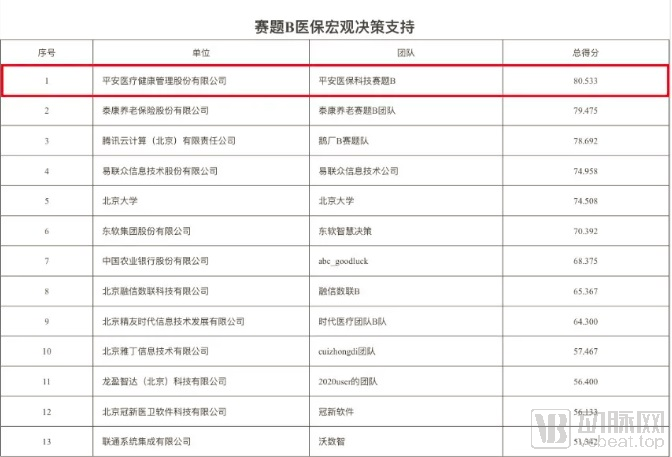
Ping An Health Insurance Technology Wins Championship in “Macro Decision Support for Health Insurance” Category at Beijing Digital Intelligence Health Insurance Innovation Competition
3. First-mover advantage in the informatization of medical insurance.In 2019, Ping An Healthcare Technology won the bid for a project with the National Healthcare Security Administration (NHSA), thereby accumulating experience in developing national-level platforms. This expertise has helped it gain recognition in subsequent provincial and municipal tender processes by leveraging its mature experience and technical advantages. Building on its explorations in constructing the NHSA platform and its own foundational capabilities, Ping An Healthcare Technology has been committed to developing a comprehensive big data governance solution for healthcare security, featuring a “data middle office + data applications” architecture.
The “Guiding Opinions on Actively Promoting the Medical Insurance Payment for ‘Internet+’ Medical Services,” issued by the National Healthcare Security Administration, establishes more detailed provisions regarding designated medical insurance providers, medical insurance settlement, and fund supervision.
For companies within the industry, the opportunities lie in:Driven by new policies, healthcare institutions are likely to accelerate the development of internet hospitals and promote the integration of regional electronic medical insurance accounts. The regulatory demands on medical insurance funds necessitate breaking down information silos among healthcare services, pharmaceuticals, and medical insurance, thereby establishing a coordinated regulatory mechanism for the “three-medical linkage” (healthcare, pharmaceuticals, and medical insurance). These initiatives require the participation of enterprises dedicated to the development of “Smart Medical Insurance.”
At the same time, this places higher demands on companies dedicated to building “Smart Medical Insurance,” such as Ping An HealthCare Technology. These enterprises are required to leverage their robust technological capabilities to empower medical insurance handling agencies, more effectively regulate all parties across the healthcare service chain, and identify irregularities through big data analytics, thereby fully ensuring the rational use of medical insurance funds.