

Riding the Surge: How Leading Chinese and U.S. Health Management Companies Are Seizing the Digital Health Opportunity
People's health needs have shifted from traditional, single-mode medical treatment toward disease prevention, healthcare maintenance, and health promotion.
Policies are also guiding this trend.In 2016, health across the entire life cycle was elevated to the level of a national strategy for the first time.. This year, the state once again emphasized the need to integrate the concept of full-life-cycle health management into all stages of urban planning, construction, and management.
Amidst growing market demand and robust policy support, health management has emerged as a blue ocean for innovation and entrepreneurship.According to data from the VCBeat database, a total of 132 financing and investment transactions occurred in the primary market for the health management sector from 2018 to the first quarter of 2020, with capital inflows amounting to approximately RMB 5.9 billion.
With numerous players entering the field and investors backing them with substantial capital, the health management sector is riding a wave of momentum. In the face of these opportunities, what narratives have health management companies crafted, and how have they communicated them?
How to Manage Your Health? According to data from Kaiser Permanente in the United States, medical care accounts for only 10%-20% of health determinants, while lifestyle and other factors account for 80%-90%. In other words,To maintain a healthy body, it is essential to change unhealthy lifestyles and behavioral habits.
Healthy habits are not formed overnight, and changing them is no easy task. According to the "Big Data Report on Family Health in China," less than one-quarter of the population understands and masters basic health knowledge and concepts, while fewer than one-fifth adopt healthy lifestyles and possess essential health skills. It is evident thatHealth literacy among Chinese residents remains low, representing a market in urgent need of solutions.
In traditional health management services, the primary reliance is on periodic medical examinations conducted by hospitals or other healthcare institutions, adopting a labor-intensive approach that results in low efficiency.Even with the integration of technological tools into traditional management practices, it remains difficult to alter the inherently “anti-human” nature of such management.
How to Achieve Efficient, High-Adherence Health Management? The Answer Lies in Enabling Individuals to Practice “Self-Management”, leveraging technological means to match the most scientifically effective health plans, driving services with data, linking comprehensive resources, and motivating users to take action.
Thanks to the development of technologies such as the Internet, the Internet of Things (IoT), and artificial intelligence (AI), as well as the widespread adoption of products like wearable devices and home monitoring equipment,Accessing continuous, dynamic health data anytime and anywhere has become a reality, and the acquisition of such multidimensional data has fundamentally transformed the underlying model of health management.
On a global scale,The digital health management model advocating “proactive health” is being implemented, supported not only by the principles of lifestyle medicine but also by underlying technologies.Following this trend, a cohort of outstanding digital health management companies has gradually emerged.
In the field of digital health management, numerous star companies have emerged abroad, including Welltok, Humanoo, and Vida. Through a systematic review, we have selected two benchmark enterprises of different types (one pure technology company and one healthcare service provider) to examine how they excel in the digitalization of health management.
As one of the 500 fastest-growing technology companies in North America,Welltok’s flagship product is the CaféWell health management platform. This platform can integrate with wearable devices, such as Fitbit wristbands, health management software, and health content platforms, to collect user data.
Upon data acquisition, the platform integrates intelligent analytics to analyze individual health data and provide professional health management recommendations.These recommendations are detailed down to the specifics, such as suggesting fitness programs and meal plans. As users adopt healthy habits according to the plans provided by Welltok, they receive corresponding rewards, including points, gift cards, and even cash.
Let us now examine Kaiser Permanente, currently the largest private nonprofit healthcare organization in the United States. Regarded as the pioneer of Health Maintenance Organizations (HMOs), its core business focuses on health management and disease management for its insured members.

To enable members to engage in proactive health management, Kaiser Permanente places significant emphasis on the development of its information technology infrastructure.Within the Group,Kaiser Permanente has established KP HealthConnect, an interoperable unified information platform., through this platform, the health team"Enables real-time synchronization of members' health and medical data, facilitating proactive monitoring and management."
How to Collect Data?Kaiser Permanente provides its members with smart wearable devices, such as smartbands, along with a health management portal and mobile app called “My Health Manager.”Data shows that Kaiser Permanente has cumulatively invested over $30 billion in electronic health information systems, and continues to do so.
Examining the trajectories of these two companies, despite significant differences in their business models, both place substantial emphasis on technological R&D and the application of AIoT (Artificial Intelligence of Things).: AIoT has brought significant benefits to a series of health management activities, including detection, assessment, effective intervention, and continuous monitoring. It is not difficult to see that,AIoT plays an irreplaceable role in digital health management.
Returning to the health management industry in China, based on research,Currently, most enterprises are focused on providing health management services, with little involvement in the digitalization of health management itself.The primary reason is that most enterprises lack the capability to build foundational digital infrastructure and integrate multi-terminal scenarios.
“Preparedness ensures success.” As a pioneer in digital precision health management in China, Miao Health is breaking this status quo.
Since its establishment in 2015, Miao Health has first leveraged the Internet of Things and smart hardware to buildThe AIoT-based IoT health big data platform “Miao+,” combined with professional medical research and artificial intelligence algorithms, has separately built the “H-Health Risk Stratification Management Platform” and the “M-AI Health Intervention Platform,” forming a unified and robust digital middle platform for health management.
Currently, Miao Health leverages the three core capabilities of Miao+, and the H/M platform to break down information silos and resolve data interface challenges. By utilizing the Health Behavior Index (M-Value) and the Health Physiological Index (H-Value), it conducts continuous, all-scenario data tracking and analysis for users, delivers personalized health management solutions tailored to individual needs, and drives the integration and application of health management across multiple industries and scenarios.
Miao Health has been making continuous efforts in the digitalization of health management., and achieved remarkable results. For instance, the AI team of Miao Health participated in the technical challenge “Medical-Health AI Exploration and Future Health Management,” winning the championship in the Intelligent Diagnosis Competition for Cervical Cancer Risk and the third place in the Intelligent Diagnosis Competition for Pulmonary Diseases. Additionally, they secured the championship in the GPU track of the “Intelligent Diagnosis Competition for Spinal Diseases” at the Apache Spark “Digital Human” AI Challenge, co-hosted by Alibaba Cloud and Intel (China).
ForService Capacity for Health Management, Miao Health has chosen to partner with Canada Wellness Inc. (CWI), the No. 1 chronic disease management organization in North America, to introduce its internationally advanced lifestyle medicine concepts and over 20 years of clinical practice experience. By integrating AIoT digital technologies, Miao Health is launching a replicable model in China, building an online-to-offline service loop to make health management accessible to all.
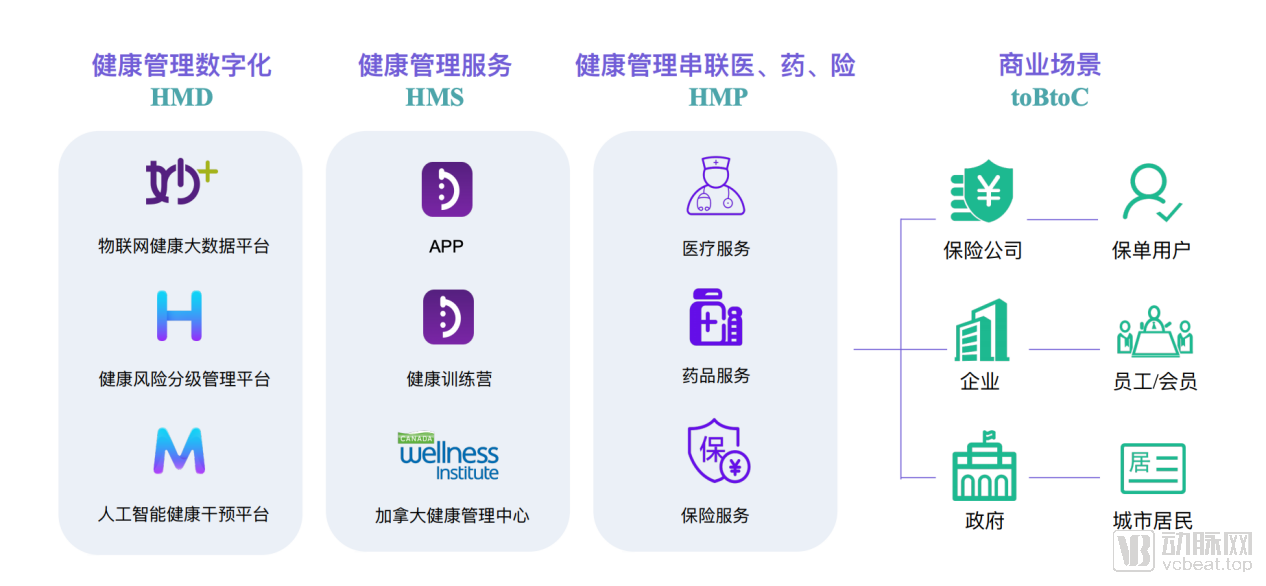
In terms of practical implementation,, More Health leverages health management as a link to integrate multiple scenarios across healthcare, pharmaceuticals, and insurance, strengthening collaboration with upstream and downstream partners in the industry chain. It has strategically positioned itself in insurance, new retail pharmaceuticals, and internet hospitals, not only injecting new momentum into the industry but also providing users with end-to-end services ranging from preliminary screening, risk warning, health assessment, and health intervention to medical consultation and insurance coverage.
For example, Miao Health collaborates with insurance companies to provide comprehensive end-to-end health insurance solutions, including enhancing insurers’ risk control capabilities and agents’ health management service competencies; it partners with real estate developers, hospitals, and government entities to jointly facilitate the nationwide rollout of upgraded AIoT-enabled Canada Health Management Center (China) stores across various cities; and it works with enterprises to deliver holistic health program solutions for employees (and served members), encompassing health promotion, medical examinations, health activities, corporate infirmaries, and customized group insurance services.
Furthermore,Digital capabilities in health management can also be deployed in a modular fashion, offering great flexibility and adaptability.In June this year, Miao Health and Baidu entered into a strategic partnership. By opening up the “Miao+” IoT health big data platform, they jointly designed an intelligent family doctor solution based on the Xiaodu Zaijia smart speaker, which can connect to over 300 smart health monitoring devices with a single click, making home-based health testing more convenient for users. It is reported that both parties will integrate more resources in the future to provide users with services such as health management, intelligent triage, and medication reminders.
Based on the above cases,In the wave of digital health management, a company’s foundational capabilities are actually more important than its business model.As new infrastructure such as 5G, the Internet of Things (IoT), and artificial intelligence (AI) continues to improve, the value of digital health management will be increasingly explored and applied.
It is crucial to recognize that behind every opportunity lie significant challenges; seizing the moment demands corporate innovation, boldness, and wisdom. Industry benchmarks such as WellTok, Kaiser Permanente, and Miao Health have written new chapters in the story of digital health management through continuous technological innovation and business model upgrades. As more players enter this arena, how will the landscape evolve in the future? Only time will tell.