

From Obscurity to Innovation Benchmark: How Shandong Provincial Third Hospital Achieved a 'Curve Overtaking' Leap Through Its Internet Hospital
“The value of internet hospitals to public hospitals may not necessarily enable them to completely overtake competitors on a curve, but it will certainly accelerate their pace.” This is the view of Lü Yongtao, President of Shandong Provincial Third Hospital. In the post-pandemic era, public hospitals have accelerated the launch of internet hospital services, and he has been adhering to this perspective and exploring its practical implementation for several years.
Last April, on the first anniversary of the release of the policy setting the tone for “Internet + Healthcare,” the National Health Commission held a press conference to showcase interim achievements. At the event, Shandong Provincial Third Hospital (hereinafter referred to as “Shandong Provincial Third Hospital”) was featured as a case study, with Lü Yongtao providing a detailed introduction to the hospital’s approach and experience in building its internet hospital. At the 2020 Digital China Summit, the internet hospital of Shandong Provincial Third Hospital stood out from more than 680 projects nationwide, winning the second prize and the Most Leadership Award in the 4th Smart Healthcare Innovation Competition.
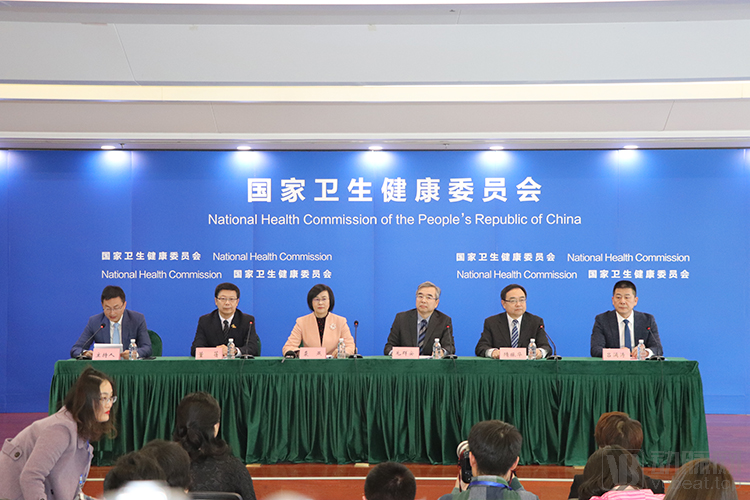
In April 2019, Lü Yongtao (first from the right), President of Shandong Provincial Third Hospital, shared experiences in internet hospital development at a press conference held by the National Health Commission.
On November 23 this year, the World Internet Conference was held as scheduled in Wuzhen. It was at this conference five years ago that the newly established Wuzhen Internet Hospital opened the door to China’s internet hospital era. Recently, coinciding with the 70th anniversary of Shandong Provincial Third Hospital, VCBeat interviewed President Lv Yongtao, Sun Jingmeng, Vice President of WeDoctor Group, and other relevant officials from the internet hospital. With a review of the development history of China’s internet hospitals, we trace back how Shandong Provincial Third Hospital rapidly grew from a little-known provincial hospital into a national benchmark for digital innovation.
Shandong Provincial Third Hospital was founded in 1950. It has successively operated under the names Shandong Provincial Transportation Workers’ Hospital, General Hospital of the Shandong Production and Construction Corps, and Shandong Provincial Transportation Hospital. In March 2017, it was transferred from the Shandong Provincial Department of Transportation to the Shandong Provincial Health Commission and renamed Shandong Provincial Third Hospital. Transitioning from an industry-specific hospital, it has become a Grade A tertiary general hospital integrating medical care, teaching, scientific research, preventive health care, and rehabilitation.
As early as 2016, Lü Yongtao began planning the establishment of an internet hospital, with the initial aim of integrating resources within the medical consortium to promote the optimized allocation of healthcare resources. The close-knit medical consortium affiliated with Shandong Provincial Third Hospital comprises one secondary hospital, one township health center, 14 community health service institutions, and 43 village clinics.

Shandong Provincial Third Hospital
“We believe that internet hospitals represent a major trend, yet top-tier hospitals have shown limited enthusiasm. As we are in a growth phase and urgently need to enhance our influence, this presents a significant opportunity for us,” said Lü Yongtao. “Even though the policy landscape was unclear at the time, someone had to take the initiative and pioneer the way.”
During the preparatory phase, Lü Yongtao led his team on multiple study visits to other provinces and municipalities, gaining valuable insights into key areas such as selecting third-party partners and leveraging the internet to extend medical resources to grassroots levels.
In July 2017, Shandong Provincial Third Hospital partnered closely with WeDoctor Group to officially launch its internet hospital. Phase I implemented functionalities including remote consultations, remote training, one-click referrals for tiered diagnosis and treatment within the medical consortium, remote appointment scheduling for examinations and laboratory tests, online commercial insurance claims settlement, and online signing services for family doctor contracts.
Since then, Shandong Provincial Third Hospital’s Internet Hospital and WeDoctor have jointly explored and continuously improved their service offerings. They have successively established a prescription-sharing platform and a pharmaceutical consortium platform, enabling follow-up patients to obtain online prescriptions, make online payments, and have medications delivered to their homes or picked up at nearby pharmacies. By connecting medical institutions at all levels within the medical consortium, as well as integrating online and offline services and both in-hospital and out-of-hospital care, they deliver services through personalized family doctor service packages and internet-based chronic disease management.
In December 2018, Shandong Provincial Third Hospital became one of the first internet hospitals to connect to the Shandong Internet Medical Services Supervision Platform and obtain an operating license. From a national perspective, it was also among the first batch of internet hospitals to be licensed following the State Council’s release of the “Opinions on Promoting the Development of ‘Internet + Healthcare’” in April 2018.
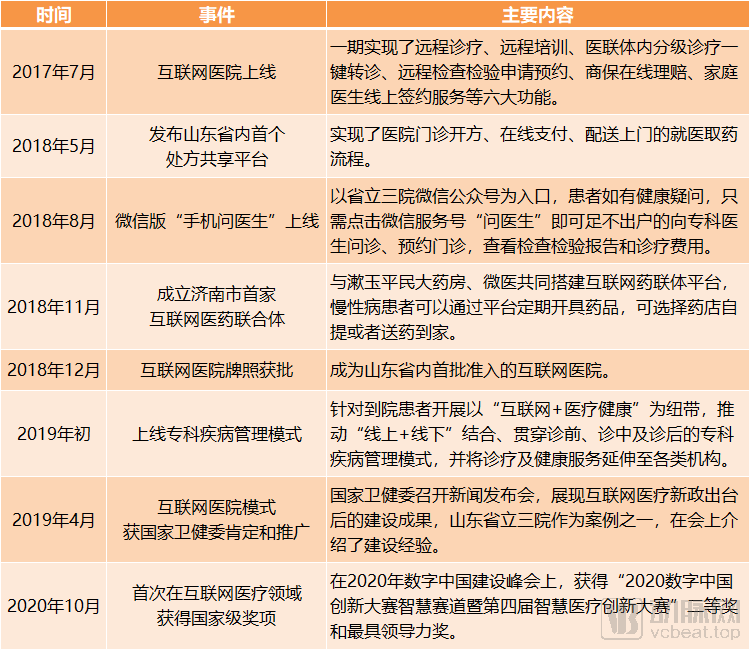
Key Milestones in the Development of Shandong Provincial Third Hospital’s Internet Hospital, Source: Shandong Provincial Third Hospital, Chart by VCBeat
In April 2019, on the first anniversary of the issuance of policies setting the tone for “Internet + Healthcare,” the National Health Commission held a press conference to showcase development achievements, with Shandong Provincial Third Hospital’s Internet Hospital featured as a case study.
At this stage, the internet-based medical services of Shandong Provincial Third Hospital have begun to yield significant results, establishing an internet hospital characterized by its family doctor contracting platform and medical consortium platform. In terms of family doctor services, 197 personalized service packages were designed, with 22,000 community residents signed up. Regarding internet-based chronic disease management, an online multidisciplinary team (MDT) for chronic disease management was established, and 23 specialty membership service packages were developed, providing internet-based MDT diagnosis and treatment services to 5,822 patients with diabetes within the medical consortium. Meanwhile, Shandong Provincial Third Hospital has expanded the scope of its medical consortium services by co-establishing “Shandong’s First Construction Site Internet Hospital” with China Construction Eighth Engineering Division; it also founded an Internet Specialty Alliance for Stone Diseases, promoting the development of internet-based medical consortia toward specialized care. The number of beneficiaries of its internet-based medical services has reached 400,000 person-times.
Presenting experiences at the press conference of the National Health Commission was only the beginning; the national influence of the Internet Hospital of Shandong Provincial Third Hospital has gradually become apparent: in June 2019, a delegation from Peking University, Fudan University, and Shandong University visited Shandong Provincial Third Hospital for exchanges; in July 2019, Zhang Xuegao, Director of the Statistical Information Center of the National Health Commission, and his team conducted research at Shandong Provincial Third Hospital...
Over the past two to three years, Shandong Provincial Third Hospital’s Internet Hospital has achieved a leap from nonexistence to establishment, from establishment to excellence, and from learning from others to becoming a model for others to learn from.
During the pandemic this year, Shandong Provincial Third Hospital’s Internet Hospital also established an online volunteer service team. By providing services such as online fever clinics, chronic disease management clinics, and health education, it met residents’ healthcare needs and delivered health management services to construction workers from China Construction Eighth Engineering Division and overseas employees of Expressway Group, playing a significant role in epidemic prevention and control.
Since the beginning of this year, driven by both policy incentives and the needs of epidemic prevention and control, the number of internet hospitals has risen rapidly, reaching 900 across China.
At the CHIMA and CHINC conferences, hospital directors have discussed in various forums how to build internet hospitals. Particularly against the backdrop of the significant disruption caused by the pandemic to normal hospital operations and the innovation driven by reforms in health insurance payment methods, internet hospitals have emerged as a potential avenue for public hospitals to extend services, reduce costs, and improve efficiency.
However, in practice, public hospitals often encounter obstacles such as inadequate organizational support and low physician engagement. How did Shandong Provincial Third Hospital address these issues?
At a press conference held by the National Health Commission, Lü Yongtao summarized the development path of internet hospitals as the “1-4-5 Model.” The “1” refers to the conceptual framework for building internet hospitals, which centers on physical medical institutions and adopts an integrated online-offline approach combining “internet hospitals with medical consortia,” leveraging internet technologies to extend the temporal and spatial reach of hospital services. The “4” denotes four core teams—management, technology, physicians, and operations—that collaborate synergistically to drive the development of internet hospitals. The “5” represents five mechanisms—support and safeguards, standards and norms, service content, conduct regulation, and operational mechanisms—to ensure the healthy and orderly development of internet hospitals.
Addressing the current challenges faced by many public hospitals in establishing internet hospitals, and drawing on the “145” model and practices of Shandong Provincial Third Hospital, we have summarized innovative experiences in three key areas.
Organizational Support: Dedicated Team for Full-Scale Implementation
Currently, the management of internet hospitals in public hospitals is mostly handled by the Medical Affairs Department or the Information Technology Department, with only a few hospitals establishing separate departments to drive this initiative. The Medical Affairs Department is preoccupied with the organizational management of medical services, quality control, and technical standards, making it difficult to attend to other responsibilities; furthermore, it lacks familiarity with informatization initiatives. Meanwhile, the Information Technology Department is bogged down with various accreditation assessments and system installation and debugging. However, an internet hospital involves more than just the procurement and installation of a software system; it also requires mobilizing physicians within the hospital for sustained operations and service delivery, a task that the Information Technology Department is ill-equipped to handle.
To advance the operations of its Internet Hospital in a better, faster, and more standardized manner, Shandong Provincial Third Hospital established a leadership group for the Internet Hospital project, with the President serving as the team leader and the Vice President in charge as the deputy leader. The hospital took the lead in the province by establishing a Smart Healthcare Department, which is specifically responsible for the day-to-day operations of the Internet Hospital. Zhu Xingguo, the former Director of the Hospital’s Information Department, was appointed as the Director of the Smart Healthcare Department. Two deputy directors were assigned under him, one overseeing medical affairs and the other in charge of information technology, thereby achieving a high level of integration between medical management and technical management.
The Smart Healthcare Department spearheaded the formulation of institutional frameworks such as the Code of Conduct for Internet Physicians, thereby refining the hospital’s three-tier regulatory system for internet-based healthcare. It established oversight mechanisms covering pre-consultation, during-consultation, and post-consultation phases, achieving full-process regulation of internet healthcare services. Notably, the Code of Conduct for Diagnosis and Treatment Services in Internet Hospitals was included in the 2019 Comprehensive Standardization Reform and “Shandong Standards” Construction Project Plan, issued by the Shandong Provincial Leading Group for the Implementation of the Standardization Strategy. This initiative aims to foster a new Shandong standard system through standardized construction projects in social governance and public services.
Physician Management: Differentiated Incentives for Full-Time and Part-Time Physicians
According to the regulations set forth by the National Healthcare Security Administration, public medical institutions conducting online follow-up consultations are required to charge fees based on the pricing standards for general outpatient consultation services, regardless of the professional rank of the medical personnel providing the care. This implies that physicians’ income from online consultations may be lower than that from offline visits, particularly for senior physicians. Coupled with factors such as limited energy and insufficient understanding of internet-based healthcare, many physicians exhibit low enthusiasm for providing online services.
In response, Shandong Provincial Third Hospital has adopted two models for its internet hospital: full-time and part-time physicians. There are five full-time physicians, who belong to the Smart Healthcare Department. Providing online services is their primary job responsibility, and they operate under a “first-come, first-served” order-grabbing system, where compensation is based on performance. Part-time physicians are doctors from other departments within the hospital. Their participation is primarily encouraged through incentives, as providing online services earns them additional income, thereby motivating them to be more active on the platform.
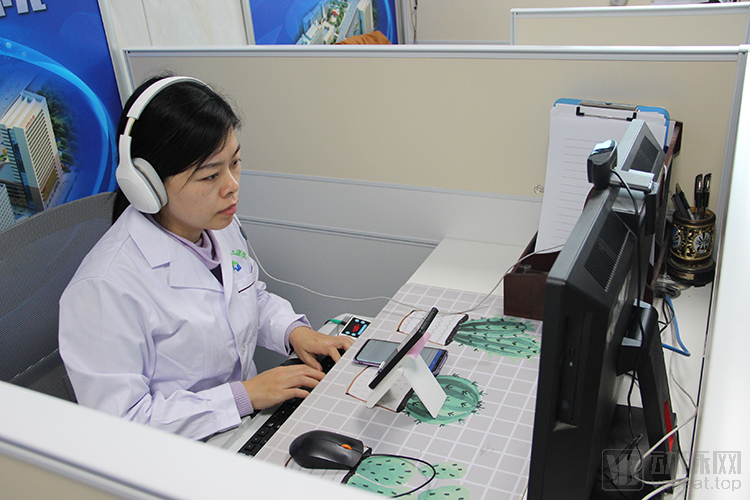
Wang Jing, Deputy Director of the Smart Healthcare Department at Shandong Provincial Third Hospital, Conducts Online Consultations
Wang Jing is one of the first physicians to join the Smart Healthcare Department and serves as its Deputy Director, overseeing medical operations. To date, she has conducted 102,000 consultations on the Internet Hospital platform. Since the platform’s launch, she has seen nearly 100 patients per day, including both weekdays and weekends. In her daily practice, she and her colleagues also facilitate precise referrals for patients with complex conditions to the appropriate departments, thereby enhancing in-house physicians’ recognition and trust in the Internet Hospital.
To enhance the clinical competencies of full-time physicians and further strengthen their collaboration with other doctors, Lu Yongtao also plans to implement a “shift rotation system,” whereby full-time physicians may opt for job rotation after working online for a specified period.
Service Innovation: From Individuals and Families to Institutions
Since 2019, after achieving significant success in providing internet-based medical services to patients and their families, the Internet Hospital of Shandong Provincial Third Hospital has begun extending its diagnostic, treatment, and health services to various institutions. For example, it co-established the “Construction Site Online Hospital” with China Construction Eighth Engineering Division, offering online consultations and health lectures through the smart device “Weiyitong”; it also collaborated with the Jinan Railway Bureau to provide free clinical consultations to travelers at Jinan West Railway Station and to promote first-aid knowledge.
As of now, the internet-based medical services provided by Shandong Provincial Third Hospital have extended to institutions in sectors such as transportation, elderly care, and banking, delivering services to employees or customers through these organizations. “There is substantial demand for health management among institutions, particularly elderly care facilities,” stated Lu Yongtao.
This B2B2C model enables internet hospitals to leverage their resources on a larger scale, while also shifting medical services toward proactive health management. From a societal perspective, this approach improves public health outcomes and helps reduce healthcare costs.
When Shandong Provincial Third Hospital was initially planning to establish its internet hospital, it faced a critical decision: should it purchase a system and develop it independently, or collaborate with partners to build it jointly? This is a common dilemma for all public hospitals embarking on such initiatives, as considerations of labor costs, financial expenditures, and operational capabilities often leave them in a state of indecision.
After a series of investigations and reflections, Lu Yongtao realized that building an internet hospital is akin to constructing a bridge, aiming to bring traditional hospitals into a “new frontier”: “The side we are on is already well-developed, while the other side still awaits our exploration. However, this bridge cannot be built by the hospital alone; it requires the specialized expertise and collaborative efforts of multiple stakeholders, including hospitals, internet companies, and pharmaceutical firms.”
Hospitals and Enterprises: Each with Its Own Strengths, Each Fulfilling Its Own Responsibilities
During the preparatory phase, Shandong Provincial Third Hospital evaluated product and service demonstrations from numerous vendors, most of which focused primarily on software services. Ultimately, the hospital selected WeDoctor, citing its robust technical support capabilities and extensive experience in operating internet hospitals. As early as 2015, WeDoctor established China’s first internet hospital in Wuzhen, the permanent host city of the World Internet Conference.
“If you simply purchase a system, even if it is cutting-edge this year, it may become obsolete in a few years, just as physicians have finally mastered its use,” said Lü Yongtao. He believes that specialization is key; by partnering with high-quality collaborators and allowing each party to focus on their respective areas of expertise, everyone can save time, mental effort, and physical resources. “There is no need to undertake tasks beyond one’s core competencies, as the costs are prohibitively high.”
Following the launch of the Internet Hospital project, WeDoctor’s positioning was not that of a technology service provider; instead, it joined forces with the Smart Healthcare Department to form an integrated project team for unified operations.
Sun Jingmeng, Vice President of WeDoctor Group, explained that WeDoctor’s focus shifts across different stages of project implementation. For instance, in the early phase, leveraging the characteristics of the internet, the company provides strategic recommendations for positioning and direction of the internet hospital and plans the exhibition hall setup. Once the plan is finalized, technical teams take charge of developing various systems, while a dedicated task force collaborates with the hospital to ensure compliance and secure necessary qualifications, such as the internet hospital license. After system launch, operational staff are deployed and work on-site at the hospital, maintaining regular collaboration with the hospital to jointly advance follow-up services.
“During the subsequent phase of normalized cooperative operations, external resources must be integrated to support functions such as prescription circulation, commercial insurance payment, and the signing and fulfillment of family doctor contracts,” said Sun Jingmeng. He noted that WeDoctor would respond to hospital needs by deploying teams or allocating resources from its group, adding, “This flexible and efficient collaboration mechanism is a key element in the development of internet hospitals by public hospitals.”
In recent years, Shandong Provincial Third Hospital, as the physical entity of its internet hospital, has comprehensively coordinated internet hospital operations and managed resource allocation within the hospital and its medical consortium, allowing physicians to focus solely on clinical care.
WeDoctor is responsible for building various systems, including the online consultation platform, family doctor contracting platform, medical consortium platform, and pharmaceutical consortium platform, as well as developing artificial intelligence products. It aims to enhance physicians’ efficiency while integrating out-of-hospital resources such as pharmaceuticals, medical devices, and health management services. In collaboration with hospitals, WeDoctor jointly designs and promotes specialized care services and personalized family doctor services.
Both parties leverage their respective strengths to jointly advance the development of internet hospitals.
How Can Medical Resources Be Replicated and Connected?
For hospitals, this collaborative model between WeDoctor and Shandong Provincial Third Hospital extends and enriches service offerings—enhancing residents’ sense of benefit—without incurring costs higher than those of purchasing systems outright. It also effectively revitalizes resources within the medical consortium, fully leveraging the value of healthcare institutions at all levels. For enterprises, it generates revenue through the integration of out-of-hospital resources and user services.
Sun Jingmeng frankly stated that, from a corporate perspective, helping hospitals build systems and apply for licenses is no longer the most critical task; what matters more is realizing the long-term value of internet hospitals through operational management. “Our primary work focuses on replication and connectivity—widely replicating the resources of large hospitals, the strengths of major specialties, and the expertise of leading physicians to the grassroots level, and then connecting with various outlets of primary healthcare institutions. This is not merely a product, but a comprehensive solution and a systematic set of capabilities.”
The pandemic has prompted many hospital presidents to realize that public hospitals can extend their existing capabilities through the Internet, moving beyond hospital walls into communities and homes. Sun Jingmeng stated that precisely because the Internet has no boundaries and internet hospitals have no “walls,” WeDoctor is not limited to collaborating with individual internet hospitals. Instead, it focuses on planning internet hospital development based on a holistic view of specific regions, enabling more extensive replication, connectivity, and integration within those areas.
More Opportunities Driven by New Technologies
Today, Shandong Provincial Third Hospital presents the following service scenario:
A gallstone patient in Linyi, whose condition was complicated by severe complications and failed to improve after an initial surgery, contacted Dr. Zhang Kai, Director of the Hepatobiliary Surgery Department at Shandong Provincial Third Hospital, through the hospital’s internet-based healthcare platform to share her medical history. As the hepatobiliary surgery department at Shandong Provincial Third Hospital is a provincial leader in this field, the patient submitted her medical records online for preliminary consultation before coming to the hospital. Dr. Zhang then performed the complex surgery as the lead surgeon. The patient has now fully recovered.
For patients with common diseases and chronic conditions, routine care can be accessed at primary healthcare institutions within medical consortiums, with specialist consultations available via internet hospital platforms when necessary.
For specific healthy populations, such as the elderly, women, and children, suitable health management approaches can be identified through services like family physicians and specialist membership programs.
It is evident that as hospital services extend from offline to online and from within the hospital to outside, they can meet the needs of different types of users and match them with corresponding medical and health resources.
The value of internet hospitals to patients and users is already clear; what, then, is their significance for public hospitals themselves?
“The value of internet hospitals to public hospitals may not necessarily enable them to completely overtake competitors by taking a shortcut, but it will undoubtedly accelerate their pace,” revealed Lv Yongtao. He noted that although the pandemic has had a significant impact on physical medical institutions, the hospital’s revenue increased by 26% year-on-year from January to September this year. While there is no precise statistical evidence proving that this revenue growth stems directly from internet hospitals, it is certain that the internet has become a continuous link connecting patients. Precise online triage enables various users to find the most suitable services, and the quality of diagnosis and treatment services provided by the hospital has also improved.

At the 70th Anniversary Conference of Shandong Provincial Third Hospital, Lu Yongtao stated that it is essential to maintain passion for entrepreneurship and professional dedication.
In Lu Yongtao’s view, internet hospitals will become a competitive tool for public hospitals in the future. “Currently, internet hospitals are an extension of in-hospital services, but with the application of technologies such as 5G and artificial intelligence, they will no longer serve merely as extensions. The scenario we envision is one where patients independently operate equipment in a consultation room, with data transmitted directly to the central hub. Physicians analyze the data and send feedback to patients’ mobile phones; if issues arise, patients can then consult specialists. At the primary care level, robots assist physicians with procedures while experts provide remote guidance.”
It is precisely because of such a scenario outlook that Lü Yongtao believes the more innovative initiatives currently deployed, the greater the future opportunities will be. “However, innovation follows its own cycle and cannot be pursued with short-sighted eagerness for quick success. We have persevered over the past few years, and we will continue to do so in the future.”
Of course, in addition to identifying the development path best suited to its own needs, a conducive environment for innovation has also been a key factor contributing to the phased achievements of the Internet Hospital at Shandong Provincial Third Hospital.
In April 2018, Shandong Provincial Third Hospital received approval from the Shandong Provincial Health Commission to become the first pilot unit for internet-based healthcare in the province. This pioneering initiative, authorized by the competent authorities, marked a significant milestone in the hospital’s collaboration with WeDoctor to advance the development of its internet hospital.
In December 2018, just two months after the National Health Commission issued the Administrative Measures for Internet Hospitals (Trial), the Shandong Provincial Internet Medical Services Supervision Platform was rapidly launched, becoming one of the first internet medical supervision platforms nationwide following the implementation of the new policy.
To facilitate the implementation of internet hospitals, the Health Commission of Shandong Province issued documents such as the “Service Guidelines for Provincial Medical Institutions to Conduct Internet Diagnosis and Treatment and Add a Second Name for Internet Hospital Practice Registration,” the “Review of Basic Conditions and Approval Process for the Shandong Provincial Internet Medical Service Supervision Platform,” and the “Operating Instructions for Registration on the Shandong Provincial Internet Diagnosis and Treatment Supervision Platform.” These documents clarified the pathways and methods for applying to establish internet hospitals, providing guiding principles for municipal-level approval of internet hospital setups. As of July 29, 2020, approvals had been granted for 112 internet hospitals.
Over the past two years, the Health Commission of Shandong Province has taken proactive measures to improve policy standards for internet-based healthcare and continuously advance the construction of nationwide health informatization. In October 2020, the National Health Commission announced 50 typical cases of “Internet + Healthcare” services. The Health Commission of Shandong Province was commended as one of the ten regional service examples for its province-wide implementation of convenient and beneficial “Internet + Healthcare” services.
In terms of top-level design, the Shandong Provincial Government, in its "Action Plan for Building Shandong Province into a Demonstration Province for 'Internet + Medical Health' (2019–2020)," proposed seven major tasks and 16 specific action measures. The plan encourages leveraging the strengths of leading enterprises to build operational platforms for internet hospitals, supports medical institutions in developing internet hospitals, and encourages licensed physicians to provide "Internet + Medical Health" services.
Meanwhile, Shandong has vigorously advanced the formulation and implementation of policies for internet-based medical care covered by medical insurance payments.
Overall, the external environment has provided fertile ground for the implementation of various innovations at Shandong Provincial Third Hospital. The new mechanisms and operational capabilities introduced by its partner, WeDoctor, have served as a guarantee for the successful execution of these innovations. The Internet Hospital of Shandong Provincial Third Hospital has also become a microcosm of the sustained growth and development of Shandong’s internet healthcare industry in recent years.
Currently, 30 provinces and municipalities across China have established regulatory platforms for internet-based medical services, indicating that the approval channels for internet hospitals will become more streamlined nationwide. It has also become commonplace for public hospitals to engage in deep operational collaborations with third-party platforms to run internet hospitals. From a regional perspective, Shandong Province’s development orientation—encouraging innovation while adopting an inclusive and prudent approach—may offer valuable insights. For public hospitals, the long-term strategic layout and differentiated competitive thinking demonstrated by Shandong Provincial Third Hospital may also provide useful lessons.
(All images in this article, unless otherwise specified, are from the Third Provincial Hospital of Shandong)