

BeyoBio Secures Tens of Millions RMB in Series Angel Funding Led by Kairui Ventures to Advance IVD Raw Material Innovation

Co-win Ventures
Early-Stage Venture Capital Firms

Bioeast
IVD Reagent Raw Materials and Total Solution Provider
VCBeat (WeChat ID: vcbeat) has learned that Hangzhou Boyue Biotechnology Co., Ltd. (hereinafter referred to as “Boyue Biotech”) recently announced the completion of its angel round financing, amounting to tens of millions of yuan.Exclusively invested by CoWin Ventures, the proceeds from the financing will be primarily used to develop new products, expand production capacity, and grow the company’s sales team.
Boyue Biologics is a provider of IVD reagent raw materials and comprehensive solutions, established in 2018. Leveraging expertise in immunology, biochemistry, proteomics, and related disciplines, the company has established R&D and production platforms for monoclonal/polyclonal antibodies, eukaryotic/prokaryotic protein expression, protein purification, and nanomaterials. Boyue Biologics focuses on supplying core raw materials required for in vitro diagnostics to mid- and downstream players in the IVD industry, including biologically active materials (antigens, antibodies, diagnostic enzymes) and chemically synthesized materials (nanospheres, substrates). Additionally, it provides comprehensive solutions for IVD enterprises in product areas such as POCT, immunoturbidimetry, and chemiluminescence.
Amid the impact of the COVID-19 pandemic in 2020, the IVD industry garnered unprecedented attention from the medical investment community. The market size of China’s IVD industry maintained a growth rate of over 15%, with in vitro diagnostic kits for SARS-CoV-2 becoming a highly sought-after focus for R&D competition within the sector.
However, on another level, the impact of the pandemic has also exposed the weaknesses of China’s in vitro diagnostics (IVD) industry. China’s upstream IVD sector relies heavily on imported core raw materials, with approximately 70% of key biological materials such as antigens, antibodies, and enzymes being imported, and around 90% of nanomaterials like magnetic microspheres and fluorescent microspheres sourced from abroad. In particular, during the COVID-19 containment period, shortages of critical raw materials—including antigens, antibodies, enzymes, nanospheres, and nitrocellulose (NC) membranes—emerged as imports from overseas were disrupted, severely hindering the healthy development of the domestic IVD industry. Consequently, capital began to focus on China’s upstream IVD market, presenting Boyue Biotechnology with its own opportunity.
“We have been deeply engaged in the upstream sector of in vitro diagnostics (IVD) for many years. Our products are typically developed approximately two years ahead of downstream IVD companies, so that by the time these downstream enterprises begin to focus on a particular product project, we have already secured the necessary upstream raw materials,” Li Yinlai, founder of Boyue Biotech, told VCBeat. “Therefore, in our product portfolio strategy, Boyue Biotech anticipates which new projects will be launched in the future IVD market and which ones will gain significant traction two years in advance, allowing us to proactively establish our market presence.”
Currently, the global market size of the in vitro diagnostics (IVD) industry has increased from $53.3 billion in 2013 to $72.5 billion in 2019, and is expected to maintain growth at a compound annual growth rate (CAGR) of approximately 5%, with the market size projected to reach $84 billion by 2022. In terms of regional market distribution, the global demand for IVD is primarily concentrated in developed economies such as North America, Europe, and Japan. Among these, North America accounts for over 40% of the market share, Western Europe holds 20%, and Japan comprises 9%, collectively representing more than 70% of the global IVD market.
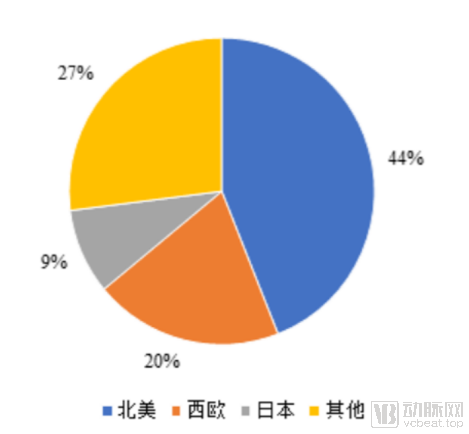
Global In Vitro Diagnostics Market: Regional Distribution
In China, the in vitro diagnostics (IVD) market was valued at approximately RMB 70 billion in 2018, with per capita spending around USD 6. However, this figure remains far below the per capita consumption level of USD 28 seen in developed countries. The rapid development of the IVD industry abroad has driven substantial demand for upstream core raw materials. Relevant national authorities have also begun conducting surveys among major enterprises in various provinces, strengthening investment in the development of upstream core raw materials to primarily address domestic demand for these critical inputs within the IVD industry.
It is reported that core raw materials in the in vitro diagnostics (IVD) industry include antigens, antibodies, diagnostic enzymes, nanomaterials (such as latex microspheres, fluorescent microspheres, and magnetic microspheres), and enzyme-synthesized substrates. These components represent the most critical strategic nodes in the upstream supply chain, directly determining over 80% of the quality of diagnostic reagent products. Based on the estimate that the market size of core raw materials for diagnostic reagents accounts for approximately 10% of the total IVD reagent market, the global market size for core IVD raw materials is around USD 8 billion, equivalent to RMB 56 billion.
Magnetic nanospheres are one of the most common raw materials in the upstream IVD sector, and due to their excellent superparamagnetic properties, they are widely used in chemiluminescence, molecular diagnostics, protein purification, and other fields.
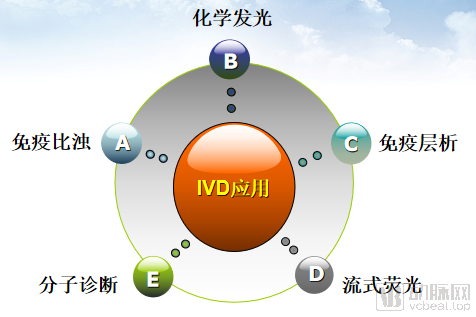
IVD Application Scenarios of Nanospheres
However, as a rapidly developing field in immunoassays, chemiluminescence relies on magnetic microspheres as its core raw material. This market is currently monopolized by international brands such as Dynabeads, JSR, and Merck, which account for more than 95% of the domestic demand for luminescent microspheres.
However, this situation may be disrupted by emerging innovative IVD companies in China. In 2020, Boyue Biology launched the first chemiluminescence-specific magnetic nanobeads for industrial production in China, becoming the country’s first industrialization platform for chemiluminescent immunomagnetic beads and breaking the long-standing foreign monopoly on magnetic nanospheres.
Li Yinlai, founder of Boyue Biologics, revealed that the company’s nanospheres have been evaluated by six chemiluminescence companies, with results demonstrating performance fully comparable to that of imported brands.
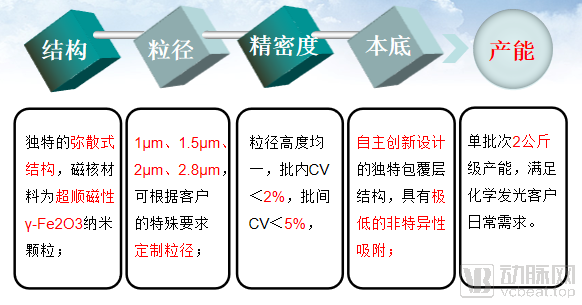
Performance Data of Boyue Bio’s Proprietary Immunomagnetic Beads
Following the acquisition of immunomagnetic bead technology, Boyue Biologics’ portfolio of chemically synthesized raw materials also includes latex microspheres, fluorescent microspheres, quantum dot microspheres, and chemically synthesized substrates. As is well known, in vitro diagnostics (IVD) is a multidisciplinary field, and the vast majority of IVD reagents are products derived from the combination of bioactive raw materials and nanomaterials. Accordingly, Boyue Biologics has strategically positioned itself early in the bioactive raw materials sector, offering a range of products including monoclonal antibodies, polyclonal antibodies, genetically engineered antibodies, recombinant antigens, natural antigens, and biological enzymes. This has made it the first company in China to establish dual independent industrialization platforms for both nanomaterials and bioactive materials. The synergistic integration of nanomaterials and bioactive materials enables the company to deliver superior-quality products to its customers.
Regarding the investment in Boyue Biopharma,Wen Gang, Partner at CoWin Ventures“It has always been our strategic focus to closely monitor the in vitro diagnostics (IVD) industry, with the upstream IVD sector representing a key investment direction. At CoWin Ventures, our core investment thesis in the IVD field centers on identifying cutting-edge technologies and exceptional teams, and positioning ourselves in companies with the potential to become leaders in their respective niches. The team at Boyue Bio brings extensive experience in the upstream IVD sector, with particularly impressive achievements in new product development. We are confident that, driven by technological innovation and high-quality products, Boyue Bio will soon emerge as a globally recognized provider of core raw materials for IVD reagents and comprehensive solutions, holding promising prospects for future growth.”
CoWin Ventures, established in 2009, specializes in investments within the healthcare and IT hard-tech sectors. Over the past 11 years, CoWin Ventures has positioned itself as an angel and early-stage investor in technology-driven enterprises. To date, it has independently managed 15 funds, with cumulative assets under management totaling approximately RMB 5 billion, providing capital and resource support to more than 100 outstanding teams and projects. CoWin Ventures has empowered over 30 star companies—including InnoLight Technology, Jutze Intelligence, Taimei Medical Technology, Cytek Biosciences, and Genetron Health—to grow into industry unicorns. Additionally, it has facilitated the successful public listings of ten high-tech enterprises, such as Tongcheng-Elong, Neusoft Reach, Huaxing Zhiyuan, Aolian Electronics, Sanchao Advanced Materials, InnoLight Technology, and Jutze Intelligence.