

Lingkui Intelligence: Revolutionizing Healthcare with Cutting-Edge Gaze-Control Technology
“"The eloquence and truth conveyed by the eyes surpass those of language."”
——Bryant Tuckerman, a Distinguished American Mathematician
Among the five major sensory systems of the human body, the eyes are undoubtedly the primary “collectors” and “transmitters” of information. The reason they are said to collect is thatThe human body receives 80% of its information through the eyes.; It is said to be transmissible because the affection between lovers and the competitive intensity among athletes both rely on the lingering, expressive interplay of eye contact.
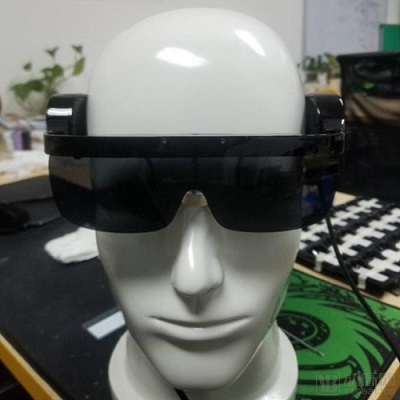
Image source: Lingkui Intelligence
But humanity’s exploration of the eyes does not stop there. Stephen Hawking, known as the “King of the Universe,” communicated with the outside world using eye-tracking technology despite being unable to move his fingers, continuing his scientific research; Gong Xunhui, hailed as the “Most Beautiful ALS Patient,” relied on an all-in-one gaze-control computer, blinking tens of thousands of times each day, to complete her 150,000-word autobiography, Beautiful Frozen Person; Wang Jia, an “accomplished young man,” used the only muscles he could still move—those in his eyes—to “recite” alongside renowned host Dong Qing.
The advancement of technology lies in helping humans live better lives. Today, eye-tracking and control technologies are gradually aligning with the trends of the times, entering the public spotlight, and emerging as a highly anticipated new mode of human-computer interaction.
The promotion and development of an emerging technology cannot be achieved without the dedicated support of enterprises, and Lingkui Intelligence aspires to serve as the “whistleblower” of this intrinsic driving force.

Chen Qian, Founder of Lingkui Intelligence
Chen Qian, founder of Lingkui Intelligence, did not embark on the path of entrepreneurship on a whim.
When reflecting on his original aspirations, he summarized two key points. On one hand, like the vast majority of “tech enthusiasts,” Chen Qian possesses a near-obsessive dedication, fueled by his passion and strong desire for gaze-control technology. On the other hand, guided by the belief that technology can transform lives and make them better, Lingkui Intelligence is committed to developing cutting-edge technologies centered on gaze-control solutions. The company aims to create technological products with significant social and practical value, serving the public and contributing to the nation’s technological advancement.
How to Turn Your Ideas into Reality? Teams and Execution Are Indispensable Components.
As an innovative companyLingkui Intelligence boasts a remarkably young and creative talent pool, with the majority born in the 1990s. After graduating from university, they joined their former classmate, Chen Qian, in his entrepreneurial endeavors. When asked why they resolutely chose to follow Chen Qian, they responded in unison: “His personal charisma—being grounded, steady, and visionary. Additionally, we share a strong belief in the potential of gaze-control technology.”
With clear goals and a dedicated team in place, a group of “employees” full of anticipation for the future officially began their “groundwork.” During the first two years after the company’s establishment, they primarily focused on formulating, validating, and optimizing theoretical proposals.
After the technology matures, theyCore Patents“Visual Control Instrument”as the foundation, with full effortBuild the “Vision Control+” Series Product Chain and Industrial Chain, we have developed cutting-edge products such as eye-controlled wheelchairs, eye-controlled computers, and eye-controlled gaming systems, which have received positive market feedback. These innovations have earned numerous accolades, including the Outstanding Project Award in the Yangtze River Delta (Shanghai) Division of the 2019 Smart City Innovation and Entrepreneurship Competition, and First Place in the Creative Product Experimental Prototyping Platform category.
A strong start has validated the application value of this technology and instilled confidence in the vibrant young team at Lingkui Intelligence. With heightened expectations for the future, they aspire to make “gaze-control technology” an accessible innovation for everyone.
“If you randomly pick 100 people on the street and ask them whether they have heard of ‘gaze-control technology,’ it would be impressive if even one person could give you an answer,” Chen Qian said with a laugh.
Compared to the widespread adoption of “voice control technology” in recent years, the emerging concept of “gaze control technology” has not yet gained broad recognition. However, human research into eye movements dates back to ancient Greece, while the concept of eye tracking in its true sense emerged in the 1930s. Due to limitations in sensor technology and information processing speeds, its development progressed extremely slowly.
With the rapid development of specialized fields such as optical information technology, sensing technology, computer technology, and human-computer interaction, eye-tracking technology has also achieved significant breakthroughs. Its application areas are continuously expanding, and it has been widely used in many fields, including military, education, medicine, market research, and psychology. In recent years, this technology has gradually penetrated into new application sectors such as wearable devices, VR/AR, artificial intelligence, and gaming, demonstrating its increasingly promising application prospects and market value.
Eye-Control Technology (i.e., Eye Tracking and Control) utilizes devices to record the timing, position, and trajectories of eye movements to infer an individual’s internal cognitive processes. It can also enable external operations desired by the user by controlling devices through eye movement trajectories. The primary mechanisms include fixation, saccades, smooth pursuit, blinking, and nystagmus.
Its general applications can be divided into two categories: one involves others using visual control technology to discern an individual’s true thoughts and attention; the other enables individuals to convey their thoughts and manipulate objects externally through precise “eye-tracking” to achieve “gaze-based control.”
The specific operational method involves eye-based conscious recognition assisted by mechatronic devices to achieve enhanced extension of human physical capabilities. This enables individuals with limited mobility—such as those with amyotrophic lateral sclerosis (ALS), stroke-induced hemiplegia, post-surgical immobility, surgeons or patients undergoing procedures, and engineers working in confined spaces with restricted limb movement—to regain normal or even superior functional abilities. For individuals with typical mobility, this technology offers a more convenient and comfortable lifestyle.
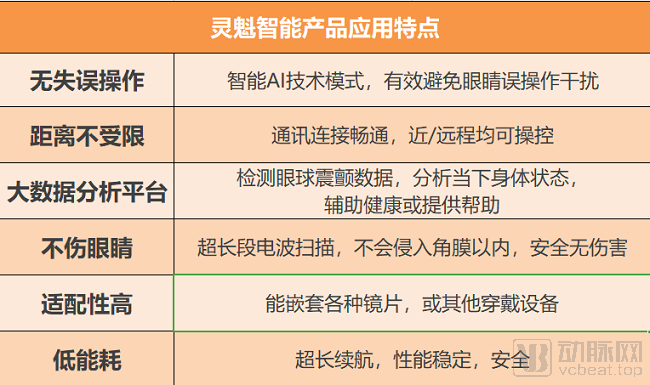
Source: Lingkui Intelligence; Chart by VCBeat
Regarding eye tracking and control, there are currently two technical solutions available worldwide: camera-based eye acquisition technology (which captures images of the eyes and performs image recognition processing using a PC or related computing devices) and Microsoft’s invasive eye-tracking technology (which uses embedded potential-sensitive materials to mark positional changes during eye movement and provides feedback to the eye, thereby achieving tracking of the eye’s focal point). However, their high prices often deter potential users.
Lingkui Intelligence has proposed a novel solution to address this pain point, namely“High-Precision Probe Scanning Technology”, the technology has completed core R&D of its key technologies, is fully ready for market application, and has achieved true mass adoption and widespread accessibility at a low cost. In addition, it offers the following five major advantages:
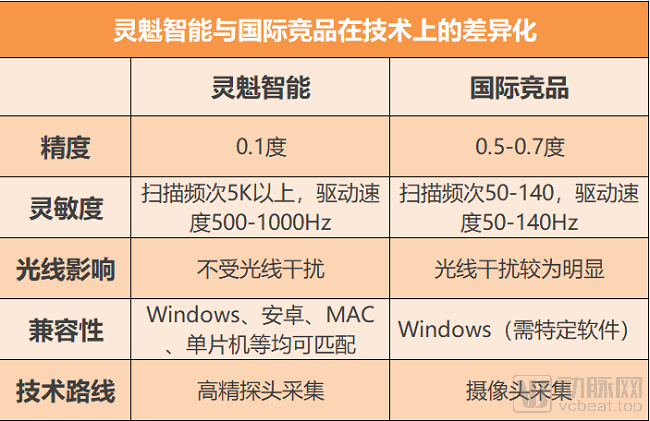
Source: Lingkui Intelligence; Graphic by VCBeat
Real-Time Tracking: Discarding cameras, it adopts high-precision probes for the first time to perform high-accuracy, high-frequency scanning of the eye’s three-dimensional structure, enabling real-time tracking of ocular coordinates and rapid acquisition and analysis of ocular data.
Rapid Response: The scanning frequency of the high-definition probe reaches5,000 times/second, which is 100 times higher than that of a camera, can capture every eye movement and respond rapidly.
Precise Instructions: Scanned by a high-definition probeAccuracy reaches 0.1, which is 5–7 times that of a camera, ensuring every ocular command is executed with precision.
High Comfort: Instead of being designed as standalone “glasses,” the high-definition probe is embedded within the eyeglass frame, ensuring an unobstructed field of view and a highly modern aesthetic.
Light, No Pressure: Unlike cameras, high-definition probes perform reliably regardless of lighting conditions, ensuring effective use both in bright daylight and low-light nighttime environments.
The technological superiority and operability have created a favorable market operating environment for Lingkui Intelligence. They will establish an enterprise-orientedSelling technology solutions as the primary focus, supplemented by self-developed and manufactured equipmentcommercial operating model, laying a solid foundation for enterprises to better integrate into the market.
“Gaze-control technology” has an extremely wide range of applications, with services spanning diverse fields such as smart homes, advertising, psychology, AR/VR, fatigue monitoring, in-vehicle interaction, and healthcare. Among these, “gaze control + healthcare” is regarded as the top priority in Lingkui Intelligence’s future strategic planning.
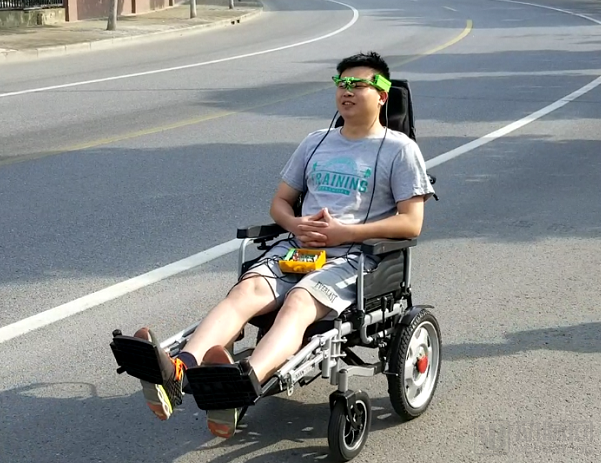
Gaze-Controlled Wheelchair
In the realm of medical products, they have already embarked on exploratory efforts and successfully developed the “Eye-Controlled Wheelchair,” a novel medical device that precisely controls wheelchair movement by tracking eye movements. This innovation will bring greater convenience to individuals with limited mobility and restricted movement capabilities, such as those with amyotrophic lateral sclerosis (ALS) and stroke patients.
“Eye-Controlled Wheelchair” is based on an instinctive ocular response: the wheelchair starts when the eyes look up, stops when they look down, turns left when the eyes move to the left, and turns right when the eyes move to the right.
Notably, in terms of speed control, the eye-controlled wheelchair adjusts its speed based on the frequency of the user’s eye movements and modulates the turning radius according to the angle of eye rotation. The wheelchair maintains stable operation even on uneven and rugged terrain, thereby enhancing safety for patients.
On the other hand, eye-controlled wheelchairs also provide monitoring capabilities. By interfacing with data ports, they enable unified, centralized, and real-time effective management of patients. This innovative feature will provide substantial assistance to nursing homes and other institutions in patient management, significantly reducing labor costs.
Lingkui Intelligence’s exploration of the healthcare sector does not stop here. The company has also developed innovative products such as “Gaze-Controlled Hospital Beds” and “Gaze-Controlled Medical Imaging Systems,” providing systematic solutions for patient mobility, medical diagnosis, and smart therapy. In the future, Lingkui Intelligence will continue to expand the broad application of its “gaze-control technology” in the healthcare field, with the aim of fundamentally disrupting existing medical concepts and operational models.
Since its inception, Lingkui Intelligence has achieved phased milestones in technology maturation and product development. However, the company is not content with these accomplishments; it is committed to making “gaze-control technology” an accessible innovation for everyone in the future.
As an innovative company on the rise, Lingkui Intelligence has attracted significant attention from numerous investment institutions. However, this “vessel” carrying its aspirations still requires greater support from “crew members.” First, talent acquisition: professional expertise will provide substantial momentum for technological upgrades and market expansion. Second, capital infusion: favorable trends in the capital market will supply the “fuel” necessary for the company’s continuous growth. Third, efficient collaboration: establishing cooperative mechanisms with manufacturers will ensure the consistency and high-quality output of its products.
Currently, Lingkui Intelligence has entered into strategic partnerships with North China Pharmaceutical Group and several elderly care institutions. This collaboration will provide substantial support to Lingkui Intelligence, enabling the company to continue developing emerging products at this stage and thereby establish a favorable market environment.
Looking ahead, Lingkui Intelligence will focus on market popularization and promotion. By enhancing the functionality of existing technologies and perfecting system integration, they aim to broaden product applications, truly embodying Chen Qian’s oft-quoted sentiment: “Technology makes life better.”