

N ovelgene Secures China's First Class III NMPA Approval for Multi-Target Colorectal Cancer Early Screening Test, Paving the Way for Regulatory Compliance and Market Expansion
After nearly two years of accumulation, the genetic testing industry finally ushered in a new boom in 2020. Companion diagnostics entered a new bottleneck after successive approvals of multiple products, so people's attention turned to the field of early screening, which is more difficult and has a wider range of applicable populations. This year, Grail, a star company in liquid biopsy early screening, applied for listing on NASDAQ, adding fuel to the cancer early screening craze.
On November 9, 2020, New Horizon Health’s colorectal cancer early screening product, “ColoClear,” officially received the Innovative Class III Medical Device Registration Certificate issued by the National Medical Products Administration (NMPA), securing the first-ever approval in the field of genetic testing-based cancer early screening. As the year drew to a close, this milestone propelled the cancer early screening sector into a crescendo in 2020, marking the true transition of genetic testing-based cancer early screening from the R&D phase into a compliant, commercialized stage.
Looking back, a genetic testing product for early cancer screening had already been approved and launched overseas. In 2014, the U.S. FDA approved Cologuard for colorectal cancer early screening and included it in the CMS coverage scope. Six years later, New Horizon Health’s acquisition of China’s first approval for cancer early screening finally filled the domestic gap in this field.
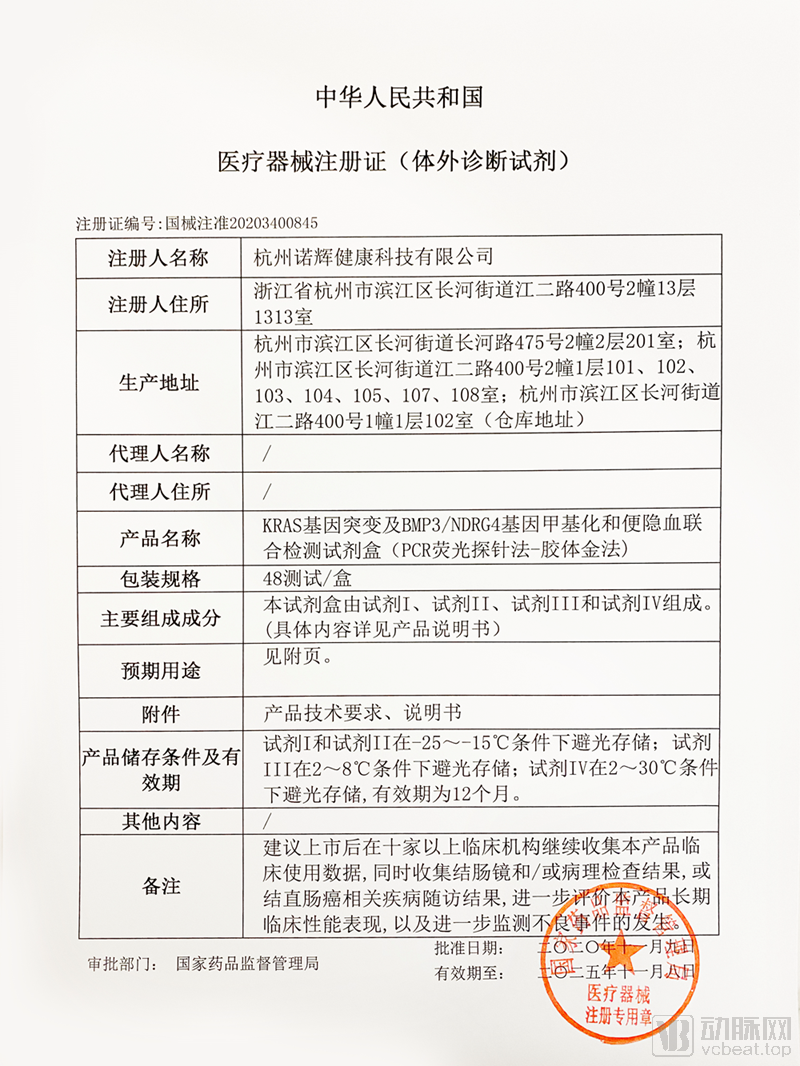
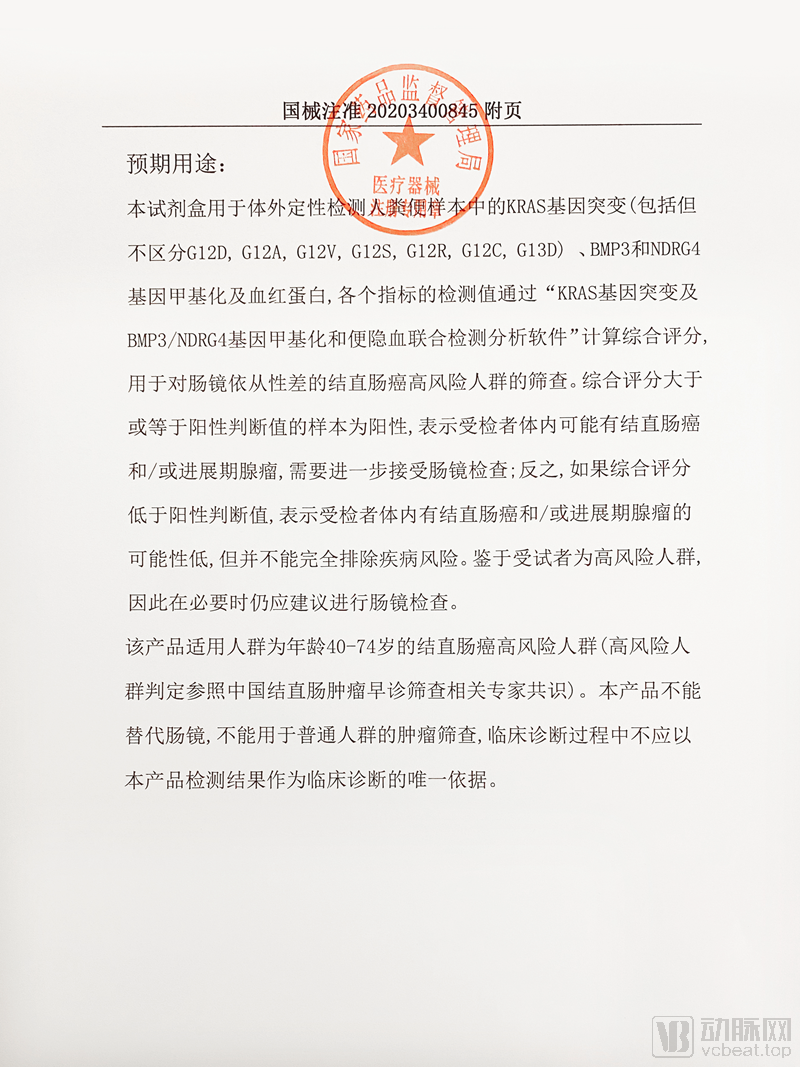
New Horizon Health’s Class III Medical Device Approval
In an interview with VCBeat, Zhu Yeqing, Co-founder and CEO of New Horizon Health, reflected on the efforts made and challenges overcome by the company over the past seven years. Building on this dialogue, we will delve deeper into how the “first approval” for early screening will impact the cancer early detection market.
Early screening represents a massive market opportunity. The hundreds of millions of individuals at high risk have created a substantial gap between this sector and the companion diagnostics market, which serves only a few million cancer patients. This disparity has made early screening a highly contested arena for genetic testing companies. Following the precedent set by Cologuard, stool-based early screening for colorectal cancer has long been regarded as the subsector with the greatest potential for breakthroughs in cancer early detection.
Taking China’s colorectal cancer early screening market as an example, China has the highest incidence rate of colorectal cancer globally, with new cases increasing from 388,000 in 2015 to 440,000 in 2019, representing a compound annual growth rate (CAGR) of 3.2%.
According to a report by Frost & Sullivan, the five-year survival rate for colorectal cancer patients in China is 56.9%. However, when focusing on patients with early-stage disease (those with carcinoma in situ that has not yet spread or metastasized), the five-year survival rate can exceed 90%. If precancerous lesions are detected and resected before the onset of cancer, the five-year survival rate approaches 100%. This significantly enhances the value of screening for populations at risk of colorectal cancer.
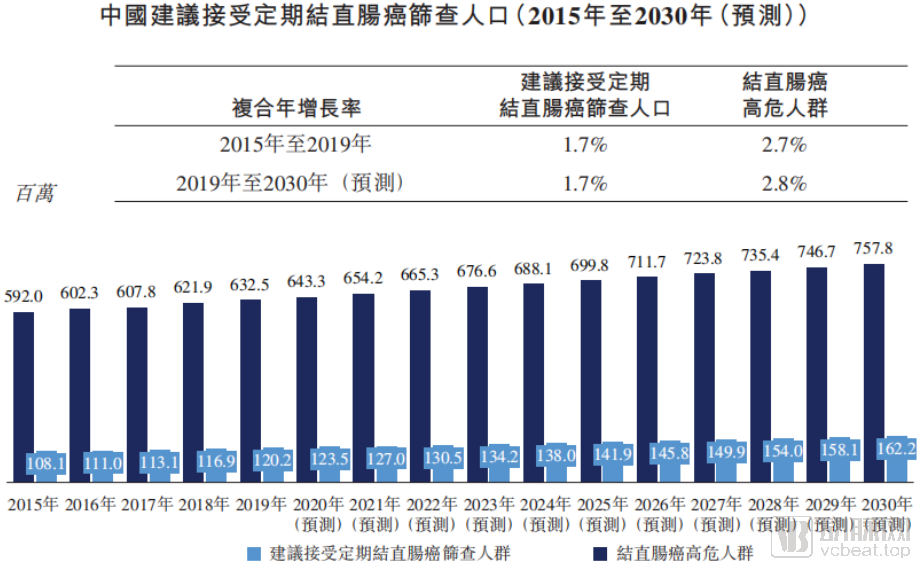
Colorectal Cancer Screening Population
In October 2018, the Colorectal Cancer Professional Committee of the China Anti-Cancer Association released the "Expert Consensus on Early Diagnosis and Screening Strategies for Colorectal Tumors in China," recommending regular screening for individuals aged 40 to 74. The high-risk population currently numbers approximately 120 million, and this figure is expected to continue growing due to population growth and an increasing proportion of elderly individuals. Assuming an average of one screening per person per year at a cost of RMB 2,000 per screening, the potential market size would reach RMB 240 billion.
The healthcare industry in China started relatively late, whereas in the more mature U.S. market, companies had already targeted this sector with specialized products. In August 2014, the U.S. FDA approved Exact Sciences’ Cologuard for colorectal cancer screening. Cologuard enables early detection and diagnosis of colorectal cancer by analyzing DNA released from exfoliated cells and white blood cells in stool samples.
Exact Sciences was founded in 1995 and has remained dedicated to non-invasive molecular diagnostics for colorectal cancer using stool samples. From its inception and the commencement of R&D to the successful FDA clearance of Cologuard in the United States, Exact Sciences has undergone a journey spanning nearly two decades.
Prior to the approval of Cologuard, colonoscopy and the fecal immunochemical test (FIT) were the optimal options for early screening and diagnosis of colorectal cancer. Compared with invasive colonoscopy, FIT offers a highly accurate, non-invasive alternative for colorectal cancer screening at a relatively affordable cost.
As a non-invasive test, Cologuard naturally selected FIT as the comparator in its clinical trials. The clinical trial results demonstrated that Cologuard was more sensitive than FIT in detecting colorectal cancer and advanced precancerous lesions (adenomas and sessile serrated polyps). The detection rate for colorectal cancer was 92% vs. 74%, and the detection rate for adenomas was 42% vs. 24%.
Although Cologuard and FIT each have their own strengths across various other metrics, with no clear superiority of one over the other, Cologuard’s higher detection rate—the core performance indicator—suffices to demonstrate its clinical value.
Therefore, the FDA’s Molecular and Clinical Genetics Panel of the Medical Devices Advisory Committee voted unanimously (10-0) that Exact Sciences had demonstrated the safety, effectiveness, and favorable risk-benefit profile of Cologuard, ultimately approving it for market launch.
Following its formal approval, Cologuard’s development has proceeded smoothly. It was quickly included in the coverage scope of the Centers for Medicare & Medicaid Services (CMS) and is covered by Medicare. The American Cancer Society (ACS) guidelines have also added Cologuard to their list of recommended options for colorectal cancer screening.
With insurance coverage providing payment assurance, Cologuard’s sales reached a new height. On February 27, 2019, Exact Sciences announced that 2 million people had used Cologuard for colorectal cancer screening.
It is now 2020, six years since Exact Sciences received regulatory approval. Over these six years, China’s genetic testing industry has evolved from scratch to a mature sector, yet no early-screening product comparable to Cologuard has gained approval from the National Medical Products Administration (NMPA).
The success of Cologuard has been a constant source of inspiration for Zhu Yeqing and New Horizon Health: “Without their proven track record, we might not have advanced so boldly. Our goal has always been to create ‘China’s Cologuard,’ and now it has finally arrived.”
All this makes the Class III medical device approval for New Horizon Health’s product even more significant, marking the first time in China that genetic testing technology has bridged the gap from auxiliary and companion diagnostics to early screening.
When it comes to New Horizon Health, the first label that comes to many people’s minds is the “fundraising king” in China’s genetic testing-based early screening sector. Over the past five years, New Horizon Health has completed five rounds of financing, raising a total of $158 million.
In the initial product design, New Horizon Health established its technical route of PCR (fluorescent probe method) combined with colloidal gold at an early stage, providing dual detection for both DNA and FIT. The choice of PCR for DNA detection was driven by the fact that PCR is fully capable of analyzing the four targets and 31 loci identified by New Horizon Health, while offering significantly lower costs compared to NGS. The addition of FIT primarily considers clinical applicability. Given the current clinical landscape, FIT is a highly mature technology whose results provide physicians with sufficient confidence to guide patients’ next steps in screening based on the outcomes provided by Changweiqing.
After the product design was finalized, New Horizon Health swiftly launched a multi-center pre-clinical trial and obtained pre-clinical data from 2,325 cases in 2016. Zhu Yeqing recalled that shortly after acquiring the pre-clinical data, the company decided to pursue the first early screening certification: “Since its inception, New Horizon has positioned itself as a company dedicated to the early screening of cancers with high incidence among the Chinese population. Failing to apply for early screening certification would have betrayed our original mission.”
Looking back, it is self-evident how difficult and stressful it was for a startup that had just completed its Series A financing to begin applying for China’s first Class III medical device registration certificate for early cancer screening via genetic testing.
“We are extremely fortunate to have received consistent support and encouragement from our shareholders and relevant regulatory authorities. Early investors sometimes questioned the necessity of pursuing this specific certification. However, once we explained the technological and compliance barriers established after obtaining the license, as well as the significant market opportunities it unlocked, they quickly came to understand our strategy. Moreover, in our subsequent funding rounds, many existing shareholders chose to increase their holdings, demonstrating their unwavering support throughout our journey. The regulatory authorities alerted us to the challenges involved at the initial application stage and provided extensive guidance during the clinical trial process, helping us avoid many potential pitfalls,” said Zhu Yeqing.
With positive responses from both investors and regulators, New Horizon Health, now free from lingering concerns, immediately launched its bid for the “first approval.”
However, at the outset of the clinical trials, patient recruitment emerged as the first major challenge for New Horizon Health. Colonoscopy is currently the gold standard for early colorectal cancer screening, and products related to colorectal cancer screening inevitably require head-to-head comparisons with colonoscopy. For products seeking approval solely for auxiliary diagnosis, enrolled subjects have already undergone colonoscopy and are aware of their results; thus, the new method need only verify the existing colonoscopy findings. In contrast, for early-screening products, although the enrolled subjects belong to high-risk populations, they are asymptomatic, and many would not otherwise require a colonoscopy. Consequently, New Horizon Health faced the daunting task of not only persuading these subjects to provide stool samples but also convincing each of them to undergo a colonoscopy simultaneously. The difficulty of enrollment was therefore considerable. As a result, enrollment progress was somewhat slow during the early stages of the clinical trials.
Over time, thanks to the relentless efforts of New Horizon Health, patient enrollment was successfully completed, and the clinical trials gradually approached their conclusion. On January 10, 2020, New Horizon Health submitted its clinical data package for registration to the National Medical Products Administration (NMPA). However, almost simultaneously, the COVID-19 pandemic erupted. The NMPA maintained an orderly workflow, accepted New Horizon Health’s marketing authorization application, and provided relevant feedback. To expedite the registration and certification process amidst the complex pandemic situation, New Horizon Health staff continued to travel to various clinical centers to coordinate the supplementation of additional clinical data.
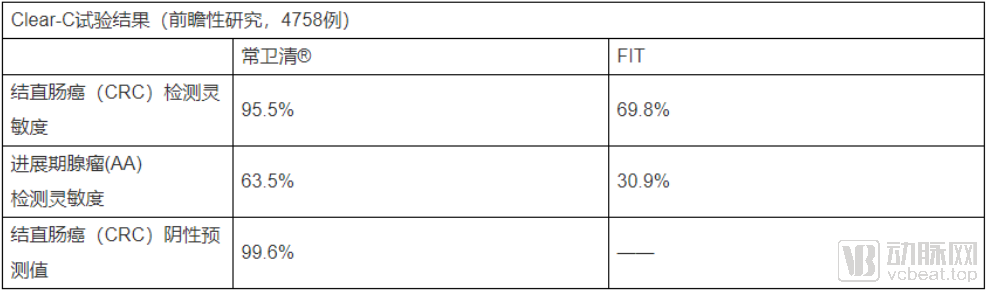
New Horizon Health Clear-C Clinical Trial Data
After overcoming numerous challenges, New Horizon Health ultimately achieved the registration and filing for the first Class III innovative medical device license for early cancer screening in China. Clinical trial results even demonstrated superiority over Cologuard’s initially disclosed registrational clinical trial data across multiple metrics. For advanced adenoma, a critical indicator in assessing carcinogenic risk, Changweiqing achieved a detection rate of 63.5%, compared to only 42.4% for Cologuard at that time. Meanwhile, Changweiqing’s negative predictive value reached 99.6%, effectively resolving the false-positive issues that Cologuard had previously encountered.
To ultimately achieve such encouraging data results, Zhu Yeqing discussed three key designs of New Horizon Health:
First, design genetic loci targeted at the Chinese population.There are certain differences in the frequency of specific genetic loci between Chinese and Western populations. Without in-depth research, it is difficult to fully understand these genotypic distinctions. Merely applying findings from existing literature would significantly compromise the test performance of the product. Therefore, from the outset of its design, Changweiqing conducted extensive sequencing analyses targeting genetic loci prevalent in the Chinese population. During the pre-clinical phase, 2,325 subjects were enrolled, allowing for the accumulation of substantial data and experience.
Second, the patented sample preservation technology provides a 7–10 day guarantee for samples.New Horizon Health conducted a series of comparative trials across dozens of medical institutions throughout China to validate the stability and accuracy of its sample preservation technology. Even in Harbin during winter, where fecal samples sometimes arrived at the laboratory frozen, the final test results remained unaffected.
Third, standardized testing procedures.With 2,325 cases in pilot studies and 5,881 cases enrolled in clinical trials, along with other test samples, New Horizon Health has continuously refined its SOP system to control the entire testing process from hospitals to laboratories.
The issuance of the first Class III medical device certification for genetic testing-based early cancer screening has had a significant impact on New Horizon Health and the entire early cancer screening industry.
For New Horizon Health itself, Changweiqing, having obtained the Class III medical device registration certificate, will become a crucial pillar for the company’s future development.
First, with the endorsement of the first cancer early screening certificate, Changweiqing's next market expansion will be smoother.Zhu Yeqing stated that Changweiqing will maintain its current price of RMB 1,996. In terms of market channels, expansion will not be limited to the hospital sector; New Horizon Health will also focus on out-of-hospital channels, including private health checkup centers, insurance companies, and internet healthcare platforms.
Second, Changweiqing occupies the central core position in New Horizon Health’s product portfolio.Changweiqing is primarily targeted at high-risk populations for colorectal cancer, providing non-invasive screening services with high accuracy and sensitivity. Another product, the Pupu Tube, has previously obtained Class II medical device certification; it is a home-use testing product mainly designed to detect fecal occult blood. Positioned as a lighter-weight solution compared to Changweiqing, it is better suited for broad-based screening needs. In addition, New Horizon Health is currently developing a premium testing product that integrates gut microbiota analysis, catering to users with more in-depth diagnostic requirements. This product portfolio, comprising these three offerings, enables New Horizon Health to deliver differentiated products and services to users with varying needs.
Third, the successful approval of Changweiqing has accumulated substantial experience for the continuous registration and certification of New Horizon Health’s subsequent products.The sequential registration and certification of New Horizon Health’s other products in the future will proceed more smoothly, particularly in the areas of clinical trial advancement and communication with regulatory authorities. YouYouGuan, New Horizon Health’s at-home test for Helicobacter pylori, has completed relevant clinical trials and submitted a registration application to the National Medical Products Administration (NMPA). Two additional products for gut microbiota analysis and cervical cancer screening are scheduled to launch large-scale, prospective, multi-center clinical trials in 2021.
In addition, New Horizon Health has also advanced its IPO process, filing an application with the Hong Kong Stock Exchange on the evening of November 10.
Beyond its impact on New Horizon Health itself, the “first certificate” may have even more far-reaching implications for the industry.
The innovative Class III medical device certificate recently approved for New Horizon Health is the first genetic testing product whose intended use explicitly specifies application in early cancer screening. The approval of this inaugural product signifies the establishment of a regulatory framework and the clarification of compliance standards. Zhu Yeqing has already observed rapid changes within the industry landscape: “After we obtained the registration certificate on November 9, experts familiar with our products have been able to publicly introduce our technology and offerings without concerns about compliance risks. This is because they can access our highly detailed approval reports, enabling them to accurately understand the value and advantages of our product for early cancer screening.”
To promote the development of the entire industry, New Horizon Health has chosen to publicly release the full text of its approval report. On one hand, this allows its partners and experts to review the complete product approval process; on the other hand, it provides guidance for industry development, enabling other companies seeking Class III medical device certification to draw on this experience, avoid unnecessary detours, and foster the industry’s progression toward greater compliance.
“Early screening is a market worth hundreds of billions, or even trillions, of yuan. In the past, we had been groping our way forward through a thick fog. But now, we can finally pierce through that fog and see this market clearly coming into view. I believe this is the greatest value that New Horizon can offer to the industry,” said Zhu Yeqing.