

DXY Launches Vaccine Service Platform with a Two-Year No-Profit Commitment, Seizing Long-Term Opportunities in 'Internet + Vaccines'
“Dingxiang Yuan will not seek profitability from its vaccine service platform over the next two years, nor will it charge any additional fees to either institutional clients or end users.” On November 25, at the launch event for the Dingxiang Doctor Vaccine Service Platform, Chu Yang, Vice President of Dingxiang Yuan, announced this plan.
On that day, DXY’s Vaccine Service Platform was launched in Shanghai. Co-developed by leading domestic and international vaccine manufacturers—including MSD, GSK, Sinovac Biotech, and Hualan Biological Engineering—alongside DXY and the DXY Clinic Development Alliance, the platform will provide end-to-end services for non-program immunization vaccines. It will establish a comprehensive online-to-offline service workflow connecting pharmaceutical companies, vaccination sites, and patients.
Amid the impact of the COVID-19 pandemic this year, public demand for vaccination has reached an unprecedented level. At the press conference held by the Joint Prevention and Control Mechanism of the State Council on November 12, Li Bin, Deputy Director of the National Health Commission, stated that public demand for vaccination has been continuously increasing in recent times, with growing willingness to get vaccinated. As of November 9, approximately 25 million doses of influenza vaccine had been administered nationwide, approaching last year’s total coverage. This year, China’s vaccine production doubled compared with the previous year, marking the highest output in the past five years.
Given that China has established a dense network for the administration of vaccines included in the National Immunization Program (NIP), with vaccination rates maintained at high levels, the volume of NIP vaccine doses is unlikely to experience significant fluctuations. Clearly, the surge in both demand and production this year has primarily occurred in the sector of non-NIP vaccines. Against this backdrop of a thriving market, why has DXY, despite its capability to build an intermediary platform, proposed a plan to forgo profits for two years? We attempt to interpret its development logic by combining information disclosed at the press conference with trends in the non-NIP vaccine market.
In fact, the “Internet + Vaccines” platform is not a new concept, and its operational models vary. Chu Yang stated that DXY focuses on the development of both upstream and downstream segments of the entire industry. Therefore, the DXY Doctor Vaccine Service Platform extends its services to other industry stakeholders, centered around user needs.
For Demand-Side Stakeholders, Enhancing Trust
In the existing “Internet + Vaccines” model, some pure e-commerce platforms treat vaccines merely as commodities for transaction, lacking in providing vaccine-related science popularization and addressing public inquiries and concerns. Other platforms, driven solely by short-term profitability, engage in overselling and make excessive promises, accepting all user reservations without the capacity to fully fulfill them. These platforms fail to deliver comprehensive vaccine services and even undermine user experience.
On the DXY Vaccine Service Platform, official WeChat accounts under the DXY brand provide users with vaccine-related health education, while online physicians on the DXY App address users’ queries. During the appointment scheduling process, the platform integrates with vaccination site inventory systems to display real-time stock levels, facilitating users’ selection of vaccination sites and setting clear expectations for vaccination. These measures help enhance user affinity and trust in the digital health platform.
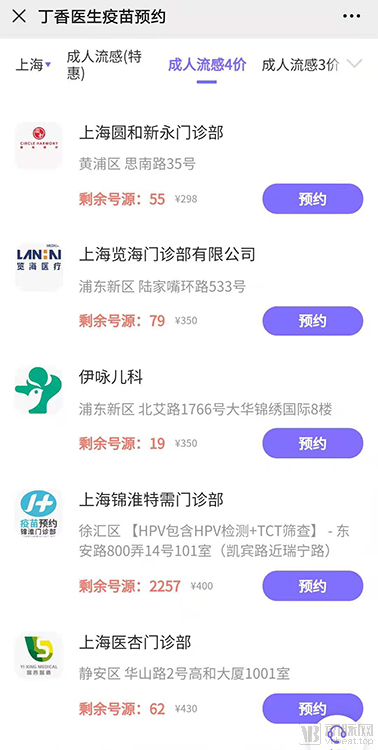
Dingxiang Doctor's Vaccine Service Platform Displays Real-Time Inventory at Vaccination Sites
After several months of trial operation, the DXY Vaccine Service Platform has officially launched online appointment scheduling for various vaccines, including HPV, influenza, and shingles vaccines. Users can log in through DXY-affiliated channels, such as the DXY official WeChat account, the Dingxiang Mama app, and the Dingxiang Jia WeChat mini-program. By clicking on “Vaccine Appointment,” they can locate nearby vaccination sites and complete online bookings. Once the online appointment is confirmed, licensed offline clinics will administer the vaccinations and manage any post-vaccination adverse reactions.
The DXY Clinic Development Alliance is a key co-builder of the vaccine service platform. Through its Cloud Manager system, the Alliance has cumulatively served over 2,000 primary healthcare institutions across China. The strength of the DXY Clinic Development Alliance enhances the management and scale of offline clinic vaccination sites, ensuring post-vaccination services for users.
Currently, the platform has onboarded approximately 100 clinics across 18 cities in China, covering Beijing, Shanghai, Shenzhen, Tianjin, Shenyang, Nanjing, Xi’an, and other regions, with this scale continuing to expand. Since its launch for trial operation three months ago, the platform has recorded 28,000 appointments, with a cumulative total of over 65,000 vaccine doses reserved.
Enhancing Accessibility from the Supply Side
Vaccines are administered to healthy individuals, which stands in stark contrast to patients who actively seek medical care. For healthy people, it is difficult to proactively seek vaccination services without external influences. Without the stimulus of the pandemic this year, demand for influenza vaccines might not have experienced explosive growth.
Even when users are willing to get vaccinated, they face numerous new questions: What diseases does each vaccine prevent? What is the efficacy rate? Are there any side effects? What precautions should be taken after vaccination? In short, every vaccine and its corresponding disease can give rise to countless such questions, making information asymmetry in the medical field even more pronounced in the realm of vaccines.
Within the public health system, vaccination sites have reached saturation in administering vaccines under the National Immunization Program, leaving little capacity for the detailed promotion and popularization of non-program vaccines.
“We provide users with educational and inquiry services through our mini-program.” At the platform launch event, Huang Yanling, Head of Marketing for MSD’s Vaccine Division, explained that after trial implementation, they found these to be merely modular services, unable to form an online-to-offline closed loop.
Therefore, internet platforms possess a natural advantage in addressing vaccine information asymmetry, owing to their robust connectivity capabilities.
It is understood that DXY has established a complete ecosystem spanning from health science communication to online medical consultations, with over 50 million health-conscious users on its new media platforms. As vaccines are a critical means of disease prevention bearing on national welfare and people's livelihoods, they constitute one of DXY’s key areas for public health education.
Dingxiang Doctor provides popular science education and consultation services on diseases and vaccines, serving both to meet users’ information needs and to promote and popularize vaccines on the supply side.
At this press conference, Merck & Co., GSK, Sinovac Biotech, and Hualan Biological Engineering all announced plans to jointly build a vaccine service platform with DXY. Previously, Pfizer and Sanofi Pasteur had also collaborated with DXY on public science education initiatives related to vaccines, aiming to enhance public awareness of and access to vaccination.
Enhancing Service Capabilities for Vaccination Providers
Offline vaccination centers are a critical component of the “Internet + Vaccines” ecosystem. For individual vaccination sites, service resources are allocated based on daily routine capacity. Consequently, a sudden surge in demand may lead to operational and service capability shortfalls, even when vaccine inventory is sufficient. Meanwhile, information asymmetry exists among different vaccination sites. While popular vaccines such as those for influenza and HPV are in short supply at most sites, less popular vaccines may experience either oversupply or shortage at individual locations.
“During our collaboration with the Dingxiang Vaccine Appointment Platform, appointment volumes have remained generally stable,” said Bai Hua, Executive Chairman and CEO of Yuanhe Medical. He added that because these users have already received comprehensive vaccination education through Dingxiang Doctor, they possess a solid understanding of vaccination criteria, expected outcomes, and potential side effects, thereby significantly reducing communication costs for vaccination providers.
As can be seen, Dingxiang Doctor’s vaccine education and consultation services can take over the corresponding tasks at vaccination sites, sparing these sites from expending excessive effort on communication—particularly during peak vaccination periods—and thereby improving their service efficiency. Meanwhile, by integrating real-time inventory data from vaccination sites, the platform facilitates patient choice and helps achieve a broader balance between supply and demand.
The above analysis reveals that DXY has built a platform covering the upstream, midstream, and downstream segments of the industry chain, serving suppliers, vaccination sites, and end-users. Why is the platform not in a hurry to achieve profitability? We believe this is primarily because the sector is still in its early stages, with all aspects of the market requiring further cultivation.
From the consumer perspective, public confidence in vaccine safety still needs to be bolstered in the aftermath of the vaccine safety incidents of recent years. Due to a lack of specialized knowledge, the general public is often unclear about whether issues arise during vaccine production, distribution, or administration. Consequently, any adverse event may lead to a blanket rejection of the entire industry.
From the supply side, vaccine production requires a certain lead time. If manufacturing is only initiated after a shortage is identified post-launch, it will inevitably result in severe vaccine scarcity. Internet platforms can front-load the matching of vaccine supply and demand, enabling manufacturers to plan production volumes in advance. Only when such platforms achieve sufficient scale can they more effectively integrate upstream resources.
From the perspective of vaccination sites, DXY’s Vaccine Service Platform currently covers approximately 100 clinics across 18 cities in China. Compared to the nearly 300 prefecture-level cities nationwide, this coverage is relatively limited. Not only DXY, but other major vaccine platforms also typically cover only dozens of cities. A key reason behind this is the scarcity of private vaccination sites, with only 300–400 such facilities available across China, resulting in insufficient service capacity.
In summary, we believe that over the next two years, DXY’s vaccine appointment platform will likely focus on deepening services for all stakeholders and refining its operational model to foster the formation and maturation of the industry ecosystem. In this process, the platform can also scale up and expand its influence among various participants.
From an industry trend perspective, non-EPI vaccines are entering a period of rapid growth, and private vaccination clinics are also poised for expansion. This presents a long-term opportunity for the DXY Vaccine Appointment Platform.
In 2010, the proportion of batch-released doses of vaccines under the National Immunization Program was approximately 46%, whereas in 2019, this share declined to just 31%. Meanwhile, the number of batch releases for non-National Immunization Program vaccines rose rapidly.
According to the National Medical Products Administration’s Drug Clinical Trial Registration and Information Publicity Platform, there are currently more than 180 vaccine projects in clinical trials, with over 40 having entered Phase III clinical trials.
In the future, more vaccines will enter the market, and new arrivals are highly likely to be classified as non-EPI (Expanded Program on Immunization) vaccines. This also means that when reaching users, these vaccines require internet platforms to provide authoritative, efficient, and timely information dissemination.
Furthermore, the Vaccine Administration Law of the People’s Republic of China, implemented in 2019, shifted the approval process for medical institutions providing vaccination services from a registration-based system to a record-filing system, thereby lowering entry barriers. If internet platforms can effectively enhance the service capabilities of private vaccination sites and even assist in customer acquisition, private medical institutions will be more motivated and willing to engage in vaccination services. Consequently, internet platforms will have more offline partners to fulfill online demand. This mutual reinforcement between internet platforms and offline vaccination sites will create a virtuous cycle.
Against this backdrop, platforms such as Dingxiang Doctor’s Vaccine Service Platform, which serve both users and the industry, can further unlock their value, making profitability a natural outcome. It is also hoped that, through the joint efforts of such platforms, information asymmetry among pharmaceutical companies, vaccination providers, and users will be eliminated in the future, fostering a vaccine ecosystem characterized by high quality, efficiency, and accessibility.