

DRG vs. DIP: A Comprehensive Overview of China's Dual Pathways in Healthcare Payment Reform
On October 19, the National Healthcare Security Administration (NHSA) issued the “Notice on Printing and Distributing the Work Plan for Pilot Programs on Global Budgeting with Regional Point Values and Diagnosis-Intervention Packet (DIP) Payment” (No. 45 [2020] of the General Office of the NHSA), proposing to integrate global healthcare security budgets in pooling regions with the point-value method over a period of one to two years, and to explore a diversified composite payment model dominated by DIP. On October 28, the NHSA convened a promotion and training meeting for the pilot programs on global budgeting with regional point values and DIP in Guangzhou, Guangdong Province, requiring local healthcare security departments to strengthen organizational leadership, clarify division of responsibilities, refine implementation plans, and solidly advance the pilot work. On November 3, the NHSA further issued the “Notice on Printing and Distributing the List of Pilot Cities for Global Budgeting with Regional Point Values and Diagnosis-Intervention Packet (DIP) Payment,” with the number of pilot regions being more than double that of the DRG pilot regions. At this critical juncture where payment model reform is imminent, Ping An Healthcare Technology, leveraging its experience since 2017 in comprehensively empowering all aspects of healthcare security payment system reforms in multiple pilot regions such as Shenzhen, Changzhou, Qingdao, and Liaocheng, and combining extensive project implementation experience with expert insights, discusses key issues arising from the two payment tools, DIP and DRG, aiming to provide assistance to various pilot regions before they embark on payment model reforms.
The two tools are broadly similar, both grounded in the theoretical basis of clustering cases with comparable resource consumption to form distinct disease groups. DRG grouping follows a three-tier logic of MDC-ADRG-DRGs, typically resulting in 600–800 groups. In contrast, DIP establishes its payment disease list through a progressive hierarchy from Level 1 to Level 3 directories, with approximately 3,000 groups at Level 2 and a total of 16,000 groups at Level 3. Although their theoretical foundations are similar, their construction logics differ significantly: DRG proceeds from medical theory to data analysis, with each group strictly adhering to a hierarchical logic that moves from anatomical systems to treatment methods, and finally to individual case characteristics; whereas DIP is based on objective big data facts, operating on the principle that “existence implies validity” for disease entities.
Both the point-based method and the rate-based method can serve as complementary payment mechanisms for Diagnosis-Related Groups (DRG). However, according to Document No. 45 issued by the National Healthcare Security Administration, Big Data Diagnosis-Intervention Packet (DIP) payment must be implemented using the point-based method under a regional global budget. The rate-based and point-based allocation methods differ in their characteristics: The rate-based method is a payment approach that allocates the annual pooled medical insurance fund for inpatient care by calculating a base rate based on projected total inpatient expenses and total weights, with reference to the weight standards of various DRGs. The point-based method is a payment approach that allocates medical insurance funds within a region by assigning points to each disease group. It establishes a relative price relationship between medical costs and weights for different disease groups, applying the principle of work points to convert these into points for each disease group, with reference to DRG weight standards. Under the rate-based method, if the base rate is set too high, it may still lead to overspending of the medical insurance fund. In contrast, while the point-based method, being allocated under a regional global budget, avoids the risk of fund overspending, it may easily incentivize hospitals to “inflate points” to generate higher revenue, particularly potentially triggering a “siphon effect” where large hospitals attract a disproportionate share of patients. Therefore, the challenge of the rate-based method lies in accurately predicting the base rate, whereas the challenge of the point-based method lies in controlling the appropriate number of hospital admissions.
Whether for DRG or DIP, the data basis for formulating grouping schemes, calculating payment standards, and conducting formal group settlement is the Medical Security Fund Settlement List. Therefore, there is no essential difference in their ultimate data requirements. However, from an implementation perspective, DRG requires data quality to be “right the first time,” whereas DIP can accommodate a “step-by-step” approach.
The data elements required for DRG grouping include principal diagnosis, secondary diagnoses, surgical procedures, neonatal birth weight, and duration of mechanical ventilation. As the specifications for completing the Healthcare Security Fund Settlement List have been introduced only recently, certain fields—such as neonatal birth weight and duration of mechanical ventilation—have not yet been fully standardized in hospitals with relatively low levels of health informatics maturity. Therefore, pilot regions or hospitals implementing DRG generally possess more mature health information systems.
In contrast, the implementation of Diagnosis-Intervention Packet (DIP) typically follows a two-step approach based on current regional practices. The first step relies solely on the primary catalog, incorporating only the principal diagnosis, primary procedure, and case volume, while excluding factors such as secondary diagnoses, tumor metastasis, radiotherapy/chemotherapy, and discharge status. Consequently, this phase has lower requirements for data quality. The second step involves integrating the third-level auxiliary catalog of disease categories, which accounts for tumor severity and condition complexity, thereby imposing stricter requirements on the documentation of secondary diagnoses. Therefore, regions with less advanced health informatics infrastructure can prioritize the first step, proceeding to refine and update disease categorizations only after improving baseline data quality. This strategy ensures that the progress of payment reform is not constrained by data quality issues, explaining why DIP reform demonstrates greater universality and practical applicability.
It should be noted that although the foundational data for implementing Diagnosis-Intervention Packet (DIP) payment can be developed incrementally, failure to rapidly achieve “progressive adequacy” will inevitably undermine the effectiveness of DIP implementation, particularly the efficacy of supporting regulatory measures under the new policy framework.
Both the implementation of DIP (Diagnosis-Intervention Packet) and DRG (Diagnosis-Related Groups) require processes such as actuarial calculation, demonstration, training, and pilot trials. However, compared to DRG, the deployment of DIP is generally faster. In addition to the higher requirements for data quality during the initial phase of DRG implementation, the development of localized DRG grouping schemes necessitates extensive medical validation. In contrast, DIP grouping can automatically generate disease classification schemes based on historical data and rules through algorithms; the validation process may be limited to verifying the correspondence between diagnoses and procedures, thereby minimizing reliance on clinical expertise. Furthermore, regardless of whether implementing DRG or DIP, essential preparatory work prior to payment model reform includes not only policy guidance and the establishment of data channels but also standardizing business operations. This involves regulating and mapping the Medical Insurance Settlement List, the Chinese Health Statistics (CHS) version of ICD-10, and ICD-9-CM, as well as conducting comprehensive education and outreach within hospitals.
The focus of fund supervision for DIP (Diagnosis-Intervention Packet) and DRG (Diagnosis-Related Groups) is highly similar. Due to the inherent characteristics of prospective payment systems, abusive practices run counter to hospital interests; therefore, such abuse is no longer considered the primary risk in medical insurance fund supervision. Instead, regulatory efforts have shifted to four key areas: the authenticity and accuracy of coding, the adequacy of hospitalization eligibility, the sufficiency of medical services provided, and the compliance of medical resource allocation. Consequently, there is essentially no difference in the underlying supervisory logic between DRG and DIP. However, it is worth noting that supervising the DIP auxiliary catalog presents significant challenges. For instance, tumor metastasis is captured through secondary diagnoses, with evidence derived from electronic medical records and corresponding laboratory and diagnostic tests. At present, most regional medical insurance authorities lack access to such data. Some regions have developed big data-based supervisory tools using available settlement detail data, focusing on abnormal costs through metrics such as the coefficient of variation and cost structure. However, these tools cannot guarantee audit precision, making it difficult to pinpoint risks accurately and imposing a severe burden on medical insurance agencies, which already face widespread staffing shortages.
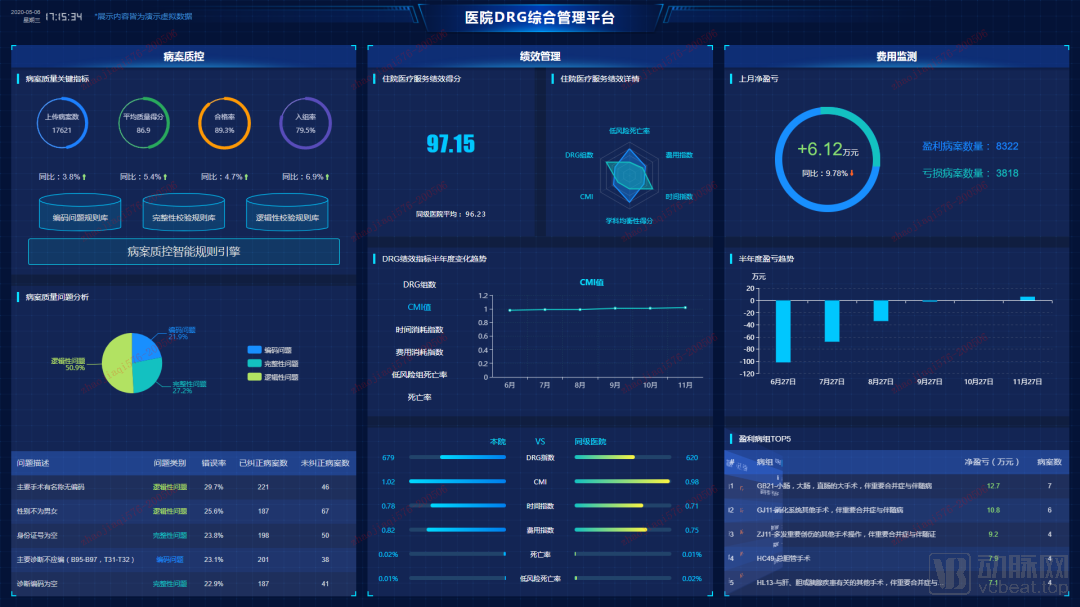
In addition to its use in prospective payment systems, Diagnosis-Related Groups (DRG) have another highly representative application as a robust tool for performance evaluation. DRG transforms “incomparable” cases into “comparable” ones through clustering. Derived metrics such as the Case Mix Index (CMI), number of DRG groups, time consumption index, cost consumption index, and mortality rate in low-risk groups serve as powerful instruments for assessing medical capability, efficiency, and quality. Theoretically, since Big Data Diagnosis-Intervention Packet (DIP) shares the same theoretical foundation as DRG—achieving comparability among cases through resource clustering—it should also be applicable to performance evaluation. However, compared with DRG, the indicator system and evaluation framework under DIP were established later, and their practical effectiveness remains to be further validated through practice.
Both DIP and DRG exhibit certain inadequacies when applied to payment for rehabilitation cases and traditional Chinese medicine (TCM) cases.
For rehabilitation cases, both DRG and DIP serve as payment tools centered on diagnostic and procedural resource utilization. Under rehabilitation diagnoses, three treatment modalities—rehabilitation, surgical, and internal medicine—may be involved, with mixed internal medicine and rehabilitation treatments being particularly common. This leads to distorted cost calculations. Furthermore, the incomplete coverage of rehabilitation procedures in the CHS version of ICD-9-CM creates coding difficulties. Consequently, neither case grouping nor cost estimation achieves the expected outcomes.
Issues concerning Traditional Chinese Medicine (TCM) cases can be summarized in two main points. First, determining payment elements is challenging due to the inconsistency between modern medical and traditional medical theoretical systems. TCM diagnoses cannot establish a well-founded correspondence with Western medicine’s International Classification of Diseases (ICD) codes, making it not entirely reasonable to map ICD-10 codes to coded TCM diagnoses. Second, it is difficult to determine the input of diagnostic and therapeutic resources. The decline of TCM is an objective reality; except for a few specialized conditions such as orthopedic splint reduction and anorectal diseases, TCM currently exists predominantly as a supplementary medicine subordinate to modern medicine. TCM syndrome differentiation fails to reflect resource utilization, thereby making it difficult to ascertain the rationality of resource allocation for TCM diagnosis and treatment.
The relationship between DIP and DRG is a topic of widespread concern in the industry. Based on the author’s practical experience, three possible scenarios regarding their relationship are briefly outlined below:
① ●The Viewpoint that DIP is a Transition to DRG: Due to characteristics such as low management costs and low data requirements for DIP, and its similarity to DRG in terms of payment models, regulatory frameworks, and grouping criteria, DIP can be regarded as an intermediate product in the eventual transition to DRG-based payment.
② ●Perspective on the Coexistence of DIP and DRG: The underlying argument is that hospitals with robust IT infrastructure, highly qualified personnel, and substantial resource investments are better suited for DRG, whereas those with weaker foundational conditions are more appropriate for DIP. Currently, certain prefecture-level cities have adopted similar payment reform models, implementing DRG in tertiary hospitals and DIP in secondary hospitals. The primary challenge lies in the equitable allocation of the insurance fund. This presents significant difficulties for health insurance management, whether addressed as a micro-level fairness issue—where the same medical case receives different fixed payments under the two grouping systems—or as a macro-level fairness issue concerning how to apportion the fund pools corresponding to each grouping method.
③ ●DIP is a localized adaptation of DRG:
For regions that lack the conditions to implement Diagnosis-Related Groups (DRG), Big Data Diagnosis-Intervention Packet (DIP) can be described as a “compromise,” designed to replace DRG and achieve similar reform outcomes—neither a “transitional” measure nor a system of “coexistence.”
Both DRG and DIP are important payment tools under the reform of payment models. As two sets of tools with the same theoretical foundation but different implementation methods, they are like shovels and hoes: each has its strengths and weaknesses, with neither being superior to the other. It can be said that they reach the same goal through different paths, both achieving the objective of “excavating” the reform of payment models.
For healthcare insurance administrators, the core imperative is to fully leverage existing tools, capitalize on their strengths while mitigating weaknesses, and establish a comprehensive supervision and management system. This approach aims to balance the transitional challenges of payment model reforms and lay a solid foundation for the future trend of refined management of healthcare insurance funds. For hospital administrators, it is equally important to grasp the key concepts of payment model reform: “prepayment systems” and “DIP/DRG.” Beyond promptly understanding the functional characteristics of these payment tools, the more urgent challenge lies in deeply discussing operational strategies to expand revenue streams, attract patients, enhance efficiency, and reduce costs under the prepayment system. For frontline medical staff, keeping pace with trends and acquiring a certain level of knowledge about healthcare insurance policies is essential. More importantly, they must shift away from reliance on the practice of ordering excessive tests and prescriptions, improve patient communication and guidance, and continuously refine their clinical skills. These are objective requirements that will soon become indispensable for all medical professionals.
In short, discard the notion of “once-and-for-all” solutions; make continuous learning and accumulation a work habit, and proactively embrace the wave of reform to remain invincible. After all, we are entering a new era of medical insurance in which only perpetual effort yields lasting ease.