

Neusoft Unveils CloudOne Strategy to Empower Digital Transformation for Small and Medium-Sized Medical Institutions

Neusoft
Provider of Connectivity and Software Products and Services
Digital transformation has become a global trend, and China’s healthcare industry has made significant progress driven by digital technologies such as the Internet, the Internet of Things (IoT), cloud computing, informatization, and artificial intelligence (AI). The development of smart hospitals has emerged as a key theme during this period, and there is growing industry consensus on cloud-based and intelligent healthcare informatization. We observe that an increasing number of information systems are being deployed in the cloud, with AI integrated as a foundational technology, enabling various institutions across the healthcare industry chain to achieve information sharing via cloud platforms.
Are Hospitals Ready for Digitalization?
How can hospitals achieve high-level integration of system modules? How can data interoperability be realized? How can application sectors be made intelligent? And how can efficiency be improved both within and outside the hospital? These are urgent challenges that hospitals need to address. In this regard, large hospitals with relatively abundant funding and technical support are still struggling to keep up. If we consider small and medium-sized medical institutions that are already “stretched thin,” the iterative development of their information systems faces even greater difficulties.
Addressing this critical pain point, Neusoft, with over two decades of expertise in the informatics sector, presented its solution. At the “Neusoft Solutions Forum 2020” held in Nanning, we not only gained insights into the “Neusoft Cloud Smart Hospital CloudOne Solution” launched for small and medium-sized hospitals, but also engaged in an in-depth discussion with Yao Yong, Vice President of Neusoft Corporation and General Manager of the Healthcare Solutions Business Unit, regarding the product’s positioning, roadmap, and strategy.

Yao Yong, Vice President of Neusoft and General Manager of the Healthcare Solutions Business Group
According to data from the "Statistical Bulletin on the Development of China's Health and Hygiene Undertakings in 2019," by the end of 2019, there were nearly 1 million medical and health institutions nationwide, with approximately 34,000 hospitals and around 950,000 primary medical and health institutions.
Behind the vast digital divide lies a fact: for any new policy or product to be implemented, small and medium-sized medical institutions will be the key determinants of its success or failure.
Infrastructure development is often the most challenging aspect to build, yet it remains a critical component. Currently, the informatization of small and medium-sized medical institutions still suffers from numerous drawbacks.
In terms of business functions, the application of these functions is uneven, with a low level of standardization and considerable difficulty in information integration.
In terms of data interoperability. Information channels have not yet been fully integrated across information platforms at various levels. Except for some established medical consortia and medical communities, most small and medium-sized medical institutions cannot fully achieve information exchange with large hospitals. In fact, small and medium-sized healthcare institutions provide a substantial amount of basic medical services and essential public health services. Much of the data generated by these institutions is required by the state and holds significant practical application value. The loss of such information will slow down the advancement of healthcare informatization.
Then there is the issue of funding shortages. Healthcare informatization is a process requiring continuous investment. Small and medium-sized medical institutions, which primarily rely on local fiscal budgets, often face significant financial pressure. This results in a situation where these institutions can afford to purchase the "vehicle" (i.e., hardware and software systems) but cannot afford the "fuel" (i.e., ongoing operational and maintenance costs) during the implementation of informatization initiatives.
Finally, the information security systems of small and medium-sized medical institutions remain inadequate. According to surveys, only 33% and 20% of these institutions have achieved Level 3 and Level 2 cybersecurity protection certifications, respectively.
“From the perspective of the current market environment, the level of informatization in small and medium-sized medical institutions remains relatively low. Measured by quantifiable standards, the electronic medical record (EMR) maturity level of small and medium-sized hospitals is only at Level 2 or Level 3, with some failing to even reach these benchmarks. Some hospitals merely have EMR systems in place that can support health insurance payments, drug pricing, and basic settlement functions. Currently, the state is promoting performance assessments for public tertiary hospitals. If county-level hospitals aspire to advance, expand their scale, and assume greater social responsibilities as healthcare institutions, it necessarily implies that their EMR maturity levels must be further elevated.” Yao Yong expressed similar views.
If overall demand shifts downward, small and medium-sized medical institutions will face increasing pressure, making the need for information technology infrastructure urgently critical. Currently, market attention remains focused on large hospitals, while small and medium-sized medical institutions are largely overlooked. However, building healthcare IT infrastructure and establishing top-down channels for healthcare informatization require significantly enhancing the digital maturity of these smaller institutions.
Neusoft’s CloudOne Smart Hospital Solution is customized to meet the personalized needs of small and medium-sized medical institutions. At the launch event, Neusoft introduced the solution as follows: Neusoft CloudOne Smart Hospital was developed and implemented to support healthcare informatization in the era of cloud intelligence. It offers a product suite featuring a full-cloud architecture, comprehensive AI integration, and a full-stack approach. Its core philosophy is to provide hospitals with a cloud-based smart hospital core business platform that ensures sustainable services, proactive upgrades, and high cost-effectiveness. The product suite is characterized by strong ease of use, streamlined business processes, and clear management models. It supports hybrid and multi-cloud deployment, along with cloud-native features such as multi-tenancy, rapid scalability, and on-demand self-service.
Discussing the original intention behind the platform’s development, Yao Yong stated, “Neusoft initially built its products around large hospitals. However, we often received projects from smaller hospitals, and in such cases, we discovered significant differences in operational logic and systems between large hospitals and small- to medium-sized ones. For instance, large hospitals have finely divided departments with relatively specialized physician roles. In contrast, at county-level hospitals, a single physician may assume two or three different responsibilities, necessitating either frequent switching between functional interfaces or an integrated system interface. Later, we found that even among county-level hospitals, there were variations based on geographic location. Hospitals in South China and East China, for example, differed significantly; although both might use two to three interfaces, the content integrated within those interfaces varied considerably.”
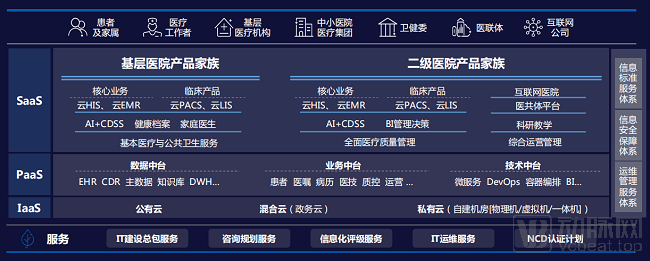
CloudOne In-Hospital Integration
Therefore, for small and medium-sized medical institutions, this solution delivers core business applications covering convenient services, clinical care, medical management, collaborative healthcare, and operational management. It provides an industry-wide cloud solution centered on CloudOne, the Cloud Smart Hospital platform, fostering regional integration of healthcare services, platform-based software architecture, and intelligent service delivery. Furthermore, it offers full-stack technical services to these institutions, including Neusoft IT consulting and Neusoft-certified secondary development services. It also creates joint solutions for electronic medical record (EMR) system grading, intelligent rational drug use, smart medical quality control, and specialty-specific disease management, integrating AI technology into every process, business segment, and decision-making point.
Meanwhile, clinical care is the core of hospitals, and small- and medium-sized medical institutions serve as important outlets for clinical services. Therefore, only by strengthening the foundation at the primary care level can the upper-tier healthcare system become more robust. Neusoft has also concentrated its main efforts on the clinical sector, which is its area of greatest expertise and experience.
In Yao Yong’s view, the information systems currently used by small and medium-sized medical institutions are relatively unstable and require continuous optimization. For application platforms targeting primary care settings, it is essential that they serve as flexible, configurable, and integrated workstations. This stands in stark contrast to the specialized operational models of large hospitals. Therefore, a fundamental restructuring is needed at the primary care level to ensure that platforms adapt to users, rather than having users “held hostage” by the platforms.
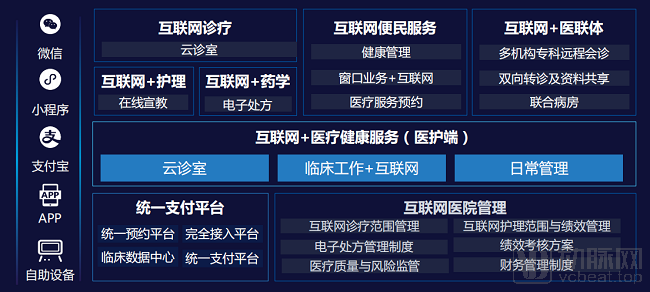
CloudOne Integrated Online Services
Multi-terminal applications also reflect the platform’s user-centric philosophy. CloudOne, the Cloud Smart Hospital solution, supports dual operation modes on both PC and mobile devices. To ensure sustainable development, the platform has built a polymorphic, hybrid multi-terminal ecosystem upon its existing infrastructure. With this flexible operational mechanism, physicians can perform tasks via PC or mobile devices within the hospital, as well as remotely from home or while on the move.
In addition, the mobile platform will bring convenience to patients. By providing patient interaction methods similar to smart terminals within hospitals, it helps patients achieve quick and effective communication in different application scenarios, significantly reducing time and labor costs, allowing patients to receive more efficient medical services.
It is reported that CloudOne, the cloud-based smart hospital solution, has been deployed in nine medical institutions, including general hospitals, specialized hospitals, and traditional Chinese medicine (TCM) hospitals. This aims to fully meet personalized needs across diverse scenarios, thereby further highlighting the platform’s value.
From a holistic strategic perspective, in addition to the CloudOne smart hospital platform itself, Neusoft is also committed to building a comprehensive informatization ecosystem. Yao Yong believes that transforming social behaviors requires reshaping the industry’s ecosystem. The factors that often constrain such transformations are policy, technology, and talent, which will also be Neusoft’s key areas of focus in the future.
On the policy front, a series of guidelines have been issued, including the “Opinions on Strengthening Performance Appraisal of Tertiary Public Hospitals,” the “Graded Evaluation Standard System for Smart Hospital Services (Trial),” and the “Notice on Further Improving the Appointment-Based Diagnosis and Treatment System and Strengthening the Development of Smart Hospitals.” These initiatives are driving the development of the medical informatics industry at multiple levels.
In terms of technology, joint solutions are provided through industrial collaboration. CloudOne, the cloud-based smart hospital platform, is deeply integrated with cloud computing, big data, and intelligent terminals. It has also established a long-term partnership with Baidu to provide operational support, thereby building a full-stack technical service network for customers.
In terms of talent development, Neusoft relies on its self-established college to create specialized training mechanisms and collaborates with other universities on joint educational programs. To make the entire training system more comprehensive and systematic, Neusoft provides courses, certifications, education, and even internship venues. It has also established multiple health and elderly care companies and hotels specifically to offer students internship opportunities, thereby enabling them to better master professional knowledge and skills.
Even so, Yao Yong stated that there is still a long way to go for medical information. “It is a lengthy process for a system to become highly intelligent. However, we have already taken the first steps. In this initial phase, we have incorporated certain clinical workflows, management controls, and even service components, but this is merely the beginning.”
Amid the broader trend, healthcare informatization is moving from the periphery to the core of hospital operations, and industry competition is becoming increasingly intense. Yao Yong holds a positive view on this development. “The healthcare informatization market is sufficiently large and requires many pioneers. Neusoft has only conducted some small-scale pilots within this space; greater participation from more enterprises is needed to collectively advance this endeavor. Only in this way can we validate that this direction is correct. If no one participates, it is highly likely that this will prove to be a false premise.”
As the industry matures, the market will naturally undergo a process of “survival of the fittest,” placing increasing survival pressure on small and medium-sized healthcare IT enterprises. “The core competitiveness of healthcare informatics in the future will lie in product cost-effectiveness—that is, who can deliver high value while simultaneously reducing costs. When innovation at the value level stagnates across the board, competition shifts to pricing. Under such a market dynamic, many small and medium-sized enterprises, lacking cost advantages, will be gradually displaced by larger corporations—a phenomenon known as ‘dimensional reduction attack.’”