

A Series of AI Class III Certificates Approved, Signaling the Emergence of a Commercial Closed Loop in Medical AI
As early as the beginning of 2018, investors in medical AI were already discussing the commercialization of their projects at salons. At that time, the general sentiment was optimistic, with one year being the estimated timeframe for medical imaging to enter a stable commercial phase.
Unexpectedly, the review and approval process remained mired in delays, and within a year, the commercialization of medical imaging AI had still not been successfully established. By the second half of 2019, the Center for Medical Device Evaluation began drafting various standards for medical AI. By that time, new capital inflows into medical imaging AI had dwindled significantly, and there was hardly any influx of fresh talent.
2020 marked a turning point. The Center for Medical Device Evaluation, fully prepared, had planned to issue two Class III medical device registrations around the Spring Festival. However, shortly after granting the Class III registration for CT-FFR, the COVID-19 pandemic struck. It was not until five months later that the second Class III registration, for brain MR, was officially announced.
Subsequent developments proceeded smoothly, with Class III certifications for AI products in orthopedics, ophthalmology, and multi-site pulmonary nodule detection being approved across various departments. Recently, Deepwise Medical, a first-tier player in medical imaging AI, also obtained its first Class III certification for an AI medical device—the Class III certification for CT-based auxiliary detection software for pulmonary nodules.
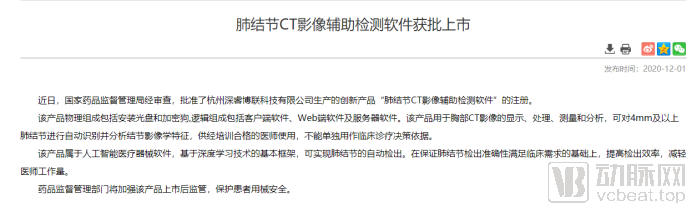
Today, the competition in the “pulmonary nodule market” has entered a new phase, where companies must strive for more than just simplistic metrics of “implementation.” At this juncture, what insights does DeepWise Medical’s breakthrough offer to the industry?
The growth cycle of a medical artificial intelligence software can be broadly divided into the following seven stages: scenario selection, market research, product design, pilot testing and adjustment, regulatory review and approval, inclusion in pricing catalogs, and large-scale marketing. For enterprises, navigating each of these stages requires a significant investment of time.
Regulatory review and approval occupy a central position in the entire process, separating the product development of medical AI from its marketing. Prior to regulatory review and approval lies the stage of corporate R&D investment, which is where the capital of many AI companies flows; following regulatory review and approval is the stage of product sales, encompassing the validation and realization of product value. Obstacles in regulatory review and approval mean that early-stage investments are disconnected from later-stage cash flow recovery—this is the most significant challenge faced by numerous medical AI enterprises.
In this context, many enterprises have attempted to front-load the subsequent sales phase of AI products, rapidly capturing market share through collaborative development, pilot trials, and other models. However, non-commercialized market deployment imposes a new and substantial cost burden on companies; with regulatory approvals delayed, the costs incurred to maintain market share continue to accumulate.
The Class III certification for medical AI devices is the key to addressing the aforementioned issues.
From a developmental perspective, obtaining the three types of certifications enables companies to smoothly transition from R&D to commercialization, allowing their innovations to be rapidly validated by the market. The resulting revenue reinvestment can then support the exploration of new AI application scenarios.
From a cost perspective, the issuance of Class III certificates has restructured the growth cycle of medical AI products, restoring the misplaced “commercialization” phase. Previously a cost center, this phase is gradually transitioning into a profit-generating segment.
As the scenario with the highest throughput and the most explorers in current imaging AI, pulmonary nodules have become an important symbol of imaging AI. Therefore, Deepwise Medical’s recent acquisition of the Class III certification for its CT-assisted detection software for pulmonary nodules is not only another recognition of medical AI by China’s regulatory authorities, but also further proof that medical artificial intelligence is capable of commercialization.
Nevertheless, beyond the regulatory review and approval process—which serves as a dividing line—companies must also focus on the product itself. Qiao Xin, CEO of Deepwise Medical, told VCBeat, “The healthcare industry is subject to stringent regulation. Throughout the entire lifecycle—from R&D and manufacturing to market access and post-market surveillance—compliance with laws and regulations is indispensable. Undoubtedly, market access is a critical milestone. Once access is granted, enhanced post-market regulatory oversight will come into effect, and we will become a key focus of such supervision.”
“Multiple products have already obtained Class III medical device registration certificates, while several others are on the verge of approval, currently in the critical final stage of regulatory review. Therefore, this year is a significant milestone year. However, this is merely the beginning, as the entire process encompasses a full lifecycle. Obtaining the certificate is just crossing the threshold; numerous challenges will still arise throughout the commercial promotion process.”
Judging from the approval model of Deepwise Healthcare this time, the green channel for innovative medical device approval established in early 2020 has had a certain positive impact on it. By the time Deepwise Healthcare’s CT-assisted detection software for pulmonary nodules was approved, a total of five AI products that had entered the green channel had passed the review and approval by the Center for Medical Device Evaluation (CMDE) (a total of five AI products entered the green channel in 2019).
Software Name | Field | Enterprise | Year |
CT-Assisted Detection Software for Pulmonary Nodules | Pneumonia | Hangzhou Deepwise Technology Co., Ltd. | 2020 |
Coronary CT Angiography Software for Vascular Stenosis Analysis | Cardiovascular | Yukun (Beijing) Network Technology Co., Ltd. | 2019 |
Diabetic Retinopathy Analysis Software | Ophthalmology | Shanghai Airdoc Medical Technology Co., Ltd. | 2019 |
Diabetic Retinopathy Analysis Software | Ophthalmology | Shenzhen Silicon Intelligence Technology Co., Ltd. | 2019 |
Coronary Artery Physiological Function Assessment Software | Cardiovascular | Beijing Kunlun Medical Cloud Technology Co., Ltd. | 2018 |
Five Companies Obtained Class III Certificates After Entering the Green Channel
What Should Be Noted When Applying for the Green Channel for Approval of Innovative Medical Devices? Deepwise Medical Believes That, in Addition to the Standard Approval Procedures, Companies Must Pay Attention to the Following Four Points When Submitting Applications:
The product applied for must legally hold the patent right for an invention of its core technology in China, or have legally obtained the patent right or usage rights for such invention in China through assignment; alternatively, the application for the invention patent of the core technology must have been published by the patent administration department under the State Council. There must be a basically finalized product, not merely a laboratory prototype, and the research process must be authentic and controlled, with traceable research data. Furthermore, the main working principle or mechanism of action of the product must be a domestic first-in-class innovation and demonstrate significant clinical value. The purpose of the innovation review is not to compel enterprises to innovate for the sake of innovation; rather, product innovation must genuinely address existing clinical problems.
Compared with the technical review in the registration process, the innovative application review adopts an expert review system, focusing on innovation and clinical application value, with a wider range of expert selection and no supplementary information channel.
Before submitting an innovative application, enterprises must obtain a CA certificate and submit materials through the electronic declaration system. The materials shall be prepared in accordance with the relevant drafting guidelines. Domestic applicants are required to submit the application form or related documents stamped after preliminary review by the provincial-level regulatory authority where the applicant is located. It is particularly important that applicants truthfully provide information on experts/entities with conflicts of interest when completing the application form, and clearly specify any experts to be recused along with the reasons for recusal. If there are no experts with conflicts of interest, this must be explicitly stated.
The Center for Medical Device Evaluation has implemented a blind selection mechanism for expert panel members participating in innovative device reviews. A backend computer system automatically contacts experts regarding meeting arrangements, ensuring that relevant staff members do not have access to the specific list of attending experts prior to the meeting. Meanwhile, the Center has piloted a video-based review mechanism for expert panels. Applicants may use video presentations to articulate their product’s innovative features, clinical application value, and responses to issues raised during previous reviews. The presentation segment is generally limited to 10 minutes, and applicants are advised to manage their pacing accordingly.
In general, enterprises seeking to utilize the green channel must pay attention to at least four key points:
1. Emphasize the integration of medicine and engineering, focus on clinical needs, conduct comprehensive assessments from multiple perspectives, and confirm that the product is truly innovative and effectively addresses clinical problems;
2. Emphasize the quality of submission materials and provide sufficient supporting data;
3. Identify clear innovation points and demonstrate the product’s significant clinical application value;
4. Choose a reasonable time to submit the application; do not submit it prematurely before the product has reached a basically finalized design.
“The issuance of the Class III medical device certificate is an important milestone, but it is only a milestone. In the process of marketization, enterprises need to pay attention to product iteration and updates, as well as market feedback, at all times. After approval, the market actually imposes higher requirements on enterprises,” said Qiao Xin.
Specifically, under the new landscape, AI healthcare companies face challenges in at least three dimensions.
First is market selection. Constrained by limitations in training data, medical AI products are often developed based on data from tertiary hospitals, yet their ultimate deployment may target primary care settings. Due to the differing needs and data quality between primary care institutions and tertiary hospitals, AI companies must accurately identify genuine demands and localize their products accordingly. Under the new circumstances, medical AI enterprises must compete on the speed of localization.
For example, if an AI company consistently trains its algorithms using high-end GPS equipment, such products will inevitably struggle to interpret the lower-quality images produced by the low-end CT scanners commonly found in primary care settings, necessitating product modifications. Under the new circumstances, medical AI companies must compete not only on the quality of their localization but also on the speed of their localization efforts.
Next is the selection of new scenarios. The expansion of medical AI from Scenario A to Scenario B is not entirely replicable. Given the high degree of specialization in the healthcare sector, companies must proceed with caution when exploring new demands. As Qiao Xin stated, “Whether a good technology can achieve commercialization and possess strong commercial promotion value depends on each company’s deep exploration of these business scenarios, their full integration with such scenarios, and the subsequent adjustment of their product strategies and strategic directions.”
Deepening the research and development of foundational AI technologies is one of the solutions to address these challenges. Taking Deepwise Medical as an example, the company has focused on building technical barriers by prioritizing areas such as in-depth data mining and auxiliary decision-making systems integrated with data. This strategic approach enables them to rapidly expand from a sole focus on medical imaging to broader clinical applications. Health check-ups and new drug development are both potential areas for Deepwise Medical’s future growth.
Finally, there is the matter of capital selection. To date, all first-tier medical AI startups have completed their Series C financing rounds, with some companies having entered Series D. Many enterprises are now setting their sights on an initial public offering (IPO). At this juncture, different companies are aligning themselves with distinct ecosystems; for instance, Shukun Technology is leaning toward industrial funds, while Infervision is aligning with state-backed entities. Collectively, these companies are leveraging the power of clusters to expand into new market spaces.
Pricing, tendering, and marketing are also challenges that AI companies must address with innovative solutions. Current market trends indicate that the average unit price for pulmonary nodule software deployed in hospitals through public tenders approaches one million RMB. If AI enterprises can successfully convert partner hospitals where their solutions are already installed into direct customers, they will usher in a new wave of growth.
“Midway through the year, I felt this sector was on the verge of collapse,” a medical AI practitioner told VCBeat. “Now, however, medical AI has regained its vitality.”
However, the vibrancy of the medical AI sector has left little room for new entrants. As prominent investors increasingly flock to leading companies, a new battle for market share is imminent. It is foreseeable that the medical AI market will undergo significant upheaval in 2021.
Amidst this wave, Deepwise Medical must also adapt to the changing landscape. Qiao Xin stated, “The next three to five years will witness an explosion in artificial intelligence technology. For Deepwise Medical, we have already laid a solid technological foundation. Over the coming five years, we aim to further strengthen our products, solutions, and clinical implementation scenarios, while intensifying our R&D efforts to gain broader clinical acceptance for our offerings.”
Today, the medical AI industry in China is developing rapidly, demonstrating strong support and assistance for innovation. Currently, review standards for Class III certification of medical AI products are being introduced successively, indicating that the industry is entering a period of vigorous growth. It is believed that more companies will participate in the future, benefiting from national policies supporting innovation, and collectively promoting the robust development of the smart healthcare industry.
Qiao Xin stated, “For enterprises, the key at this stage is to effectively seize the development opportunities brought by policy. As a core force in the new wave of industrial transformation, DeepWise Medical will actively participate in the construction of the new era. We will remain grounded and forge ahead with determination, channeling all resources into innovation-driven development, and strive tirelessly to build an innovative nation and realize the Chinese Dream of the great rejuvenation of the Chinese nation.”
“Amidst transformation, we go all out every minute.”